A customer walks into a Swiss pharmacy on Friday afternoon, picks up a sleek bottle labelled sea salt spray, and asks a familiar question: “Will this give me that effortless texture, or will it just dry my hair out?” That single question captures the opportunity in this category. People aren’t only buying a styling product. They’re buying the promise of easy, natural-looking hair that still feels modern, clean, and premium.
For trade partners, that question also reveals a gap. Many shoppers have seen sea salt spray online, but few have had the science, formula quality, climate fit, and compliance explained clearly at the shelf. In Switzerland, where customers often read ingredient lists carefully and expect performance with integrity, that explanation matters. It’s often the difference between a curiosity purchase and a trusted repeat item.
Sea salt spray sits at an interesting crossroads. It belongs to styling, but it also touches wellness, marine beauty, natural formulation, and sensorial retail storytelling. That makes it especially useful for pharmacies, boutiques, spas, hotels, and premium e-commerce assortments looking to add something that feels both accessible and premium.
The Enduring Allure of Effortless Beach Hair
A good sea salt spray solves a very specific beauty problem. Customers want shape without stiffness, body without heavy wax, and a finish that looks lived-in rather than overworked. In retail, that usually shows up in simple language: “I want more texture,” “My hair falls flat,” or “I want waves that don’t look too done.”
That desire isn’t new. Europe has long linked salt with care, ritual, and vitality. The tradition of using salt for wellness reaches back to ancient Celtic production methods around 2000 BC, and natural sea salt aerosol processes over waters such as Lake Geneva mirror the oceanic phenomena that create mineral-rich air, an idea that has helped shape marine-inspired cosmetics over time, as noted in this overview of sea salt aerosol and the historical tradition of salt use in Europe.
For Swiss retailers, that heritage gives sea salt spray more depth than a trend-led styling mist. It lets you position the category within a broader language of marine care, clean beauty, and sensorial wellbeing. That’s especially useful in stores where shoppers already respond to thermal, botanical, and mineral narratives.
Why the look keeps selling
Beach hair has remained popular because it signals ease. It suggests that the wearer didn’t need to fight with their hair to get there. In merchandising terms, that’s powerful. Products that promise lower-effort beauty often convert well because customers can visualise the result immediately.
Three retail contexts make sea salt spray especially relevant:
- Pharmacies and drugstores can present it as a light texturiser with a more natural profile than many traditional styling products.
- Spas and hotels can frame it as part of a marine or post-treatment finishing ritual.
- Boutiques and clean beauty e-commerce shops can use it to bridge styling and ingredient-conscious haircare.
Sea salt spray works best when the customer understands both the aesthetic result and the formula philosophy behind it.
That’s where professional guidance changes the sale. A premium bottle with the right story, the right ingredient balance, and the right usage advice won’t feel like a novelty. It will feel curated.
The Science Behind Tousled Texture
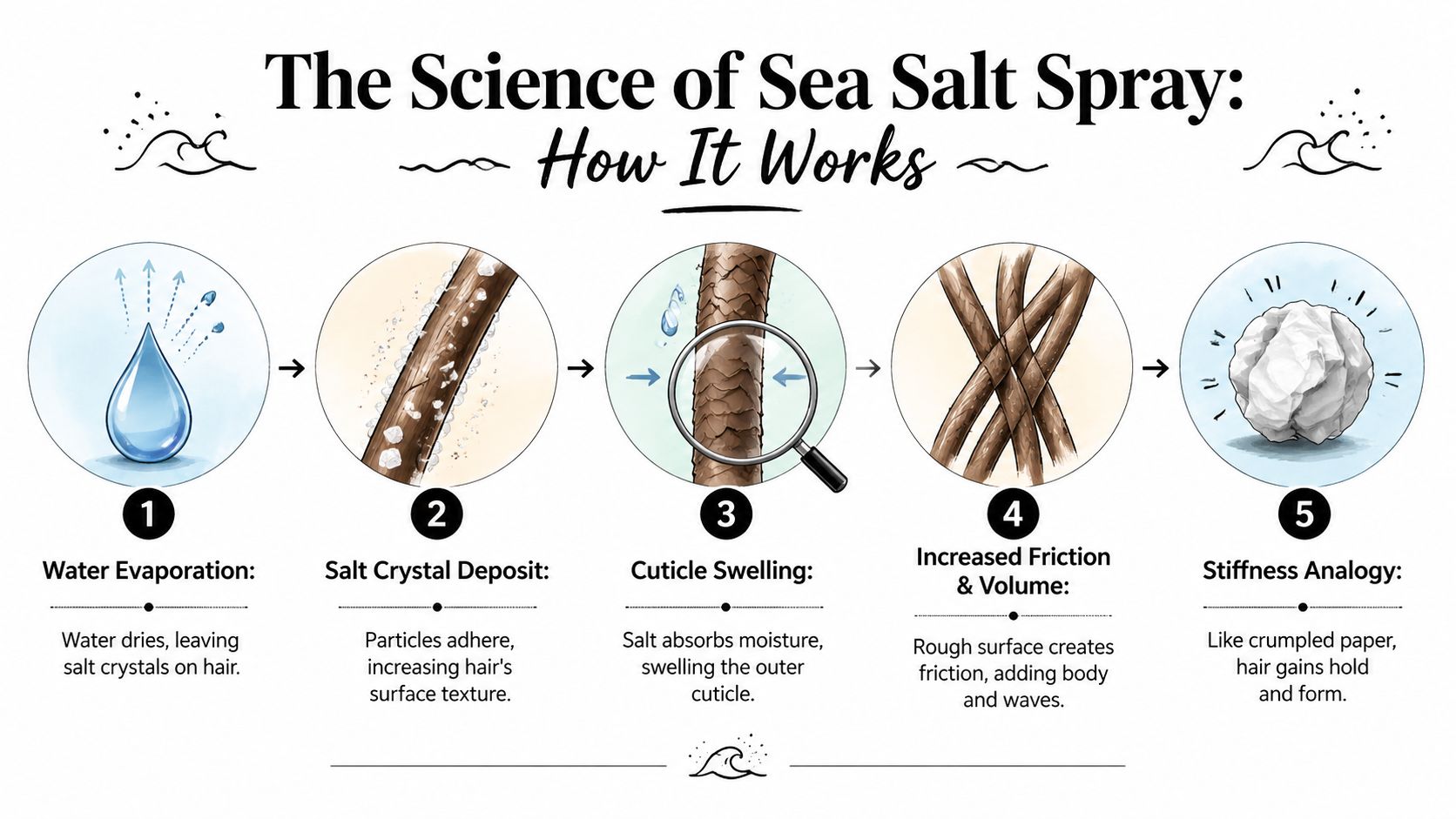
Sea salt spray seems simple, but the effect is quite precise. The easiest way to explain it to staff or clients is with an everyday analogy. If you dampen a sheet of paper, scrunch it, and let it dry, it won’t return to the same smooth flat shape. It gains memory, stiffness, and irregular structure. Hair behaves in a comparable way when a salt-based styling mist dries on the fibre.
What happens after application
When you mist sea salt spray onto damp hair, the water phase spreads the dissolved salts across the fibre. As the water evaporates, the salts remain behind in microscopic deposits. Those deposits don’t make the hair smoother. They do the opposite. They create a slightly rougher surface and increase contact between strands.
That increased contact is what many customers describe as “grip”. Hair separates more easily into pieces, roots feel less slippery, and waves or bends have a better chance of staying visible. The finish is usually more matte than glossy because the surface is no longer uniformly smooth.
The process is easier to teach if you break it into five simple stages:
- The spray wets the fibre. Damp hair gives the formula room to spread evenly.
- Water evaporates. The liquid disappears, but the dissolved solids remain.
- Salt deposits stay on the cuticle. The outer surface becomes less sleek.
- Friction rises between strands. Hair grips itself more readily.
- Texture becomes visible. Separation, body, and tousled movement appear.
Why salt creates hold
Salt is hygroscopic, which means it interacts readily with moisture. In styling terms, that matters because it changes how the hair surface behaves as the formula dries. Instead of a silky, low-friction fibre, you get one with more tactile resistance. That’s why braids, loose updos, bends, and second-day refresh styles often respond so well to sea salt spray.
A common point of confusion is whether sea salt spray “curls” the hair. It doesn’t create a new hair type. What it does is reveal and exaggerate the movement already present. Straight hair may gain bend and body. Wavy hair usually gains definition. Curly hair may gain separation and a more undone finish.
Practical rule: Sea salt spray doesn’t replace structure. It magnifies it.
Sodium chloride versus magnesium sulfate
Not every salt-based spray behaves the same way. Sodium chloride is the ingredient commonly associated with the category. It contributes roughness, strand separation, and that recognisable beachy feel. But many stronger-performing formulas also rely on magnesium sulfate, often chosen when a brand wants volume with a slightly more refined texturising effect.
According to ingredient analysis discussed by formulators, magnesium sulfate can form micro-crystalline networks that boost hair fibre diameter by 10 to 15 percent through osmotic swelling and enhanced fibre separation, giving a noticeable increase in volume and texture that can outperform sodium chloride alone in some conditions, as explained in this discussion of magnesium sulfate and texturising performance in sea salt spray formulas.
That distinction helps at shelf level. If a customer says, “I want texture, but not that crispy dry feeling,” a better-balanced formula often includes more than one texturising mineral plus supportive conditioning agents. That’s formulation strategy, not marketing fluff.
Why the finish feels matte
Smooth, reflective hair looks shinier because light bounces off a more uniform surface. Salt-treated hair is less uniform. It scatters light differently, so the result appears softer and more matte. That’s desirable for customers seeking relaxed texture, but it also means product positioning matters. If the shopper wants polished shine, sea salt spray shouldn’t be sold as a universal answer. It’s a texture product first.
Retail teams who understand that mechanism can explain sea salt spray with confidence. They won’t have to fall back on vague claims about “beach vibes”. They can show exactly why the product works and who it suits best.
Decoding the Formulation for Natural Efficacy
A premium sea salt spray should never be judged by the front label alone. Two bottles can promise beach texture and perform very differently because the formula architecture underneath is different. For Swiss retailers focused on natural beauty, the key question isn’t only “Does it contain sea salt?” It’s “How has the formulator balanced texture, comfort, stability, and credibility?”
The salt phase
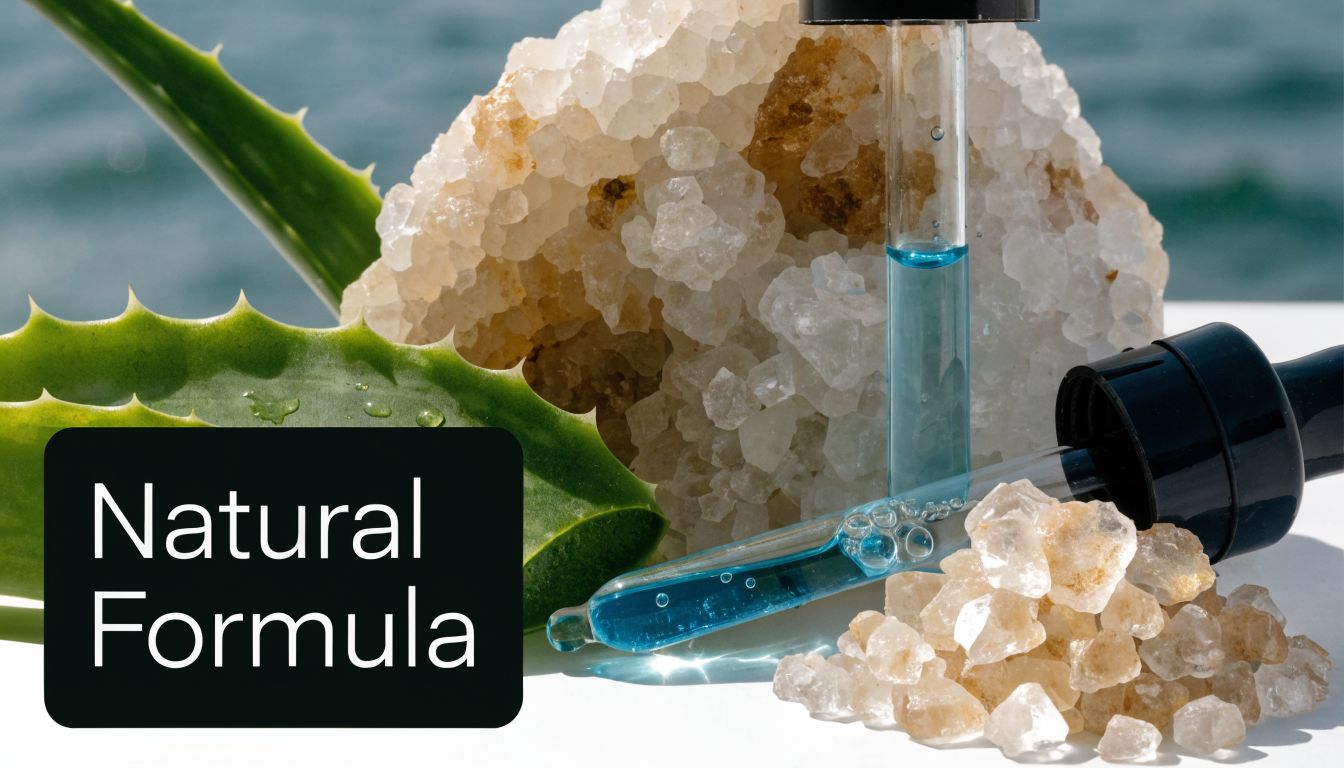
The heart of the formula is the mineral phase. This usually includes sea salt, magnesium sulfate, or both. What matters isn’t just the ingredient identity but the level used. Too little, and the product behaves like scented water. Too much, and the result can feel harsh or brittle.
A useful benchmark comes from patented formulation work showing that premium formulations use 3 to 7 parts by weight of salt per 100 parts seawater for effective texture without excessive dryness. In that range, salt crystals can adsorb onto hair cuticles via electrostatic forces, increasing surface friction and grip. The same reference also notes alignment with Swiss REACH Annex XVII salinity limits for non-irritant claims, which makes the concentration range relevant commercially as well as technically. See the patent summary on salt-to-seawater ratios and compliance considerations for sea salt spray.
That single point is useful in buyer conversations. It gives staff a concrete way to explain why some sprays feel refined and others feel crude.
The water base
Consumers often assume “marine” means someone bottled ocean water. In reality, the water phase is a formulation choice. Some brands work from purified water and build the mineral profile deliberately. Others lean into a marine identity through seawater-derived components or marine adjuncts. Either approach can work if the final system is stable, sensorially pleasing, and consistent in spray performance.
For a natural retailer, the water phase influences the story. Purified water supports a cleaner technical profile. Marine-linked water or marine actives support a more spa-oriented narrative. Neither should be oversold. What counts is whether the formula delivers a fine mist, even distribution, and reliable drying behaviour.
The comfort system
The distinction between premium and entry-level styling sprays lies in their formulas. Salt creates texture, but the rest of the formula decides whether the product feels usable over time. Conditioning support is what prevents “beachy” from turning into “parched”.
Look for formulas that include supportive ingredients such as:
- Aloe vera or similar soothing humectants that soften the drying perception of salts.
- Hydrolysed proteins that help the fibre feel less fragile after texturising.
- Lightweight botanical oils used carefully so they don’t collapse the texture effect.
- Marine extracts when the brand wants a stronger spa or thalasso identity.
Retailers in the clean beauty space often benefit from explaining these ingredients functionally rather than romantically. “This helps limit the rough feel of the salt” is more convincing than “infused with nourishing botanicals” on its own.
The best natural sea salt spray doesn’t fight the salt effect. It cushions it.
What to avoid in a premium natural offer
For a Swiss audience that reads labels closely, omission can be as persuasive as inclusion. A formula positioned as natural, ECOCERT-aligned, or premium should be coherent. If it leans heavily on ingredients that undermine the clean positioning, the story weakens.
Areas to assess carefully include:
- Harsh drying alcohols when they dominate the quick-dry feel at the expense of comfort.
- Silicones if the product claims a natural, lightweight, texturising profile but leaves artificial slip or residue.
- Overpowering synthetic fragrance when the brand narrative is marine purity or wellness.
- Needlessly complex styling polymers if the product is meant to sit credibly in a clean-beauty assortment.
This doesn’t mean every technical ingredient is undesirable. It means the formula should make sense. A natural sea salt spray should feel intentionally composed, not cosmetically conflicted.
How ECOCERT thinking influences selection
ECOCERT standards matter because they push brands towards ingredient transparency, ecological processing logic, and a cleaner sourcing narrative. For retailers, that gives useful selling language. It also creates a stronger bridge between hair styling and the wider values driving premium natural beauty in Switzerland.
When reviewing a line, ask questions that go beyond marketing copy:
| Formula question | Why it matters in retail |
|---|---|
| Does the ingredient list support the natural claim? | Staff can explain the product without overpromising. |
| Is the texturising system balanced by comfort ingredients? | Customers are more likely to repurchase. |
| Does the sensorial profile suit pharmacy, spa, or boutique channels? | Scent, finish, and mist quality affect placement. |
| Is the marine story authentic rather than decorative? | The product feels curated, not trend-chasing. |
A good sea salt spray formula is never just salt and water. It’s a deliberate balance of texture, tolerance, identity, and trust. That’s the standard worth bringing into a premium Swiss assortment.
Mastering Application for Every Hair Type
Even an excellent formula underperforms if customers use it badly. Most complaints about sea salt spray come from one of three mistakes: too much product, the wrong hair condition at application, or no adjustment for local climate. In Switzerland, climate adaptation matters more than many brands acknowledge.
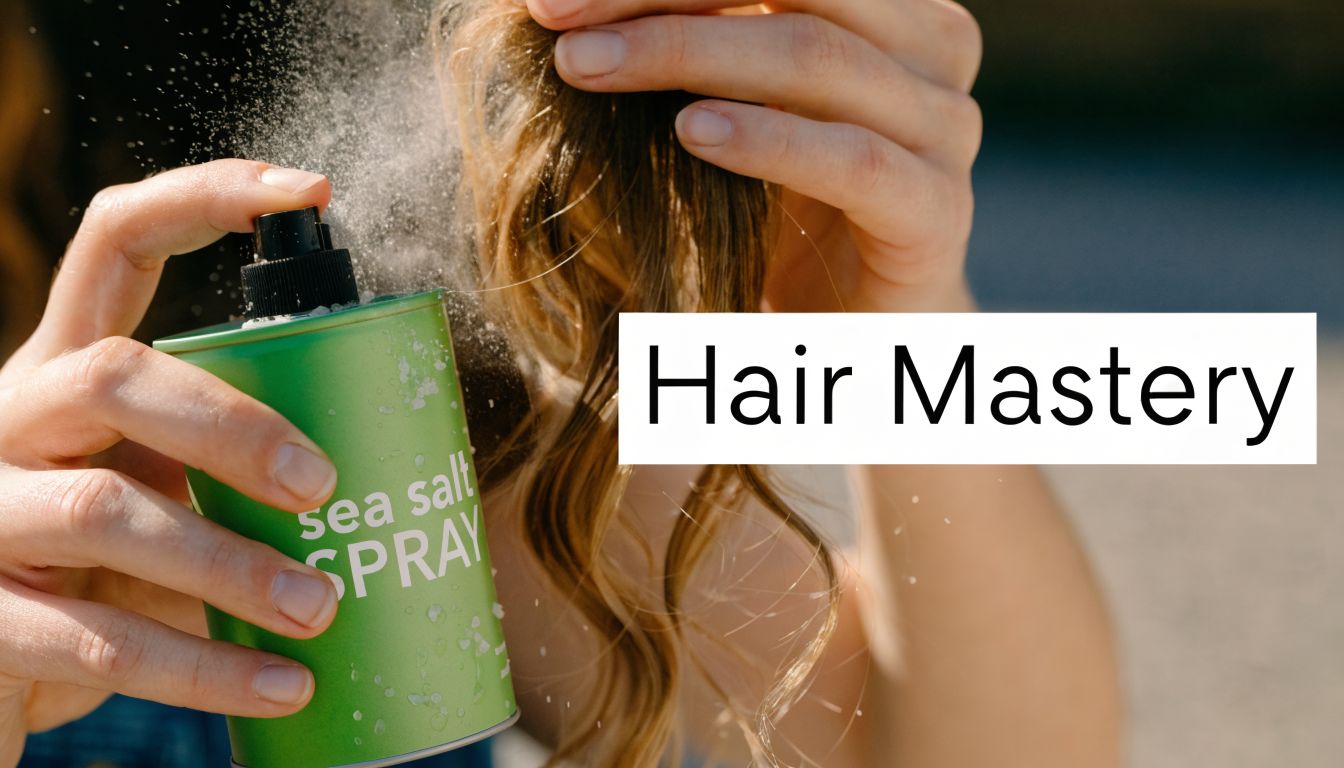
A strong in-store recommendation starts with one simple instruction: begin on damp, towel-dried hair, not soaking wet hair and not fully dry hair if the goal is main styling. Damp hair gives better distribution and a more even finish. Dry-hair use is best treated as a refresh technique, not the default method.
The Swiss climate factor
Local advice gives retailers an edge. Swiss cities such as Zurich average 75 to 85 percent relative humidity, which can intensify sea salt’s moisture-drawing effect. That means clients with low-porosity hair should often choose formulas with humectant support or use a slightly diluted application approach to reduce over-drying and fragility, as outlined in this guide to sea salt spray use in high-humidity conditions relevant to Swiss haircare.
In practical terms, that means you shouldn’t train staff to give the same script to everyone. A customer in a humid city flat and a guest leaving a dry spa treatment room may need different advice.
A simple professional method
Use this method for most first-time users:
- Detangle gently first. Product should enhance texture, not lock knots into place.
- Mist through mid-lengths and roots lightly. Ends usually need less.
- Use hands to scrunch, twist, or lift. The hands activate the pattern.
- Air-dry or diffuse softly. Aggressive heat can push the hair into roughness quickly.
- Rework only when mostly dry. Constant touching while wet can create frizz.
On low-porosity hair, less product and more hand-shaping usually gives a better result than repeated spraying.
Sea Salt Spray Application by Hair Type
| Hair Type | Best Application Method | Expected Result | Professional Tip |
|---|---|---|---|
| Fine hair | Apply lightly at roots and mid-lengths on damp hair, then lift while drying | More body and airy texture | Keep the formula away from heavily conditioned ends |
| Thick hair | Section hair before misting, then scrunch or twist larger pieces | Controlled separation and relaxed movement | Work in layers so the inner hair receives product too |
| Wavy hair | Mist on damp lengths and scrunch upward | Enhanced natural wave pattern | Stop before saturation or the wave can look heavy |
| Curly hair | Apply sparingly to selected areas rather than all over | More separation and a looser, undone finish | Pair with a moisturising leave-in if curls are already dry |
| Straight hair | Use on damp hair, then twist sections or diffuse lightly | Added bend, grit, and volume | Explain that it builds texture, not a true curl pattern |
| Colour-treated hair | Focus on moderate use and moisture-balanced formulas | Texture with less compromise to feel | Recommend alternating with hydrating styling days |
Matching the product to the result
Sea salt spray isn’t one look. It can serve several salon-adjacent outcomes:
- Loose waves need light distribution and scrunching.
- Lift at the crown responds well to root-focused misting on fine hair.
- Grit for braids or updos often works best on nearly dry hair.
- Relaxed curl separation requires restraint, not blanket application.
That versatility makes it easy to cross-sell, but only if staff describe the result clearly. Customers often say “beach hair” when they seek either volume, definition, or grip. Those aren’t identical needs.
A quick visual demo can help staff show the difference in technique:
When to be cautious
Some clients need a gentler conversation. Very dry, heavily bleached, fragile, or over-processed hair may not enjoy frequent salt styling. In those cases, a retailer can still keep the sale by repositioning sea salt spray as an occasional texture tool rather than a daily staple.
Use caution when the customer describes:
- Frequent breakage
- A rough feel even before styling
- Strong chemical treatment history
- Ends that already feel porous or rigid
For these shoppers, suggest a formula with visible conditioning support and advise targeted application rather than full-head saturation. That kind of honesty builds credibility. It also reduces the chance that a good product gets blamed for bad usage.
Merchandising and Marketing in the Swiss Market
Sea salt spray earns its shelf space when it’s sold as more than a casual styling mist. In Switzerland, premium beauty customers often want a coherent reason to trust a product category. They respond to formulation integrity, ethical positioning, and a story that feels grounded rather than loud.
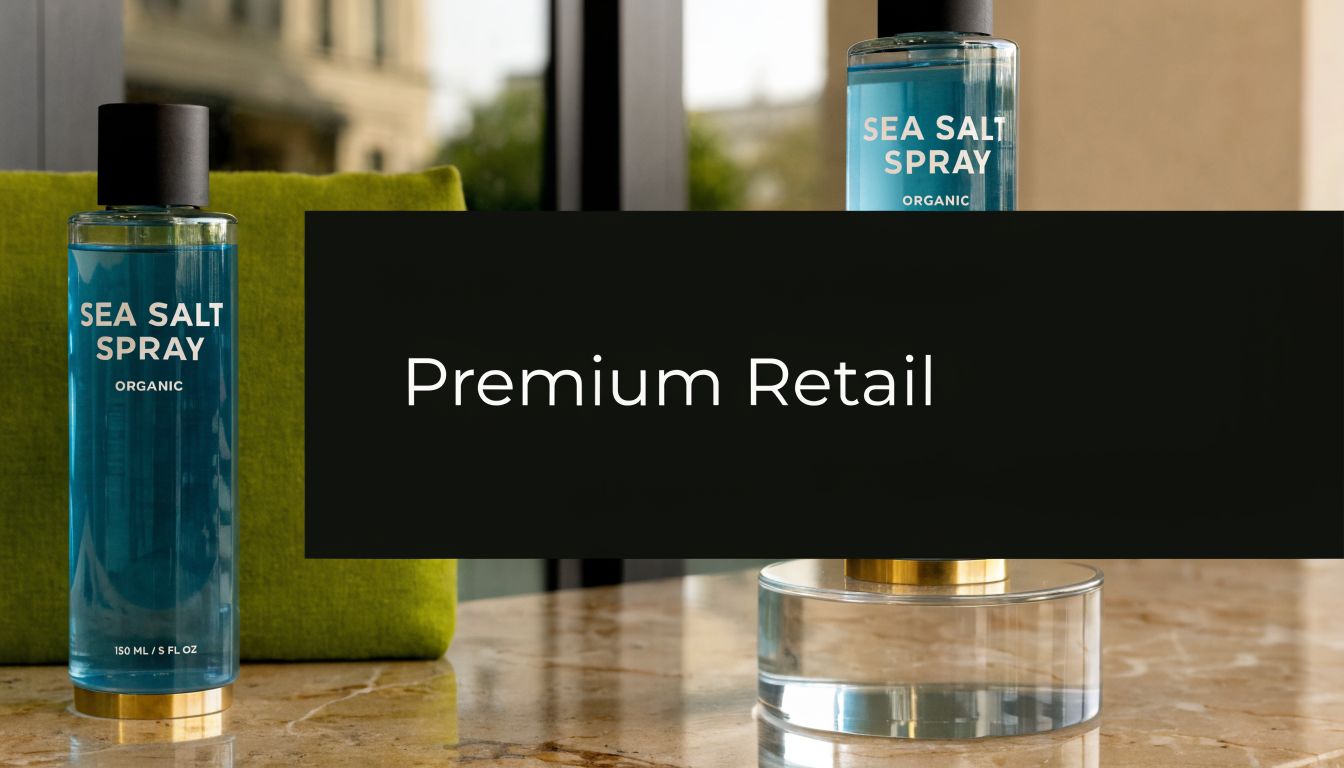
The commercial case is strong. The global sea salt spray market was valued at $1.2 billion in 2024 and is projected to reach $2.8 billion by 2033, growing at a 9.7% CAGR, according to this overview of sea salt spray market growth and clean beauty demand. For Swiss retailers and spas, that matters because the category sits directly inside the natural and clean beauty demand driving premium purchasing.
The story that sells
A strong merchandising angle combines three elements. First, the result must be easy to picture: texture, movement, light grip. Second, the formula needs a believable reason for being premium: marine minerals, careful salt balance, clean formulation, cruelty-free or ECOCERT-aligned positioning. Third, the product should connect to a broader lifestyle idea such as wellness, low-effort elegance, or travel-inspired haircare.
That gives you several workable narratives:
- Marine ritual for spas, hotels, and thalasso-adjacent settings
- Clean styling essential for pharmacies and ingredient-conscious retail
- Effortless texture with integrity for boutiques and premium e-commerce
In-store presentation that lifts perceived value
Sea salt spray benefits from context. If it sits alone beside generic styling products, it can look interchangeable. If it’s grouped with marine care, lightweight leave-ins, scalp refreshers, or travel-size ritual products, it gains identity.
Try these display principles:
- Use tactile language on shelf talkers such as matte texture, soft grip, or undone waves.
- Pair it with one moisturising companion so the customer sees a routine, not a one-off item.
- Lean into mineral and marine visual cues without becoming kitsch.
- Train staff to spray a sample card or demonstrate on a small hair section where appropriate.
Customers often understand sea salt spray fastest when they can feel the mist quality and hear a clear explanation of who it’s for.
Digital selling needs a different structure
Online, the product needs sharper framing. A listing that says “adds beachy texture” won’t do enough heavy lifting. Customers need help identifying themselves in the use case. Fine hair. Flat roots. Second-day refresh. Grip for braids. Humid climate styling. Those entry points convert better because they solve a named problem.
Retailers building category-specific campaigns can also benefit from thinking in journeys rather than isolated products. If you’re refining e-commerce flows, this practical guide on how to build sales funnels is useful because it shows how to structure interest, education, and conversion across product-led pages.
Messaging that suits Swiss premium retail
The most effective copy in this category tends to avoid exaggerated glamour language. Swiss premium customers usually prefer clarity over hype. Strong phrases include:
| Positioning angle | Better wording |
|---|---|
| Texture claim | Adds airy texture and touchable grip |
| Natural profile | Mineral-led styling with a clean formulation mindset |
| Luxury feel | A sensorial finishing mist inspired by marine care |
| Practical result | Helps fine hair hold shape and gives waves more definition |
The category is commercially attractive because it’s easy to understand, easy to demonstrate, and easy to cross-sell. But it performs best when the retailer treats it as curated expertise rather than a trend item. That’s what justifies the premium position.
Navigating Compliance and Product Integrity
A sea salt spray may look simple on shelf, but product integrity is where professional retail standards show. In Switzerland, that means treating formula claims, packaging choices, and handling practices with the same seriousness you’d apply to skincare.
Start with claim discipline
Retailers should be careful not to overstate what a product can do. Sea salt spray can add texture, separation, and grip. It can support a natural styling effect. It shouldn’t be presented as repairing damage, transforming hair structure permanently, or suiting every scalp without qualification unless the brand’s substantiation clearly supports those claims.
That’s especially important in pharmacy and clinic-adjacent environments, where customers often assume a higher standard of accuracy. Good selling language stays close to observable benefits.
Read the pack like a professional
Before ranging a product, confirm that the presentation supports serious retail. Review:
- Ingredient listing clarity so staff can answer questions without guessing
- Period After Opening symbol so inventory teams can explain use-after-opening expectations
- Batch traceability for quality control and stock rotation
- Usage directions that reflect the actual product behaviour
If a product is marketed into a natural channel, the packaging should also protect what’s inside. Salt systems are relatively straightforward, but supporting botanical ingredients, fragrance components, and marine extracts can still lose quality if the pack is poorly chosen.
Packaging affects performance
The bottle and atomiser shape the user experience more than many buyers realise. A fine, even mist distributes minerals better than a coarse jet. That means fewer sticky patches, better section coverage, and a more premium first impression.
Look for packaging choices that support quality:
- UV-protective or otherwise protective bottles when the formula includes sensitive natural adjuncts
- Reliable atomisers that produce a consistent cloud rather than droplets
- Closure systems that minimise leakage in travel, spa, or retail environments
A mediocre atomiser can make a good formula feel cheap in the customer’s hand.
Shelf management and in-store confidence
Natural styling products often need more thoughtful stock handling than generic mass-market alternatives. Store them away from unnecessary heat and direct light where possible. Rotate older units forward. Ensure testers remain clean and functional if your retail model allows testing.
Retail teams should also know how to answer practical questions without improvising. If asked about sensitivity, dryness, or suitability for damaged hair, the safest response is to refer to the formula profile and usage guidance rather than making sweeping promises.
A concise staff checklist helps:
- Confirm the product’s main styling role.
- Match it to the customer’s hair type and dryness level.
- Explain how much to use and where to apply it.
- Mention any moisture-balancing companion product if relevant.
- Point to the labelling for ongoing care and storage guidance.
Compliance isn’t only a legal necessity. It’s also a positioning tool. When a retailer demonstrates precision, the whole assortment feels more trustworthy.
Frequently Asked Questions for Trade Partners
How should staff demonstrate sea salt spray on the shop floor
Keep the demonstration short and tactile. Staff should explain the result first, then spray lightly onto a small section or visual swatch if your environment allows. The strongest script is usually: what it does, who it suits, and how to avoid overuse. That’s easier for customers to remember than a long ingredient recital.
Should pharmacies present it as haircare or styling
Treat it as a styling product with haircare awareness. That distinction matters. It helps staff speak openly about texture, grip, and finish while still discussing comfort ingredients, clean formulation logic, and climate-adapted use.
Does it work for spa and hotel retail
Yes, especially when your concept already includes marine, mineral, or wellness-led rituals. Sea salt spray works well as a finishing product after blow-dries, soft waves, or low-maintenance holiday styling. In spa retail, the product benefits from being placed near lightweight leave-ins or other sensorial finishing items.
Are larger professional sizes relevant
Often, yes. Spas, salons within hotels, and back-bar styling areas may prefer formats that support repeated use in service settings. The right size depends on the service model, but the underlying principle is simple: retail sizes drive discovery, while larger professional formats support ritual consistency behind the chair or in-cabin.
How does sea salt spray fit into a broader assortment
It fills a useful gap between pure treatment products and heavier stylers. In a solution-based assortment, it can sit beside scalp refreshers, lightweight moisturising supports, curl enhancers, or travel-friendly styling essentials. That makes it valuable for retailers who want a more complete natural haircare offer without carrying a huge styling wall.
What’s the most common selling mistake
Oversimplifying the product. If staff say only “it gives beach waves,” they miss customers who want root lift, braid grip, or second-day texture. Better education widens the category.
Train teams to sell the finish, the formula logic, and the right usage pattern. Not just the trend name.
Curating Your Perfect Marine Haircare Offer
Sea salt spray earns its place in a premium assortment when it’s chosen and presented with discipline. The science explains why it works. The formulation reveals whether it deserves a natural positioning. Application advice determines whether customers love it or blame it. Merchandising turns a familiar product into a high-trust category.
For Swiss retailers, the key opportunity lies in curation. A strong offer doesn’t need dozens of styling products. It needs a few that are coherent, climate-aware, ethically credible, and easy for staff to explain. Sea salt spray can play that role beautifully when it sits inside a wider marine or clean-beauty strategy.
It also opens useful adjacent conversations. A client buying texture may also need hydration, scalp comfort, or accessory-safe styling. If your assortment includes extension users, for example, a practical essential hair extension product guide can help teams think more carefully about compatible aftercare and styling recommendations.
A well-chosen sea salt spray doesn’t just add a SKU. It strengthens your identity as a retailer who understands modern natural beauty and translates it into products customers can use.
If you’re building a premium marine, natural, or pharmacy-ready haircare selection, beautysecrets.agency can help you curate brands with strong formulation logic, recognised standards, and the kind of product storytelling that supports confident retail sales across Switzerland.