A pharmacy buyer in Zürich or a spa manager in Genève usually reaches the same point sooner or later. Traditional wholesale still matters, trusted retail partners still matter, but customer discovery has shifted. People now research ingredients, claims, textures, and brand credibility long before they walk into a store or place a trade order.
That’s why amazon for advertisers matters far more to Swiss beauty brands than it did a few years ago. The channel isn’t only about mass-market volume. Used properly, it can support premium positioning, disciplined customer acquisition, and a stronger digital shelf for brands that depend on trust, formulation quality, and clean presentation.
The Amazon Opportunity for Swiss Beauty
Swiss beauty decision-makers often hesitate for sensible reasons. They worry Amazon will flatten brand value, attract the wrong audience, or create pricing pressure they can’t control. Those risks are real. They’re also manageable if the account is built for premium retail, not bargain-bin volume.
Amazon’s advertising ecosystem gives brands access to an average monthly ad-supported audience of more than 275 million in the U.S. across properties including Prime Video, Fire TV, Twitch, IMDb, Amazon Music, and live sports, according to Amazon Ads agency advice for 2025. For Swiss beauty brands, that scale matters less as a vanity metric and more as proof that Amazon has become a media environment, not just a marketplace.
Why premium beauty can work here
Swiss consumers buying natural or premium skincare usually want three things from an unfamiliar brand:
- Evidence of quality through ingredients, certifications, and precise claims
- Confidence in the seller through reviews, listing quality, and fulfilment reliability
- A clear reason to pay more through formulation story, sensorial appeal, or specialist positioning
Amazon can support all three if your listings, ads, and operational setup are aligned. It’s especially useful for brands with a strong point of difference such as marine spa cosmetics, certified-organic mother and baby care, or fresh-pressed oils.
Amazon works for premium beauty when the product page feels like a serious retail environment, not a marketplace afterthought.
Where Swiss brands usually get it wrong
The failure pattern is familiar. Brands launch quickly, copy over distributor copy, run loose keyword campaigns, and then decide Amazon “doesn’t suit premium”. In most cases, the issue isn’t the channel. It’s the execution.
A more disciplined winning Amazon marketing strategy starts with assortment control, claim discipline, and campaign structure that reflects buyer intent. That matters more in Switzerland because shoppers are selective, multilingual, and highly responsive to signals of legitimacy.
Building Your Foundation for Amazon Success in Switzerland
Before ad spend starts, the account needs to be structurally sound. Swiss beauty brands often want to begin with creative and traffic. In practice, the core work starts with entity choice, listing control, and compliance documentation.

Choose the right commercial setup
The first decision is usually Seller Central or Vendor Central.
Seller Central gives you more pricing control, more direct advertising control, and usually more day-to-day responsibility. It suits brands and distributors that want tighter command over catalogue, stock, and retail presentation.
Vendor Central can work if Amazon is buying wholesale and the relationship already exists. The trade-off is less flexibility in some areas and less direct control over how commercial decisions are applied.
For most Swiss beauty brands entering Amazon carefully, Seller Central is often easier to manage strategically because it lets the team control:
- Catalogue ownership with tighter oversight of titles, images, and attributes
- Advertising execution at SKU level without waiting for retail-side changes
- Brand presentation through A+ Content, Brand Store assets, and listing updates
Brand Registry isn’t optional
If the brand has a registered trade mark, Brand Registry should be part of the launch sequence. It helps protect listings, reduces the risk of content tampering, and provides access to merchandising tools that matter in beauty.
That layer allows many premium brands to start looking credible on Amazon. Without that layer, the listing can feel generic. With it, the brand can present ingredients, usage guidance, imagery, and product family relationships in a way that supports a higher-end purchase decision.
Practical rule: Don’t treat Brand Registry as an admin task. Treat it as the point where your brand stops renting space and starts controlling it.
Swiss compliance is where many launches stall
For beauty brands advertising in Switzerland, strict Swissmedic and EU-aligned regulations are a primary hurdle. A 2025 analysis of CH e-commerce data found that 68% of Swiss beauty advertisers struggle with ad disapprovals due to unverified sustainability claims, as noted in Amazon’s Sponsored Products best practices guide.
That single issue explains why many clean beauty campaigns underperform before they’ve even had a fair test. Teams write “natural”, “clean”, “sustainable”, “cruelty-free”, or “organic” into listings and ads as if those terms are just positioning language. In Switzerland, they often function more like compliance triggers.
What to verify before launch
For regulated cosmetics, I’d insist on a pre-launch checklist that covers both Amazon policy and Swiss market expectations.
Claims file
Keep clear substantiation for ecological, certification, and cruelty-free claims. If a listing says ECOCERT-certified or cruelty-free, the internal file should support it.Language coverage
Swiss buyers don’t all search in the same language. Product descriptions, key attributes, and customer-facing copy should reflect the relevant German, French, and Italian needs where applicable.Ingredient and use-case clarity
Avoid vague wellness language if the product’s benefit needs precise framing. Cosmetic claims should stay within what your documentation supports.Packaging consistency
The product shown in images, the variant sold, and the on-pack wording need to match. Mismatch creates both compliance and conversion problems.
A useful training aid for internal teams is this walkthrough video, especially when you’re aligning retail, compliance, and media stakeholders:
A contrarian setup that often works better
Swiss beauty advertisers often default to broad consumer reach. That isn’t always the best starting point. The same Amazon guide notes that prioritising business-only placements for B2B targeting to Swiss pharmacies and spas has shown 25% higher ROAS by avoiding consumer mismatches on ethical claims.
That matters if your range is better suited to professional buyers, wellness operators, or premium resellers than impulse-driven mass retail traffic.
A simple way to decide is this:
| If your product is mainly for… | Start with… |
|---|---|
| Pharmacies, clinics, spas | Business-oriented targeting and tighter claim language |
| Premium consumer retail | Standard retail campaigns with stricter brand filters |
| Mixed channels | Separate campaign logic so trade intent and consumer intent don’t dilute each other |
Foundation mistakes that create expensive problems later
The most expensive Amazon accounts rarely look broken on the surface. They look rushed.
- Weak listing inputs: good ads can’t rescue incomplete bullets, poor titles, or missing compliance attributes.
- Unverified sustainability language: this is one of the fastest ways to trigger disapprovals or credibility issues.
- Shared catalogue logic across markets: Swiss localisation usually needs more care than a direct copy from a larger EU market.
- No internal owner for listing governance: when compliance, trade, and media all assume someone else is checking details, avoidable errors stay live.
Swiss beauty brands don’t need a flashy start. They need a controlled one.
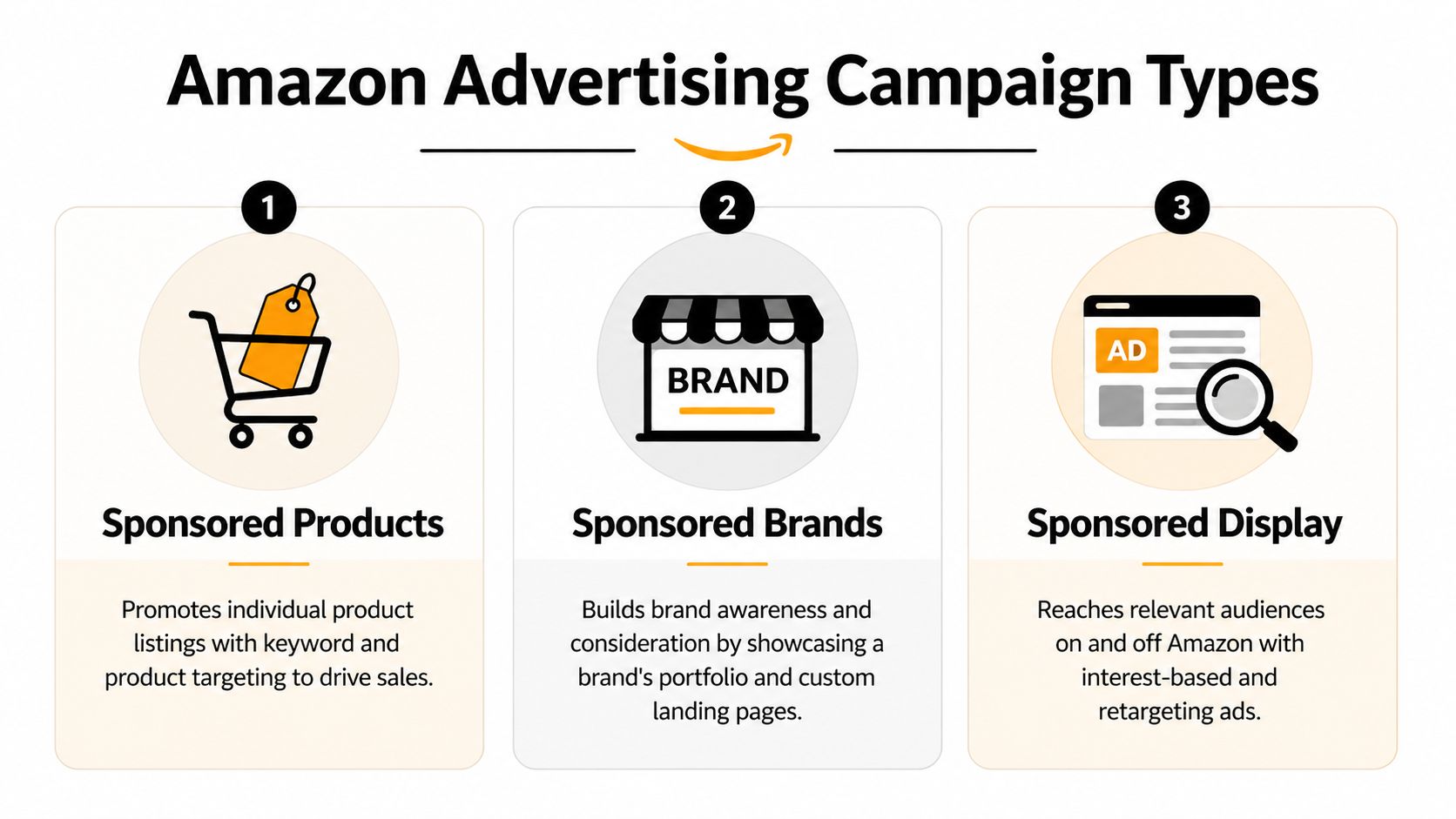
Choosing Your Amazon Advertising Campaign Types
Most beauty accounts don’t fail because they picked the “wrong” ad format. They fail because they expect one format to do every job. On Amazon, campaign types work best when each one has a narrow role.
Sponsored Products for high-intent demand
If someone searches for a specific product type, concern, or ingredient profile, Sponsored Products usually deserve the first budget allocation. They’re the workhorse format. They put individual SKUs in front of people already expressing buying intent.
For Swiss beauty brands, you can defend commercially important searches such as premium anti-ageing, organic baby care, or marine spa cosmetics. The format is direct and measurable. It also exposes poor product-market fit quickly, which is useful.
Use Sponsored Products when you need to:
- Drive sales on hero SKUs with clear keyword intent
- Test new search demand before building broader brand campaigns
- Protect branded searches if competitors are showing near your terms
Sponsored Brands for premium positioning
Sponsored Brands are often underused by beauty advertisers who focus too heavily on the next attributed sale. That’s short-term thinking. In premium categories, shoppers often need to understand the brand before they commit to the product.
This format helps showcase a fuller range and send shoppers to a Brand Store or curated landing page. That’s especially valuable when the sale depends on a ritual, ingredient story, or product family logic rather than a single SKU pitch.
A marine skincare line, for example, may convert better when shoppers first see the broader spa identity rather than one isolated jar or serum.
If the product needs context to justify the price, Sponsored Brands often carry that burden better than Sponsored Products.
Sponsored Display for re-engagement
Sponsored Display sits in a different part of the decision process. It’s less about intercepting active search and more about following up with relevant audiences. For beauty, that matters because many shoppers browse, compare, and delay the purchase while they weigh texture, ingredients, and price.
This format can help recover attention from shoppers who viewed a product detail page but didn’t convert. It’s also useful when you want to keep a premium range visible without forcing every campaign into search.
A practical use case is a shopper who viewed a multipurpose balm or baby care range, then left to compare options. Sponsored Display gives you another chance to reintroduce the product with better timing.
Amazon DSP for broader audience building
DSP isn’t for every Swiss beauty brand, but it matters more now than many teams realise. It helps brands reach people on Amazon-owned properties and third-party inventory with broader audience logic than standard sponsored ads can provide.
CH-specific guidance shows a 35% performance uplift for e-commerce resellers who combine business placements with negative targeting against non-cruelty-free competitors, and notes 28% year-on-year growth in luxury natural skincare ad spend in the CH market for 2026, according to Amazon’s guide to understanding Amazon advertising. That makes DSP especially relevant for Swiss wellness and spa targeting where audience quality matters more than raw click volume.
For teams comparing formats in more detail, this overview of Advertising with Amazon is useful as a supplementary planning resource.
Which campaign type fits which objective
| Objective | Best starting format | Why it fits |
|---|---|---|
| Capture active demand | Sponsored Products | Closest match to high-intent search behaviour |
| Introduce a brand story | Sponsored Brands | Better for range presentation and premium positioning |
| Re-engage non-buyers | Sponsored Display | Useful after product page views and consideration |
| Reach niche audiences beyond search | Amazon DSP | Stronger audience planning across owned and external inventory |
The trade-offs Swiss advertisers should accept
No format is universally efficient.
- Sponsored Products can scale quickly, but they can also become overly reliant on discount-led intent if the listing doesn’t support premium value.
- Sponsored Brands improve perception, but they need better creative discipline and stronger catalogue structure.
- Sponsored Display can extend reach, but weak audience definitions make it drift.
- DSP opens more advanced targeting, but it demands tighter planning, stronger measurement, and more patience.
A well-run Swiss beauty account usually combines these formats. It doesn’t throw all of them live at once. It stages them based on catalogue readiness, margin tolerance, and whether the brand needs immediate sales, trade prospecting, or broader market education.
Targeting and Creatives for the Swiss Beauty Consumer
Good targeting on Amazon is usually less glamorous than people expect. It starts with search term hygiene, language nuance, and the discipline to separate discovery from conversion. In Swiss beauty, that matters even more because premium shoppers often use very specific words when they search.
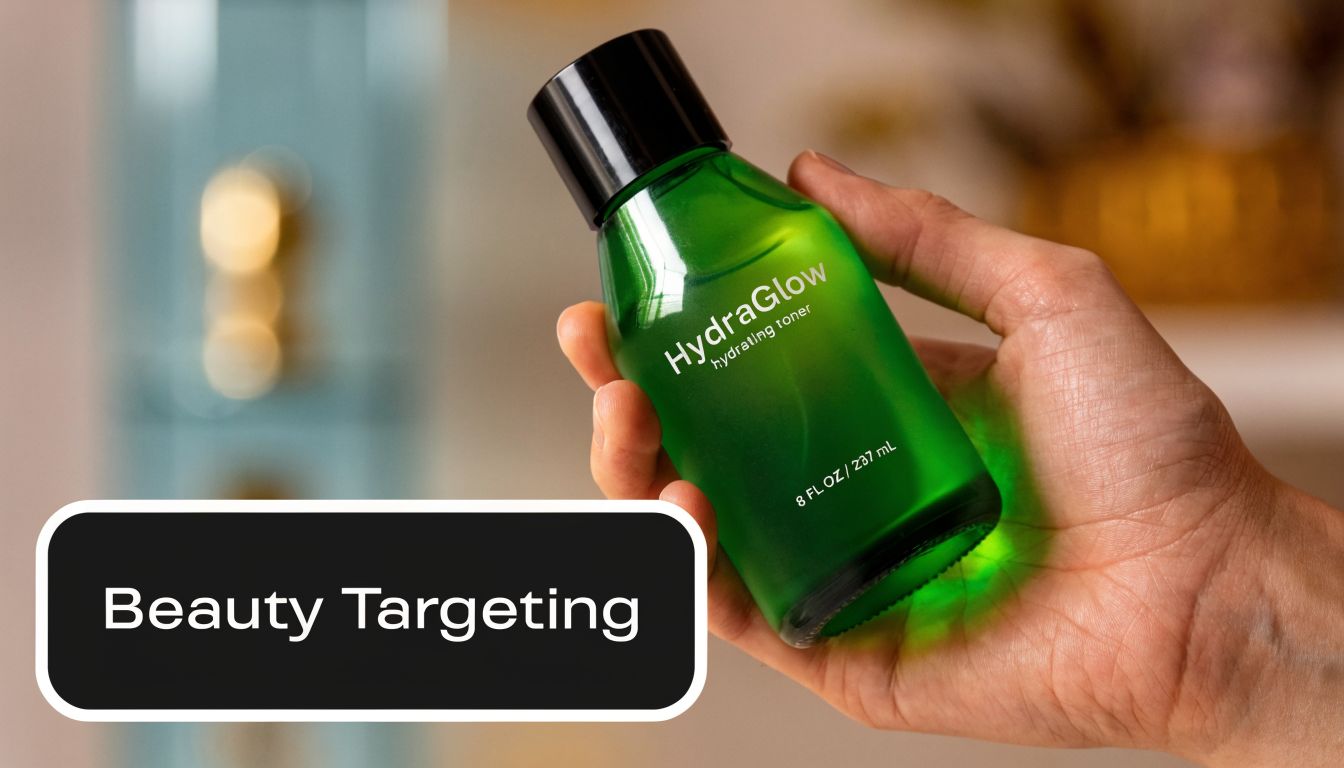
Build targeting around intent, not guesswork
In the Swiss market, exact match keywords consistently outperform broad match with 25-40% higher ROAS, and a best practice is to harvest search terms from auto campaigns for 7-14 days before segmenting them into dedicated exact, phrase, and broad campaigns. Using CH-language negatives like “billig” can cut irrelevant clicks by up to 35%, according to Amazon’s guidance on common sponsored ads mistakes.
That should shape account structure from the start.
A practical keyword workflow
I’d build Swiss beauty search campaigns in layers rather than one mixed campaign.
- Start with auto for discovery: let Amazon surface real search terms and ASIN relationships first.
- Move proven terms into exact: premium efficiency is typically achieved with this approach.
- Keep phrase for controlled expansion: useful for variants and longer formulations.
- Use broad carefully: broad belongs in discovery, not as the centre of the account.
This is especially important in multilingual markets. A shopper looking for premium skincare in Zürich won’t necessarily search like a shopper in Lausanne. Translating the same term isn’t enough. Search behaviour changes with language, retail culture, and how benefits are expressed.
Field note: mixed match-type campaigns nearly always hide waste. They make weak search terms look acceptable because strong ones mask the damage.
Negative keywords deserve more attention
Negative keywords aren’t just a clean-up task. They’re a positioning tool.
For premium beauty, negatives can help remove searches that suggest bargain intent, dupes, low-trust alternatives, or inappropriate product expectations. If the account targets luxury oils or specialist mother-and-baby care, filtering out cheap-intent queries protects budget and keeps reporting honest.
A short working list often includes terms related to bargain hunting, imitation products, and irrelevant cosmetic use cases. The exact list should come from real search term reports, not assumptions.
Audience targeting in beauty works best with restraint
Audience targeting can be powerful, especially for clean beauty or organic care segments, but broad audience stacking often muddies performance. Start with tighter audience logic tied to product context.
A few examples:
| Audience angle | Best use |
|---|---|
| Clean beauty interest | For products with clear certification or ingredient story |
| Organic baby care | For mother-and-baby ranges with trust-sensitive messaging |
| Spa and wellness interest | For sensorial, ritual, or marine-led product families |
The message and the product page need to match the audience promise. If the ad says premium botanical care and the listing looks generic, the click won’t turn into a sale.
Creative has to do more than look attractive
Beauty creatives fail when they’re vague. “Natural”, “luxury”, and “clean” aren’t persuasive on their own. The shopper needs to see what the product is, how it fits into a routine, and why it deserves attention.
What strong beauty creative usually includes
- Clear pack recognition so the shopper can match ad, thumbnail, and delivered product
- Texture or usage cues especially for oils, balms, and sensorial body products
- Specific benefit framing that stays inside compliant cosmetic language
- Consistent premium design across main image, secondary images, A+ Content, and Brand Store
What usually weakens conversion
- Overdesigned images that hide the pack
- Lifestyle shots with no product clarity
- Generic copy that could belong to any skincare line
- Claims that are too aggressive for the documentation behind them
Use the page to complete the sale
Amazon ad performance in beauty is tied closely to what happens after the click. The creative gets attention. The detail page earns the purchase.
I’d want a premium Swiss beauty listing to answer these questions quickly:
- What is this product?
- Who is it for?
- Why is it different?
- How is it used?
- What proof supports the positioning?
If one of those answers is missing, the campaign usually needs more effort to convert. In practical terms, that means higher acquisition pressure and more wasted traffic.
The best creatives in this category don’t shout. They reduce uncertainty.
Fulfilment and Inventory Management for Swiss Advertisers
Advertising performance often gets blamed for problems created by fulfilment. A campaign can be well targeted, efficiently bid, and still underdeliver because stock is unstable, dispatch times are uncompetitive, or the catalogue keeps dropping out of availability.
For Swiss advertisers, the FBA versus FBM decision is more than an operations question. It affects conversion, eligibility, stock planning, and how confidently you can scale media.
The real difference between FBA and FBM
Fulfilment by Amazon (FBA) usually offers more convenience on the customer side. Amazon handles storage, packing, shipping, and a large part of the delivery experience.
Fulfilment by Merchant (FBM) gives the seller more control over stock handling, packaging, and operational standards, but it also puts more responsibility on the business to maintain speed and consistency.
For natural cosmetics, that decision gets more sensitive because shelf life, batch control, and product handling standards can matter just as much as delivery speed.
FBA vs FBM for Swiss Beauty Brands
| Criteria | Fulfilment by Amazon (FBA) | Fulfilment by Merchant (FBM) |
|---|---|---|
| Customer delivery experience | Usually more standardised and convenient | Depends on your warehouse and carrier setup |
| Operational control | Lower direct control once stock is inbound | Higher control over storage, packing, and dispatch |
| Premium packaging preferences | More limited | Easier to customise within your own process |
| Regulated cosmetics handling | Requires confidence in inbound prep and stock planning | Easier to align with internal handling procedures |
| Cross-border complexity | Can simplify some customer-facing logistics | More operational burden sits with the seller |
| Stock agility | Replenishment planning must be tighter | Easier to redirect stock across channels if organised well |
Where FBA usually wins
FBA tends to help when the brand wants a smoother customer experience, simpler scaling, and less day-to-day shipping friction. It can also support campaigns that need steady conversion conditions because fulfilment variables are more controlled.
That said, FBA isn’t automatically the best fit for every Swiss beauty range. If the products are sensitive, highly premium, or operationally complex, the loss of handling control may matter.
Where FBM can be the better choice
FBM often suits brands that need stricter stock oversight, closer packaging control, or a more selective way of managing premium inventory. It can also work well for businesses already running a capable warehouse and customer service function.
For teams considering that route, these strategies for Fulfilled by Merchant (FBM) success are a useful external reference point.
Stock-outs do more than stop sales. They interrupt ranking momentum, reset learning, and make ad data harder to trust.
The inventory mistake that hurts ads most
Going out of stock on an advertised SKU creates a chain reaction. Campaign momentum slows, organic position can weaken, and the relaunch often costs more than maintaining availability would have cost in the first place.
For Swiss beauty brands with expiry-sensitive products, that creates a balancing act. You don’t want excess ageing stock. You also don’t want aggressive advertising against fragile inventory.
The practical answer is tighter forecasting, narrower launch assortments, and campaign pacing that reflects operational reality. On Amazon, the media plan and the inventory plan need to be written together.
Measuring Performance and Optimising for Profitability
Too many teams optimise Amazon using metrics they haven’t fully interpreted. They see a high ACoS and cut bids. They see a strong ROAS and raise spend. In Swiss beauty, those reactions can be premature because the data doesn’t always arrive cleanly or immediately.
Read the metrics in context
ACoS tells you how much ad spend was required to generate attributed sales. ROAS gives you the inverse view. TACoS helps reveal how advertising relates to total sales, not just directly attributed ad revenue.
Those metrics are useful only when tied to a commercial objective. A launch SKU can tolerate a different efficiency profile than a mature hero product. A pharmacy-facing line with repeat purchase potential can justify a different threshold than a one-off giftable item.
A useful commercial frame looks like this:
| Scenario | What matters most |
|---|---|
| New product launch | Visibility, search term discovery, early conversion signal |
| Core SKU protection | Stable efficiency and branded search defence |
| Premium range building | Mix of direct return and halo effect across the catalogue |
| Margin control phase | Tighter ACoS discipline and stricter query filtering |
Use the longer lookback window properly
A major change from unBoxed 2025 was expanded historical access. Advertisers can now view daily data for 15 months and monthly data for 5 years in the Amazon Ads console, as covered in Intentwise’s review of the two key unBoxed 2025 announcements.
For Swiss beauty brands, that’s valuable because it makes seasonality, category timing, and recurring demand patterns easier to judge. It’s particularly useful for search themes tied to gifting, wellness cycles, or post-holiday replenishment.
Don’t overreact to delayed data
The CH region has known 24-72 hour conversion data lags, and if teams optimise too aggressively around incomplete data, ACoS can be inflated by 15-30%. The same source notes that the expanded historical view is important for setting realistic ACoS targets of 20-30%.
That changes how weekly optimisation should work.
- Avoid same-day ROAS decisions: they’re often too noisy to trust.
- Use rolling windows instead of isolated days: this smooths reporting lag.
- Separate launch analysis from mature SKU analysis: the same threshold won’t fit both.
- Review search terms on a schedule: don’t make keyword decisions off one volatile day.
Delayed attribution punishes impatient advertisers more than inefficient ones.
What to optimise every week
A practical optimisation routine doesn’t need to be complex. It needs to be consistent.
Check search term quality
Move strong terms into tighter campaigns. Add negatives where intent is clearly off.Review placement and budget pressure
If the campaign is constrained early, judge whether it deserves more budget or sharper filtering.Compare product detail page readiness
Sometimes the ad isn’t the bottleneck. The listing is.Look at profitability by SKU group
Hero products, trial products, and premium sets shouldn’t be judged by one blended target.
Where advertisers still lose margin
The usual issue isn’t a single bad metric. It’s misreading the relationship between them.
A campaign with acceptable ROAS can still be weak if it only captures branded demand you would have won anyway. A campaign with softer ACoS can still be worth keeping if it introduces a new product family and lifts wider catalogue sales.
The best optimisation decisions come from three views at once: query quality, listing quality, and stock quality. If one of those is weak, the metric alone won’t tell the full story.
Frequently Asked Questions for Swiss Beauty Brands
Can I advertise sustainability or cruelty-free claims on Amazon in Switzerland
Yes, but only when the claim is properly supported and reflected consistently across listing content and packaging. Swiss beauty teams get into trouble when positioning language outruns documentation. Keep internal claim files organised, and make sure marketing copy uses the same wording your compliance team is willing to defend.
Should I run the same ad copy in German, French, and Italian
Not blindly. Swiss shoppers don’t just translate terms. They search differently. Adapt keyword sets and customer-facing copy to the relevant language context, especially for premium skincare concerns, ingredient-led products, and mother-and-baby ranges.
Is Amazon suitable for premium beauty, or does it always push discount behaviour
It can support premium beauty if the brand controls the environment. That means disciplined pricing, strong imagery, compliant benefit language, and a product page that looks like serious retail. Premium positioning breaks down when listings are thin, reviews are unmanaged, or bargain-intent traffic is allowed to dominate.
Should a Swiss spa or pharmacy-focused brand advertise differently from a consumer-first brand
Yes. If the range is better suited to professional buyers, trade stockists, or wellness operators, campaign logic should reflect that. Retail-intent traffic and professional-intent traffic rarely behave the same way, so combining them too early often muddies performance.
How many SKUs should I launch with
It's a smaller number than often estimated. A tight range is easier to merchandise, easier to keep in stock, and easier to learn from. Start with products that represent the brand clearly and have enough margin, review potential, and repeat-purchase logic to justify ad support.
What’s the biggest creative mistake in Swiss beauty on Amazon
Vagueness. Many listings look polished but don’t answer the shopper’s practical questions. Buyers want to know what the product does, who it’s for, how it’s used, and why it deserves the price. If those answers are buried, even good ads struggle.
Should I choose FBA or FBM for regulated cosmetics
It depends on how much stock control, packaging oversight, and dispatch consistency you already have. FBA can improve convenience. FBM can preserve more operational control. The right answer usually comes from your warehouse capability, expiry management needs, and how much flexibility the assortment requires.
If you're evaluating how to position natural, premium, or pharmacy-relevant skincare on Amazon in Switzerland, beautysecrets.agency can help you assess brand fit, compliance readiness, and channel strategy with a distributor’s understanding of Swiss retail, spas, e-commerce, and regulated beauty categories.