A customer steps up to the counter in Zürich, Lausanne, or Lugano and asks the same question retail teams hear every week. They want one product, not six. It has to work for the body, the home, travel, and ideally the family. It also has to look credible in a Swiss setting where ingredient scrutiny is high and vague “natural” claims don’t survive the first follow-up question.
That’s where dr bronner's 18 in 1 becomes commercially interesting.
For the right retailer, it solves two problems at once. It gives the customer a recognisable multi-use product with a clear identity, and it gives the store a story that’s bigger than “liquid soap”. You’re not just placing another cleanser on shelf. You’re introducing a concentrated, purpose-led formula with an unusually broad use case, a long brand history, and enough technical substance to satisfy pharmacy, boutique, spa, and premium e-commerce staff who need to answer hard questions well.
Swiss retail demands more than enthusiasm. Staff need to know where the product performs brilliantly, where it needs adaptation, and where customer guidance matters. That’s especially true with castile soap, because versatility is real, but it isn’t frictionless. Water hardness, pH, dilution, and claim discipline all matter.
The One Bottle Solution Your Customers Are Asking For
A common in-store scenario goes like this. A customer arrives looking tired of clutter. They’ve tried separate cleansers for hands, shower, dishes, laundry, and travel. They’re now asking for one cleaner option that feels ethical, practical, and not overly fragranced.
In that moment, Dr. Bronner’s 18-in-1 Pure-Castile Soap is easy to position.
It answers a modern buying pattern. Customers want fewer bottles, clearer ingredients, and products that justify their space at home. In Swiss retail, that matters even more because shoppers often read labels carefully and expect the product to do exactly what the front pack suggests.
Dr. Bronner’s also carries weight as an established brand rather than a fast-moving clean beauty trend. Its roots go back to the late 1940s, when Emanuel Bronner founded the business and built a formula that has remained central to the brand’s identity. That continuity matters on shelf. It tells the customer this isn’t a novelty product built around one viral use.
For trade partners, the stronger commercial point is this. The bottle starts conversations in more than one category.
- In pharmacies, it fits the customer who wants a simplified care routine and asks informed questions about dilution and skin comfort.
- In eco-focused boutiques, it supports the low-waste and fewer-products mindset.
- In spas and hotels, it works as a practical retail add-on because the multi-use story is easy to understand.
- In premium online retail, it performs well when the product page explains what to do, what not to do, and how to adapt it locally.
A customer rarely asks for “18 uses”. They ask for less clutter, fewer compromises, and a product they can trust.
That’s the opportunity. Sell the bottle as a smart simplifier, then back that up with clear instructions. In Switzerland, confidence comes from specifics.
Understanding the Dr Bronner's '18-in-1' Philosophy
The phrase dr bronner's 18 in 1 can sound like classic marketing shorthand if staff only repeat the number. It lands much better when they explain the philosophy behind it.
Dr. Bronner’s built its identity around an All-One idea. In retail language, that means one concentrated formula can cover multiple jobs, reduce excess consumption, and support a more minimalist routine. The point isn’t only convenience. It’s a different way of buying and using products.
Why the idea still works
Customers don’t just respond to the bottle because it’s multi-use. They respond because the proposition feels disciplined. One formula, used properly, can replace several single-purpose products. That reduces overbuying and makes the purchase feel rational.
For Swiss shoppers, that has three clear advantages:
Routine simplification
A concentrated soap is easier to understand than a shelf full of narrowly separated products.Travel and secondary-home convenience
Multi-use products make sense for gym bags, ski trips, chalets, and carry-on packing.A cleaner product story
Customers often trust a product more when the formula and brand purpose feel coherent.
Heritage matters on shelf
Brand heritage often sounds abstract until a customer is deciding between a recognised cult classic and a newer private-label alternative. Dr. Bronner’s has been around since the late 1940s, and that long presence helps staff frame the product as proven rather than experimental.
It also gives the “18-in-1” claim context. The formula wasn’t designed yesterday to chase a trend. It has lasted because people kept finding practical uses for it.
A good sales line isn’t “it does everything”. That can sound careless. A better line is that it handles many jobs well when used at the right dilution.
Practical rule: Sell the philosophy first, then the use case. Customers buy the simplified lifestyle before they memorise the cheat sheet.
What staff should avoid saying
Some versions of the story weaken trust. Avoid overpromising or treating every use as equal.
- Don’t present every use as ideal for every person. Skin type, fragrance tolerance, and local water conditions still matter.
- Don’t turn “18-in-1” into a gimmick. It works best when framed as concentrated utility.
- Don’t skip the why. If staff can’t explain why one bottle can do multiple jobs, the concept can sound inflated.
When teams understand the All-One philosophy, they stop sounding scripted. They start sounding informed. That’s what sells premium multi-use products in Switzerland.
Decoding the Formulation and Performance
A Swiss customer picks up a bottle, sees “18-in-1,” and asks the question that decides the sale: “How can one soap work for this many jobs without being harsh or gimmicky?” Staff need a clear answer grounded in formulation, not brand mythology.
Dr. Bronner’s liquid castile soap works because it is a concentrated soap made from saponified organic oils. In practical retail terms, that means plant oils are converted into a water-soluble cleanser, then balanced to clean effectively across multiple uses when the dose is adjusted properly.
Why the liquid behaves differently
The key technical point for staff is the alkali system. Dr. Bronner’s liquid soap is made with potassium hydroxide rather than the sodium hydroxide commonly used in bar soap. That gives the formula its liquid format and helps it disperse readily in water.
The oil blend matters too. Variants are built on a mix of organic oils such as coconut, olive, hemp, and palm kernel, with fragrance or essential-oil differences depending on the version. That is why the product can clean thoroughly while still feeling less aggressive than many high-foam synthetic cleansers.
The formula is also superfatted. Some oils remain unsaponified, which softens the user experience on hands and body. That point is worth teaching carefully because it helps explain customer satisfaction without drifting into claims the product does not make.
Superfatting explains the feel, not the whole performance
Superfatting is one of the few technical terms store teams should remember.
It explains why the soap can feel more forgiving than many customers expect from an alkaline cleanser. It does not change the basic chemistry. This is still soap, and soap is still alkaline.
That trade-off should be stated plainly in Swiss retail. Customers who want a versatile, concentrated wash often respond well to that profile. Customers with a highly reactive skin barrier, fragrance sensitivity, or a strong preference for acidic facial cleansers may need more guidance, a gentler variant, or a different product category altogether.
The balanced sales message is simple. Mild for a soap. Concentrated enough that dilution and use case decide the result.
Why Swiss water conditions affect customer satisfaction
At this stage, local market knowledge improves sell-through.
Performance changes with water hardness. In parts of Switzerland with harder water, mineral content can reduce lather and increase the chance of soap residue if the customer uses too much product. In softer water, rinsing usually feels cleaner and easier. Staff should frame that as normal soap behaviour, not as inconsistency.
That has direct sales implications:
- Recommend a lighter dose before suggesting a heavier one.
- Explain that concentrated soap should not be used like standard shower gel.
- Ask about the customer’s commune or region if they report residue or weak lather.
- Position Baby Mild for cautious shoppers who are more concerned about fragrance load than marketing claims.
These points matter in Switzerland because expectations are high. Customers often compare Dr. Bronner’s with syndet-based body washes, pharmacy cleansers, and eco refills in the same shopping trip. A strong retail answer acknowledges that castile soap offers versatility and ingredient simplicity, while local water conditions and correct dilution shape the experience.
A quick visual explainer helps staff connect formulation to use.
The retail translation
Customers do not need a chemistry lesson. Retail teams do.
Use this wording on the shop floor: “It’s a concentrated liquid castile soap made from saponified organic oils. The formula is superfatted, so it can feel gentler than many strong cleansers, but it is still an alkaline soap. Results depend on using the right amount, especially in Swiss hard-water areas.”
That answer is accurate, commercially useful, and easier to defend in a compliance-aware sales environment.
The Certifications That Build Unshakeable Trust
In Switzerland, certification language can either build trust fast or create confusion fast. Staff shouldn’t recite logos. They should explain what those certifications mean in purchasing terms.
For Dr. Bronner’s, the value of certification sits in three areas. Ingredient integrity, sourcing ethics, and business conduct. Together, they support premium positioning better than fragrance claims or trend language ever will.
What these certifications do in practice
Dr. Bronner’s is commonly associated with standards such as USDA Organic, Fair Trade certification, Leaping Bunny, and Certified B Corporation. For a retail conversation, each one answers a different customer concern.
- USDA Organic supports confidence in agricultural ingredient standards.
- Fair Trade certification speaks to how key raw materials are sourced and the conditions around supply.
- Leaping Bunny matters for customers who treat cruelty-free status as essential.
- B Corporation certification gives a wider business ethics frame beyond the bottle itself.
That combination works particularly well in Swiss premium retail because the customer often wants ethical coherence, not just one clean-ingredient claim.
Why ethics supports sell-through
Price resistance tends to soften when the product story is organised around verifiable standards rather than vague brand values. A customer may not memorise the technical label language, but they understand what responsible sourcing and cruelty-free positioning mean.
That matters because Dr. Bronner’s doesn’t sit best as a bargain product. It sells best when it’s framed as a concentrated, purpose-led, high-utility purchase with strong sourcing credentials behind it.
A good in-store explanation might sound like this:
You’re not paying only for soap. You’re paying for a concentrated formula plus the supply-chain standards and business choices behind it.
The Swiss nuance
Swiss retailers should still stay precise. Certification familiarity in Switzerland is shaped by local expectations, and many customers know names like ECOCERT or BIO Suisse better than some US-origin labels. That doesn’t weaken Dr. Bronner’s. It means staff should explain equivalence carefully and avoid implying certifications the brand hasn’t explicitly claimed in the Swiss context.
Use the certifications as trust signals. Don’t stretch them into local claims you can’t document.
Best talking points for staff
- Lead with verified standards. Customers respond better to named certifications than broad “clean beauty” language.
- Tie ethics to function. A certified product still needs to work. Connect standards to concentration, versatility, and quality.
- Avoid certification inflation. If a shopper asks whether the product is ECOCERT-certified, answer clearly rather than substituting another label and hoping it passes.
Premium retail teams separate themselves from generic sellers. They don’t just reassure. They translate.
Mastering the 18 Uses A Practical Guide
A Swiss customer buys one bottle for the shower, then comes back asking whether it can also replace dish soap, hand soap, or travel minis. That follow-up sale depends on how clearly your team explains use, dilution, and limits.
The selling job is not to recite all 18 uses from memory. It is to guide the first successful use, then expand from there. In Switzerland, that matters even more because shoppers tend to expect precision. If the advice sounds vague, confidence drops fast.
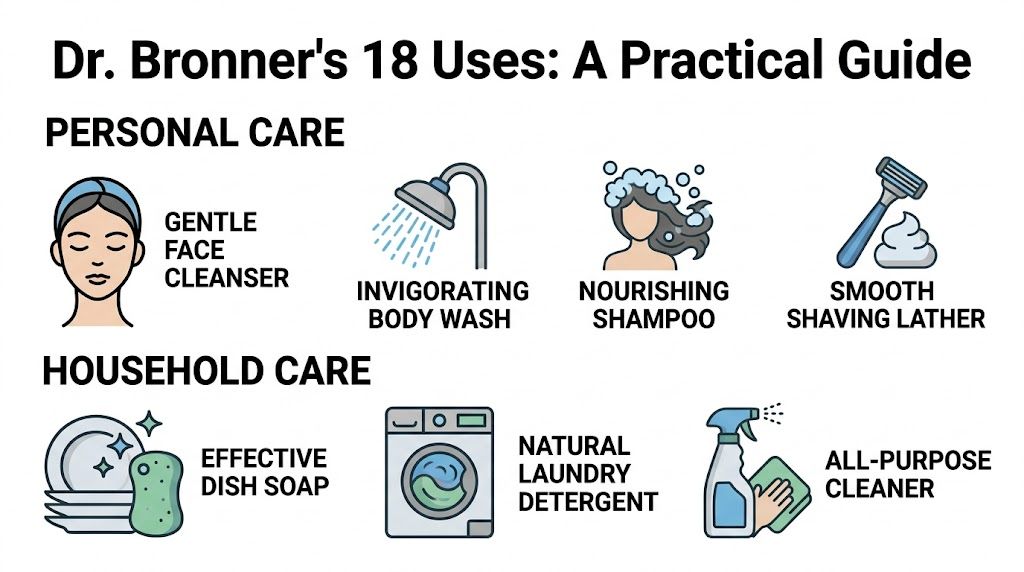
A practical way to train staff is to group the uses into three sales buckets: personal care, household cleaning, and laundry or fabric care. That keeps the conversation structured and reduces the risk of overpromising.
Personal care uses that staff should know cold
For skin and hair, the strongest advice is simple. Start with less product than the customer expects.
Face wash
Recommend a few drops on wet hands. This suits minimalist shoppers, but staff should also note that highly reactive or impaired skin barriers may prefer a gentler dedicated facial cleanser.Body wash
A small amount is usually enough. The formula is concentrated, so adding more product rarely improves the wash experience.Shampoo
This can work well for customers who want a stripped-back routine, especially when they understand that hair feel depends heavily on water hardness, hair type, and rinse technique.Shaving
It provides slip when worked with water. It does not mimic a dense shaving foam, so the sale works best when that expectation is set before purchase.
That last point matters in Switzerland, where regional water hardness can change performance from one canton to another. Staff should describe the product accurately: versatile, concentrated, and effective with the right method.
Household uses with the clearest sales path
The household side often creates repeat purchase because customers can see the bottle replacing several separate cleaners. The strongest retail conversations stay focused on simple, believable use cases.
| Use Case | How to Position It | Staff Guidance |
|---|---|---|
| Hand soap | Daily sink-side use | Encourage dilution in a dispenser for better control and economy |
| Dishwashing | Manual dish cleaning | Best for shoppers who want one formula across kitchen tasks |
| All-purpose cleaning | Counters and general wipe-downs | Recommend a labelled diluted bottle for home use |
| Delicates | Hand-washing smaller items | Position for occasional garment care, not as a specialist textile system |
| Travel | One bottle across multiple needs | Strong fit for gym bags, cabins, and short trips |
Avoid presenting every household use as identical in performance to a purpose-built specialist cleaner. Customers respond better to a clear trade-off. One concentrated soap can cover many daily tasks, but the method matters, and some customers will still prefer dedicated products for specific jobs.
Laundry needs the most careful explanation
Laundry is where poor guidance creates the most disappointment.
Dr. Bronner's can appeal to customers who want ingredient simplicity and lower product clutter, but staff should explain the process in plain terms. The wash routine may include an acidic rinse step to improve feel and help manage mineral interaction. That point is especially relevant in parts of Switzerland with harder water. If a shopper wants a standard detergent experience with no method change, a specialist laundry product may be the better recommendation.
That is good retail practice. It protects trust, reduces returns, and helps the customer choose the right use case for their routine.
How to present the “18 uses” without overwhelming the shopper
A better in-store script is narrow and specific.
Start with the purchase trigger
Ask what they want the bottle to replace first. Shower gel, hand soap, dish soap, or travel-size products are the easiest entry points.Add one realistic second use
If they came in for body wash, suggest hand soap or gym bag travel use. If they came in for home care, suggest dishes before laundry.Give usage guidance at shelf or at handover
Printed staff notes, shelf talkers, or QR-based instructions all work, as long as the advice is brief and consistent.Match the message to the price conversation
Concentration supports the premium, but only if the customer understands how long the bottle can last in real use. Retail teams reviewing margin structure can sharpen that discussion with guidance on how to price products for retail.
The most reliable recommendations by retail channel
Pharmacy
Lead with handwashing, body wash, and Baby Mild for cautious first-time buyers.Boutique
Focus on shower use, travel convenience, and one-bottle simplicity for small living spaces.Spa or hotel retail
Position it around weekend bags, chalet stays, and practical packing.Online
Put usage guidance high on the page. Swiss shoppers buying online often compare carefully, and they reward clarity.
“18-in-1” works best as a guided promise. Show the customer the first use that will work well in their home, with their water, and in their routine.
Merchandising and Selling Dr Bronner's in Switzerland
A customer walks into a Swiss pharmacy or concept store looking for one product that cuts clutter at home and still feels credible at the sink, in the shower, and in a travel bag. Your shelf has to answer that need fast. Dr. Bronner’s should read as a disciplined multi-use proposition, not as a novelty.
Where it sits in store matters, but the selling job is really about category framing. In Switzerland, the bottle can belong to personal care, travel, giftable eco living, or selected household adjacencies, depending on the outlet and the claims you can support at point of sale.

What to highlight on shelf
Swiss shoppers usually respond to four selling cues. Multi-use. Concentration. Recognised standards. Practical instructions.
Keep the proof points disciplined. Dr. Bronner’s publishes annual business and impact reporting in its 2022 statistics report, which buyers can use to verify company scale and giving commitments. For international footprint, Dr. Bronner’s also states its availability across more than 40 countries. That matters in a Swiss buying conversation because it shows the brand is established globally, while still requiring local claim control in-store.
Do not let the shelf message drift into broad lifestyle language. Swiss retail works better with plain benefits and clear usage boundaries.
Effective placement ideas
Primary placement should match the store’s strongest traffic mission.
Pharmacy or apothecary
Place it with natural wash products or sensitive-skin led body care. Baby Mild usually deserves first visibility because it lowers trial resistance.Organic or eco store
Give it a main home in body care, then support it with a secondary placement near low-waste household lines if your staff can explain appropriate uses accurately.Travel, outdoor, and concept retail
Build around carry-light convenience. Weekend bags, cabin luggage, gym kits, and chalet stays are concrete Swiss use cases that convert better than generic “18 uses” messaging.Department store or premium boutique
Keep the display tight and orderly. Too many claimed uses on one sign can make the product look unfocused.
POS copy that helps staff sell
Good shelf copy reduces the explanation burden without creating compliance risk. Use short lines that tell the shopper what the bottle is, who it suits, and why the price is higher than a standard liquid soap.
Examples that work:
- Concentrated castile soap for selected body, hand, and home uses
- One bottle. Clear dilution guidance. Less clutter at home
- A multi-use soap for travel, guest bathrooms, and everyday washing
- Premium price, slower usage when diluted correctly
For retail teams reviewing pack sizes, margin, and price ladders, Market Edge’s guide on how to price products for retail is a useful reference.
Match the message to the customer
The same bottle should not be sold with the same script in every Swiss channel. A family shopping in a pharmacy wants reassurance. A design-led boutique customer wants simplification. An outdoor customer wants pack efficiency.
| Customer type | Best entry point | Staff angle |
|---|---|---|
| Eco-conscious family | Fewer products around the home | Practical reduction of bottle count, with clear instructions |
| Minimalist shopper | One bottle for daily basics | Convenience, concentration, less bathroom clutter |
| Outdoor customer | Travel, hiking, gym, short stays | Light packing and flexible use on the go |
| Sensitive-skin shopper | Baby Mild or the gentlest option available | Care-first advice, patch-test mindset, no exaggerated promises |
Strong merchandising makes first purchase easier. Strong staff guidance is what earns the refill, the larger size, or the second scent.
Navigating Swiss Regulations and Local Conditions
A customer in Zürich buys one bottle for the shower, sink, and weekend travel kit. Two days later, the feedback depends less on the global promise and more on local execution. Was the use explained clearly, was the right variant recommended, and did the customer use it in Swiss tap water without overapplying it?
That is the retail reality in Switzerland. Dr. Bronner’s can perform well here, but the selling script needs local discipline.
Global messaging needs Swiss review before it reaches shelf
Do not copy international product copy into Swiss retail materials without checking every claim. Switzerland is a high-trust market with low tolerance for vague eco language, loose certification shorthand, or implied dermatological promises that are not supported in your file.
For trade partners, the practical rule is simple. Keep claims tied to documentation you hold. That includes INCI presentation, certification wording, usage language, and any statement that could be read as a skin-tolerance or sustainability claim. If your team manages claim approvals, training records, or version-controlled product files across channels, LitPDF’s article on mastering 21 CFR 11 is a useful reference for disciplined digital documentation.
Swiss partners also ask sharper questions than many export markets. They may want to know how a multi-use soap should be presented under cosmetics rules, where household-use language becomes risky, or how to answer certification questions without overstating equivalence. Train for that level of scrutiny before launch, not after the first customer complaint.
Local water conditions affect user experience
This is the operational point many brands miss.
Dr. Bronner’s is a true soap, not a synthetic detergent wash. In hard water, true soap can lather less freely and leave more residue if the user applies too much or rinses poorly. That matters in Switzerland because hard water is common in many regions, and retailers should treat that as a sales-training issue, not as an afterthought. The Swiss Federal Office for the Environment provides the right regulatory context on water protection and local water management at bafu.admin.ch.
The customer does not need a chemistry lecture. Staff do need one practical sentence they can use: performance may feel different depending on local water hardness, so dilution, dose, and rinsing matter.
Skin suitability requires careful language
Avoid broad comfort claims for frequent undiluted use. A highly concentrated soap with an alkaline pH will not suit every routine, especially repeated facial cleansing, very frequent handwashing, or customers who already report a reactive skin history.
That does not make the product unsuitable. It means the recommendation must be specific. For cautious customers, start with the mildest option, advise dilution where appropriate, and avoid promising that one formula works the same way for every skin type and every use case.
A credible Swiss sales approach sounds measured. It gives the customer enough guidance to succeed on first use and avoids the kind of overclaim that drives returns.
What compliant, low-friction selling looks like in store
Present it as a concentrated soap
Staff should explain that the bottle is designed for measured use, not standard shower-gel dosing.Adjust advice to the use case
Handwashing, body use, and travel are easier entry points than encouraging every listed use on day one.Prepare staff for hard-water questions
Reduced foam does not always mean poor cleaning. Explain technique before the customer assumes the formula is failing.Use exact certification wording
If a customer asks about standards, quote the certification or claim as documented on pack or supplier materials.Keep pharmacy and natural retail scripts separate
A pharmacy shopper often wants tolerance guidance. A zero-waste shopper may care more about concentration and bottle reduction.
Clear instructions protect both conversion and compliance.
The strongest Swiss partners treat adaptation as part of the value proposition. They do not sell the bottle as a universal shortcut with no conditions. They sell it as a concentrated, versatile soap that works best when the user understands dose, dilution, and local water conditions. That is a stronger position in this market, and it is the one that holds up after the first purchase.
Answering Key Questions and Sales Objections
A customer in Zürich picks up the bottle, reads “18-in-1,” and then asks the two questions that decide the sale. Will it be effective here, and is it worth changing from what they already use. Staff need clear answers that are realistic for Swiss conditions, especially hard water, higher price sensitivity in premium retail, and stricter expectations around product claims.
Will it work in Swiss hard water
Yes, with the right expectation setting.
Dr. Bronner’s is a true soap, so minerals in hard water can reduce lather and leave more visible residue than a synthetic body wash or detergent-based cleanser. In many Swiss households, that is the primary reason for the concern. The product still cleans, but the user may need less product, better rinsing, and in some cases an acidic rinse for household applications where soap scum becomes noticeable.
The staff answer should stay practical. “Yes, but Swiss hard water can change the feel. Start with a small amount, rinse well, and adjust the method if you see residue.”
Is it suitable for sensitive skin
Handle this carefully and stay inside what the pack and supplier materials support.
The safest recommendation for a cautious customer is the Baby Unscented variant, because it avoids added fragrance and gives staff a cleaner first recommendation for customers who are reactive, buying for children, or trying the brand for the first time. That is a retail recommendation, not a medical claim. Staff should avoid promising that any soap will suit every sensitive skin customer.
A better script is simple. “Baby Unscented is usually the best starting point if you want the mildest option in the range. Use it diluted and patch test first if you are very sensitive.”
Why is it priced above ordinary soap
Price resistance usually drops once the customer understands what they are comparing.
This is not positioned against a standard ready-to-use shower gel on pack size alone. It is a concentrated castile soap with multiple practical uses, a strong ethical sourcing story, and certifications that matter to natural channel shoppers. The trade-off is equally important to say out loud. It asks more from the user. They need to dose it properly, choose the right application, and accept that one product will not outperform a specialist formula in every task.
That answer tends to build trust faster than a hard sell.
Can it replace my normal laundry detergent
For some customers, yes. For others, no.
It can suit customers looking for a lower-fragrance, multi-purpose option who are willing to follow dilution instructions and adapt for water hardness. It is a weaker recommendation for shoppers who expect the convenience and stain performance of a dedicated detergent, wash technical fabrics, or want a plug-and-play solution with no adjustment. In Swiss retail, that distinction matters because returns often come from expectation mismatch, not product defect.
Quick objection-handling lines for staff
For hard water
“It works, but hard water can reduce lather. Start with a small dose and rinse thoroughly.”For sensitive skin
“Choose Baby Unscented first and keep the use diluted, especially on first trial.”For value concerns
“You are buying a concentrate with several uses, not a standard ready-to-use wash.”For scepticism about the 18 uses
“Start with one use you already need, such as hands or body, then decide if you want to expand.”For laundry questions
“It can work for the right customer, but it does not replace every specialist detergent.”
Precision closes the sale more effectively than enthusiasm. In Switzerland, the partner who explains the limits as clearly as the benefits usually wins the repeat purchase.
If you're building a stronger Swiss assortment around ethical, multi-purpose beauty and wellness brands, beautysecrets.agency can help with brand selection, trade support, and market-ready guidance for pharmacies, boutiques, spas, and premium e-commerce partners.