Scar care cream isn't a fringe add-on any more. Creams held 36.2% of the global topical scar treatment market in 2025, the largest product segment in a market estimated at USD 1,883.3 million in 2025 and projected to reach USD 4,686.7 million by 2033 at a 12.1% CAGR, according to Grand View Research's topical scar treatment market analysis.
For Swiss pharmacies, spas, and premium retailers, that matters for one simple reason. Customers don't walk in asking for “topical scar treatment market share”. They ask for something that feels safe, credible, easy to use at home, and compatible with a clean beauty routine. Scar care cream sits exactly at that intersection.
The partners who handle this category well don't treat it like a side shelf next to antiseptics. They treat it as a trust category. A good recommendation can support post-procedure care, acne recovery, postpartum skin concerns, burn aftercare once skin is closed, and the persistent dark marks clients often describe as “scars” even when texture is minimal. That mix of concerns is why the category deserves sharper curation than it usually gets.
The Growing Opportunity in Professional Scar Care
Swiss customers already understand premium skincare. What they often don't get from mass retail is nuanced guidance. Scar care cream gives pharmacies and spas a chance to offer that guidance in a format customers are comfortable buying over the counter.
Cream's category leadership is not accidental. It reflects convenience, non-invasive use, and the fact that this is a home-care product people can apply consistently without equipment or clinic visits. In Swiss pharmacy and dermocosmetic channels, those are exactly the qualities that turn a product from occasional purchase into a considered staple.
Why this category is bigger than post-surgery care
Scar concerns come from many directions. Surgery is one. Acne, burns, minor trauma, aesthetic procedures, and inflammatory skin episodes all feed demand. That broad entry point changes how partners should merchandise and advise.
A scar cream display that only speaks to surgical recovery is too narrow. A stronger assortment speaks to:
- Texture concerns after incisions or injury
- Colour concerns such as lingering red or dark marks
- Comfort needs once skin has closed and feels tight or dry
- Routine compliance for customers who want simple home use
Practical rule: The strongest sellers in scar care are usually the products staff can explain clearly in under a minute.
Trust grows when advice is specific
Customers rarely need hype here. They need timing, reassurance, and realism. Raised scars don't respond the same way as shallow pitted acne marks. Fresh closed incisions don't need the same advice as older hyperpigmented marks. Retailers who understand that difference usually see fewer returns, better compliance, and stronger repeat business.
For surgical customers, it also helps to align product advice with broader recovery education. Dr. Fater's insights on scar prevention are useful because they reinforce a point professionals should repeat often: outcomes improve when prevention starts early and care is consistent.
Understanding Scar Types and the Healing Timeline
Before recommending any scar care cream, read the scar in front of you. Not every visible mark is the same biological problem, and not every product should be expected to do the same job.
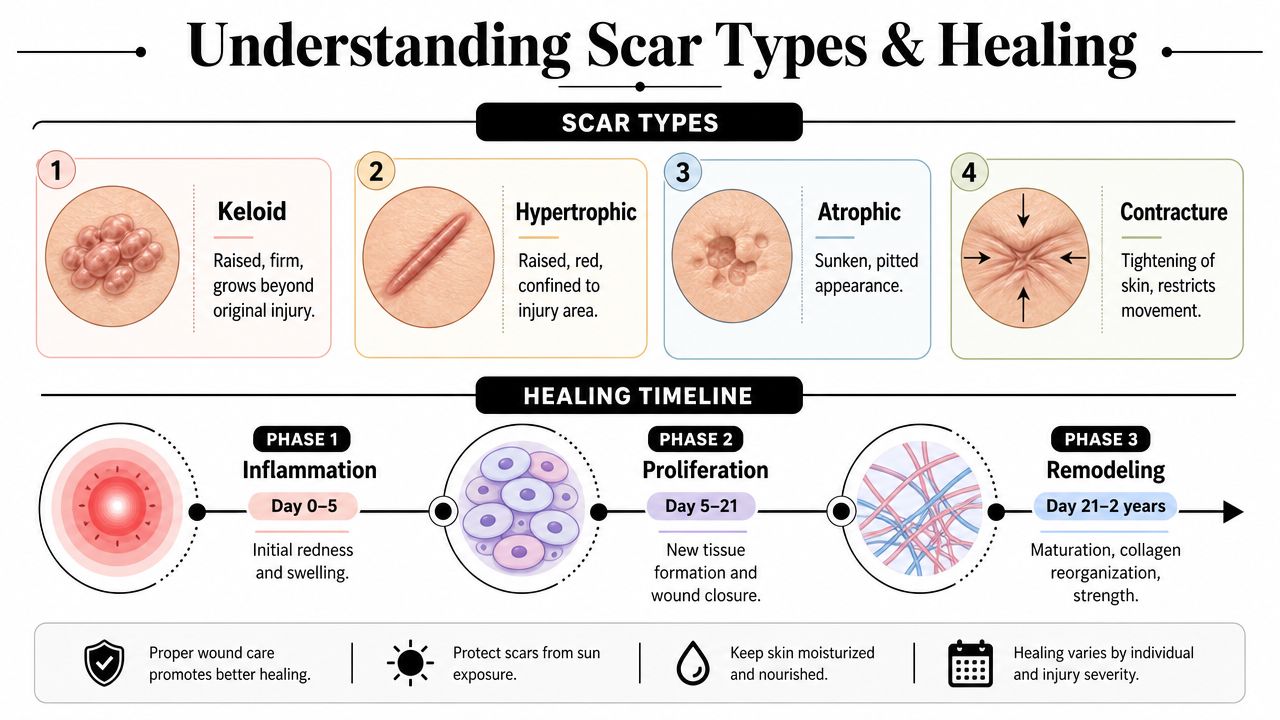
How to recognise the main scar patterns
Atrophic scars sit below the surrounding skin. Acne marks are the classic example. They look pitted or indented because the skin didn't rebuild enough supportive tissue during healing. A cream can help the skin environment and appearance, but partners should be careful not to imply that a topical alone can rebuild deep structural loss.
Hypertrophic scars are raised, often red, and stay within the boundary of the original wound. Think of a line scar that becomes thick and prominent but doesn't spread into neighbouring skin. This is one of the most relevant scar types for silicone-based topical care.
Keloid scars are also raised, but they extend beyond the original injury. They can keep enlarging outside the wound line and may need medical assessment rather than a retail-only solution. In these situations, staff should feel confident saying, “This deserves dermatologist or physician input.”
Contracture scars develop when skin tightens after more extensive injury, often affecting movement and comfort. In retail settings, these customers usually need supportive care plus clinical follow-up.
The healing timeline underneath the surface
A scar tells the story of wound healing. Understanding the stages helps staff explain why timing matters so much.
Inflammation
The area is red, swollen, and active. The body is cleaning up damage and protecting the site. This is not the moment for a scar cream on an open wound.Proliferation
The skin starts building new tissue and closing the gap. Collagen is laid down quickly, but it is not yet organised neatly.Remodelling
This is the long phase. Collagen fibres reorganise, the scar slowly matures, and texture and colour evolve over time.
A scar that looks “worse” before it looks better is often following a normal remodelling pattern, not failing treatment.
What professionals should ask before recommending a product
A short consultation at the shelf or treatment desk can prevent poor recommendations. Ask:
- Is the skin fully closed? If not, don't move into scar appearance management yet.
- Is the main complaint raised texture, tightness, redness, or darkening?
- Did the mark come from acne, surgery, a burn, or trauma?
- Is the scar staying within the wound line, or spreading beyond it?
- Is the area under movement or tension, such as a joint, abdomen, shoulder, or face?
Those answers point the customer in very different directions. Raised, closed, recent linear scars often suit silicone-focused support. Flat but dark marks may need pigment-focused care. Deep pitted scars need expectation-setting from the start.
The retail value of getting classification right
When staff can distinguish a raised scar from a pigmented mark, the conversation becomes more credible. That's where pharmacy and spa channels can outperform general e-commerce. The customer doesn't just buy a cream. They leave with a clearer idea of what their skin is doing, what's realistic, and when to seek medical help.
The Evidence Behind Key Scar Cream Ingredients
Published scar data tends to cluster around a small number of ingredients, and that matters for buying decisions. A pharmacy or spa can stock ten scar creams that look credible on shelf, yet only a few rely on ingredients with consistent scar-focused evidence.
For assortment planning, the first screen is simple. Separate products built around silicone from products that are mainly moisturisers with a scar claim. That single distinction usually predicts whether the formula is designed for scar management or for general skin comfort.
Silicone is the benchmark
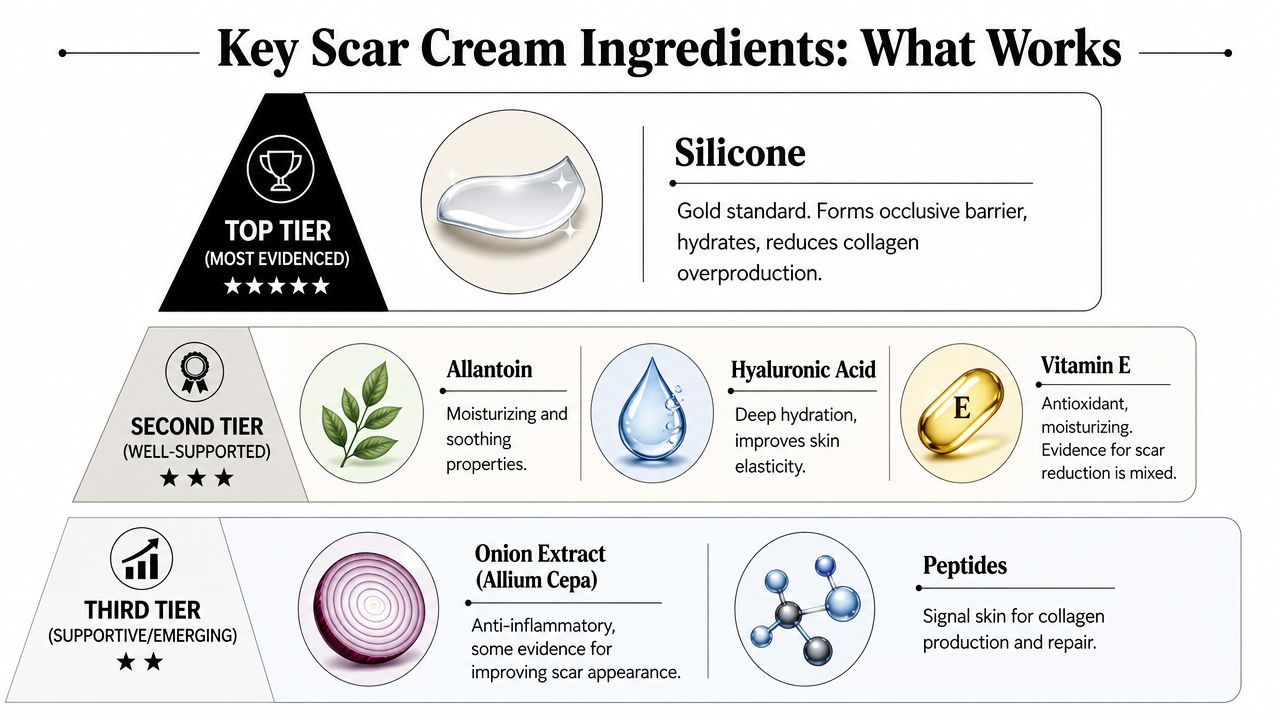
Topical silicone still sits at the centre of evidence-based scar care. A peer-reviewed review found that silicone gel improved postoperative scar outcomes versus placebo or no treatment, including pigmentation, height, and pliability, with clearer benefits appearing over longer use, as outlined in this PMC review of topical silicone gel in scar management.
That is useful at shelf level because it gives teams a defensible starting point. Silicone supports scar improvement through occlusion and hydration control. It helps reduce transepidermal water loss and creates conditions that can improve softness, flattening, and comfort over time. It is less exciting than many botanical stories, but the evidence base is stronger.
Here is the ingredient hierarchy worth showing staff during training.
What a serious silicone formula looks like
Ingredient lists help separate a true scar product from a comfort cream. An OTC example from DailyMed lists dimethicone 3% as the active, alongside ascorbic acid 1%, tocopherol 0.2%, panthenol 0.2%, and allantoin 0.2%, as shown in this DailyMed scar gel monograph.
For retail partners, that formulation pattern has practical value. Silicone does the primary scar-focused work. The supporting ingredients improve feel, tolerance, and routine acceptance. In Swiss pharmacy and spa settings, compliance often depends as much on cosmetic elegance as on claim language. A product that pills, shines too much, or feels greasy may be clinically rational and still underperform commercially because customers stop using it.
Supportive ingredients and where they fit
Supportive ingredients still matter, but they should be positioned correctly. Allantoin is a good example. A second DailyMed reference shows allantoin 0.5% in an OTC scar gel labelled for temporary protection of minor cuts, scrapes, and burns, as illustrated in this DailyMed allantoin scar gel listing.
That does not place allantoin in the same evidence tier as silicone for raised scar reduction. It places it in the supportive tier. It can improve comfort, reduce irritation risk, and make a formula easier to use consistently. For trained staff, that distinction improves recommendation quality and helps avoid overclaiming.
Peptides sit in a similar discussion, but with a different commercial risk. They attract interest because they fit the language of repair and regeneration, and they can support a premium positioning. Still, for raised, recent, or postoperative scars, they should not displace silicone-led products as the first recommendation. For teams who need a plain-language explainer for client conversations, GHK-Cu peptide for skin and hair gives useful context on why peptides are discussed in repair-focused formulations, even though the scar-specific evidence base is not equivalent to silicone.
Comparing the ingredient logic
| Ingredient | Primary Mechanism | Level of Evidence (for scar reduction) |
|---|---|---|
| Silicone | Occlusive barrier, hydration support, reduces transepidermal water loss | Strongest support in this category |
| Allantoin | Skin protectant, soothing, barrier comfort | Supportive rather than primary |
| Vitamin C | Antioxidant support, collagen-related role, helps with overall scar quality | Useful in broader scar routines |
| Niacinamide | Helps with inflammation and uneven tone | More relevant for discoloration concerns |
| Azelaic acid | Targets dyschromia and post-inflammatory marks | More relevant for pigmentation-prone cases |
| Onion extract | Often positioned for appearance support | Evidence is less central than silicone |
| Peptides | Repair-oriented signalling concept | Emerging or supportive, not benchmark |
What usually underdelivers
Oil-rich balms, botanical creams, and natural repair salves can be good adjuncts. They can soften dry skin, improve massage slip, and appeal to customers who want a cleaner profile. But if the formula lacks a well-supported scar-active ingredient, partners should not present it as equivalent to a silicone-led scar treatment.
That trade-off comes up often in clean-beauty curation. A natural-looking pack and a long plant list can sell quickly, yet repeat purchase depends on whether the customer sees change in the concern that brought them in. For raised or firm scars, evidence should lead the assortment. For comfort, barrier support, and sensory appeal, supportive ingredients can then add value without confusing the product's role.
Buying rule for partners: If a brand makes strong scar claims, identify the ingredient doing the scar-specific work. If that answer is unclear, the claim usually is too.
Addressing Post-Inflammatory Hyperpigmentation
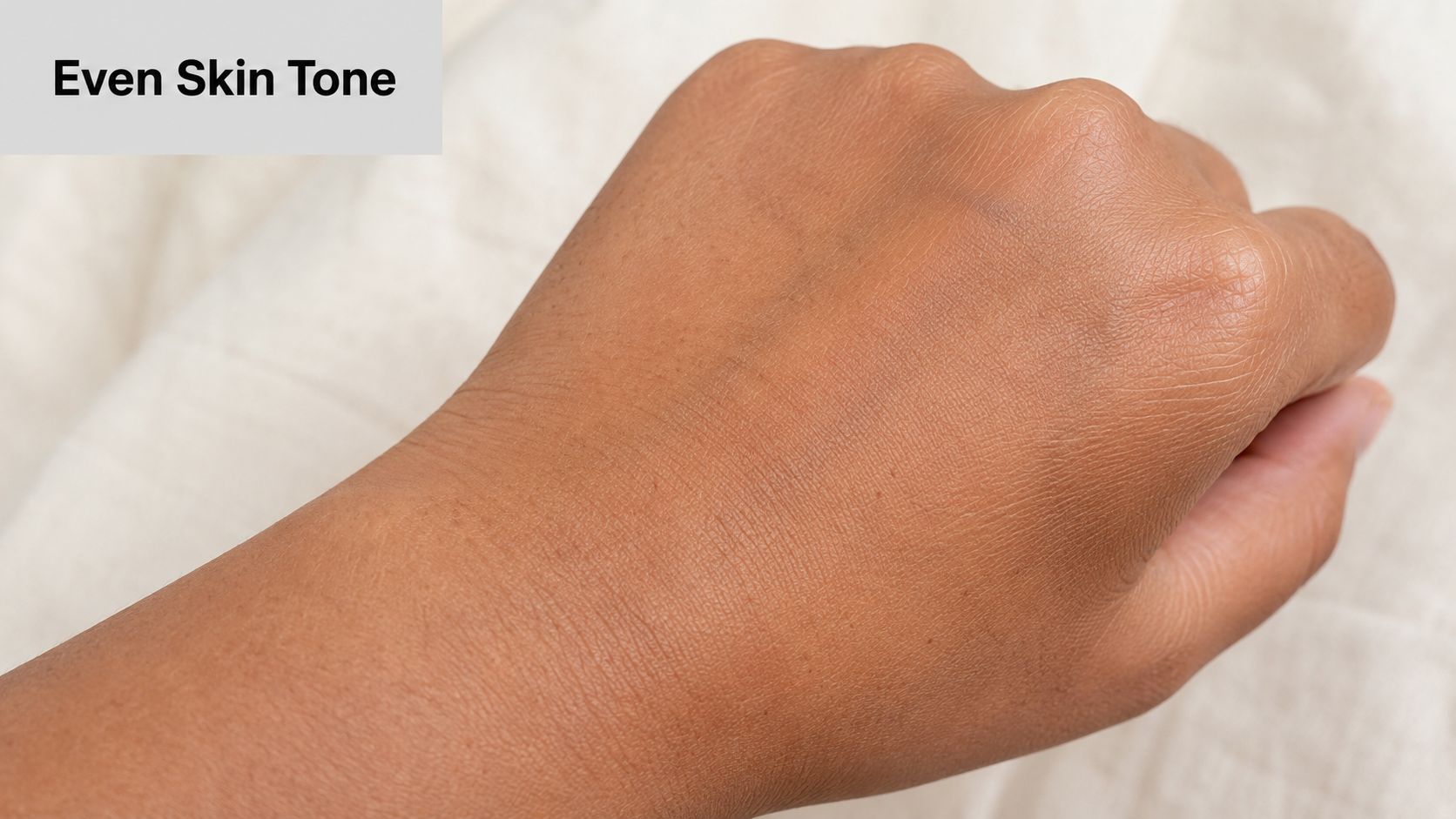
Many customers say “scar” when the bigger issue is colour, not texture. The mark is flat, but it stays red, brown, or uneven long after the skin has closed. If staff recommend only silicone in those cases, they may miss the customer's real concern.
That matters especially in darker skin tones and in anyone with a tendency towards post-inflammatory hyperpigmentation. A scar can soften nicely and still remain cosmetically distressing because the pigment problem was never addressed.
Texture is only half the story
An evidence review on facial scars notes that niacinamide and azelaic acid are well-tolerated options for inflammation and dyschromia, and that topical vitamin C may support collagen synthesis and improve scar quality. It also highlights that these ingredients are especially relevant when adapting scar care to diverse skin tones, as discussed in this PMC review on topical management of facial scars.
That gives retail teams a more inclusive framework:
- If the scar is raised or firm, think first about texture management.
- If the scar is flat but dark, think about pigment pathways.
- If both are present, the routine may need more than one product category.
Ingredients that deserve shelf space
Niacinamide works well in pharmacy and spa retail because customers usually tolerate it well and understand it as a familiar skincare active. In scar routines, it makes sense for clients dealing with uneven tone after acne, irritation, or minor injury.
Azelaic acid suits the customer who says, “The bump is gone but the mark won't fade.” It belongs in staff education even if the product is sold in a more general brightening or blemish-aftercare category.
Vitamin C is useful when you want one conversation to bridge scar quality and brightness. It also fits naturally into premium skincare merchandising because clients already associate it with radiance and skin recovery.
Don't force one product to do every job. A scar cream may improve texture, while a pigment-focused serum handles the mark the customer actually notices in the mirror.
How to advise without overpromising
The wrong message is “this removes scars”. The better message is more precise: “This supports the visible quality of a closed scar, and if colour is your main concern, we should choose ingredients for that specifically.”
For Swiss pharmacy teams, this is also a service differentiator. Many customers with darker skin tones have learned to be sceptical because standard scar advice often ignores pigmentation risk. Staff who can name that concern and adjust the recommendation immediately build trust.
A Practical Guide to Application and Duration
The product matters. The protocol matters just as much. A strong scar care cream used inconsistently, started too early, or applied to the wrong type of wound often gets blamed for disappointing results.
The simple rule is this: start when the skin is fully closed, then stay consistent long enough for remodelling to happen.

When to start and what to look for
Scar care cream is for closed, re-epithelialised skin. If the area is still open, weeping, crusted, or actively irritated, the customer is not yet in the scar-management phase.
This distinction sounds basic, but it is where many routines go wrong. Staff should describe the transition clearly. The moment the wound is closed and the care goal shifts from protection to scar optimisation, that's when scar cream becomes relevant.
How to apply it in a way customers will follow
Most customers do better with a simple protocol than a complicated one. In practice, the advice should sound like this:
Clean the area gently
The skin should be clean and dry before application.Use a thin layer
More product doesn't improve outcomes. It usually just makes compliance worse.Massage lightly if appropriate
Gentle application can improve acceptance and make the routine feel intentional, but the area shouldn't be irritated.Apply consistently
The most evidence-aligned approach for topical silicone products is regular, repeated use over time.Review after several weeks
If the scar is worsening, spreading beyond the original wound, or causing concern, the customer should be referred onward.
Why duration is where most routines fail
An evidence-based scar routine asks for patience. Extended and consistent use of silicone-based products is important for reducing erythema and thickness, and for new incisions, tension management also matters because it addresses a root cause of raised scarring before it starts, as explained by Embrace Scar Therapy's guidance on scar prevention and tension relief.
In practice, this means staff should prepare customers for months, not days. Short bursts of use rarely match how scars remodel. The customer who applies a product faithfully for a brief period and stops too soon may conclude that “nothing works”, when the issue was duration rather than product choice.
Tell customers what success looks like early: less redness, softer feel, flatter profile, and gradual improvement rather than a sudden disappearance.
Cream is not always enough
Areas under mechanical stress often scar more visibly. Think shoulders, chest, abdomen, knees, or any incision pulled by movement. In those cases, a cream may support the surface environment while tension relief, dressing strategy, or medical follow-up addresses the deeper mechanical problem.
That is where professional advice becomes more than a product recommendation. It becomes risk management. Customers appreciate that honesty, especially after procedures.
How to Curate a Clean and Natural Scar Care Selection
“Clean” is easy to say and hard to define. In scar care, the term shouldn't mean “full of botanicals and free from everything else”. It should mean the formula is transparent, non-irritating, fit for purpose, and honest about what it can do.
That standard protects both your customer and your assortment.
Start with function, then assess philosophy
A clean-looking pack does not make a formula suitable for scar care. Buyers should first ask what the product is designed to do. Is it a silicone-led scar management product for closed scars? Is it a soothing skin protectant? Is it a general balm that may comfort dry skin but lacks a strong scar-specific mechanism?
Once the product's role is clear, then assess the brand's wider philosophy:
- Ingredient transparency should be easy to verify
- Intended use should be clearly stated
- Formula tolerance matters more than trend alignment
- Claims discipline is a sign of a serious brand
What to screen for during range reviews
A practical buying checklist helps. Use questions like these with every prospective brand:
- What is the hero mechanism? If the answer is “natural repair” without specifics, keep digging.
- Is the formula likely to irritate healing or recently healed skin? Fragrance-heavy products deserve caution.
- Does the packaging and training material distinguish open wound care from closed scar care?
- Are certifications relevant and current? ECOCERT, cruelty-free commitments, and ethical sourcing can strengthen trust when they are genuine and documented.
- Can your staff explain the product in plain language? If not, the range may be too confusing for retail success.
Natural doesn't excuse weak positioning
Some botanical-rich creams belong in the assortment, but not always in the scar section. A comforting balm may perform beautifully in post-treatment hydration, body care, or multi-use repair. That doesn't automatically make it the right recommendation for a raised post-surgical scar.
Category discipline is important. Keep the scar shelf focused on products that either:
- have a clear scar-management rationale,
- address discolouration linked to healed marks,
- or support comfort and barrier quality with honest positioning.
A well-curated shelf is narrower than most buyers think. Fewer products, better explained, usually outperform a crowded display with overlapping claims.
Clean retail works best when it is clinically literate
Pharmacy and spa customers are increasingly comfortable with products that combine natural positioning and evidence-based actives. They don't need a false choice between clinical and clean. They need brands that respect both.
That gives Swiss retailers a strong positioning opportunity. Stock fewer “miracle scar” products. Stock more formulas whose purpose, texture, tolerance, and mechanism your team can explain without guessing.
Merchandising and Messaging for the Swiss Customer
Swiss customers make fast judgments at shelf level. In scar care, the first few seconds often determine whether they ask for advice, compare products, or walk away.
For pharmacies and spas, that makes merchandising a clinical task as much as a retail one. The range should help customers identify their concern quickly, while giving staff a clear route to a precise recommendation. Group products by use case before brand. A customer looking for support after surgery, acne, or postpartum recovery should not have to decode the assortment alone.
Where scar care cream should sit in store
Scar care usually sells better beside the need state that triggered the purchase than in a broad “skin problems” block. That is especially true in Swiss pharmacy, dermocosmetic, and premium spa environments, where customers expect orderly logic and credible guidance.
Useful adjacencies include:
- Post-procedure and dermocosmetic care for surgery, in-clinic treatments, and referral-led recommendations
- Acne aftercare for flat residual marks and facial discolouration concerns
- Maternity and recovery care where C-section or body-related scar needs are relevant
- Wound-care transition areas for customers ready to move from first aid to scar management once the skin has closed
Online, the same rule applies. Build category pages around concerns and recovery stages, not only around brands or ingredient families.
Staff language that builds confidence
Good staff training in this category depends more on accuracy than volume. Teams need short phrasing that separates scar type, timing, and expected outcome without sounding scripted.
Useful language includes:
“If the skin has closed and the scar feels raised, a silicone-led option is usually the clearest place to start.”
“If the mark is flat and your main concern is colour, we should look at pigmentation support rather than scar texture alone.”
“This product can support scar appearance, but you will need regular use for several weeks before you can judge the result properly.”
That kind of wording protects trust. It keeps the recommendation realistic, matches the product to the concern, and reduces returns driven by poor expectation-setting.
Messaging that fits Swiss customer expectations
Swiss customers tend to respond well to disciplined communication. They want clear use cases, credible reasoning, and quality signals that support the formula rather than distract from it.
Three principles work well in practice.
First, be specific about indication. State whether the product is intended for raised scars, newer closed scars, discolouration after acne, or comfort and barrier support during recovery.
Second, keep the evidence language measured. Explain why silicone has a defined role, why pigment-focused actives may suit flat dark marks, and why some natural balms are better positioned as supportive care than primary scar treatment.
Third, use quality cues carefully. Clean sourcing, ethical standards, and certification help close the sale once the efficacy story is coherent. They rarely rescue a vague claim.
For shelf talkers, tester cards, and product detail pages, a simple structure works well:
- Who it suits
- When to start
- What it is designed to improve, such as texture, colour, or comfort
- How long to use before reassessment
The retail advantage of precise claims
Overwritten scar messaging weakens conversion. If one shelf card promises smoothing, fading, repairing, renewing, brightening, and restoring at the same time, customers often read it as marketing rather than guidance.
Precise language sells better. “Silicone support for closed, raised scars” is easier for staff to recommend, easier for customers to remember, and easier to defend if questions arise.
That precision also improves assortment performance. A tighter selection with distinct roles usually outperforms a larger range filled with overlapping claims. In wholesale reviews, I see the same pattern repeatedly. The retailers who win in this category are the ones whose teams can explain why each SKU is there, who it suits, and when it should be used.
If you are reviewing a scar care assortment for Swiss pharmacies, spas, or premium retail, beautysecrets.agency can support range evaluation, brand selection, and positioning around natural, ethically sourced, clinically credible skincare.