Most advice on teeth whitening strips starts in the wrong place. It starts with shade change, convenience, or celebrity-style before-and-after promises.
For a Swiss retailer, the first question isn't whether teeth whitening strips are popular. It's whether the product is legal to sell, safe to recommend, and credible enough to fit a premium assortment. In Switzerland, that changes the whole conversation.
A strip can look elegant, feel modern, and perform well in another market, yet still create compliance risk in a Swiss pharmacy or clean-beauty store. At the same time, the category opens a useful commercial opportunity for retailers who understand formulation, sensitivity, and the growing demand for gentler alternatives. Customers don't just want whiter teeth. They want guidance they can trust.
The Retail Opportunity in Teeth Whitening
Teeth whitening strips sit at the intersection of beauty, oral care, and wellness. That makes them commercially attractive, but also easy to mishandle.
A customer often walks in with a simple request. They want an at-home product that feels easier than booking a dental appointment and more targeted than a whitening toothpaste. On the shelf, strips seem to answer that need. They look compact, premium, and straightforward.
Why this category is different in Switzerland
In Switzerland, the category isn't just about cosmetic appeal. It's about regulatory fit and retail responsibility.
Imported whitening strips often arrive with packaging and claims designed for other markets. Staff may assume that if a product is widely sold abroad, it must also be suitable for Swiss OTC retail. That assumption can cause problems. A retailer needs to check the active system, the legal classification, the concentration limits, the claims language, and whether the product belongs in a pharmacy, a beauty boutique, or only in a professional channel.
That complexity creates an opening for better retail practice.
Where smart retailers gain an edge
The strongest sellers in this space don't behave like passive stockists. They act like informed curators.
They do three things well:
- They filter assortments carefully. They don't confuse international popularity with Swiss suitability.
- They train teams to explain differences. Staff can tell the difference between peroxide-based strips, peroxide-free formats, and softer maintenance products.
- They merchandise by need state. Customers with staining concerns, sensitivity concerns, and clean-label preferences don't need the same recommendation.
Retail reality: A whitening product doesn't earn trust because it looks premium. It earns trust when the retailer can explain what it is, how it works, and where its limits are.
Why advisory selling matters
This category rewards conversation. Customers often ask the same practical questions. Will it hurt? Will it work on coffee stains? Can I use it if my teeth are sensitive? Is it safer to choose a natural option?
A retailer who answers clearly can move the sale from impulse purchase to considered purchase. That's good for reputation and good for repeat business.
For Swiss pharmacies, drugstores, spas, and clean-beauty retailers, teeth whitening strips aren't just a trend item. They're a test of category discipline. Done well, they support premium positioning. Done poorly, they create confusion fast.
How Teeth Whitening Strips Actually Work
Most teeth whitening strips use a simple delivery format. A thin flexible strip holds a whitening gel against the tooth surface for a fixed period. The strip isn't the active part. It's the carrier.
Peroxide strips and the stain-lifting process
With traditional strips, the active ingredient is usually hydrogen peroxide or carbamide peroxide. Both work through oxidation.
A useful way to explain this to staff is to compare it with lifting a stain from a delicate fabric. You don't scrape the stain off. You use a chemical process that breaks the coloured material into smaller, less visible fragments. On teeth, peroxide does something similar. It interacts with stain molecules and makes them less noticeable.
Many customers think whitening strips "sand" the teeth, making proper explanation essential. Properly formulated strip systems don't work like a scrub. They work chemically.
What customers usually misunderstand
People often confuse two different things:
- Surface cleaning
- Colour lightening
A whitening toothpaste mainly helps remove external buildup and fresh surface staining. A strip is designed to sit on the teeth long enough for its actives to address discolouration more directly.
Another common confusion is the difference between stains on natural teeth and dental restorations. Strips are aimed at natural tooth surfaces. They won't reliably change the shade of crowns, veneers, fillings, or bonding in the same way.
Peroxide-free and enzyme-led alternatives
Not every strip relies on peroxide. Some peroxide-free products use alternative whitening chemistry, while others focus on stain loosening and optical brightening.
Natural-led formulas usually take a gentler route. Instead of aggressive bleaching, they may rely on ingredients that help loosen stain build-up or support cleaner-looking enamel through repeated use. Fruit-derived enzymes are the clearest example. Papaya and pineapple are often discussed in this context because their enzyme content is associated with protein breakdown. In oral care, that translates into a milder stain-management story rather than a dramatic bleaching story.
The distinction is important at shelf level. A peroxide strip aims for stronger chemical whitening. An enzymatic or botanical strip usually suits customers who value a softer profile, gradual change, or a cleaner ingredient story.
Here's a short explainer you can use in staff training:
- Peroxide strips address stain colour through oxidation.
- Peroxide-free strips usually focus on gentler stain release or cosmetic brightening.
- Natural enzyme systems are better positioned as mild alternatives, not direct substitutes for high-intensity bleaching.
This short video gives a useful visual overview of the format and how consumers use strips at home.
Why contact time matters
Strips work because they keep the active gel in close contact with the teeth. That's their key advantage over rinse-off formats.
If a customer asks why strips may feel more effective than a toothpaste, the answer is simple. The active stays where it's needed for longer. That doesn't automatically make every strip suitable for every user, but it explains why the format remains attractive.
The strip is a delivery tool. The formula, the active system, and the contact time determine what kind of whitening experience the customer gets.
The Swiss Regulatory Landscape for Whitening Products
In Switzerland, whitening is not a category where retailers can rely on foreign packaging claims. The legal threshold matters.
The key point is clear. The Swiss Cosmetic Ordinance (KVO) limits hydrogen peroxide to 0.1% in OTC products sold without dental supervision, while stronger use belongs in a professional setting. A linked summary of that issue also notes that a 2023 Swiss Dental Association survey found that 68% of pharmacies were unaware of enforcement gaps, with consumer sensitivity complaints tied to imported strips that exceeded the limit, as described in this discussion of whether teeth whitening strips really work.
What the KVO means in practice
For a retailer, the KVO isn't an abstract legal text. It affects daily buying decisions.
If a strip is sold over the counter in Switzerland, the peroxide content must fit the OTC rule. A product that sits comfortably in a US or UK beauty chain may not belong on a Swiss shelf. That includes strips bought through parallel import, marketplace channels, or distributors who haven't adapted their portfolio to Swiss requirements.
Many assortments often falter in this regard. Buyers focus on brand recognition, social media visibility, or attractive margin. They spend less time on classification and composition.
Why imported products create risk
Imported whitening strips are often marketed with phrases that sound familiar to consumers: fast results, advanced enamel-safe technology, professional strength, dentist-level whitening. None of those phrases tells you whether the product is suitable for OTC sale in Switzerland.
Retailers need to review more than the front pack.
A practical compliance check should include:
- Ingredient review: Confirm the active whitening system and whether hydrogen peroxide is present.
- Local suitability: Check whether the concentration fits Swiss OTC retail conditions.
- Claims discipline: Avoid claims that imply a medical or supervised treatment when the product is sold as a cosmetic.
- Supplier documentation: Ask for a compliance file, product information, and the basis for Swiss market placement.
The difference between consumer sale and supervised use
This point often confuses store teams. They hear that peroxide whitening is common in dentistry, then assume a similar product can sit in consumer retail.
It can't be treated that loosely.
Under the Swiss framework described above, there is a difference between a product intended for unsupervised OTC sale and one used under dental supervision. That distinction is central to assortment planning. If a buyer ignores it, the issue isn't only legal. It also affects customer safety, complaints handling, and insurance exposure.
Practical rule: If a whitening strip depends on a peroxide level that goes beyond OTC consumer limits, it shouldn't be merchandised like a normal self-selection beauty product.
What staff should say to customers
Frontline staff don't need to quote legal articles word for word. They do need a compliant script.
Useful language includes:
- For imported products: "Not every whitening strip sold abroad is suitable for Swiss over-the-counter retail."
- For peroxide questions: "The active system matters. In Switzerland, over-the-counter limits are strict."
- For stronger results: "If someone wants a higher-strength whitening approach, dental supervision is the appropriate route."
That script protects the customer and the store.
A better category strategy
The safest approach is to build the category from the regulation outward, not from trend demand inward.
Start with what is compliant. Then sort products by user profile:
| Assortment lens | What to check | Retail implication |
|---|---|---|
| OTC legal fit | Peroxide level and cosmetic status | Determines whether the product can be sold in general retail |
| Sensitivity profile | Formula intensity and usage instructions | Helps staff direct cautious users to gentler options |
| Premium positioning | Ingredient quality, claims restraint, packaging clarity | Supports pharmacy and clean-beauty credibility |
| Education need | Simplicity of explanation | Reduces misuse and avoidable complaints |
A Swiss retailer gains credibility by being selective, not by offering the broadest strip wall. In this category, fewer products with stronger compliance logic usually outperform a cluttered assortment.
Comparing Whitening Methods for Customer Guidance
Customers rarely compare teeth whitening strips only against other strips. They compare them against the whole whitening category.
That means staff need language that places strips in context. A customer wants to know whether strips are the right middle ground, too weak, too irritating, too complicated, or the most practical option for home use.
A useful way to position strips
Strips usually sit between two ends of the market.
On one side, there are low-intensity products such as whitening toothpastes. On the other, there are dentist-led services and customised tray systems. Teeth whitening strips appeal to people who want more focus than a toothpaste but less friction than booking clinical treatment.
That middle position is their commercial strength.
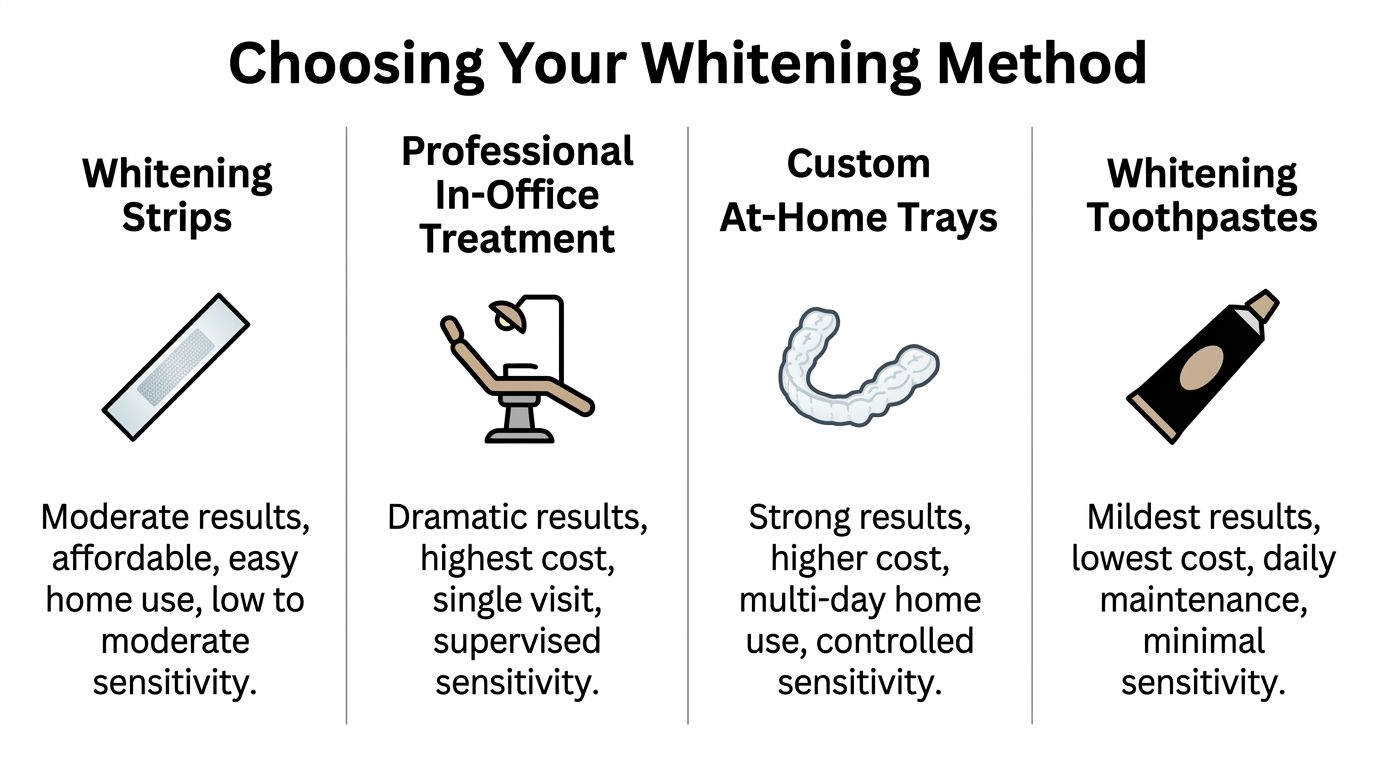
At-a-Glance Guide to Teeth Whitening Options
| Method | Average Cost (CHF) | Treatment Time | Typical Results | Best For |
|---|---|---|---|---|
| Whitening Strips | Varies by brand and formula | Short daily wear over a treatment cycle | Moderate visible brightening on natural teeth | Customers who want focused home whitening |
| Professional In-Office Treatment | Highest in the category | Usually appointment-based | Strongest and fastest visible change | Customers seeking supervised whitening |
| Custom At-Home Trays | Higher than standard retail products | Repeated home sessions using dentist-provided trays | Strong results with a more tailored fit | Customers who want home use with professional oversight |
| Whitening Toothpastes | Lowest entry cost | Daily ongoing use | Mild brightening and stain maintenance | Customers who want upkeep or a cautious starting point |
The cost column stays qualitative because pricing varies widely by clinic, channel, and formulation. For Swiss retail teams, the more useful skill is comparative guidance.
How to explain each option without overselling
Whitening strips
Strips are easy to understand and easy to use. That lowers the barrier for first-time buyers.
They work best when the customer has realistic expectations. They want a visible cosmetic improvement at home, and they're willing to follow a treatment routine. If they expect dramatic clinical change from a simple strip, staff should reset the frame early.
Professional in-office whitening
This is the option for customers who want stronger supervision and a more treatment-led experience. It isn't a retail substitute. It's a referral point.
A pharmacy or premium beauty retailer gains trust when staff can say, "For that level of result, a dentist is the better channel."
Custom at-home trays
These sit between clinic and home care. They usually appeal to customers who want a more personalized approach than an off-the-shelf strip can provide.
From a guidance perspective, trays are useful to mention because they help explain why fit matters. Some customers dislike strips because the format feels generic or slides on the teeth. In those cases, a dentist-provided tray system may suit them better.
Whitening toothpastes
A whitening toothpaste is not the same category as a strip. It belongs in the maintenance conversation.
It suits customers who are stain-conscious but hesitant about concentrated whitening formats. It also works as a support product after any whitening cycle.
A good retail recommendation doesn't always end with a strip. Sometimes the best advice is a maintenance product. Sometimes it's a dental referral.
Decision questions staff can ask
A short consultation works better than a product monologue. Try questions like these:
- "Are you looking for a first whitening step or a stronger at-home option?"
- "Do you usually get tooth sensitivity from whitening or cold drinks?"
- "Do you want a conventional whitening product or something with a cleaner ingredient profile?"
- "Are you trying to treat visible staining, or just maintain brightness?"
Those questions help narrow the route quickly.
When customers want more background
Some shoppers arrive after researching broad consumer roundups. If they want a general overview of formats available for home use, this guide to best teeth whitening at home options is a useful companion because it frames the broader array of at-home options in plain language.
A simple consultation model for the counter
You can teach teams to use a four-part structure:
- Identify the goal. Brighter look, stain control, or maintenance.
- Check comfort level. Sensitivity history, preference for gentle formulas, concern about irritation.
- Match the format. Strip, toothpaste, or referral to professional care.
- Set expectations. Explain that results vary by stain type, enamel condition, and consistency of use.
That model keeps the sale grounded. It also reduces returns caused by mismatch rather than product defect.
The Rise of Clean and Ethical Whitening Alternatives
The most interesting shift in whitening isn't stronger chemistry. It's the move toward gentler, cleaner-positioned options that still make commercial sense in premium retail.
That shift is especially relevant in Switzerland because sensitivity is not a niche problem. A 2025 Swiss Society of Odontology report noted that 35% of adults in Switzerland report dentin hypersensitivity, and the same summary states that this has supported 18% market share growth for natural alternatives like marine extracts in the premium spa segment, as discussed in this review of whether teeth whitening strips are safe.
Why the clean-whitening conversation is growing
Many customers don't reject whitening. They reject the trade-off they expect to come with it.
They assume whitening means discomfort, gum irritation, or a formula that feels too aggressive for repeated use. That makes peroxide-free and naturally positioned options easier to understand at shelf level. The pitch isn't only "white teeth". It's "a gentler route to a brighter-looking smile".

Which alternatives deserve attention
Not every "natural" whitening idea belongs in a premium assortment. Retailers should separate credible gentleness from novelty.
A practical way to judge alternatives:
- Enzyme-led systems: These are easier to position for customers who want a mild stain-management option and a softer ingredient story.
- Marine-inspired oral care concepts: These fit well in spa and wellness retail because they combine sensorial appeal with a premium clean-beauty identity.
- Charcoal-led products: These may look dramatic on social media, but they need close scrutiny because abrasion concerns can undermine the premium and protective message.
The product story matters as much as the ingredient story. In a Swiss pharmacy or premium spa shop, clean oral care has to feel disciplined, not gimmicky.
Certifications and ethical signals
Customers who buy clean beauty often use the same filters in oral care.
They look for cues such as:
| What they look for | Why it matters in whitening |
|---|---|
| ECOCERT-style credibility | Signals a more disciplined formulation approach |
| Cruelty-free commitments | Aligns oral care with broader ethical buying habits |
| Vegan suitability | Matters for ingredient transparency and lifestyle fit |
| Clear ingredient language | Makes it easier for staff to explain the product honestly |
These signals don't replace efficacy. They shape trust.
How to position clean alternatives without overclaiming
Retailers should avoid promising that a natural option will perform like a clinical bleaching service. That's where credibility breaks.
Instead, use balanced language:
- For sensitive customers: "This option is designed for a gentler whitening experience."
- For clean-beauty shoppers: "The formula prioritises ingredient transparency and a softer use profile."
- For spa and wellness clients: "This sits closer to premium oral care maintenance than an intensive bleaching treatment."
Customers who prioritise comfort and ingredient values often prefer a slower, more reassuring whitening journey over a harsh quick fix.
That message resonates in premium channels because it matches how clean beauty is already sold in skincare and body care.
Merchandising and Selling Teeth Whitening Products
A whitening category fails at shelf level when every product says the same thing. Bright smile. Fast action. Easy use. Sensitive formula.
Good merchandising gives the customer a reason to stop, compare, and choose. In this category, the winning approach is problem-solution merchandising, not brand-stacking.
Build the fixture around need states
Group products by customer concern, not only by manufacturer.
A practical shelf structure could include:
- Visible stain correction: For shoppers focused on coffee, tea, or smoking-related discolouration.
- Gentle whitening: For customers who are nervous about discomfort.
- Maintenance and aftercare: For toothpaste, low-intensity polishers, and comfort-support products after a whitening cycle.
- Clean and ethical oral care: For shoppers actively seeking peroxide-free, cruelty-free, or natural-led options.
That structure helps customers self-select before they ask for help.
Train staff with a simple script
A strong sales script doesn't need to sound clinical. It needs to sound organised.
Teach teams to cover four points in conversation:
- What kind of whitening are you looking for? Fast cosmetic improvement, maintenance, or a gentle first step.
- Have you used whitening before? Prior experience often reveals sensitivity or unrealistic expectations.
- Do you have crowns, veneers, or other visible dental work? This helps avoid disappointment.
- Would you prefer a conventional strip or a clean-label alternative? That question often opens the premium sale naturally.
Keep a short reference card behind the counter. Staff should never have to improvise compliance-sensitive language.
Use educational signage, not hype
The best point-of-sale material in this category is calm and specific.
Good signs explain:
- How strips work
- Who they're best for
- When a gentler alternative may be more suitable
- When the customer should seek dental advice instead of self-selecting
Retailers that want inspiration for store layout and display logic can adapt broader retail merchandising strategies to oral care, especially around category blocking, shopper flow, and bundle placement.
Bundle for outcomes, not only basket size
Cross-selling works best when the bundle solves a complete use case.
Try combinations like these:
| Bundle idea | Why it works |
|---|---|
| Whitening strip plus gentle toothpaste | Supports daily care during or after a whitening cycle |
| Peroxide-free brightening product plus premium mouth rinse | Fits wellness and clean-beauty positioning |
| Whitening product plus soft-bristle toothbrush | Reinforces a gentle-home-care message |
| Sensitive-user set with mild oral care accessories | Helps cautious shoppers commit to the category |
A bundle should answer an obvious customer question. If the logic isn't clear, the bundle feels forced.
The easiest whitening sale is often the second sale. One product creates interest. A thoughtful routine creates confidence.
Placement rules that usually work
Placement changes performance in this category because shoppers don't always expect whitening in the same aisle.
Use these rules:
- Near premium oral care: Best for comparison shopping and considered purchases.
- Near pharmacy consultation zones: Useful when advice is part of the sale.
- Near spa and self-care gifting areas: Suitable for clean, sensorial, or ritual-based whitening alternatives.
- Not buried with commodity toothpaste only: That makes every whitening solution look interchangeable.
A successful whitening display doesn't shout. It clarifies.
Frequently Asked Questions for Your Customers
Do teeth whitening strips work on crowns, veneers, or fillings
Usually, customers should expect whitening strips to target natural teeth, not restorations. If someone has visible crowns, veneers, bonding, or fillings, warn them that the surrounding natural teeth may lighten differently. That's a strong reason to recommend a dental consultation before they start.
How long do results last
Results vary with diet, smoking habits, oral hygiene, and the product type. A customer who drinks coffee, tea, or red wine regularly may notice staining return sooner than someone with fewer staining habits.
The safest way to explain it is this: whitening isn't permanent maintenance-free colour change. It needs ongoing care.
Are teeth whitening strips safe for sensitive teeth
That depends on the formula and the customer's history. If a customer already reacts strongly to cold drinks, whitening products may feel less comfortable.
Guide them toward gentler options, lower-intensity formats, or a non-strip maintenance route. If they've had significant sensitivity before, a dental professional should advise them.
Can pregnant or breastfeeding customers use whitening strips
Retail staff should avoid giving blanket reassurance here. For pregnant or breastfeeding customers, the cautious answer is to recommend that they speak with their dentist, pharmacist, or medical professional before starting any whitening treatment.
If the customer still wants a cosmetic brightening route, it may be more appropriate to discuss gentle oral-care maintenance products rather than an active whitening programme.
Can teenagers use them
For younger users, caution matters. A retailer shouldn't present teeth whitening strips as a casual beauty accessory for children or very young teens.
If a parent asks, direct them to professional advice before purchase. That keeps the conversation safe and appropriate.
What if the customer feels gum irritation
Tell them to stop using the product and review whether the strip was placed correctly or whether the formula may be too strong for them. If irritation continues, they should seek dental advice.
What if a customer wants the strongest product available
That request is often a sign that the customer may be better served outside retail. If the goal is a more intensive whitening effect, recommend dentist-supervised options rather than trying to stretch an OTC product beyond its proper use.
The best answer at the counter isn't always "yes". Sometimes it's "this isn't the right product for your situation".
Swiss retailers that want a more selective, premium approach to oral care can explore the clean, ethically sourced portfolio at beautysecrets.agency. The agency supports pharmacies, spas, clinics, and premium retail partners with compliant, high-quality beauty and wellness assortments shaped for the Swiss market.