A client has just come back from a ski holiday in Verbier. Their cheeks look dull, the pigment on the upper face seems darker than it did in autumn, and they want “something stronger than a facial, but not too extreme”. If you work in a Swiss clinic, pharmacy, spa, or premium skincare retail setting, that conversation is familiar.
The TCA peel peeling process becomes more than a treatment detail. It becomes a consultation skill. Clients rarely ask for “protein coagulation in the epidermis”. They ask why they’re peeling, how much they’ll peel, whether patchy flaking is normal, and whether the result will justify the downtime.
In Switzerland, that matters commercially as well as clinically. A significant number of chemical peels are performed by dermatologists in the CH region, with procedural demand showing substantial annual growth. This is driven by anti-ageing and pigmentation concerns suited to alpine climates and fair skin types commonly found among the Swiss population (Healthline overview of TCA peels). TCA remains relevant because it sits in a useful middle ground. It offers more visible resurfacing than many light acids, yet it can still be adapted carefully for different indications and business models.
For partners who also want international context on how chemical peels are presented to clients in destination aesthetics markets, this guide to Chemical Peel in Miami is a useful contrast. Swiss buyers often prefer a more conservative, compliance-led framing, but the consumer questions are surprisingly similar.
The Role of TCA Peels in Modern Aesthetics
TCA, or trichloroacetic acid, is one of the workhorse tools of professional resurfacing. It has lasted because it solves common problems cleanly. Fine lines, acne marks, uneven tone, and sun-induced texture change all respond well when the peel depth matches the skin’s tolerance and the indication is chosen properly.
Swiss practice gives TCA a particularly strong home. Alpine UV exposure, seasonal dryness, and a large demand for visible but still controlled rejuvenation create a good fit for medium-strength peels. Clients often want results they can see without stepping into highly aggressive treatment territory.
Why professionals still rely on it
A TCA peel isn’t “just exfoliation”. It’s a controlled chemical injury that produces a visible renewal response. That’s why experienced practitioners trust it. It’s predictable when performed well, and it can be adjusted through concentration, layering, preparation, and post-care.
From a business angle, TCA also supports several models at once:
- Dermatology clinics can use it for medically informed resurfacing plans.
- Spas and wellness centres can position lighter professional peels within a curated skin-renewal programme.
- Pharmacies and premium retailers can support the treatment journey with barrier repair, cleansing, and strict UV care.
Why peeling matters so much in the client conversation
Clients fixate on the peeling because it’s the most visible part of the treatment. Staff sometimes make the same mistake. They treat peeling as the result, rather than a sign that the result is underway.
That confusion causes avoidable problems. A client who expects dramatic sheet-like peeling may think the treatment failed if they only get fine flaking. Another client may panic when one area sheds faster than another. Both reactions can damage trust if the team hasn’t explained what’s normal.
Practical rule: The visible peel is only one part of the outcome. Your consultation should focus on healing quality, pigment control, and long-term texture change, not on how dramatic the flaking looks.
That mindset helps clinics deliver better care. It also helps retailers recommend the right support products instead of overloading healing skin with actives.
Understanding the Science of TCA Peel Peeling
A TCA peel works by removing damaged outer material in a controlled way, so the skin surface can rebuild with better texture and more even colour. In clinical terms, trichloroacetic acid creates a precise chemical injury. The value of the treatment lies in that precision.
For Swiss clinics and retail partners, that distinction matters. Patients often judge the treatment by how much they peel. Practitioners need to judge it by tissue response, healing quality, and suitability within Swiss safety expectations and a product philosophy that supports barrier recovery rather than aggressive over-treatment.
What TCA is doing on contact
TCA is a keratocoagulant. It denatures proteins in the skin, which means it changes their structure on contact and produces controlled coagulation in the treated layers. The visible white change, called frosting, is the clinical sign of that reaction.
Frosting is an endpoint, not a cosmetic effect. It helps the practitioner judge how the peel is behaving in real time.
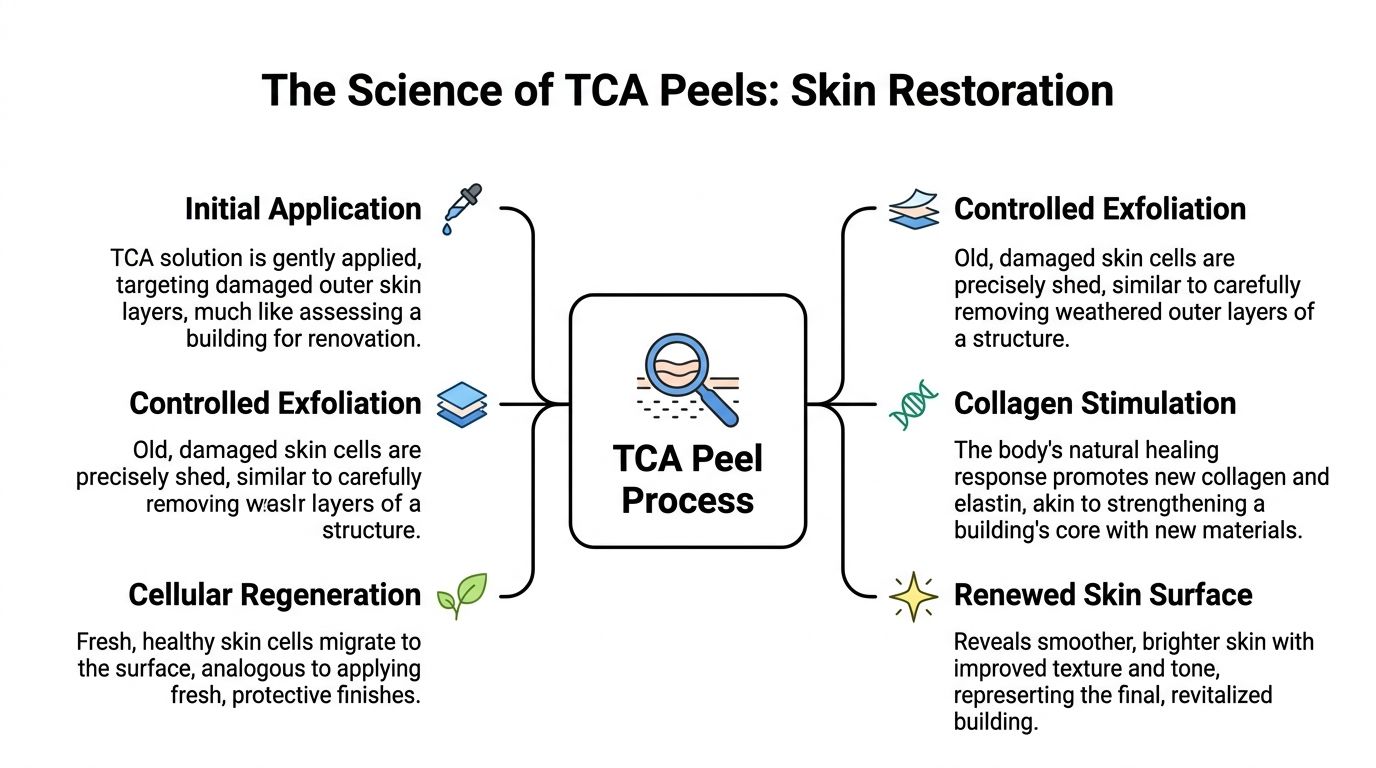
The biological sequence behind peeling
Staff usually understand TCA more clearly when they separate the process into stages.
Application
The solution is applied evenly to prepared skin, with attention to region, skin thickness, and the intended endpoint.Protein coagulation
TCA coagulates epidermal proteins and, depending on the formula and technique, can extend into superficial dermal tissue.Inflammatory signalling and repair
The skin initiates a wound-healing response. Clients do not see this stage clearly, but much of the improvement in tone and texture begins here.Desquamation
Treated surface layers loosen and shed. This is the peeling phase patients notice most.Regeneration
Re-epithelialisation follows, and later remodelling can improve smoothness and overall skin quality.
A practical analogy helps here. Frosting is the immediate in-room signal, peeling is the visible clean-up phase, and regeneration is the actual rebuilding work. If staff confuse those steps, they give poor advice.
Why some formulations heal more elegantly
Pure strength is not the only variable that matters. Vehicle, combination acids, skin preparation, and aftercare all influence how the skin responds.
That point is useful in Switzerland, where many partners want results that fit a more refined treatment model. Clinics need outcomes that look medically credible. Pharmacies and premium retailers need homecare recommendations that support healing without clashing with increasingly ingredient-conscious buyers. ECOCERT-aligned cleansers, barrier-support creams, and fragrance-disciplined post-procedure care fit this model well because they reduce unnecessary irritant load while the skin is rebuilding.
In practice, blended or carefully selected protocols can produce visible renewal with a calmer recovery profile. That makes them easier to position in clinics that want measurable results and in retail environments that value clean, well-tolerated support products.
Why visible peeling varies so much
Visible flaking is an inconsistent marker. Two patients can receive a similar peel and show very different shedding patterns.
Several variables explain the difference:
- Skin thickness differs by facial zone
- Sebum levels change how the peel penetrates and lifts
- Pre-treatment preparation affects acid uptake
- Application technique and number of coats change tissue injury
- Post-peel behaviour influences how neatly the skin sheds
Effective patient education protects trust. Fine flaking can still accompany a successful peel. Uneven shedding across the nose, mouth, and cheeks can still be normal. Teams that explain this early get fewer anxious calls and better product compliance.
Peeling is one visible sign of resurfacing. It is not the full measure of treatment success.
What clinic staff should watch for
When I train junior staff, I reduce the science to three checkpoints:
- Frost shows the immediate procedural response
- Peeling shows how the treated skin is shedding
- Texture, pigment, and recovery quality show whether the plan delivered value
That framework is practical for Swiss medical practices, medispas working within local rules, and retailers supporting post-peel care. It also supports better product selection. A clinic built around controlled procedures and clean, recovery-focused homecare can differentiate itself clearly in the Swiss market, especially when patients are already looking for evidence-based treatments that still align with a lower-irritation, ECOCERT-aware philosophy.
Navigating TCA Concentrations and Peel Depths
Concentration is only part of peel depth, but it’s the easiest starting point for treatment planning. The same percentage can behave differently depending on skin prep, number of coats, combination formulas, and the operator’s technique. Still, staff need a framework.
A practical way to think about depth
Professionals usually think in three bands:
- Lighter concentrations for superficial renewal
- Mid-range concentrations for more visible resurfacing
- Higher-strength approaches used cautiously and usually within specialist medical settings
In Swiss practice, the safest conversations happen when staff discuss concentration together with endpoint, downtime, and indication. “We use a 20% peel” means little to a client. “We’re aiming for controlled flaking and pigment correction with moderate downtime” means far more.
The medium-depth category matters most
For many clinics, medium-depth work is the commercial and clinical sweet spot. It’s where TCA can address photoageing, early scarring, and uneven tone with more visible impact than a superficial peel.
A particularly useful protocol is combination peeling. For medium-depth peels, combining 35% TCA with Jessner's solution achieves uniform penetration into the superficial papillary dermis, equivalent to 50% TCA alone but with a reported <5% incidence of scarring (ClinicalGate discussion of TCA peel technique).
That is important for Swiss operators who want strong results without moving casually into high-risk standalone strengths.
TCA Peel Concentration, Depth, and Expected Outcomes
| TCA Concentration | Peel Depth | Typical Peeling Process | Downtime | Primary Indications |
|---|---|---|---|---|
| 10-15% | Superficial | Fine flaking or light shedding. Some clients barely “see” a peel. | Shorter downtime, often easier to fit into work schedules | Dullness, mild uneven tone, early texture change, cautious first treatment |
| 15-25% | Superficial to light medium | More visible peeling, often around the mouth, nose, and mobile facial zones first | Moderate downtime with tighter post-care discipline needed | Mild pigment irregularity, superficial acne marks, early lines |
| 30-35% | Medium-depth | Noticeable peeling, tighter skin, more defined frosting endpoint in practice | Clear downtime. Clients need preparation and good expectation setting | Photoageing, more established dyschromia, acne scarring, textural irregularity |
| 35% with Jessner's solution | Medium-depth with enhanced uniformity | More even shedding pattern when performed well, with controlled white frost endpoint | Similar medium-depth downtime, but often selected to improve consistency of penetration | Moderate photoageing, pigmentary concerns, resurfacing plans where operator wants stronger effect with lower scarring risk than higher standalone TCA |
| Above 35% and specialist protocols | Deeper resurfacing territory | Heavier inflammatory response and a more demanding recovery profile | Significant downtime and tighter medical oversight | Reserved for carefully selected cases and experienced medical settings |
How staff should interpret the table
Don’t treat the table like a menu. It’s a starting map. The ultimate treatment choice depends on what the skin can tolerate and what the client can manage afterwards.
For example, a person with mild pigment and poor compliance isn’t a better candidate for a stronger peel. They’re often a better candidate for a gentler protocol plus excellent post-care.
Visual cues matter more than marketing terms
Terms like “light”, “advanced”, or “power peel” don’t help staff make safe decisions. Clinical observation does.
Look for:
- Even application pattern
- Expected level of frosting
- Anatomical variation across facial zones
- The client’s heat and discomfort response
- Any area suggesting too-rapid penetration
A disciplined operator treats the peel as a live procedure, not a prewritten package.
A Swiss retail note
Retail teams should never imply that stronger peeling is always better. In premium settings, the better message is this: the most successful peel is the one whose depth, recovery, and homecare fit the client’s skin and lifestyle.
That’s how you build repeat confidence rather than one-off curiosity.
Identifying Ideal Candidates and Clinical Indications
Not every person with uneven tone needs a TCA peel. Not every person asking for one should receive one. Good selection protects outcomes, reputation, and compliance.
The strongest candidates are usually clients with a clear concern, realistic expectations, and the discipline to follow instructions through the healing window.
Who tends to benefit most
TCA is commonly considered when a practitioner wants controlled resurfacing for concerns such as:
Photodamage
Sun-induced roughness, mottled tone, and early lines often respond well.Pigment irregularity
This includes uneven post-summer discolouration and some forms of melasma or post-inflammatory change, when approached carefully.Acne scarring
Superficial and moderate textural irregularities can improve with properly selected peel depth.Fine lines and crepey texture
Especially in clients whose skin looks tired rather than dehydrated.
The ideal candidate also understands that the skin may not peel evenly, and that the final result doesn’t arrive on day two.
Why consultation must go beyond one skin-type model
Many practices remain too simplistic in this regard. They use a script built for fair, uniform skin and then apply it to a much broader patient base.
That approach doesn’t hold up in modern Switzerland. A 2022 European study including Swiss clinics found that 35% of mixed-ethnicity patients experienced uneven zonal peeling, leading to anxiety and a 28% higher risk of PIH without appropriate post-care (CC Plastic Surgery discussion citing post-care variability).
That finding should change how staff speak to clients. Mixed heritage, varied Fitzpatrick patterns across the same face, and different healing behaviour all require more specific counselling.
If one cheek peels heavily and the T-zone hardly flakes, that may be normal. What matters is whether the skin is healing evenly, not whether it is shedding symmetrically.
Contraindications that should stop or delay treatment
A practical consultation includes firm “not now” decisions. Use caution or defer treatment when you see:
- Active infection or inflamed dermatitis
- Compromised barrier with ongoing irritation
- A history suggesting poor wound healing or keloid tendency
- Recent use of strong resurfacing agents without recovery
- Poor compliance with sun avoidance
- Unrealistic expectations about downtime or speed of results
A peel is not just a formula. It’s a commitment to healing behaviour.
How to discuss home-use questions without sounding dismissive
Clients often ask if they could “just try a weaker one at home first”. Retailers and clinic teams need a calm answer.
A useful educational resource for that conversation is this article on an at-home facial peel. It helps frame why peel suitability depends on more than product strength alone.
The key is not to shame curiosity. It’s to explain that TCA requires judgement about skin history, anatomical variation, and aftercare capacity. Those are professional decisions, not only shopping decisions.
Ensuring Safety and Compliance in Swiss Practice
Some people talk about TCA as if the peel itself is the danger. That’s too simplistic. The greater risk usually comes from poor selection, weak protocols, casual supervision, or retail messaging that blurs the line between professional treatment and consumer experimentation.
Swiss practice rewards the opposite approach. When operators are disciplined, TCA can sit inside a well-governed treatment pathway.

The regulatory baseline matters
The Swiss context isn’t permissive about casual high-strength use. Swissmedic has logged adverse events from TCA products, many from at-home use. The Helvetic Pharmaceutical Act requires certified applicators for TCA concentrations above a certain threshold, with significant fines for non-compliance. (FDA warning page referenced for professional supervision context).
That should influence how clinics train staff and how retailers position any related products. If the treatment crosses into professional territory, your language should make that explicit.
The main risks professionals must manage
A TCA peel can go wrong in familiar ways. The causes are usually preventable.
Post-inflammatory hyperpigmentation
More likely when skin type, prep, or aftercare are misjudged.Persistent erythema
Often linked to too much depth for the client’s recovery profile.Scarring
Rare in good hands, but more likely after aggressive technique, picking, infection, or inappropriate strength.Infection or HSV reactivation
Linked to poor screening, poor post-care, or missed prophylactic planning where relevant.
What a strong protocol looks like
Safety doesn’t come from one action. It comes from a chain of small correct decisions.
Before the peel
Confirm the indication. Review healing history. Check for recent irritation, infections, or unrealistic social timing. Assess whether the client can follow strict post-care.
During the peel
Watch the skin, not the clock alone. Respect facial zones that take the peel differently. Record concentration, coats, endpoint, discomfort, and any asymmetry.
After the peel
Give written instructions. Explain what normal looks like and what needs a call back. Build in a follow-up touchpoint rather than leaving the client to interpret healing alone.
Clinic standard: If your staff can’t explain why a client is peeling unevenly, they aren’t ready to sell or support TCA treatment.
How retailers can stay compliant and still add value
Retailers don’t need to perform peels to play a meaningful role. They can support safe treatment by doing three things well:
Screen responsibly
If someone asks for stronger acids after seeing social media trends, direct them to a qualified professional.Curate recovery products
Gentle cleansers, bland barrier support, mineral SPF, and non-irritating hydration are legitimate additions.Avoid therapeutic overreach
Don’t let merchandising language imply that home products replicate supervised TCA outcomes.
Swiss clean-beauty positioning assists in this area. A retailer can stand for quality, natural alignment, and compliance at the same time.
Optimising Results with Pre and Post-Peel Care
A client books a peel for Thursday, then arrives after a week of scrubs, retinoids, and spot treatments. The treatment itself may still be technically correct, yet the outcome is already less predictable. Pre and post-peel care work like priming and sealing a painted wall. If the surface is unstable, the finish suffers.
The strongest clinics in Switzerland treat aftercare as part of the medical service, not as an afterthought at reception. That approach protects outcomes, supports compliance, and creates a clearer retail role for partners who want to stay aligned with a clean, ECOCERT-minded philosophy.
Preparing the skin before treatment
Preparation should reduce background irritation and make the skin easier to read on peel day. Staff should explain this in plain terms. Quiet skin behaves more predictably than inflamed skin.
A practical preparation plan often includes:
Mild cleansing
Use a gentle cleanser and avoid aggressive scrubs or repeated degreasing unless the treatment protocol specifically requires it.Review of pigment risk
Clients with a history of post-inflammatory hyperpigmentation may need a more cautious pre-conditioning plan under professional supervision.Stopping unnecessary irritants
Home acids, fragranced exfoliants, benzoyl peroxide, and enthusiastic retinoid use shortly before treatment can increase reactivity.
For Swiss clinics and retailers, this is also a positioning point. Clients who prefer clean formulation standards usually respond well to a simpler pre-peel routine with fewer competing actives and a clearer purpose.
Why recovery planning matters as much as peel selection
Choosing the right peel is only one part of the result. Recovery determines how evenly the skin settles, how comfortable the client feels, and how confidently they judge the treatment.
This matters commercially as well as clinically.
A clinic that gives vague aftercare advice often generates extra messages, unnecessary worry, and preventable irritation. A clinic that gives a clear recovery plan builds trust and creates a legitimate reason to recommend support products that fit the treatment, especially in the Swiss premium segment where clients expect both efficacy and restraint.
The first recovery phase
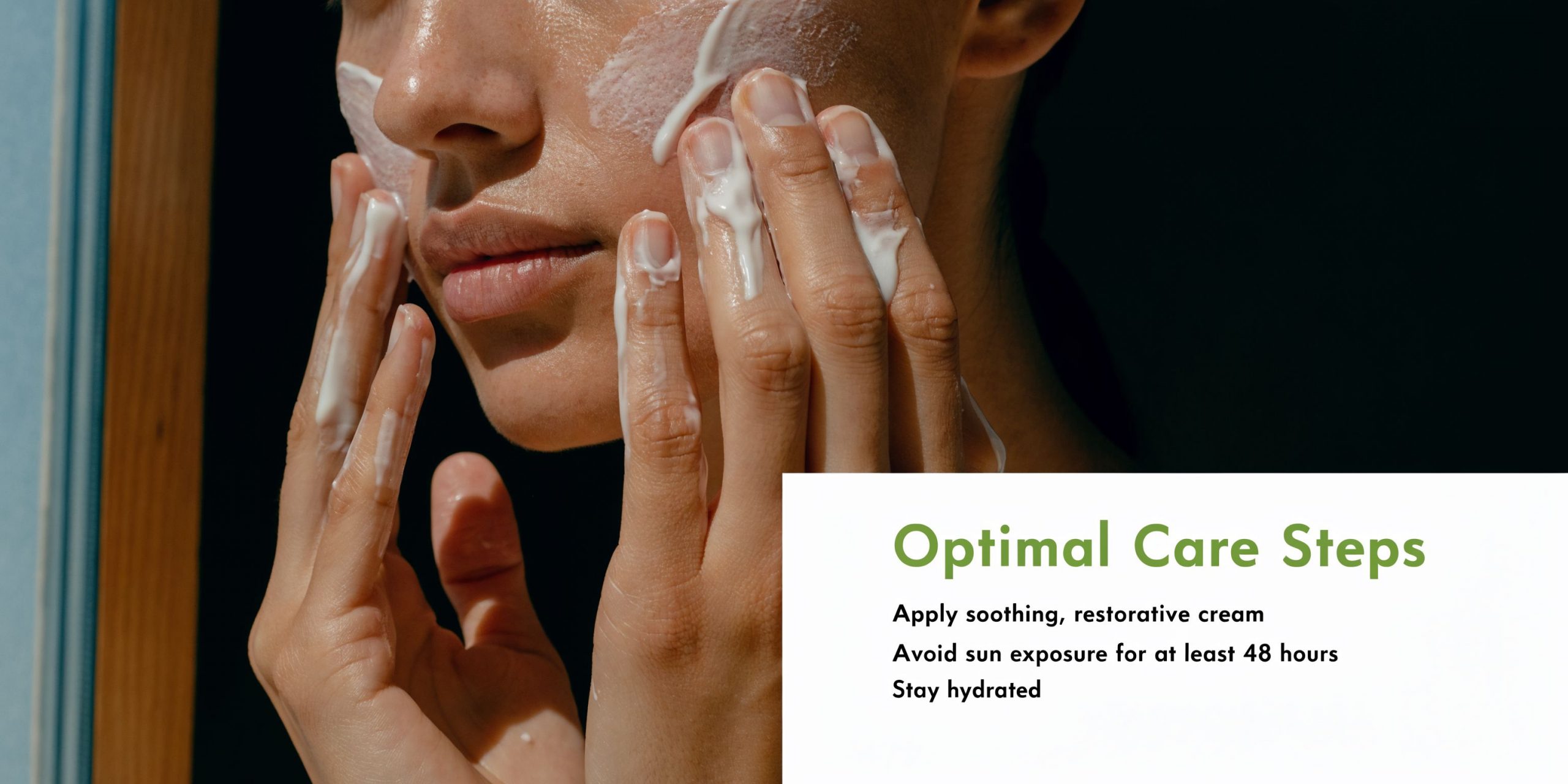
During the first days after treatment, the routine should stay narrow and consistent. Healing skin is busy doing repair work. It does not benefit from experimentation.
Focus on three basics:
Gentle cleansing
Use cool or lukewarm water and a non-stripping cleanser.Low friction
Avoid rubbing, picking, exfoliating cloths, and vigorous towel drying.Barrier support
Use simple hydrating or cushioning products that reduce tightness without adding unnecessary stimulation.
Product philosophy is particularly relevant here. Clinics and retailers who want an ECOCERT-aligned or clean-beauty story should build recovery around ingredient restraint, low fragrance risk, and barrier-friendly textures rather than around trend-driven actives. That gives partners a differentiated offer without implying that a retail product can replace professional supervision.
A few categories can fit this recovery window well when selected carefully:
Simple facial oils
Used selectively, they can reduce dryness and improve comfort on skin that tolerates them well.Protective balms
These can help buffer tight, fragile-feeling areas.Hydrating serums with a short ingredient list
These suit clients who want moisture support without added exfoliants or perfume.
What to keep out of the routine
Post-peel skin usually reacts badly to ambition. Staff should say this directly.
Avoid recommending:
- Retinoids
- AHA or BHA exfoliants
- Low-pH vitamin C products on reactive skin
- Fragranced formulas
- Any product that stings, burns, or creates visible redness after application
If a client describes burning, treat that as useful information, not as overreaction. The barrier is telling you the routine is too active.
Educating clients with visual support
Written instructions matter, but visual teaching often improves compliance. Clients remember stages more easily when they can match what they see in the mirror to a simple action plan.
The business opportunity in aftercare
Aftercare products should solve recovery tasks. That is the standard clinic staff and retail partners should use.
A strong Swiss model is a post-peel kit built around three functions:
- Cleanse without stripping
- Moisturise without provoking
- Protect with mineral SPF and disciplined sun avoidance
That framework is easy to train, easy to explain, and easier to keep compliant. It also supports a higher-value retail conversation. Instead of selling more products, you are matching each item to a phase of healing.
For clinics, that means fewer avoidable setbacks and better patient confidence. For retailers, it creates room for a differentiated offer built on clean formulation standards, careful claims, and real support during recovery.
Answering Common Patient Questions
Good consultations often come down to a few sentences said well. Staff should be able to answer common concerns clearly, without sounding defensive or vague.
Will the peel hurt
Tell the client that many individuals feel heat, stinging, or a strong prickling sensation during application. The exact feeling varies by concentration, skin sensitivity, and treatment area.
What helps is framing the sensation as temporary and expected. Don’t promise “no discomfort”. Promise supervision and clear guidance.
How much will I peel
Say this plainly. “You may peel a lot, or only a little. Both can be normal.”
Remind them that the cheeks, mouth area, forehead, and T-zone often behave differently. If peeling is uneven, that doesn’t automatically mean the treatment failed.
When can I wear makeup again
A safe client-friendly answer is: “Not until the skin has finished the active peeling stage and feels calm again.” If they press for a date, explain that healing varies and the skin sets the schedule.
That answer is better than giving a fixed promise that may not fit their recovery.
When will I see the final result
Set two timelines. The first is the visible recovery timeline, when flaking settles and the skin looks fresher. The second is the remodelling timeline, when texture and collagen-related improvements continue to develop.
Clients handle downtime better when they know the first reveal isn’t always the final outcome.
What should I do if one area looks strange
Give them a clear instruction: contact the clinic if they see unexpected darkening, prolonged raw areas, discharge, or anything that looks different from the guidance they were given.
That advice reduces panic, and it prevents clients from trying to “fix” the peel themselves.
If you’re building a Swiss-ready peel support strategy for clinics, pharmacies, spas, or premium retail, beautysecrets.agency can help you curate compliant, ECOCERT-aligned, ethically sourced skincare assortments that complement professional treatment journeys without compromising a clean-beauty positioning.