A pharmacy buyer in Zürich once told me the easiest products to reorder are the ones staff can explain in one sentence and still feel proud recommending. Weleda Skin Food fits that test. It's familiar enough to move quickly, but distinctive enough to earn space in a curated premium assortment.
An Introduction to a Skincare Legend
Few skincare products survive changing trends, changing textures, and changing consumer language without losing relevance. Weleda Skin Food has done exactly that. In trade terms, that matters more than hype. Retailers don't need another product that peaks on social media and disappears six months later. They need a SKU with repeat purchase behaviour, recognisable packaging, and a story staff can tell without sounding rehearsed.
For Swiss pharmacies and premium retailers, Skin Food sits in a useful commercial position. It isn't an obscure niche formula that needs heavy education, and it isn't a commoditised basic that gets dragged into pure price competition. It lives in the middle ground where trust, utility, and brand recognition support steady sell-through.
Why it keeps earning shelf space
The strongest retail products usually do three things well:
- They solve a visible problem: Skin Food is easy to recommend for dry, rough, weather-stressed skin.
- They carry a clear identity: The green tube, rich texture, and multi-purpose reputation make it memorable.
- They invite more than one purchase context: Hand care, facial use for very dry skin, overnight treatment, travel, gifting, and winter skincare all create different entry points.
That breadth is useful in Switzerland, where purchasing behaviour often shifts by channel. A pharmacy customer may want reassurance and ingredient clarity. A spa guest may respond to ritual and sensoriality. A premium e-commerce shopper may arrive already primed by cultural recognition around the product.
Skin Food works best when retailers stop treating it as just another moisturiser and position it as a trusted all-round dry-skin staple.
There's also a practical advantage in staff training. Some products need a long script. Skin Food doesn't. Teams can explain who it's for, where to use it, and why the texture is intentionally rich in under a minute. That simplicity helps conversion on the shop floor, especially in busy stores where consultations are short.
The Core Philosophy of A 100 Year Heritage
Weleda didn't build Skin Food around novelty. It built it around continuity. That's why the product still makes sense in a market crowded with fast claims and short launch cycles.
Launched in 1926, Skin Food becomes a 100-year heritage product by 2026, and public coverage continues to frame it that way. The same reporting notes that a tube sells every 6 seconds globally, and that it won 51 awards in the UK alone over the past decade in coverage discussing its sustained popularity, which is unusually strong evidence of long-term commercial relevance for a natural skincare product (Harper's Bazaar on Weleda Skin Food's heritage and ongoing popularity).

Heritage only matters if it still converts
Retailers hear “heritage” constantly. Most of the time, it's decorative language. Here, it has operational value.
A product with this kind of longevity usually brings three commercial benefits:
- Lower explanation burden: Customers already know the name, or they've heard it mentioned by friends, editors, or makeup artists.
- Higher trust at first touch: A long history reduces the “unproven product” barrier.
- Better role as an anchor SKU: It can stabilise a natural skincare shelf that also includes newer, less familiar items.
That doesn't mean every customer will love it. Some won't. The original formula is dense, glossy, and unmistakably rich. Customers expecting a fast-absorbing gel-cream often reject it on texture alone. That's not a flaw in the product. It's a mismatch in recommendation. Good retailing starts with matching texture tolerance to lifestyle.
Simplicity as a selling point
Skin Food also benefits from a philosophy many shoppers have returned to. They don't always want a complex routine. They want one reliable product that handles dry patches, hands, elbows, winter exposure, and occasional facial use for very dry skin.
That makes Skin Food commercially useful in Swiss pharmacies because it speaks to a familiar customer mindset. Practical care. Clear use case. Recognisable standards. Minimal theatre.
Retail lesson: Heritage doesn't sell by itself. Heritage plus present-day usefulness does.
The original purpose still reads clearly today. It's a rich, nourishing cream designed for skin that feels overworked, depleted, or rough. In a market full of specialised micro-solutions, that broad usefulness is one reason it remains easy to place, explain, and reorder.
A Deep Dive Into The Formulation
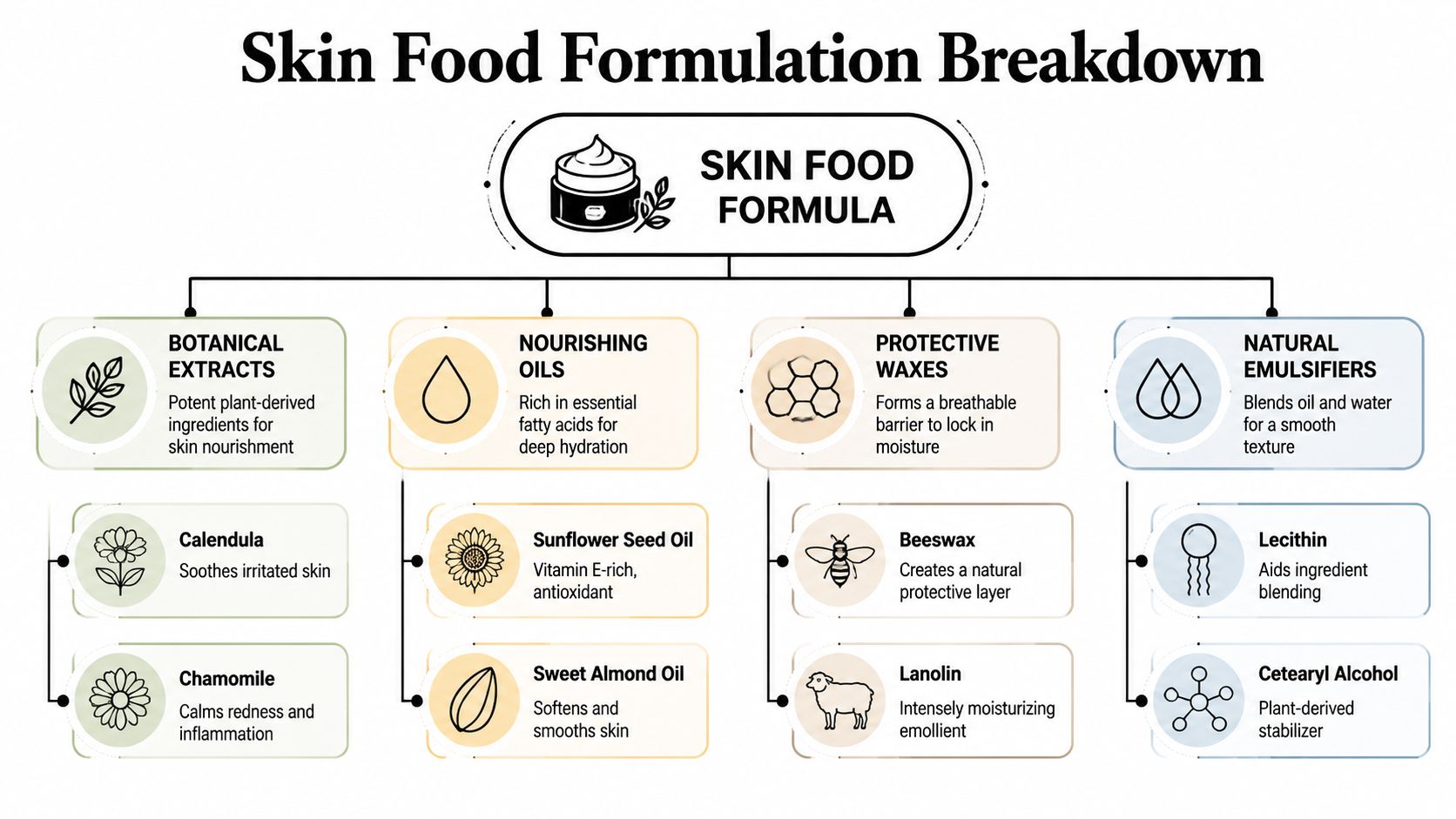
Retail staff sell this product better when they understand the formula as a system, not just a list of ingredients. Skin Food works because it combines lipid-rich nourishment, protective occlusion, and botanical support in one dense cream. Think of it as a hearty meal for dry skin. Oils feed, waxes seal, and extracts help calm the overall experience of stressed skin.
The lipid phase that does the heavy lifting
The most commercially important formulation point is this: Skin Food Original isn't trying to feel weightless. It's designed to support a compromised or depleted skin barrier with a richer emollient structure.
A dermatology review highlighted sunflower seed oil and sweet almond oil as key lipid-phase components that support impaired skin barrier function. The same review noted a 28-day use study reporting a 17% increase in skin moisture and an 18% improvement in skin smoothness (dermatology review discussing Skin Food Original's lipid system and 28-day results).
That gives your team a more precise way to describe it. Don't say it “hydrates nicely”. Say it's a barrier-supporting emollient cream with a rich oil phase suited to dryness and roughness.
The protective layer and why it matters
Beeswax is part of what gives Skin Food its recognisable finish. It helps create a protective film that slows moisture loss and makes the cream feel substantial. In practice, that's why customers often like it on hands, elbows, cuticles, and exposed areas during colder months.
This also explains one of the main trade-offs:
- What works: Dry skin, rough patches, overnight use, hand care, and use in harsh weather.
- What doesn't: Customers who want instant absorption, a matte finish, or a barely-there daytime moisturiser.
Lanolin also contributes to the dense, cushioned feel. Staff should be comfortable mentioning that the formula is intentionally rich and that a small amount usually performs better than a large one. Over-application is one of the main reasons customers say it feels too heavy.
A short product explainer can help:
- Warm a small amount between fingertips.
- Press onto dry areas rather than rubbing aggressively.
- Use sparingly on the face unless the customer specifically wants a richer finish.
Later in the consultation, this visual aid can support ingredient education:
The botanical story staff can actually use
Customers buying natural skincare often ask what the plants are doing in the formula. Staff don't need to overclaim. They need a clear, memorable explanation.
Use this language on the floor:
- Calendula: Commonly associated with soothing care for skin that feels irritated or uncomfortable.
- Chamomile: Often used to support a calmer feel when skin looks or feels reactive.
- Rosemary: Adds to the formula's distinctive herbal profile and helps position the product as more than a plain occlusive cream.
- Sunflower and sweet almond oils: These are the nourishment base. They help soften and support the skin's outer layer.
Customers don't need a chemistry lecture. They need to understand why the cream feels rich and who that richness is for.
The best staff conversations balance honesty and confidence. If someone has oily skin and dislikes heavy textures, don't push the original. If someone has rough hands, wind-chapped cheeks, or recurring dry patches, Skin Food becomes much easier to sell because the formula matches the complaint.
Certifications and Swiss Market Compliance
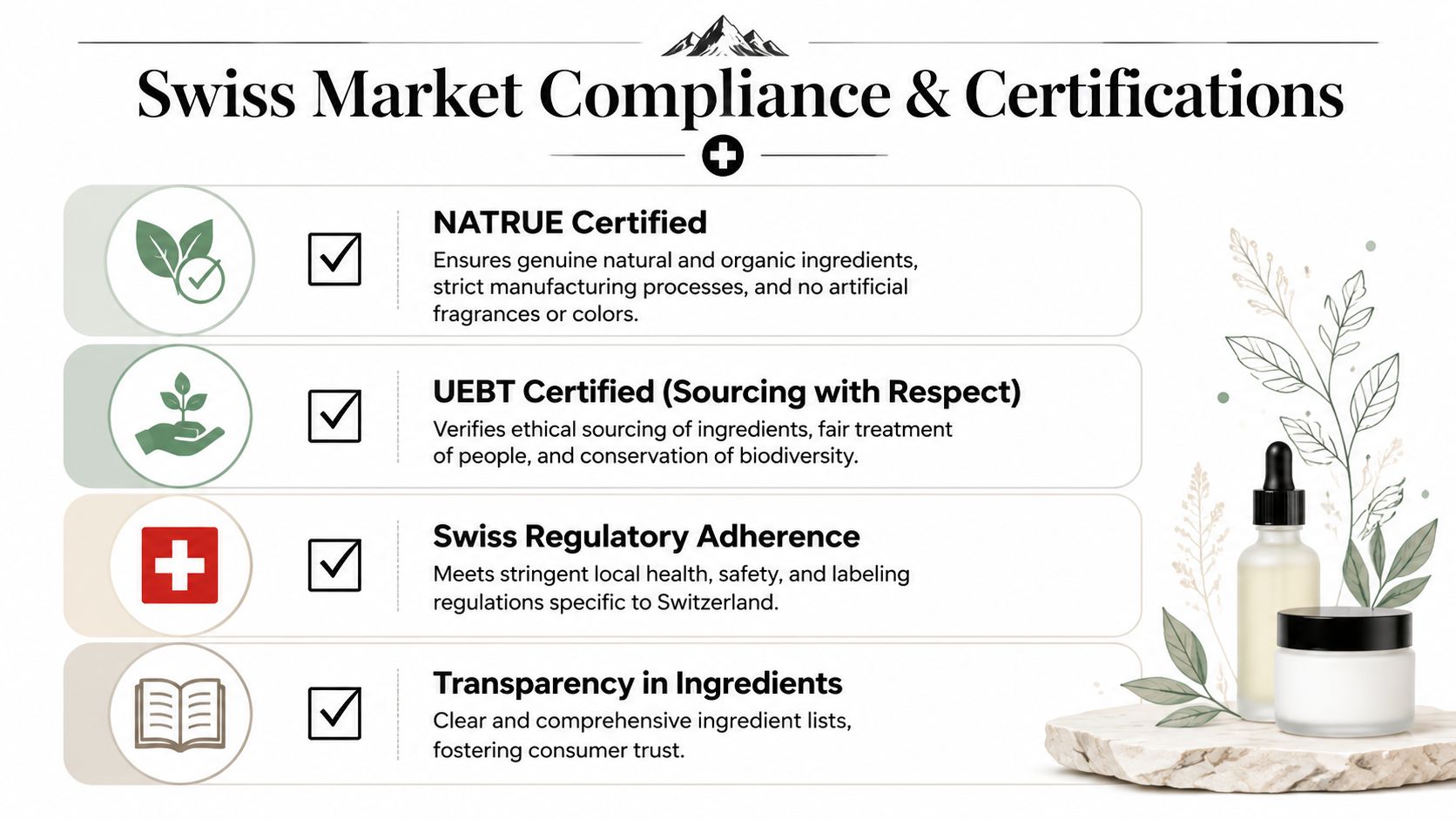
Swiss retailers don't benefit from vague “clean beauty” language. They benefit from claims that can be checked, explained, and defended on shelf. That's why certification matters.
For Skin Food Original, the strongest practical points are straightforward. Weleda states that the product is NATRUE-certified natural and packaged in 95% recycled aluminium (Weleda product page for Skin Food Original Ultra-Rich Cream). Those are not decorative details. They're concrete merchandising tools.
What these signals do in-store
In premium Swiss retail, certification helps reduce friction in the buying decision. It gives staff a reference point when customers ask what “natural” means in practice.
The commercial value shows up in several ways:
- Shelf confidence: Certified-natural positioning is easier to support in premium pharmacy and clean beauty environments.
- Clearer staff language: Teams can point to a recognised standard rather than making loose claims.
- Packaging relevance: Recycled aluminium supports sustainability conversations without forcing the product into a purely eco niche.
This is particularly useful in assortments where every SKU is competing for a finite amount of trust. A certification logo can't replace performance, but it can help justify why a customer should stop and consider the product.
Compliance is also about restraint
Retailers should avoid overstretching the message. NATRUE and recycled packaging are strong points. They don't mean the product is right for every shopper, every ethic, or every texture preference.
That restraint improves credibility. Teams should say what the product is, not what they wish it were.
For example:
| Selling point | Good retail wording | Avoid |
|---|---|---|
| Certification | NATRUE-certified natural product | “Purest cream on the market” |
| Packaging | Tube uses 95% recycled aluminium | “Zero-impact packaging” |
| Positioning | Rich natural cream for dry, rough skin | “Perfect for everyone” |
Swiss customers often respond well when a retailer gives them limits as well as benefits. It signals expertise, not hesitation.
In pharmacy and premium retail, compliance language works best when paired with concrete use cases. Certification opens the door. A precise recommendation closes the sale.
The Skin Food Collection Variants and Uses
The original cream gets most of the attention, but a good assortment decision rarely depends on a single hero SKU alone. Retailers need to decide whether they want Skin Food as a one-product statement or as a small family that supports different needs and basket sizes.
In practice, the range works best when each variant has a clearly assigned role. If staff can't explain the difference in texture and use within a few seconds, the line becomes noisy and customers default back to the original because that's the name they recognise.
Weleda Skin Food Variants At a Glance
| Product Variant | Texture | Primary Use | Ideal Customer |
|---|---|---|---|
| Skin Food Original Ultra-Rich Cream | Dense, rich, occlusive | Intensive care for dry, rough areas and richer facial use | Very dry skin customer, winter shopper, hand-care buyer |
| Skin Food Light | Lighter, easier-spreading cream | Everyday moisturising with less heaviness | Customer interested in the Skin Food idea but hesitant about rich textures |
| Skin Food Body Butter | Rich body texture | All-over body nourishment | Body-care shopper, spa customer, gift buyer |
| Skin Food Lip Balm | Protective balm texture | Dry lip care | Till-point add-on shopper, seasonal impulse buyer |
How to choose the right assortment
Not every Swiss retailer needs the full collection.
A practical rule of thumb:
- Pharmacies and drugstores: Start with Original and Light. That gives staff a clear answer for both intensive and everyday texture preferences.
- Premium beauty retail: Add Body Butter if body care is already a meaningful category in the store.
- Spas and hotels: Body Butter can support treatment-room storytelling and retail follow-up more naturally than the facial variants alone.
- Point-of-sale strategy: Lip Balm usually works best as an add-on rather than the lead item.
The mistake I see most often is range inflation. A retailer brings in too many variants at once, then gives each one too little space and too little staff education. Skin Food sells better when the line is edited.
Selling by need state rather than by product name
Staff should begin with the complaint, not the SKU.
For example:
- A customer says their hands crack in winter. Recommend Original first.
- A customer likes natural skincare but hates thick creams. Move to Light immediately.
- A customer wants a giftable body product with a recognised name. Body Butter becomes easier to place.
- A customer is standing at checkout with one skincare item already in hand. Lip Balm is the natural final add-on.
That recommendation flow matters because Skin Food Weleda products are texture-led purchases. Customers often decide with their fingertips before they decide with ingredient language.
A good Skin Food assortment shouldn't feel broad. It should feel edited, obvious, and easy to navigate.
Staff application tips that help conversion
Application advice reduces returns and disappointment. It also makes staff sound experienced rather than scripted.
Use short guidance like this:
- Original: Best in small amounts. Strong fit for dry patches, hands, elbows, and richer evening use.
- Light: Better for customers who want easier daytime wear.
- Body Butter: Position it as comfort body care, not as a technical treatment.
- Lip Balm: Keep the message simple. Protection, nourishment, convenience.
The more precisely each variant is assigned to a customer moment, the easier it becomes to cross-sell within the range without sounding pushy.
Merchandising and Retailing Strategy
Skin Food should never disappear into a generic moisturiser bay. It performs best when it's treated as a recognisable icon with multiple buying triggers. In-store, that means giving it context, not just shelf facings.
Recent social visibility supports that strategy. BeautyMatter reported that Skin Food generated 19.6 million impressions in 2024, up 215.3% versus 2023, and 22.3 million views in 2024, up 2,472% from 2023, showing that the product still attracts strong discovery momentum rather than relying only on legacy recognition (BeautyMatter on Skin Food's recent social media growth).

Where to place it for best commercial effect
The strongest placements usually fall into one of three models:
- Cult classics zone: Group it with proven hero products rather than with every moisturiser in the natural segment.
- Seasonal dry-skin destination: Use it in winter repair, hand care, alpine climate, or travel-focused merchandising.
- Till or consultation adjacency: Smaller-format or add-on variants benefit from high-traffic, low-decision areas.
What doesn't work is burying the product inside a large wall organised only by brand. Customers who came in specifically looking for Skin Food may still find it. Everyone else is less likely to stop.
Staff talking points that actually convert
Teams don't need ten claims. They need three clean lines they can adapt.
Try these:
- For dry, rough skin: “This is the richer one. It's best when the skin feels depleted, tight, or weather-worn.”
- For texture concerns: “If you like the Skin Food idea but not a heavy finish, start with the lighter version.”
- For natural-leaning shoppers: “It combines a recognised natural certification with a packaging story that's easy to explain.”
A short consultation often works better than a full demonstration. Skin Food's texture is distinctive enough that customers usually decide quickly once they try it.
Connect heritage to current demand
Heritage alone can attract older loyalists. Social visibility helps bring in newer customers who've seen the product online and want to understand whether it's worth buying. That creates a useful dual audience for Swiss retailers: the customer who already trusts the name, and the customer who discovered it through digital beauty culture.
For retail teams handling marketplace or omnichannel planning, broader channel strategy matters too. This practical resource on channel expansion for beauty brands on Amazon is useful because it frames how established beauty products can maintain brand clarity while moving across digital sales environments.
The best Skin Food display doesn't try to look trendy. It looks dependable, tactile, and easy to understand.
Four merchandising moves worth using
- Lead with problem solving: Use phrases built around dryness, roughness, and comfort rather than abstract beauty language.
- Show the texture truthfully: Don't hide the richness. The texture is part of the value proposition.
- Train for objection handling: “Too thick” is common. Staff should know when to redirect to Light instead of forcing the original.
- Refresh by season: Skin Food has natural moments in winter, travel, hand care, and gift periods. Use them.
A retailer who merchandises Skin Food as a practical classic usually gets better results than one who tries to make it sound like the newest innovation on the shelf.
Your Partner in Natural Skincare Success
Weleda Skin Food remains commercially relevant because it solves a simple retail problem well. It gives buyers a product with a clear use case, a recognisable identity, a formulation staff can explain, and standards that fit premium natural merchandising in Switzerland.
That combination is rare. Many heritage products lack current energy. Many trend-led products lack staying power. Skin Food sits in the narrow band where history, utility, certification, and modern visibility reinforce each other.
For Swiss pharmacies, premium retailers, and spas, the opportunity isn't just to stock a famous cream. It's to stock it with discipline. Choose the right variants. Train staff on texture honesty. Merchandise it around real dry-skin needs. Use its heritage carefully, and let its practical usefulness do the selling.
Retailers who approach Skin Food that way usually don't treat it as filler. They treat it as a dependable performer inside a considered natural skincare assortment.
If you're building a stronger natural skincare portfolio for Swiss retail, pharmacy, spa, or premium e-commerce, beautysecrets.agency can help you evaluate assortments with a distributor's eye for compliance, texture fit, commercial positioning, and long-term brand value.