You're probably dealing with a familiar tension right now. Guests expect the calm, polish, and outcome of a luxury spa, but your margins don't improve just because the robe is softer, the tea is better, or the treatment room lighting is warmer. In Switzerland, the challenge is sharper. Clients are discerning, ingredients matter, certification matters, and a generic retail shelf at reception won't carry a premium wellness concept.
That's why Savoy Resort Spa is useful to study.
Not because it sits in the Swiss market. It doesn't. Savoy Seychelles Resort & Spa is located in Beau Vallon, Mahé Island, Seychelles, covers approximately 6.5 hectares, and has no operational presence or data points in Switzerland, according to Expedia's property listing for Savoy Seychelles Resort & Spa. That distance is helpful. It lets Swiss spa managers assess the property as a benchmark rather than as a direct local competitor.
For managers reviewing their own positioning, broad consumer inspiration also matters. Lists such as Lucidoura's 7 top-rated spas for relaxation are useful because they show how customers browse wellness options emotionally first, then rationally. They buy atmosphere, trust, and aspiration before they buy a treatment slot.
An Introduction to a Global Wellness Benchmark
Savoy Resort Spa works as a benchmark because it combines the parts many operators struggle to connect. Setting, scale, hospitality, and wellness are organised as one experience rather than separate departments. That's the mark of a mature luxury offer.
Swiss operators can learn a lot from that model without copying the tropical aesthetic. A mountain spa in Graubünden, a lakeside property in Vaud, and an urban wellness floor in Zürich don't need palm trees to compete. They need coherence. The guest should feel that the treatment philosophy, product choice, service choreography, and retail environment belong to the same brand world.
What Swiss managers should pay attention to
A property like Savoy is useful when you look past the postcard appeal and focus on operational signals.
- Spatial ambition: The size of a resort shapes guest expectations before a therapist touches the client.
- Brand consistency: Luxury isn't one hero treatment. It's the repeated feeling that every touchpoint has been considered.
- Commercial discipline: Premium wellness properties rarely rely on treatment revenue alone. The strongest ones build value across rooms, food, events, and ancillary spend.
Practical rule: Don't benchmark only décor. Benchmark how the whole guest journey supports perceived value.
That's the lens Swiss spa managers should use here. Savoy Resort Spa isn't interesting because it is exotic. It's interesting because it shows what happens when wellness is treated as a core business pillar, not a side amenity attached to the hotel.
An Idyllic Location on Beau Vallon Beach
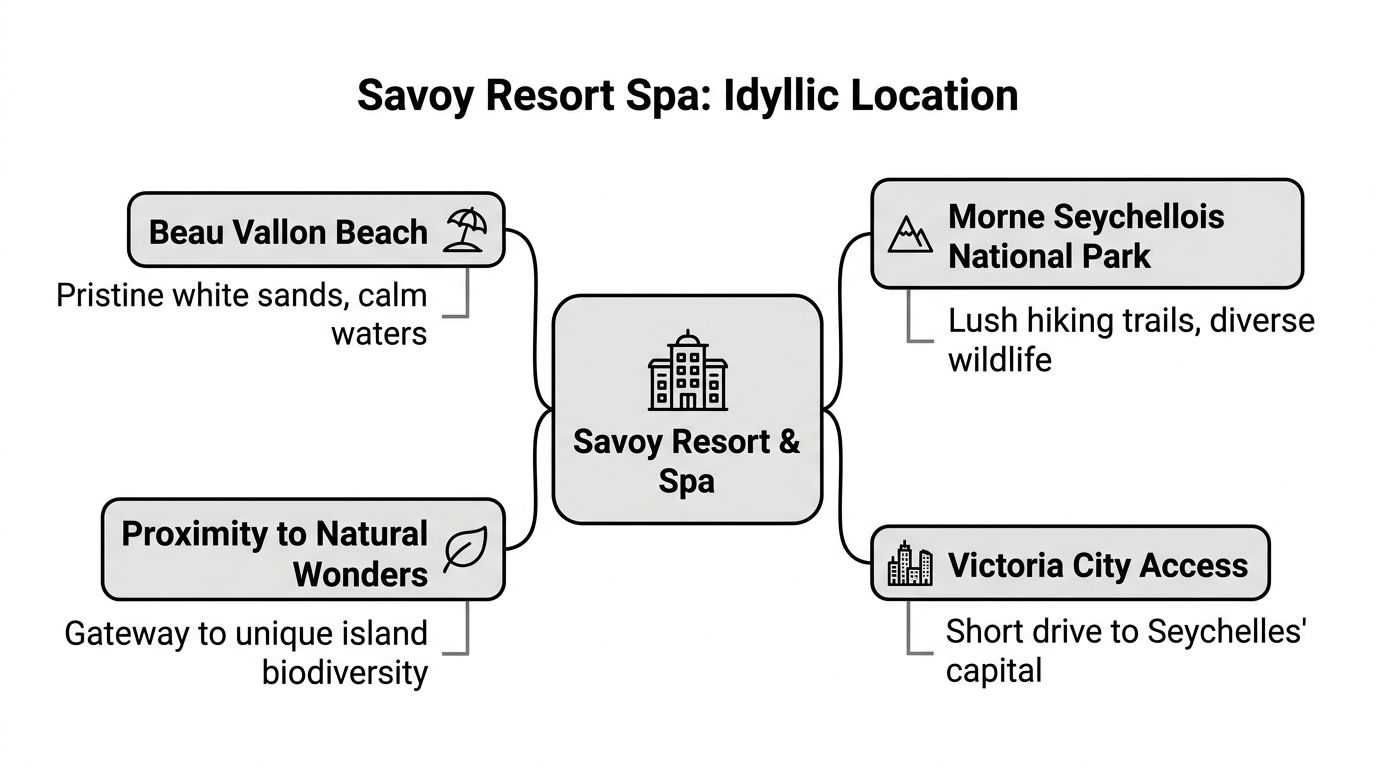
Location still does heavy lifting in luxury wellness. Savoy Resort & Spa sits on Beau Vallon Beach in Mahé Island, Seychelles, spans 6.5 hectares, and is positioned 15 km from Seychelles International Airport and 3 km from Morne Seychelles National Park, as listed by Travel Weekly's Savoy Resort & Spa profile. Those details matter because they create a specific promise. The guest is close to arrival infrastructure, close to nature, and fully inside a leisure setting.
The beach setting does more than beautify the brochure. It reduces friction. Guests don't need to be persuaded to slow down when the sea, light, and open horizon already do that work. For spa operators, that's a reminder that environment is part of treatment efficacy. A strong pre-treatment state often begins outside the treatment room.
Here's the location model at a glance:
Why the setting supports the brand
Beau Vallon gives the property an easy visual identity. Sand, water, tropical planting, and open air all support a restorative narrative without verbal explanation. Morne Seychelles National Park nearby adds another layer. The resort isn't only a beach base. It also sits near an area associated with biodiversity and outdoor exploration.
For Swiss managers, the lesson isn't to imitate island marketing. It's to sharpen your own environmental asset.
| Swiss spa context | Stronger strategic use |
|---|---|
| Alpine hotel spa | Tie treatments to altitude recovery, muscle reset, and seasonal rituals |
| Urban day spa | Emphasise contrast, privacy, and nervous system decompression |
| Lakeside wellness property | Build programmes around water, sleep, and sensory quiet |
The point is simple. Luxury guests accept a premium when the place itself feels inseparable from the treatment story.
A short visual impression helps illustrate the atmosphere many guests associate with the property:
What works and what doesn't
What works is using location as a silent therapist. Views, access, and natural context lower the burden on your copywriting and your sales team.
What doesn't work is trying to compensate for an ordinary setting with inflated language. Swiss properties with no obvious natural drama should focus on spatial control instead. Quiet circulation, better transitions, scent zoning, superior sound insulation, and stronger material choices often outperform decorative excess.
A guest forgives many things in hospitality. They rarely forgive a disconnect between the promise of calm and the actual feeling on site.
Inside the Acclaimed Savoy Spa Facilities
A guest arrives ten minutes early, lowers their voice at the entrance, and starts reading the property before the therapist says a word. That moment is operational, not cosmetic. At Savoy Resort Spa, the facility mix signals that wellness has been planned at hotel level, not added later as an amenity.
As noted earlier in the article, the property includes a large outdoor pool and a spa layout with nine treatment rooms, including jacuzzi couple suites. For Swiss managers, those details matter less as trophy features and more as evidence of planning discipline. Capacity, privacy, and circulation shape perceived value before treatment quality has a chance to do its work.
What the facility mix gets right
The strongest luxury spas make space support revenue logic.
- Multiple treatment rooms give the operation room to segment demand. One cabin can stay dedicated to body rituals while another handles facials or couples bookings, rather than forcing constant resets between incompatible protocols.
- Couple suites with added wet features widen package design. They help convert anniversaries, short-stay romance bookings, and premium upsells into higher basket value.
- A substantial pool area increases dwell time and changes guest behaviour. The spa becomes part of a half-day ritual, which raises the odds of pre-treatment consultation, post-treatment relaxation, and retail conversation.
That last point is where many Swiss properties still leave money on the table. They invest in hardware, but fail to use the longer guest journey for product education, certified natural retail, and brand storytelling.
The Swiss trade-off is different
Few Swiss spas need resort-scale square metres. Many do need better zoning.
I see the same pattern repeatedly. A property adds a sauna, a water feature, and one attractive treatment room, then assumes the guest experience will feel premium. In practice, weak transitions erode the investment. Corridors carry noise. Storage spills into the room. Couple rituals are offered in spaces that were never designed for side-by-side treatment flow.
Savoy works as a benchmark because the infrastructure appears aligned with guest expectation. Swiss operators should copy the logic, not the footprint.
| Facility element | Strategic value | Common Swiss weakness |
|---|---|---|
| Dedicated treatment rooms | Better therapist focus and cleaner scheduling | Rooms are too generic to support specialist protocols |
| Couple suites | Stronger package pricing and occasion-based sales | Built for brochure appeal, not operational use |
| Pool and wet area | Extends stay and perceived value | Poor acoustic zoning or limited privacy |
| Transition spaces | Supports calm, consultation, and retail readiness | Underdesigned, cramped, or visually disconnected |
A well-designed spa also improves product credibility. If a manager wants to partner with premium botanical or certified clean beauty lines, the setting has to support that promise. Guests are more likely to trust recommendations when the environment feels coherent, ingredient-led, and professionally controlled. That is also why retail teams should understand ethical positioning. A useful reference point is this cruelty-free skincare guide.
The practical lesson for Swiss spa managers is clear. Build spaces that help therapists work well, help guests stay longer, and help products sell naturally after treatment. Savoy shows what happens when facility planning supports brand value. The opportunity in Switzerland is to apply that same discipline with tighter layouts, stronger natural product partnerships, and a post-treatment retail strategy that is still missing in much of the market.
Signature Treatments and Product Philosophy
Facilities create confidence, but treatments create memory. In luxury wellness, the menu should feel edited, not crowded. Guests don't want a long list of disconnected facials and massages. They want a treatment logic they can understand and trust.
Savoy Spa's treatment environment, including its dedicated rooms and couple suites, suggests a curated ritual approach rather than a purely transactional one. That matters because the best spa menus do two things at once. They deliver immediate sensory satisfaction, and they anchor the guest in a product philosophy strong enough to justify continuation at home.
What a premium product philosophy should include
In practice, luxury spas tend to succeed when they align with one or more of these product narratives:
- Marine-based care: Strong for remineralising, body contouring, and thalasso-adjacent positioning.
- Botanical or organic rituals: Effective when ingredient provenance and skin comfort are central to the client base.
- Alchemical or heritage-led formulations: Useful when the spa wants a more ceremonial, niche, or high-touch identity.
Swiss managers should take product selection more seriously than many currently do. The wrong line undermines the therapist's work. If the formulas feel generic, the texture disappoints, or the ingredient story sounds borrowed from mass retail, the treatment loses authority.
What works in the room and what fails at the shelf
What works is consistency. If your therapist speaks about skin barrier support, massage medium purity, or ritual layering, the retail offer should reflect that same language. If your spa claims to be clean, sustainable, and ingredient-conscious, the guest shouldn't encounter a shelf full of poorly explained products with no visible certification cues.
What fails is the split identity model:
- a polished cabin experience,
- a thoughtful therapist,
- and a reception retail area that looks like leftover stock from another business.
That's especially risky in Switzerland, where customers often read labels carefully and expect claims to be defensible.
For managers refining their ethical positioning, a practical consumer-facing resource such as this cruelty-free skincare guide can help clarify the language many clients already recognise around cruelty-free standards, ingredient ethics, and suitability across skin types.
Product philosophy isn't decoration. It tells the guest whether your spa believes in outcomes enough to let the treatment continue beyond the appointment.
The strongest treatment menus are built backwards from that reality. Start with the result you want to own. Then choose the textures, protocols, and home-care products that make the claim feel coherent. Savoy Resort Spa is useful here not because every detail is public, but because it represents the kind of superior treatment world where product choice can't be random.
The Five-Star Guest Experience and Market Position
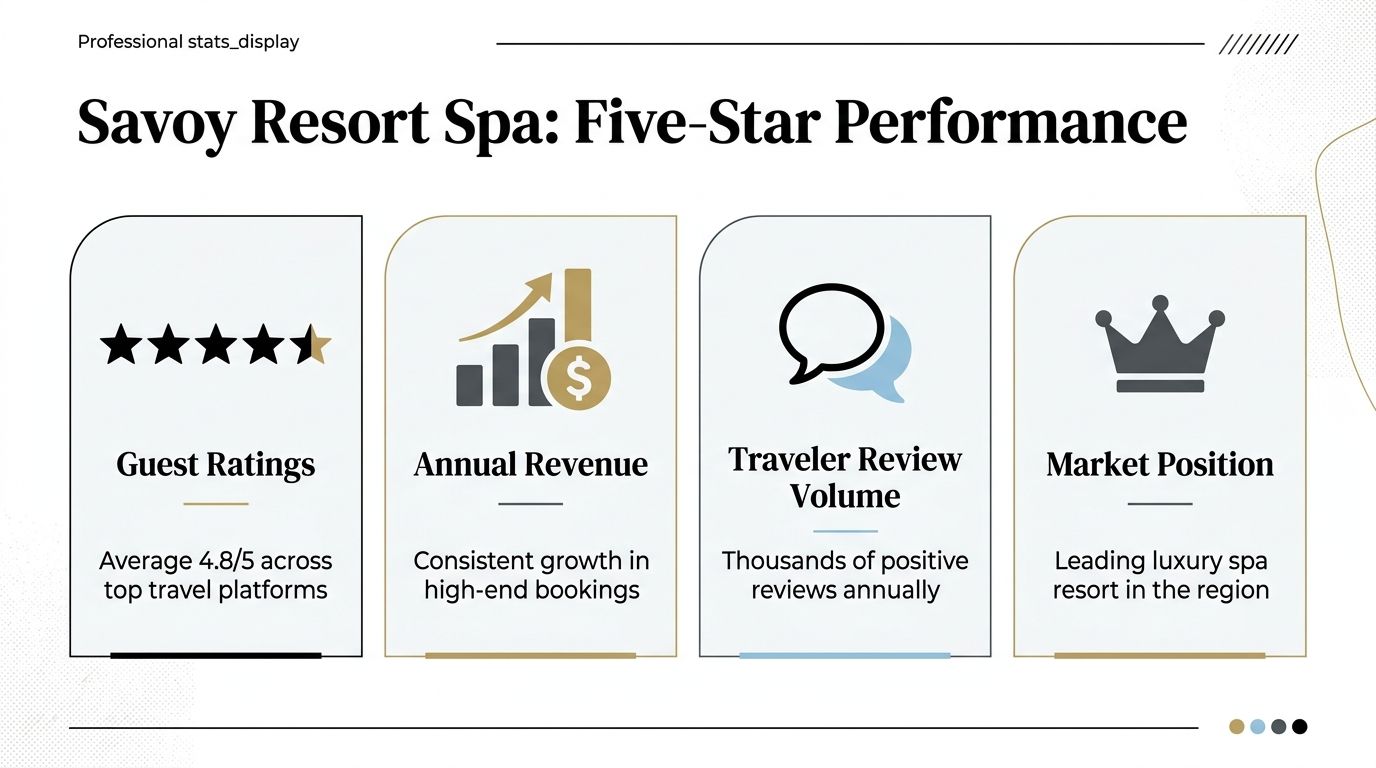
A spa concept becomes commercially persuasive when reputation and revenue support each other. Savoy Resort & Spa operates as a 5-star hotel, has an average guest rating of 8.4 out of 10, reports annual revenue of $57 million, and has 2,446 traveller reviews on TripAdvisor, according to Savoy Seychelles Resort & Spa's official site. It is also distinct from the unrelated Royal Savoy Hotel & Spa in Lausanne, which avoids confusion for Swiss readers comparing brand names.
Those numbers matter because they show market traction, not just aesthetic polish. Plenty of properties look expensive. Fewer convert that impression into durable guest approval and meaningful business scale.
Here is the required performance snapshot:
Why this matters to Swiss spa managers
The commercial lesson isn't that every Swiss spa should pursue resort scale. It's that guests pay for confidence. A five-star positioning works when the service promise is repeatedly confirmed, publicly reviewed, and operationally sustained.
Three signals stand out:
- Guest rating strength: An 8.4 out of 10 average suggests the property delivers a broadly satisfying experience.
- Review volume: More than two thousand TripAdvisor reviews indicate visibility and sustained guest interaction.
- Revenue scale: Reported revenue at $57 million shows that premium hospitality can support a substantial business footprint when the ecosystem is well built.
The practical benchmark
Swiss managers should read those metrics as indicators of trust architecture.
| Metric | What it signals operationally |
|---|---|
| Guest rating | Service consistency |
| Review volume | Market presence and discoverability |
| Revenue | Commercial resilience of the premium model |
The mistake would be to isolate spa performance from hotel or brand performance. In luxury hospitality, guests don't experience departments. They experience one brand. If check-in is cold, corridors are noisy, or food service feels off-brand, the spa has to repair that trust deficit.
That is why Savoy Resort Spa remains a useful reference point. It shows what happens when wellness is embedded inside a broader five-star system rather than treated as a decorative add-on.
The Post-Treatment Gap A Swiss Opportunity
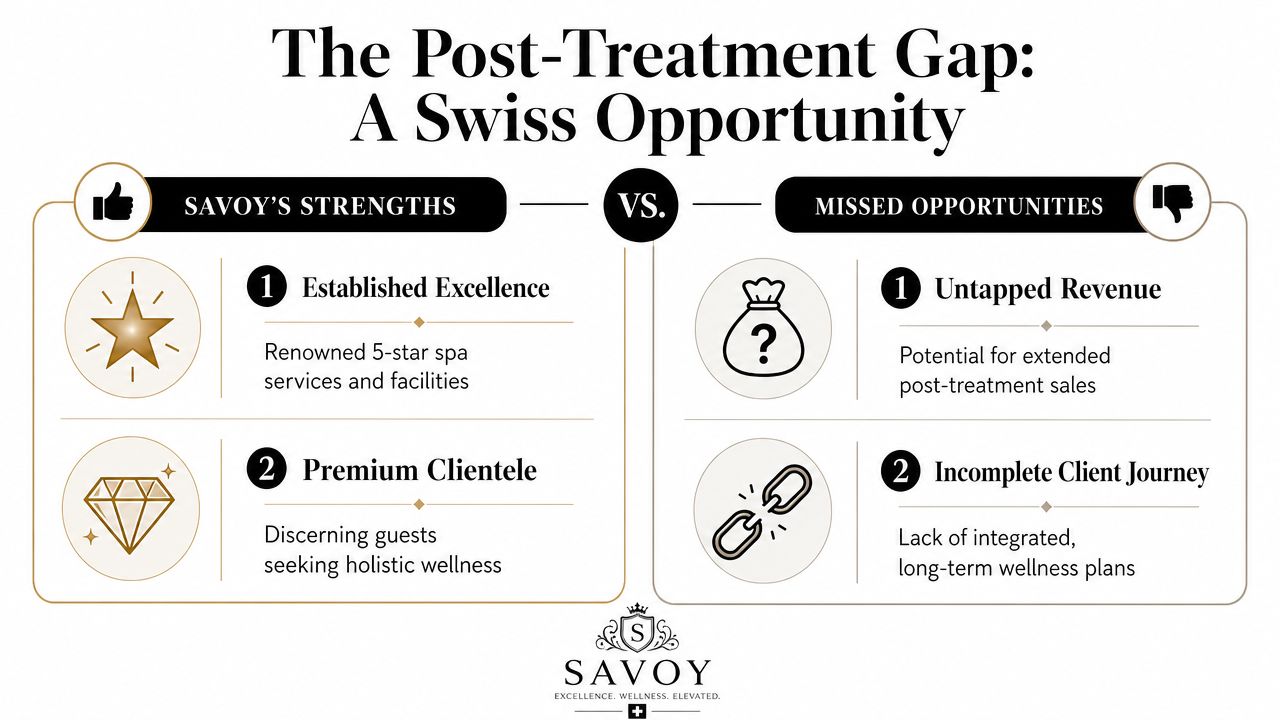
A guest leaves a first-rate facial relaxed, impressed, and ready to follow professional advice at home. Then the journey stops. No personalized aftercare, no credible product prescription, no retail edit that matches the treatment logic. For Swiss spa managers, that is the commercial gap worth studying.
Savoy Spa is a useful benchmark precisely because so much of the guest experience is already well executed. As noted earlier, its own spa guidance helps frame the treatment journey clearly. What appears less developed in the article's broader picture is the handover from cabin experience to home-care routine. In practice, that missing step affects both guest confidence and revenue quality.
Here is the business tension visually:
Why this gap matters more in Switzerland
Swiss spa clients usually expect precision. They want to know which product supports the result, which ingredient may irritate freshly treated skin, and which routine is realistic between appointments. If the therapist ends with a polite goodbye instead of clear aftercare, the service feels incomplete.
Managers often hesitate here for good reason. Poorly handled retail advice can sound scripted and transactional. That risk is real. The answer is not to avoid recommendation. The answer is to make recommendation part of treatment quality, with trained therapists, tight product curation, and language that serves the guest rather than the sales target.
Advisory point: Post-treatment recommendation works best as professional aftercare, supported by products the therapist trusts and can explain in detail.
The strongest model usually includes three operational choices. First, keep the assortment narrow and relevant to the treatment menu. Second, select certified natural brands whose ingredient standards support the spa's positioning. Third, train therapists to explain use, timing, and expected results in plain language.
Poor execution is easy to spot. Generic leaflets, front-desk upselling, and disconnected product walls all weaken credibility. So does stocking a luxury line that looks expensive but has no clear certification story, no ingredient transparency, and no link to what happened in the treatment room.
Swiss operators can outperform many international resorts. The domestic market already rewards curation, origin transparency, and product integrity. Savoy Resort Spa therefore serves as more than an aspirational property reference. It shows Swiss managers where even a polished five-star concept can leave money, loyalty, and authority on the table if post-treatment retail is not built as part of the service itself.
Building a World-Class Offering with BeautySecrets.Agency
For Swiss spa managers, one fact should shape the next move. No region-specific technical specifications or benchmark data exist for Savoy Resort Spa in Switzerland because the resort is physically located in the Seychelles, which makes local execution and market fit a Swiss responsibility, as noted in Trivago's Savoy Seychelles Resort & Spa listing context.
That is the strategic takeaway. International benchmarks can inspire positioning, but they can't choose the right retail architecture, certification mix, therapist education plan, or product portfolio for your Swiss clientele. A local partner has to do that work.
What a strong Swiss implementation looks like
The right approach usually includes four elements:
- Certified natural product selection: Choose lines whose ingredient standards support your brand promise.
- Therapist training: Staff must know how to translate treatment outcomes into relevant home-care advice.
- Merchandising discipline: Retail should feel like an extension of the treatment room, not a separate shop corner.
- Channel fit: The assortment should reflect whether you serve hotel guests, destination spa visitors, pharmacy-led wellness buyers, or medical-aesthetic clients.

Why brand partnerships matter now
Swiss spas don't need to become copies of Savoy Resort Spa. They need to adopt the stronger lesson behind it. Luxury wellness works best when treatment, ingredient philosophy, and aftercare recommendation form one system.
That is where carefully chosen brand partnerships change the economics of the spa. They improve credibility with ingredient-conscious guests. They give therapists better tools. They create a more complete guest journey. And they turn post-treatment moments from an afterthought into a source of retention, trust, and differentiated value.
The practical opportunity is clear. Use international properties like Savoy as inspiration for service level and ambience. Build the retail and aftercare layer around the realities of the Swiss market, where certified natural products, ethical sourcing, and informed recommendation carry real weight.
If you're a Swiss spa, hotel, pharmacy, retailer, or wellness operator looking to build a stronger post-treatment retail strategy with certified natural and ethically sourced brands, beautysecrets.agency can help you translate that opportunity into a credible market-ready offer. Their Swiss-focused portfolio includes Abahna, Fushi, JULISIS, Les Thermes Marins de Saint-Malo, Little Butterfly London, and Egyptian Magic, with support suited for premium wellness environments that want cleaner positioning, stronger product storytelling, and better commercial alignment.