You're probably looking at Iceland and trying to decide whether Reykjadalur is one of those places that looks magical online but feels awkward in real life. Long walk, changing outdoors, unpredictable weather, unknown water chemistry. Fair questions.
Reykjadalur works when you treat it as both a hike and a bathing ritual. Not a spa day in the polished sense, and not a hard trek either. It's a raw, open-air soak reached on foot through a geothermal valley near Hveragerði, with steam rising from the earth and a warm river waiting at the end. The setting is wild enough to feel transporting, but accessible enough that many travellers can do it comfortably with decent preparation.
For wellness-minded travellers, and especially for Swiss pharmacies, spas, and skin-focused advisers thinking about how to frame the experience for clients, its genuine benefit lies in honesty. The Reykjadalur hot spring thermal river is restorative because of its natural surroundings, the warmth, the contrast of effort and release, and the simplicity of bathing outdoors. What doesn't work is treating it like a medically predictable hydrotherapy environment. It isn't that.
Go prepared, keep expectations realistic, and the reward is memorable: a natural soak under Icelandic sky, with enough structure to feel manageable and enough roughness to feel earned.
Your Wild Icelandic Spa Awaits
A Reykjadalur day usually starts with ordinary travel stress. You've been in the car, checking forecasts, wondering whether the trail will be muddy, and asking yourself if carrying a towel uphill is really worth it. Then the walk begins, the town drops behind you, and the whole mood changes.
The valley has a way of stripping things back. Steam drifts across the hillside. The path climbs steadily. The air smells of wet earth and geothermal heat. By the time you reach the river, you're no longer chasing a checklist item. You're looking for a place to sit in warm water and let your shoulders finally unclench.
Why this place feels different
Reykjadalur isn't built around polished facilities or a staged spa narrative. That's exactly why many experienced Iceland travellers keep recommending it. You earn the bath. The walk gives the soak context.
A few trade-offs come with that simplicity:
- You won't get a luxury changing room. Expect a far more basic setup.
- You can't control the weather. Wind, drizzle, and mud are part of the experience.
- You shouldn't expect clinical certainty. The river is natural, not standardised.
The best Reykjadalur visits happen when people stop asking it to behave like a resort.
Who tends to love it most
Reykjadalur suits travellers who enjoy two things at once: movement and recovery. That includes couples, solo hikers, wellness professionals, and visitors who find the ritual of arriving somewhere on foot more satisfying than stepping out beside a bus stop.
It also appeals to people who care about how an environment feels on the skin. Not because every benefit can be measured precisely, but because heat, fresh air, mineral-rich water, and the shift from effort to immersion create a kind of reset that many indoor spas try to imitate.
If your ideal Iceland moment involves quiet exertion followed by a long exhale in warm water, this is one of the strongest outings you can choose.
Planning Your Trip to Reykjadalur
A good Reykjadalur day starts before the trailhead. Leave Reykjavík with enough margin that you are not hiking fast, changing in a rush, or cutting short the soak because of the drive back. The river rewards unhurried visitors.
Reykjadalur sits near Hveragerði in South Iceland, and that town is the practical last stop for water, food, and a final weather check. If you want the outing to feel restorative rather than slightly chaotic, treat logistics as part of the wellness ritual. Eat something light, fill your bottle, secure your dry clothes in a waterproof bag, and arrive ready to walk.
The first real choice is transport. Self-driving gives more control over pace, layers, snacks, and how long you stay in the water. A tour suits travellers who prefer someone else to handle the road, parking, and timing. I usually recommend driving if you care about bathing at your own rhythm, especially if you want time for a simple skin-friendly routine before and after the soak.
The numbers that matter before you leave
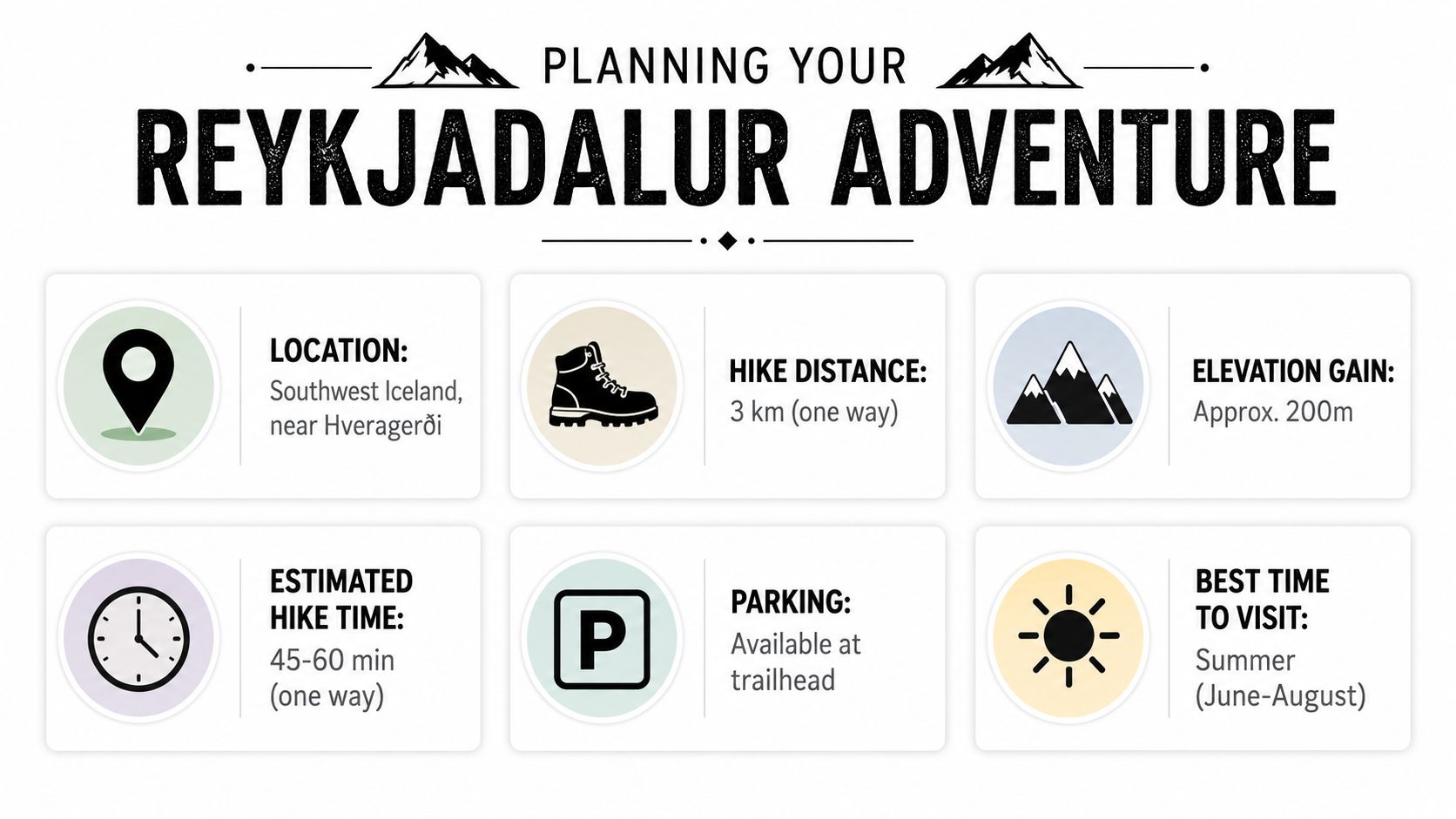
According to a Reykjadalur guide from Adventures.is, the walk to the bathing area is about 3 km each way with roughly 320 metres of elevation gain, and the usual hiking time to the river is around 40 to 60 minutes.
That sounds manageable, and for many reasonably fit travellers it is. The planning mistake is assuming the whole outing is short. Once you add the drive, the uphill walk, changing, soaking, cooling off, and the return hike, this works better as a half-day plan than a quick stop.
A quick overview helps:
| Detail | What to expect |
|---|---|
| Location | Near Hveragerði, southeast of Reykjavík |
| Trail length | About 3 km one way |
| Return route | Same trail back |
| Difficulty | Moderate for casual hikers |
| Bathing access | River access is free |
| Parking | Paid at the trailhead |
Parking and timing
Parking fees and payment methods can change, so check the posted information at the trailhead before you set off. Build in more time than you think you need. Reykjadalur is at its best when you can sit in the warmer channels of the river long enough for your breathing to slow and your muscles to let go.
For wellness-focused travellers, timing also affects how the experience feels on the skin. In cold wind or rain, getting out of the water can feel harsher, especially if you have reactive or dry skin. A dry towel, warm base layer, and a fragrance-free balm for hands, lips, and exposed cheeks make a noticeable difference on the walk back.
Planning rule: Give yourself enough time for the full cycle. Travel, hike, soak, dry off, and return without rushing any part of it.
What works well
A few choices make Reykjadalur noticeably better:
- Use Hveragerði as your final prep stop. It is the easiest place to organise snacks, water, and any last-minute clothing layer.
- Pack dry clothes as carefully as you pack swimwear. Post-soak comfort matters more than people expect.
- Keep skincare simple. Before the bath, skip heavy actives or strongly scented products. Afterward, apply a gentle moisturiser or body oil once you are dry to support the skin barrier after heat, mineral water, and wind exposure.
- Avoid stacking a rigid reservation straight after the hike. The outing feels better when you can let the recovery effect last.
The least successful visits usually involve poor footwear, too little insulation, and a resort mindset. Reykjadalur gives something better than a polished spa, but only if you plan for the weather, the walk, and the very natural changing conditions.
The Hike Through the Smoky Valley
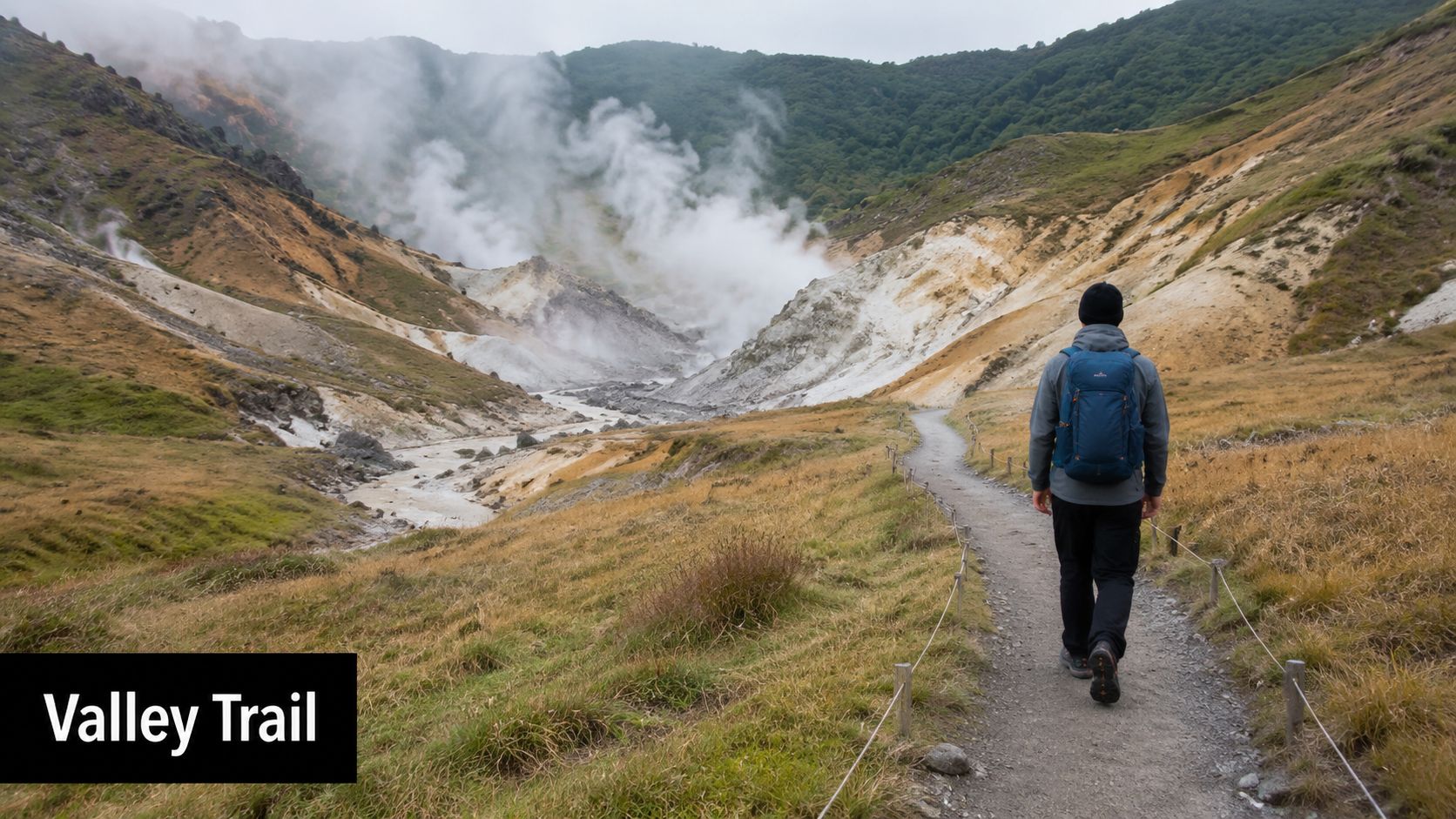
The first part of the Reykjadalur walk tells you almost everything you need to know. The path rises early, your breathing deepens, and steam vents remind you that this isn't just a countryside trail. You're walking into an active geothermal area.
What the trail feels like in practice
“Easy to moderate” sounds tidy on paper, but in Iceland that phrase still deserves respect. The route is mostly uphill on the way in, and although many reasonably fit travellers handle it well, it's not a casual flip-flop stroll.
The practical challenges are usually these:
- Steady climbing: The ascent is what tires people more than the distance.
- Mud underfoot: In spring or rainy weather, the trail can become messy and slippery.
- Exposure: Wind can make a mild day feel much sharper.
That said, the hike gives back constantly. You're not trudging through featureless terrain. You pass a valley shaped by heat and water, where vents hiss, ground steams, and the natural world feels alive in a way few trails do.
How to walk it well
I'd approach Reykjadalur with the mindset of an efficient hill walk, not a race. Shorter steps, even pace, layers you can remove quickly, and a backpack you can manage while changing later. People who push too hard on the climb often arrive overheated, then cool down too fast once they stop.
A better rhythm looks like this:
| Better approach | Usually backfires |
|---|---|
| Walk steadily from the start | Charging the first uphill section |
| Pause briefly for views | Long stops that cool you down |
| Wear proper footwear | Trusting fashion trainers in mud |
| Keep your towel packed tight | Carrying loose, damp-prone items |
Wet ground changes this hike more than distance does. If the trail is muddy, your shoes matter more than your fitness.
Make the hike part of the ritual
A wellness-focused mindset is beneficial. Instead of treating the walk as an obstacle before the “real” reward, use it as the first phase of the experience. Let your body warm up naturally. Let your breathing settle. Notice when your mind finally leaves airport mode and work mode behind.
That shift is one reason Reykjadalur lands so strongly with repeat visitors. The soak feels better because you've approached it under your own power. The valley has already done half the work before you even touch the water.
Bathing in the Hot Spring River
You finish the climb warm, a little wind-flushed, and then the river comes into view with steam lifting off it. This is the moment to slow down. Reykjadalur rewards people who arrive with a calm head and a bit of patience, because the bathing itself is simple, shared, and far more natural than any built spa.
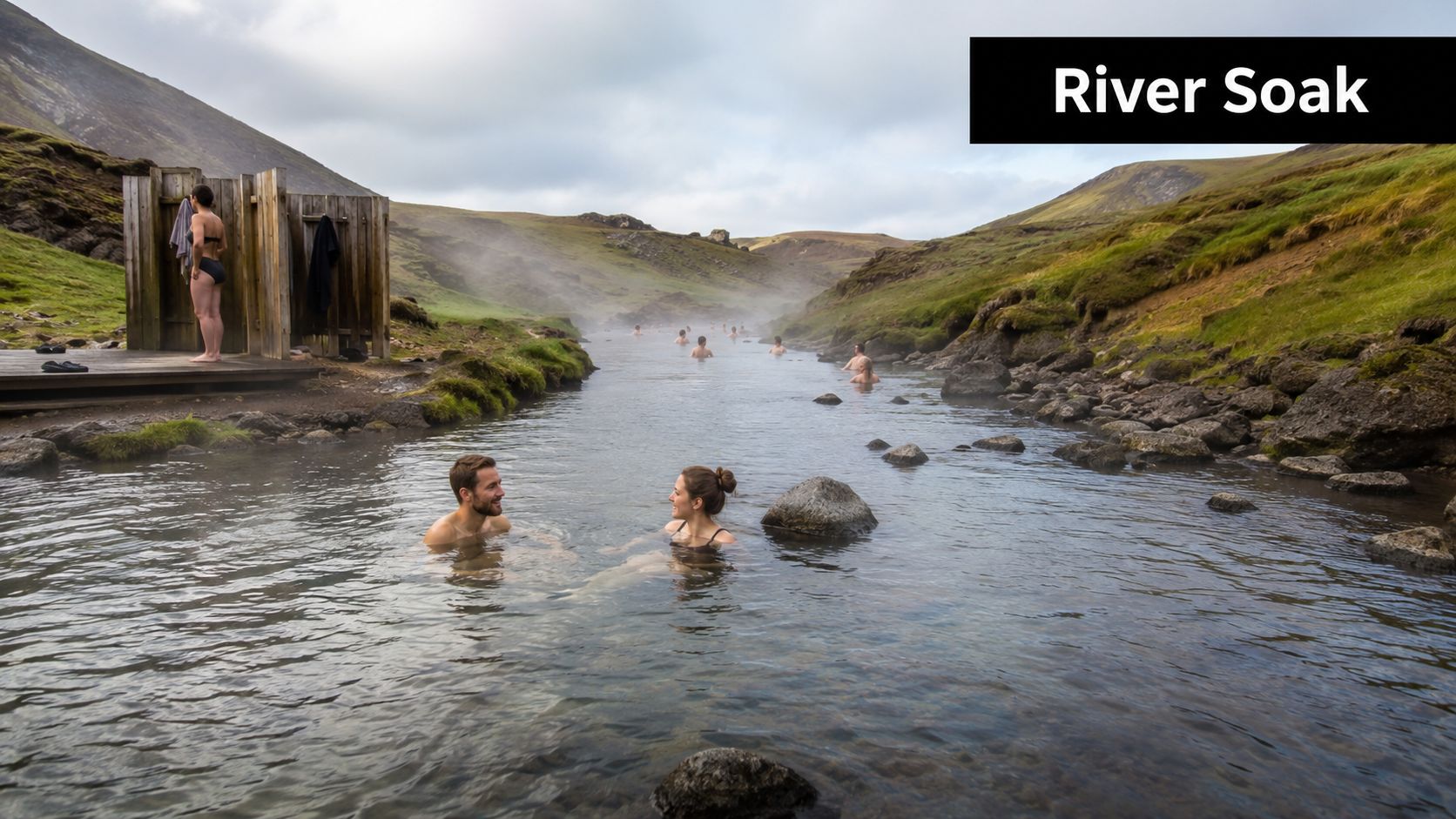
There are basic changing screens and boardwalk sections, but privacy is limited and the river temperature varies along the flow. As noted earlier, some stretches feel pleasantly warm while others are hotter, so the best approach is to test before settling in. I always tell spa-minded travellers to treat this less like a pool and more like a living thermal treatment. You adjust to the water, the weather, and the mood of the place.
Finding the right spot
A good bathing spot is usually found, not claimed instantly. Walk a little first. Watch where people are lingering comfortably, then step in slowly and let your lower legs adjust before sitting deeper.
This works well:
- Keep your dry clothes grouped together. The return feels much easier when you can change fast.
- Test the water with care. A few steps upstream or downstream can change the temperature noticeably.
- Give your body a minute. Heat can feel stronger after a windy hike.
- Move if the spot is wrong. Enduring water that feels too hot is not toughness. It is poor judgment.
For wellness-focused visitors, there is a real trade-off here. A longer soak can feel quite relaxing, but overdoing it often leaves skin more reactive, especially in cold air and geothermal water. Sensitive or dry skin usually does better with a moderate soak, then a prompt rinse or gentle dry-off and re-layering afterwards.
Make it restorative, not just hot
The river has the raw appeal that many destination spas try to imitate, but the skin experience is different. Wind, mineral water, sweat from the hike, and a damp change back into clothes can either leave you restored or slightly stripped.
A better ritual is simple. Go in with clean, product-light skin if possible. Skip heavy fragranced body products before bathing. After your soak, pat the skin dry rather than rubbing hard, then get into warm layers quickly. If you are building the day around natural skincare, this is one of those places where less product before the bath and barrier support after the bath works best.
That balance matters for travellers who already enjoy thermal bathing as part of a broader wellness practice. The calming effect of immersion is part heat, part stillness, and part the mineral water itself. For broader context, this Guide to magnesium for wellness is a useful read.
Extra caution with children and older bathers
Families need a more conservative approach here because a natural river is never as predictable as a managed spa pool. Temperature can vary, footing can be slippery, and the transition from warm water to cool air can hit children and older adults quickly.
Use practical judgment:
- Keep children within arm's reach at all times.
- Choose shorter soaks. Watch faces, energy, and comfort level rather than the clock alone.
- Help with entry and exit. Wet timber, stones, and mud often create the bigger risk.
- Get out early if anyone seems flushed, tired, or unsettled.
Shorter, well-supervised bathing is usually the smarter choice.
A short visual helps first-time visitors understand the setting before they arrive:
Bathing etiquette that keeps the place enjoyable
Reykjadalur feels special because it still asks something from visitors. A bit of restraint goes a long way.
- Change efficiently and keep the boardwalk clear.
- Carry every item back out, including wet waste and used wipes.
- Keep voices low enough for other people to hear the river.
- Treat it as a shared bathing place, not a party stop.
The best visits tend to feel quiet, warm, and slightly elemental. That is the luxury here.
What to Pack for Your Thermal River Hike
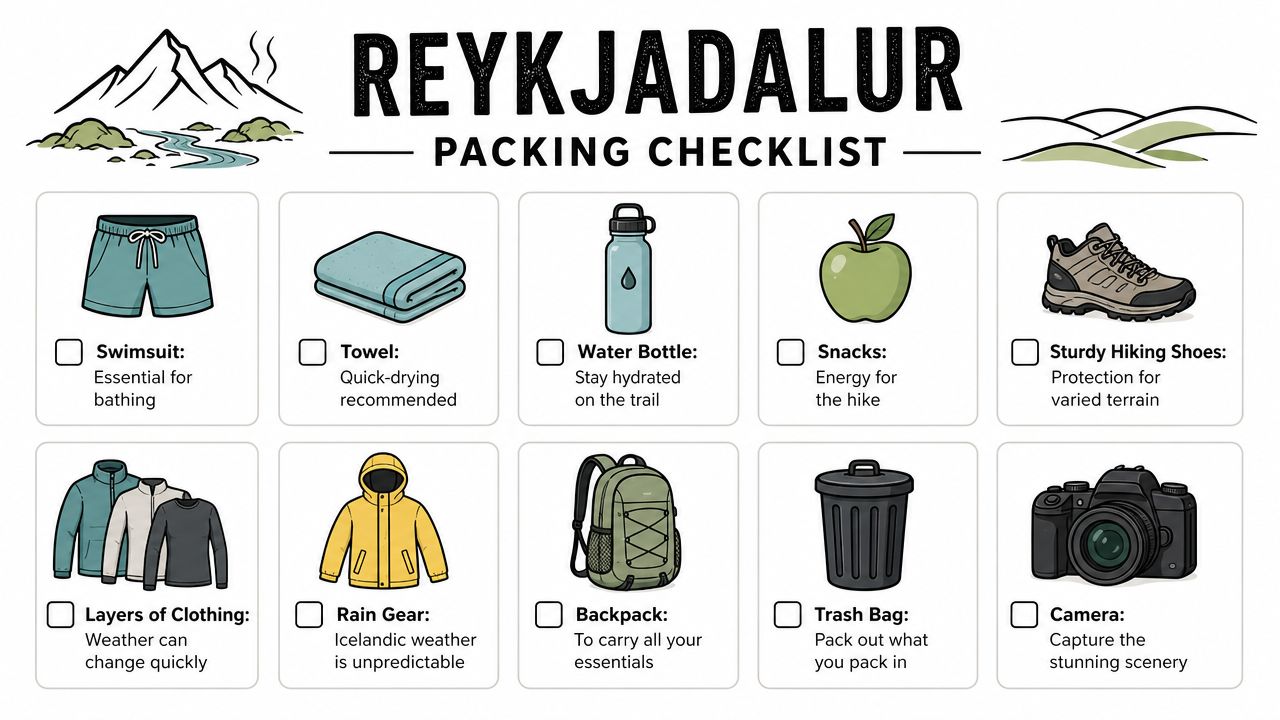
Packing for Reykjadalur is less about quantity and more about friction reduction. Every item should solve a real problem on the trail, at the river, or during the damp walk back.
A poor packing setup turns a restorative outing into a cold, messy one. A good setup makes the whole day feel organised, even when the weather isn't.
The non-negotiables
Start with the obvious, but don't stop there.
- Swimsuit and towel: A quick-drying towel is easier to carry and less miserable afterwards.
- Sturdy footwear: The trail can be muddy, and that changes everything.
- Layered clothing: You want clothing that handles wind, exertion, and post-bath cooling.
- Rain protection: Even on a decent forecast, Iceland can switch mood quickly.
If you want a practical refresher on layering and fabric choices, this guide to dressing effectively for outdoor adventures is worth a look before you pack.
The items people forget
These are the pieces that usually separate a smooth Reykjadalur visit from an annoying one:
| Item | Why it matters |
|---|---|
| Dry bag | Protects phone, towel, and dry clothes from rain and splash |
| Water bottle | The uphill walk is still a physical effort |
| Simple snacks | Useful before or after the soak |
| Slip-on footwear for after | Gives your feet relief at the car |
| Plastic or wet bag | Keeps soaked swimwear away from dry layers |
Bring one bag system for dry items and another for wet ones. Mixing them always feels manageable at first, until the walk back.
Pack for the return, not just the arrival
This is the mindset that helps most. People usually picture the warm river. They don't picture putting damp skin into outdoor clothes while wind picks up. Pack for that moment.
A smart Reykjadalur bag should let you do three things quickly: change, warm up, and protect your dry items. If you can manage those without rummaging through a wet backpack, you've packed well.
A Natural Wellness Ritual
The wellness appeal of Reykjadalur is real, but it needs careful framing. The river is described as mineral-rich, yet there is no publicly available data on specific mineral concentrations such as silica or magnesium, and no published pH range, according to this overview of Reykjadalur's water-information gap. For sensitive skin, that's not a minor detail.
For spas, pharmacies, and skin advisers, the right stance isn't to overclaim. It's to acknowledge uncertainty and build a skin-friendly ritual around it.
Before the soak
A sensible pre-bath approach keeps the skin barrier calm rather than overloaded.
Use these principles:
- Skip strong exfoliation before the hike. Freshly sensitised skin is less happy in natural thermal water.
- Avoid heavily fragranced body products beforehand. Simplicity is safer in unknown water chemistry.
- Keep skin clean and lightly protected. A basic, non-occlusive routine is usually the most practical choice.
This matters especially for clients already managing reactivity, dryness, or a history of irritation in thermal or marine environments.
After the soak
Post-bath care is where the wellness ritual becomes useful rather than decorative. Since the precise water profile isn't published, your goal should be barrier support, hydration, and comfort.
I'd recommend a sequence like this:
- Rinse if your skin feels tight or reactive. Not everyone needs it, but some will.
- Pat dry, don't scrub. Friction after heat exposure can tip skin into redness.
- Apply a gentle hydrating layer first. Think soothing, not active.
- Seal with a richer cream or balm where needed. Knees, shins, hands, and elbows often need more support.
A few product categories tend to work better than others after natural hot-water bathing:
- Barrier-first creams instead of high-acid body treatments
- Simple balms for wind-exposed areas
- Comforting body oils on still-damp skin, if the formula is gentle
- Mother-and-baby style sensitive-skin textures for travellers who react easily
Unknown water chemistry calls for a conservative skincare strategy. Gentle products usually outperform ambitious ones after thermal bathing.
What works for Swiss wellness professionals
For Swiss pharmacies and spas, Reykjadalur is a good example of where premium natural cosmetics can be positioned intelligently. Not as miracle correction, and not as pseudo-medical thermal therapy. Instead, as supportive post-exposure care.
That means recommending routines built around tolerance:
| Better counselling angle | Weaker counselling angle |
|---|---|
| Hydrate and support the barrier | Promise mineral-specific effects you can't verify |
| Advise patch-aware, sensitive-skin options | Assume all thermal water behaves the same |
| Frame the soak as experiential wellness | Present it as standardised treatment |
That distinction builds trust. It also respects what Reykjadalur is: beautiful, restorative, and biologically less predictable than a controlled spa basin.
Pro Tips for an Unforgettable Visit
The strongest Reykjadalur visits usually come from small decisions, not heroic ones. Arrive with time, protect your dry layers, and treat the weather as part of the outing rather than a personal insult.
Choose your moment well
If you dislike crowds, the broad rule is simple. Avoid the most obvious peak windows and give yourself flexibility. Reykjadalur is popular because it's accessible and free to bathe in, so solitude is never guaranteed.
Better timing habits include:
- Go when your schedule allows patience. Rushing ruins the mood.
- Watch the sky as much as the forecast. Conditions can look different on arrival.
- Be realistic about family pace. Children and older relatives may need more stops and more warmth after bathing.
Take photos without sabotaging your comfort
The valley is photogenic, but steam, moisture, and cold hands aren't kind to careless gear handling.
A practical photography approach:
| Do this | Skip this |
|---|---|
| Keep your phone in a protected pocket or dry bag | Leaving electronics exposed on wet surfaces |
| Take quick shots before bathing | Fumbling with gear once your hands are wet |
| Photograph the hike as well as the river | Saving everything for the end point |
One of the nicest visual records of Reykjadalur often comes from the approach path. Steam, slopes, and the sense of movement tell the full story better than a single bathing photo.
End the day properly in Hveragerði
Hveragerði earns more than a passing glance. It gives Reykjadalur context. After the hike, the town is the natural place to warm up, dry off fully, eat something solid, and return to ordinary civilisation without losing the geothermal mood too abruptly.
Don't finish Reykjadalur by sprinting to the next landmark. Finish it by letting the body come down slowly.
The final trade-off to accept
Reykjadalur is one of those places that rewards the right temperament. If you need full privacy, perfect infrastructure, and exact predictability, a developed lagoon will suit you better. If you like a little mud, a little effort, and a lot of atmosphere, this valley delivers something more memorable.
The experience works because it isn't over-managed. That also means you have to do your part. Walk carefully. Bathe thoughtfully. Protect your skin afterwards. Leave the place clean.
That's the version of Reykjadalur worth seeking.
Swiss pharmacies, spas, and wellness retailers that want to turn experiences like Reykjadalur into thoughtful aftercare rituals can explore the natural and premium cosmetic portfolio at beautysecrets.agency. Their curated selection is well suited to partners who need gentle, high-quality formulations for sensitive, post-bath, and barrier-support routines without compromising on ethical sourcing or premium positioning.