A premium spa menu in Switzerland often reaches the same decision point. Clients want something expressive, natural, photogenic, and low commitment. Your team wants a service that feels refined, fits a wellness setting, and doesn't introduce avoidable risk. A henna hand tattoo can meet that brief, but only if you treat it as a professional cosmetic ritual rather than a novelty add-on.
That distinction matters. Consumer content usually focuses on quick patterns and social media aesthetics. A Swiss spa owner or retailer has a different job. You need to evaluate safety, product purity, service design, staff training, and client communication at the same time. If any one of those pieces is weak, the service stops feeling premium very quickly.
The businesses that get this right don't sell “temporary tattoos”. They offer a culturally rooted, plant-based adornment with clear boundaries, careful sourcing, and excellent aftercare guidance. That's where trust, repeat bookings, and brand fit come from.
The Art of Henna A Timeless Opportunity for Your Business
A client checks into your Zurich spa for a facial before a wedding weekend. She wants something refined for her hands, visible in photographs, gentle on the skin, and temporary enough that it does not interfere with work the following week. Your therapist can offer that service profitably, but only if henna is positioned with the same discipline you apply to any premium cosmetic treatment.
That is the commercial opportunity.
A henna hand tattoo gives Swiss spas and retailers a rare combination of benefits. It is service-based, visually distinctive, and time-limited. Clients get adornment without the commitment of conventional tattooing, while the business gains a treatment that fits bridal bookings, private events, seasonal packages, hotel experiences, and selected in-store activations.
The strongest results come from treating henna as part of a professional offer, not as a novelty counter service. In practical terms, that means clear product standards, well-defined consultation steps, staff who can explain what clients should expect, and a menu position that matches the rest of your brand.
Why henna suits a premium Swiss business
Henna carries cultural depth as well as visual appeal. For a premium business, that matters because clients are not only buying a pattern on the skin. They are buying trust, context, and the feeling that the service belongs in your environment.
A useful comparison is the difference between serving loose-leaf tea in a luxury hotel and selling a sweetened bottled drink at a kiosk. Both begin with a plant ingredient. The value changes through sourcing, presentation, training, and guest experience. Henna works in the same way.
In a Swiss spa, boutique hotel, or pharmacy-adjacent wellness concept, henna can support several strong business objectives:
- Service differentiation: It gives your menu a visible treatment that feels curated rather than routine.
- Low-commitment client appeal: It suits guests who want self-expression for an event without a permanent result.
- Natural brand alignment: Plant-based positioning can fit well, provided the formula is pure and the claims stay accurate.
- Retail attachment: Hand care, gentle cleansing, protective balms, and aftercare oils can be sold around the appointment.
That last point deserves attention. A good henna service does not end when the design is finished. Like a facial that drives homecare sales, it creates a reason to recommend supporting products with a clear purpose.
Where commercial value is gained or lost
Some Swiss business owners still place henna in the wrong category. They associate it with festival stalls, resort kiosks, or low-control tourist retail. That assumption hides a profitable service line.
The premium version is defined by control.
Control over what enters the formula. Control over how the service is described. Control over who performs it. Control over which clients are suitable, and which should be declined. Without those controls, henna can weaken a premium brand very quickly.
Clients usually ask the same practical questions. What exactly is being applied? How dark will it become? How long will it last? Is it suitable for sensitive skin? A trained team should answer these questions with the calm precision of a skin therapist discussing an active serum. Confidence sells the service.
For that reason, henna works best in businesses that already value consultation, documentation, and ingredient transparency. It can strengthen your offer without moving into invasive territory, and it creates a visible result that often prompts conversation, photographs, and repeat bookings.
The opportunity extends beyond treatment rooms. Retailers can use henna during curated launch events. Hotels can add it to bridal or celebration packages. Selected pharmacies can offer it cautiously in a dermocosmetic setting where staff are trained to screen for sensitivity concerns and explain boundaries clearly.
Used well, a henna hand tattoo is not a side attraction. It is a commercially sound, culturally respectful service category with room for premium pricing, retail support, and strong brand fit in the Swiss market.
Understanding Henna The Science and Tradition
A client sits in your reception area before a bridal booking and asks a question that sounds simple: “What is this made from?” Your answer shapes trust long before the first pattern is drawn. In a premium Swiss setting, henna should be explained with the same clarity you would expect for a professional peel, mask, or botanical body treatment.
What Henna Is
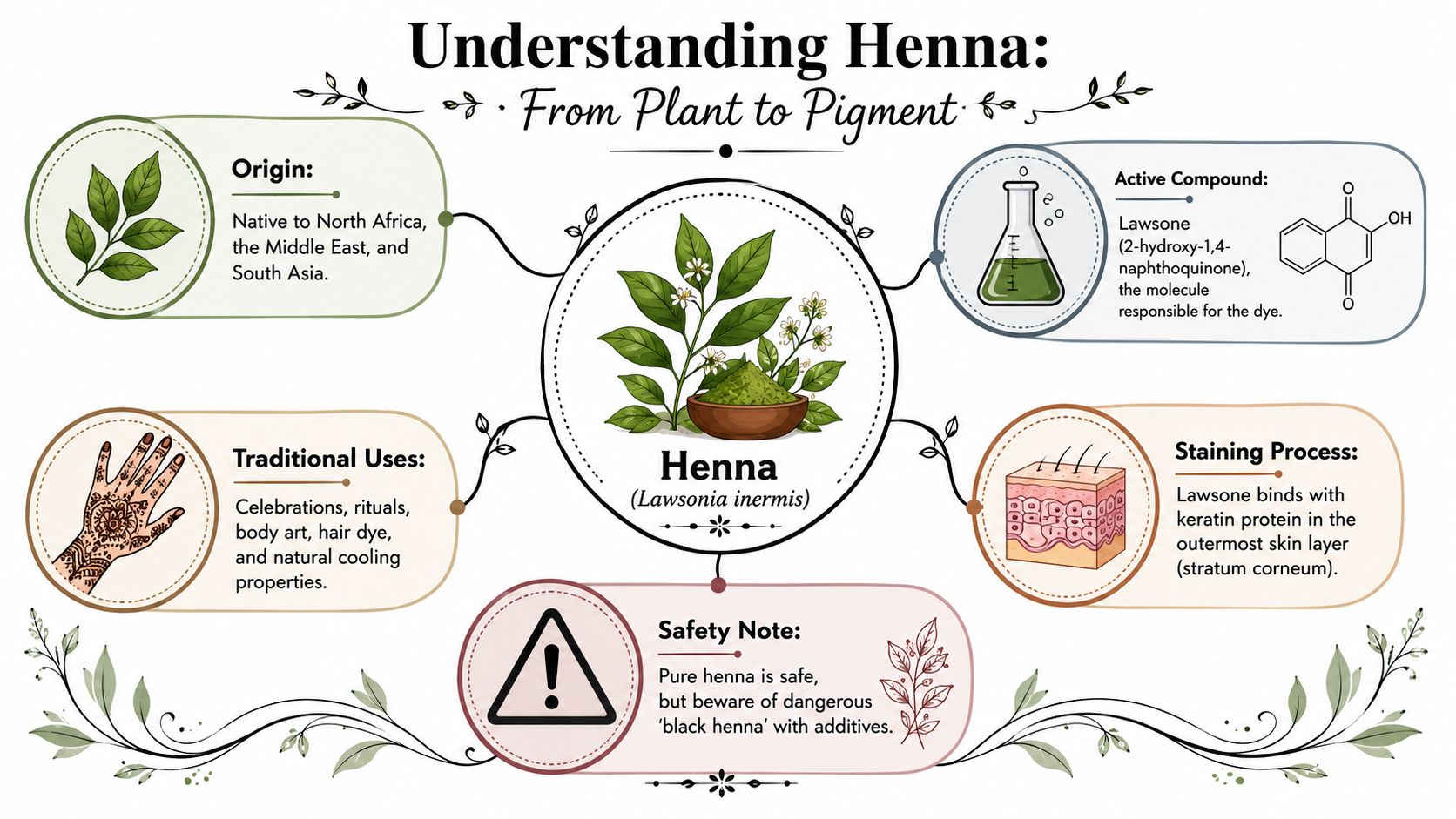
Henna comes from Lawsonia inermis, a plant whose colouring molecule is lawsone, also known as 2-hydroxy-1,4-naphthoquinone. That molecule stains the outermost skin layer by attaching to keratin, which is why henna behaves very differently from ink, paint, or adhesive transfers.
For staff training, this distinction matters. If your team describes henna as a surface decoration, clients will expect instant colour and uniform wear. If they describe it correctly as a temporary botanical stain, clients understand why the result develops gradually and fades as skin renews.
Tea on linen is a useful comparison. The colour takes hold because it bonds with the material rather than sitting on top as a coating. Henna works in a similar way with keratin in the stratum corneum.
That explains three commercial realities of the service:
- The colour develops over time. Fresh paste and fresh stain do not show the final result.
- The fade pattern is gradual. As surface skin cells shed, the design softens.
- Placement affects performance. Palms, fingers, and areas exposed to friction, soap, or sanitiser may behave differently from less active areas.
For a spa owner, this is more than technical detail. It is expectation management, and expectation management protects reviews, repeat bookings, and staff credibility.
Why tradition matters in a premium service
Henna also carries cultural weight. It has long been used for adornment in celebratory settings, especially on hands and feet, and many clients associate it with weddings, family ceremonies, and festive preparation, as noted earlier in the article.
That background should shape your service language. A premium business should not present henna as novelty entertainment or fast event decoration. It should present henna as a respected adornment practice with established motifs, placement traditions, and social meaning.
This distinction affects brand fit. A luxury spa that treats henna casually can make the service feel cheap. A spa that explains the tradition with restraint and respect can position it alongside other high-touch ritual services.
How to explain the result without creating confusion
Client confusion usually starts with the visible gap between paste, fresh stain, and developed stain. Staff need a calm, consistent script.
| Client question | Clear professional answer |
|---|---|
| Why does the paste look different from the final colour? | The paste is the delivery medium. The visible stain appears after contact with the skin and continues developing after removal. |
| Why is it darker the next day? | Pure henna deepens over the following hours as the stain oxidises and settles into the outer skin layer. |
| Why does one client keep the design longer than another? | Skin turnover, washing frequency, friction, placement, and aftercare all affect how long the stain remains visible. |
A good rule for team training is simple. Explain process before promising appearance.
That approach helps clients understand what they are buying, and it helps your business position henna as a controlled professional service rather than a casual add-on.
Navigating Henna Safety and Swiss Regulations
A guest sits in your reception area before a wedding weekend in Zürich. She asks for a deep black henna hand tattoo because she saw one on holiday and wants the same dramatic contrast. In a premium Swiss business, that moment is not only a style conversation. It is a product safety decision, a compliance decision, and a brand protection decision.
The problem with black henna
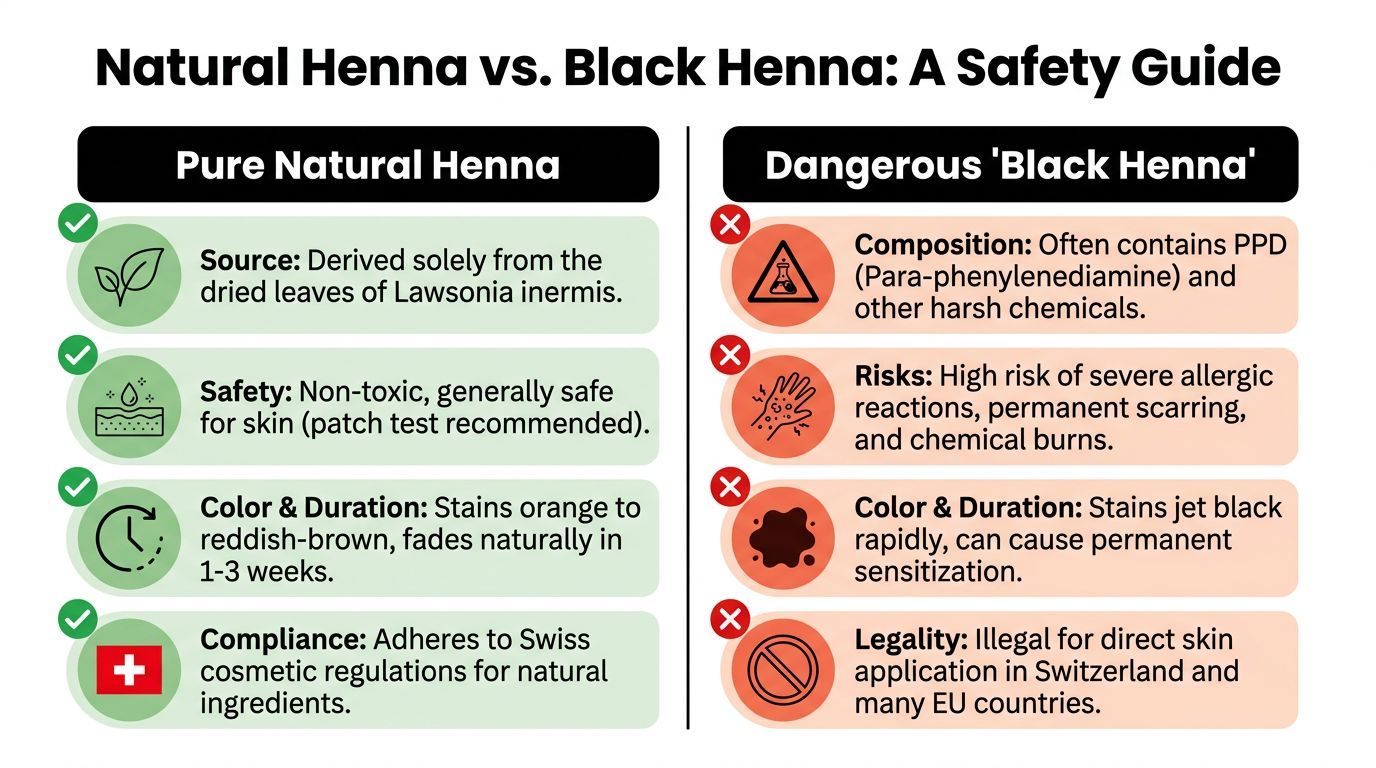
The first point to teach staff is simple. Henna is not one uniform category. Pure natural henna stains in a brown to reddish-brown range. Products sold as “black henna” often achieve that darker result by adding other dye agents, and that is where the risk profile changes sharply.
The ingredient that deserves particular scrutiny is paraphenylenediamine (PPD). PPD is known in dermatology for its sensitising potential. For a spa owner or retailer, the practical meaning is clear. A cone that promises unusually dark, fast results may behave less like a botanical adornment product and more like an avoidable liability.
Why this matters in commercial practice
Skin reactions do not always appear while the client is still on site. A service can look uneventful at the counter, then turn into a complaint two days later. That delay creates a false sense of safety for undertrained teams and poorly controlled suppliers.
Published discussion of body art history and dermatological concerns notes that black henna has been associated with allergic contact reactions and that regulatory treatment of skin use has long been more restrictive than many informal sellers imply, according to this review of henna body art and dermatological risk.
For a Swiss operator, the lesson is straightforward. If your records cannot show what was used, who supplied it, and what the client was told, you are operating on trust alone. Premium businesses should operate on verification.
A critical rule: If a product claims to produce a black stain from “henna,” treat it as a safety and compliance concern until the full composition is verified.
What Swiss businesses should require before offering the service
You do not need laboratory training to set a high standard. You do need procedures that would still look sensible under supplier review, client complaint review, or insurer review.
Use a filter like this:
- Require full ingredient disclosure. A supplier who cannot provide a complete INCI list is asking you to buy blind.
- Separate pure henna from mixed dye products in your buying process. Do not let merchandising language blur that line.
- Screen clients before booking or application. Ask about dye allergies, eczema, previous reactions to hair colour, and broken or irritated skin on the hands.
- Set a written patch-test policy where appropriate. Staff should also explain that a patch test reduces uncertainty but does not remove all risk.
- Create a referral boundary. Clients with a history of severe dye reactions should be directed to a pharmacist or medical professional rather than informally reassured.
This is how premium service discipline works. A good spa does not prove quality by saying yes to every request. It proves quality by knowing when to slow the process down.
Regulation, positioning, and trust
Swiss clients often assume that a service offered in a polished setting has already been vetted. That assumption can help your business, but it also raises the standard you must meet. Boutique presentation does not compensate for weak sourcing controls.
A safer operating model starts with language. Staff should say “pure henna” only when the ingredient list supports that claim. They should explain that darker and faster are not automatic signs of better quality. In fact, for hand application, those promises are often the first reason to ask harder questions.
That distinction matters commercially. A luxury spa should never package uncertainty as exotic appeal. If the cone contents are unclear, the service should not be marketed as natural, premium, or suitable for sensitive clients.
A practical decision filter
Before launch, test your service model against four operational questions:
| Question | If the answer is no |
|---|---|
| Do we have full ingredient disclosure? | Pause the product review |
| Can staff explain the difference between pure and black henna? | Delay service launch |
| Do we have written client aftercare and reaction guidance? | Build it first |
| Do we exclude damaged or highly reactive skin? | Update consultation forms |
Strict standards protect more than skin. They protect client trust, insurer confidence, and the long-term value of the service category in your business.
Mastering Application and Aftercare for Lasting Results
A client arrives on Friday afternoon for a hand design before a Saturday wedding in Zürich. The application itself takes less than an hour, but the commercial result is decided by what happens over the next twelve to twenty-four hours. In a premium spa, henna should be managed like any other results-sensitive service. Technique matters, and client handling matters just as much.
Start with consultation, not design
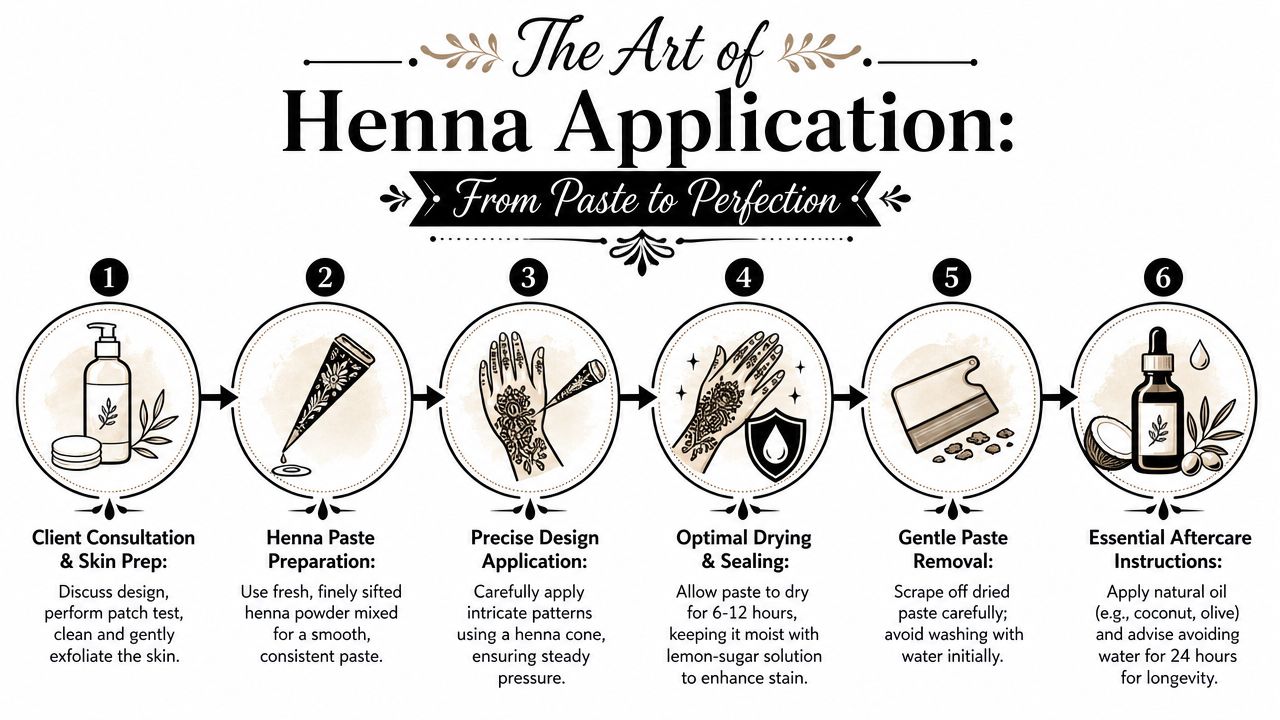
The first conversation sets the service up for success or for disappointment. Ask about skin condition, event timing, preferred placement, and the client's expectation of colour depth on day one versus day two. Henna develops over time, so a guest booking for a same-day campaign shoot needs different advice from a bridal client who has planned ahead.
Preparation should be gentle and controlled. Clean hands, dry skin, and minimal surface residue give the paste better contact with the skin. Over-cleansing or aggressive prep adds no value and may create irritation on an area that will already face frequent washing.
For spa teams, this is the practical rule. Treat the appointment like a luxury facial with a colour service timeline attached. The visible finish is only one part of the outcome. Durability, comfort, and expectation management are part of the sale.
Contact time shapes the business model
Henna needs time on the skin to leave a stronger stain. If the paste is removed too early, the result is usually lighter and shorter-lived. As noted earlier, this is why fast-service positioning often works against client satisfaction, especially on hands, where washing and friction are constant.
That point often causes confusion. Clients see a dry surface and assume the process is finished. It is not. Surface drying only means the paste has set enough to sit in place. Stain development continues while the paste remains in contact with the skin.
A premium service model should reflect that reality. Apply the design professionally in-spa, then provide clear instructions for protected wear, safe removal, and realistic colour development over the following day.
Strong henna results come from controlled contact time and disciplined aftercare, not from rushing the appointment.
For teams that want a visual reference on handling and flow control, this demonstration is useful:
A professional protocol that works
Consult and screen
Confirm sensitivities, damaged skin, occupation-related hand washing, and event date. Recommend placements that suit hand shape, daily habits, and the client's tolerance for visible fading.Prepare the skin
Clean the area carefully and keep the surface free from oils, heavy hand cream, or residue that may interrupt even contact.Apply with control
Use steady pressure, consistent line weight, and enough paste height to keep the design defined while it dries. Controlled application usually produces a cleaner luxury finish than thicker, hurried lines.Protect the setting phase
The paste may dry on the surface relatively quickly, but the colour result still depends on undisturbed contact. Give clients written instructions on how to avoid smudging, friction, and premature removal.Remove without washing
Advise clients to scrape away dried paste gently instead of rinsing it off immediately. Water too soon can reduce the early development phase.Support the first day
Recommend limited water exposure, mild cleansers, and sensible protection during household or work tasks. Hands fade faster than less active body areas, so aftercare has direct commercial impact on satisfaction.
The aftercare message clients actually need
Client complaints often come from timing errors, not poor service execution. A fresh stain rarely shows its final tone immediately after paste removal, and hand washing affects wear far more than many guests expect.
Give every client a short printed or digital aftercare note. Keep the language plain and practical:
- Expect continued development: The colour usually deepens after the paste is removed.
- Limit prolonged water exposure: Frequent washing, soaking, and steam speed fading on the hands.
- Avoid harsh detergents and strong surfactants: These strip the surface faster and shorten visible wear.
- Use light barrier support if appropriate: Gentle moisturising can help the skin stay comfortable and keep the design looking neater.
The businesses that keep this service profitable are usually the ones that standardise the full client journey. Good consultation, careful timing, and consistent aftercare messaging turn henna from a novelty add-on into a credible premium service.
Sourcing Premium Henna Products Responsibly
A spa owner adds henna to the menu, books fill quickly, and then the real test begins. Can the business reorder the same quality every time, document what is in the product, and let staff answer safety questions without hesitation? In Switzerland, sourcing decides whether henna remains a premium service or turns into a preventable risk.
Start with supplier transparency, not brand aesthetics
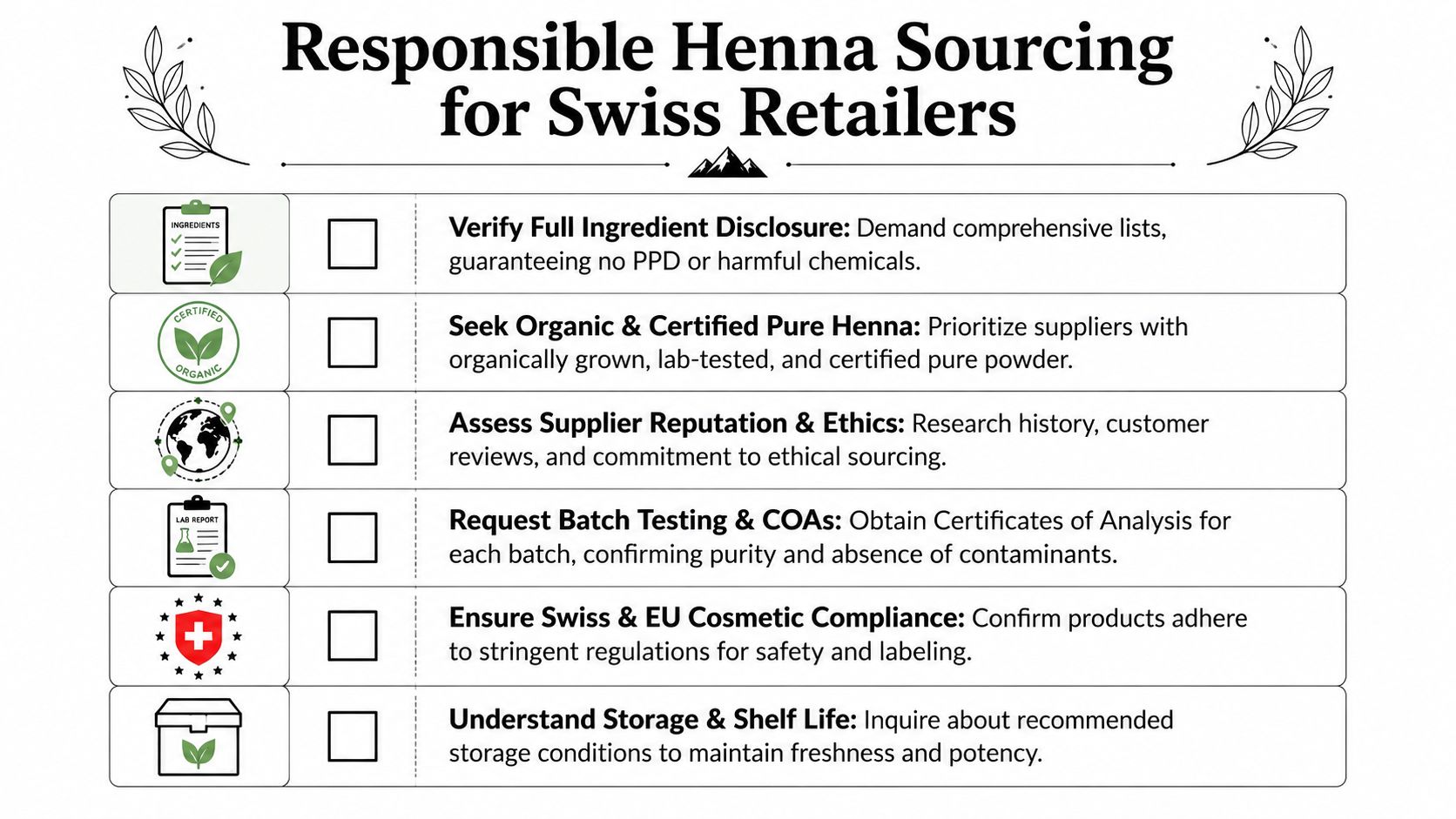
Procurement for henna should work like procurement for any serious cosmetic item. Attractive packaging, cultural storytelling, and social buzz do not replace formula clarity. A premium supplier should be ready to explain what is in the product, where the henna is grown, how the material is processed, how batches are identified, and how the product should be stored before use or resale.
If those answers come slowly, change by email, or remain vague, treat that as a purchasing warning. Swiss clients paying premium prices expect the discipline of a professional beauty business. They are not paying you to experiment with unclear stock.
Consumer content often blurs the line between traditional henna and adulterated fast-darkening products. For a spa or retailer, that confusion becomes a commercial problem. Staff confidence drops, consultations become hesitant, and premium positioning weakens.
Build a supplier file your team can actually use
A good supplier file should help three departments at once. Buying needs traceability. Front-of-house staff need plain-language product facts. Management needs evidence that the service can scale across locations or seasons without quality drift.
Ask for documents before the first order, not after a client query.
Full ingredient disclosure
Review the INCI list before purchase approval. If a supplier avoids written disclosure, remove them from consideration.Clear exclusion statements for high-risk additives
Your team should not have to infer whether PPD or similar adulterants are absent. The supplier should state it clearly.Batch identification and traceability
Henna is a plant-based material. Like any agricultural input, quality can shift if sourcing and handling are poorly controlled. Batch records let you track what was used, where, and when.Storage and shelf-life guidance
Freshness affects service consistency. A credible supplier explains storage temperature, light exposure, opened-versus-unopened handling, and realistic use periods.Use-case fit
Some products are suitable for professional treatment rooms. Others are packaged more appropriately for retail shelves. Your supplier should know the difference and support both conversations correctly.
What a premium sourcing conversation sounds like
The best suppliers speak the language of cosmetic control and service performance. They can still respect the cultural history of henna, but they do not hide weak documentation behind heritage language.
Use a review table like this during vendor selection:
| Supplier question | What you want to hear |
|---|---|
| Can you provide the full INCI list? | Immediate, documented disclosure |
| How do you address PPD concerns? | Clear written confirmation that it is excluded |
| What support do you offer for sensitive-skin client conversations? | Cautious guidance, limitations, and retail-facing support material |
| What proof of quality is available? | Batch records, testing information, or equivalent product documentation |
| How should the product be stored in a spa or boutique setting? | Specific written handling and shelf-life instructions |
One sentence can save you months of trouble. If your buyer cannot explain a henna product to a regulator, therapist, and client using the same facts, the product is not ready for a premium Swiss setting.
Buy for service reliability, not just ingredient romance
Henna sourcing is often discussed as if the only question is whether the powder sounds natural. For a business, the more useful question is whether the supplier helps you deliver a repeatable paid service. A beautiful first order means little if the second batch behaves differently, arrives with incomplete documentation, or leaves staff unsure what to say at the retail counter.
That is why premium sourcing and commercial viability belong in the same conversation. Reliable product information improves consultations. Stable supply improves scheduling. Consistent quality protects reviews and repeat bookings. Retail attachment also becomes easier because clients trust the service behind the product.
If you plan to promote henna online, keep your sourcing standards visible in your messaging. Educational content about ingredient clarity, professional handling, and premium service positioning tends to perform better than trend-led posts that copy consumer DIY culture. The ShortsNinja social media guide is a useful reference for turning that kind of expertise into content your audience will understand.
Buying principle: Choose henna suppliers the same way you would choose a skincare manufacturer for a premium treatment room. Documentation first, consistency second, branding third.
Marketing Henna Services in Your Swiss Business
A henna service doesn't sell well when it's described vaguely. “Temporary tattoo” is too broad. “Natural hand adornment” is better, but still incomplete. Clients need to understand what they are booking, how it develops, and why your version is safer and more refined than the informal alternatives they've already seen online.
Position the service by occasion and setting
Start with use cases clients already recognise. Bridal events. Wellness weekends. Eid, Diwali, and celebratory gatherings. Resort and hotel activations. Seasonal retail events. Private appointments for visible but non-permanent adornment.
That approach gives your menu structure. Instead of one generic line item, build a small service family. Keep the options easy to understand:
- Express placement for minimal motifs on the back of the hand
- Signature hand design for more developed decorative work
- Event booking for bridal or group occasions
- Retail pairing with hand care or gentle aftercare products
This keeps the conversation focused on suitability and experience, not just design complexity.
Market the colour development honestly
One of the smartest marketing moves is also one of the simplest. Explain that henna develops in stages. The staining kinetics follow a biphasic pattern, with visible dye transfer during the first hours and a secondary darkening phase over the next 24 to 48 hours after paste removal, as described in this explanation of henna's two-stage stain development.
That point helps you in three ways. It reduces premature disappointment. It creates anticipation. And it gives your team a strong follow-up moment for post-treatment messaging.
A useful line for booking pages and consultation cards is: “Your design will continue to mature after application, so the best colour often appears later rather than immediately.”
Build trust through language, not hype
Avoid dramatic claims. Don't promise “instant dark results” or “tattoo-like permanence”. Those phrases attract the wrong expectations and can steer the conversation back toward the very products a premium operator should avoid.
Use language that signals craft and care:
| Weak message | Stronger message |
|---|---|
| Fast black tattoo effect | Botanical henna hand adornment |
| Instant results | Colour develops naturally after application |
| Festival tattoo | Ritual-inspired decorative hand service |
| One-size-fits-all | Consultation-led placement and aftercare |
Clients respond well when your copy sounds informed, calm, and specific. That tone reinforces safety before a single question is asked.
Social media should educate as well as attract
Henna is naturally visual, but image-first marketing can backfire if it strips away the service explanation. Your posts should show the design process, stain development, and aftercare journey, not just the final hand pose.
A practical framework for organising that content appears in the ShortsNinja social media guide. It's useful because it helps businesses map content by objective instead of posting attractive images without a clear booking purpose.
For this category, your content mix should include:
- Portfolio posts showing your actual design style and placement quality
- Expectation-setting reels explaining how colour deepens after removal
- Safety education posts clarifying the difference between pure henna and black henna
- Occasion-led campaigns tied to weddings, celebrations, and hotel experiences
The service sells best when operations and marketing match
Marketing can only amplify what the operational side already supports. If your team gives clear aftercare advice, your reviews will reflect that. If your consultation is disciplined, clients will describe the service as professional rather than casual. If your sourcing is transparent, your brand can speak confidently about quality without sounding defensive.
That is the core advantage for Swiss businesses. You don't need to compete with low-cost novelty vendors. You need to offer something they can't. Better screening, better language, better products, and a better client journey from first enquiry to final fade.
If you're building a premium henna or clean-beauty offer for Swiss spas, pharmacies, or retail, beautysecrets.agency can help you evaluate natural product positioning, compliance-minded assortment choices, and brand-fit sourcing with the level of care this category requires.