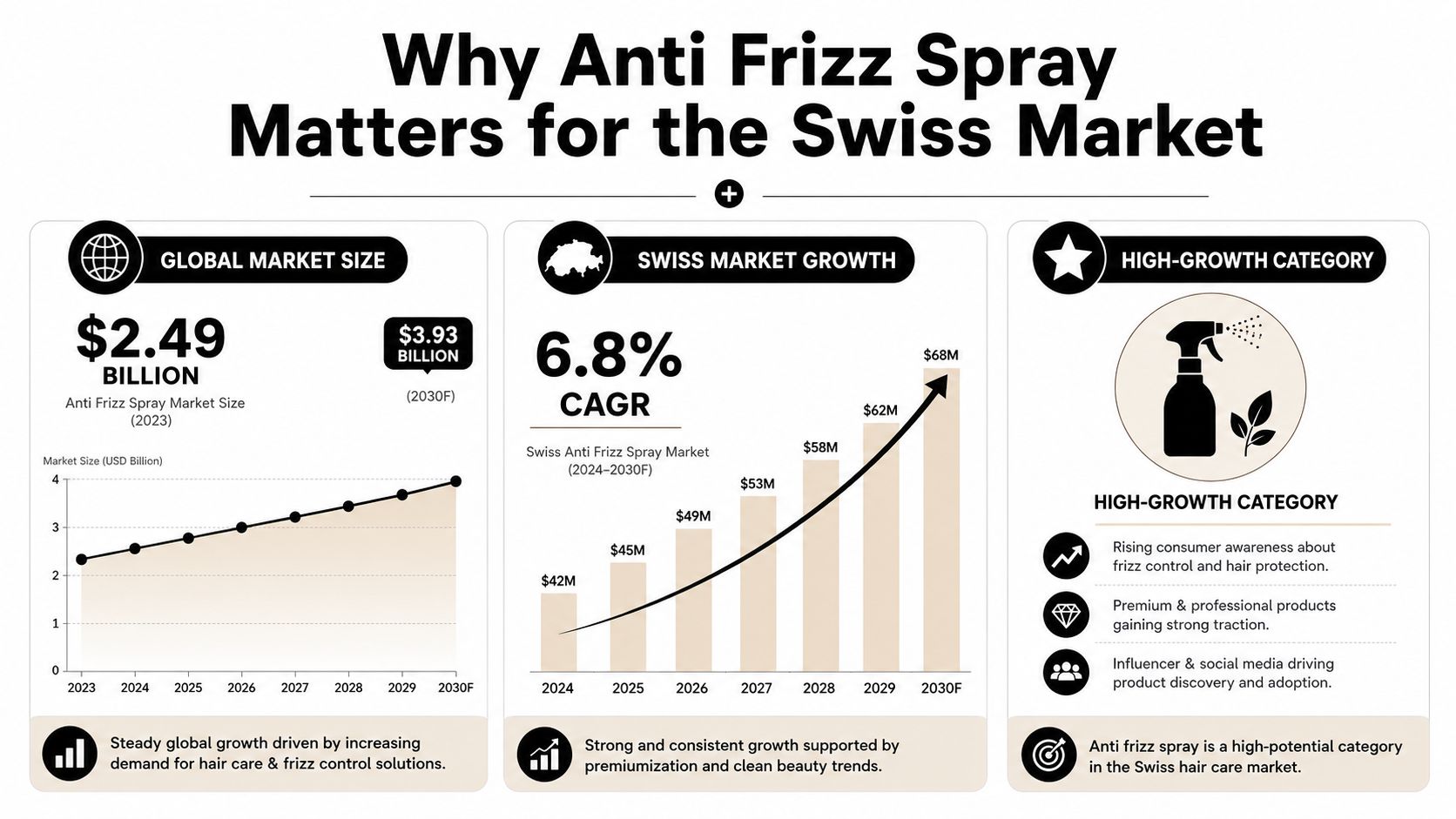
Anti frizz spray is not a niche add-on in Switzerland, it sits inside a category that is still expanding fast. One market study projects the global anti-frizz hair care market to rise from USD 5.1 billion in 2024 to USD 12.0 billion by 2034, a gain of USD 6.9 billion at a CAGR of 8.9% over 2025 to 2034, while another forecast puts the market at USD 5,703.7 million in 2025 and USD 12,803.8 million by 2035 with serums and oils already holding 39.2% share. Switzerland sits inside Europe, and Europe is part of the region that already accounts for over 55% of global anti-frizz product sales, so Swiss demand belongs to a market that's already commercially proven and still growing. For pharmacies, drugstores, spas, and premium e-commerce partners, that makes anti frizz spray a serious shelf category, not a seasonal afterthought. Global anti-frizz market outlook and anti-frizz hair care forecast back that commercial reality.
Why Anti Frizz Spray Matters for the Swiss Market
Swiss retailers should treat anti frizz spray as a routine styling and finishing product with real basket potential. The category is not being pulled by hype alone, it's being supported by a broad global market that's still adding value, and Europe already carries a majority share of demand in anti-frizz products. That matters in Switzerland because the country's trade channels are built for premium, functional personal care, which is exactly where frizz-control products belong.
What the numbers mean on shelf
The commercial message is simple. If a category is growing globally and already anchored in Europe's demand base, Swiss buyers don't need to wait for proof of concept. They need a clean assortment, disciplined price architecture, and formulations that match real customer routines.
Practical rule: Stock anti-frizz spray as a repeat-use solution, not a one-off treatment. Customers buy faster when the product sits next to blow-dry, smoothing, and heat-protection items, not isolated in a “problem and solution” corner.
That's especially true in pharmacies and drugstores, where shoppers expect function, clarity, and trust. Premium e-commerce and spa retail can go further by separating lightweight finishers from stronger humidity blockers. The category earns its place when the shopper can immediately see the use case.
The strongest retailer mistake is overthinking the sell-in. Anti-frizz solutions already live in a growth market, and Switzerland sits in a region with meaningful category share. The right move is to merchandise for convenience, then educate for results.
How Anti Frizz Spray Actually Works
Frizz starts when hair absorbs moisture from the air. The cuticle lifts, the fibre swells, and the surface stops reflecting light evenly. In Switzerland, that becomes a practical issue because indoor heating, alpine weather shifts, and quick changes in humidity can make hair behave differently from one hour to the next.
The barrier does the real work
Good anti frizz spray works like a thin raincoat for hair. Film-forming polymers help create that barrier, while silicones or quaternary conditioning agents reduce water uptake and lower friction across the fibre. That's why the best sprays don't just make hair look smoother for a moment, they help it stay smoother through the day.
A professional formula cited in the source materials shows 24-hour frizz control with a long-lasting anti-static finish, while another claims 72-hour humidity protection and up to 400°F thermal shielding when heat-activated during blow-drying. Those claims matter because they show the category is built around performance, not just gloss.
Retail takeaway: If a customer wants “less frizz”, ask whether they mean wet-hair prep, heat-styling support, or dry-hair finishing. That question prevents the usual mismatch between product and routine.
For staff who want a simple reference point, the Japanese moisture guidance from Japanese moisture tips for frizz is useful because it reinforces the same logic, moisture balance, friction control, and a cleaner surface finish, without turning the conversation into a science lecture.
The smart way to explain the product is to describe what the spray blocks, what it smooths, and when it should be applied. Customers understand that faster than ingredient jargon, and it gives your staff a script that sounds practical instead of promotional.
Silicones Versus Natural Alternatives in Formulation
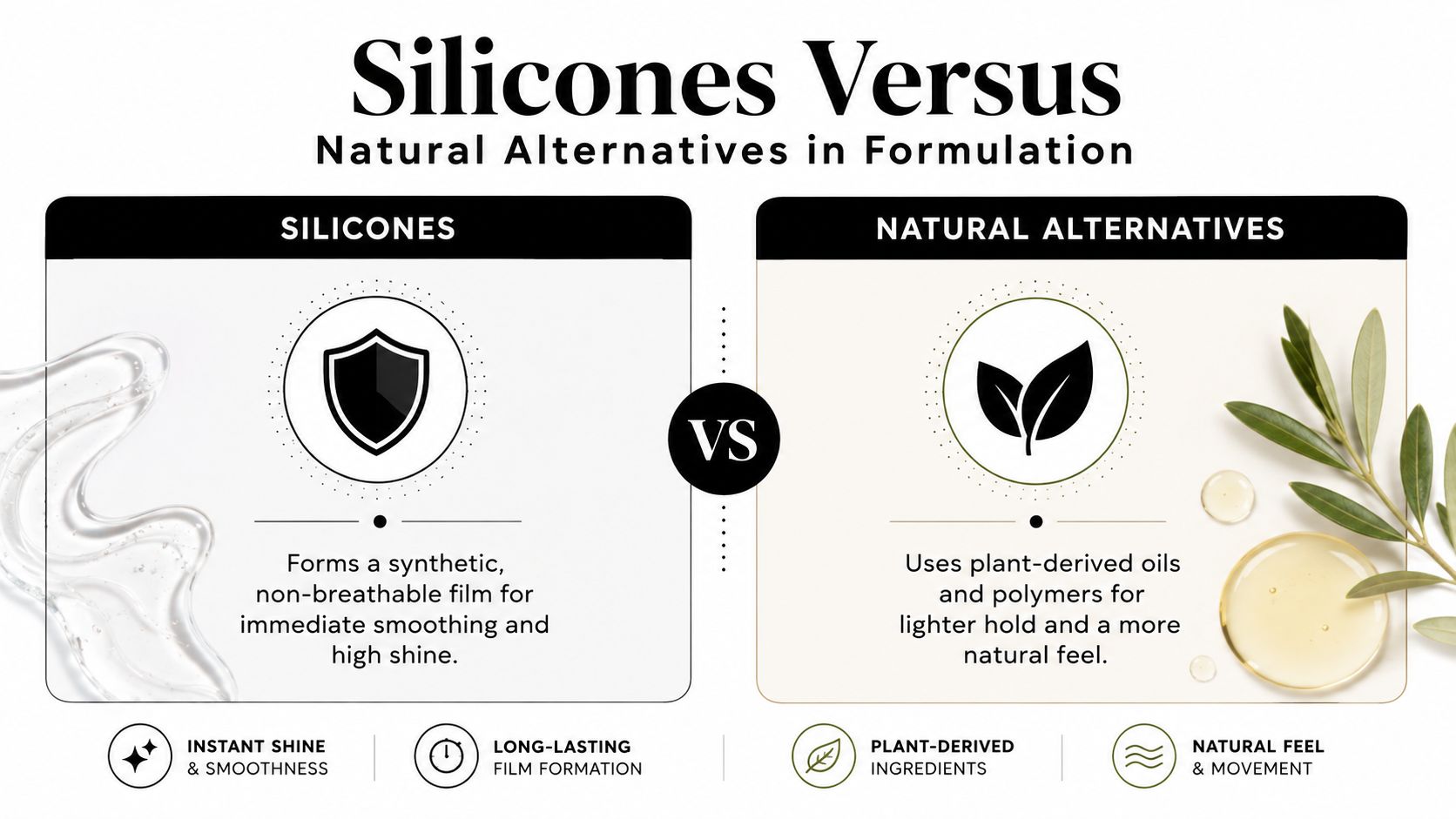
Swiss assortments get decided by understanding diverse shopper needs. Some shoppers want immediate smoothness and high shine, others want a lighter, more natural feel, and retailers need enough technical confidence to sort those demands into the right shelves. The wrong answer is pretending all anti-frizz formulas do the same thing, because they don't.
What silicones give you
Silicones like dimethicone form a smoother-feeling surface and usually deliver faster visible polish. They're efficient when the shopper wants sleekness, frizz suppression, and a finish that looks polished under retail lighting or salon mirrors. The trade-off is build-up potential and the fact that some clean-beauty shoppers will skip them immediately.
What natural alternatives give you
Plant-derived oils and proteins behave differently. They tend to feel lighter, can suit customers who want a more natural sensory profile, and often fit better into eco-certified or natural assortments. They rarely deliver the same instant cosmetic slip as silicones, though, so retailers need to sell them as a different solution, not as a weaker version of the same thing.
One helpful resource for shopper education is ingredients to avoid in hair products, because it gives a clean way to discuss why some customers move away from certain films, propellants, or heavy finishing agents. Use that conversation carefully, though. Don't frighten shoppers, just match their expectations to the texture and result they want.
For Swiss retailers, the decision comes down to channel fit. Pharmacies and premium spas can carry both camps, but they should label them clearly. Customers who want clean aesthetics and softer finishers should not be pushed into a silicone-heavy spray just because it shines more in a demo.
Understanding Formulation Types and Delivery Systems
Delivery system matters as much as the ingredient deck. A spray bottle that feels light in the hand can still behave very differently on hair, and buyers who ignore that difference end up with overlapping SKUs that confuse customers and slow turns.
| Formulation Type | Key Actives | Best For | Application Moment |
|---|---|---|---|
| Aerosol spray | Propellants, cationic polymers, conditioning agents | Even deposition, fast dry-down, polished finish | After styling or as a finishing layer |
| Non-aerosol spray | Flexible polymers, keratin, silicones or lighter conditioning agents | Lower-odour formats, a softer sensory feel | Wet hair prep or dry-hair finishing, depending on formula |
| Thermal protectant spray | Heat-active shielding agents, conditioning polymers | Blow-drying and hot-tool routines | Before heat styling |
| Humidity blocker | Film-formers, anti-static agents, smoothing agents | Frizz defence in damp or changing weather | Final step before exposure outdoors |
| Leave-in spray | Lightweight conditioners, detangling aids, smoothing actives | Daily maintenance and easy comb-through | After washing, before styling |
What the delivery system tells the buyer
A published INCI example lists Alcohol Denat., Hydrofluorocarbon 152a, Dimethyl Ether, Octylacrylamide/Acrylates/Butylaminoethyl Methacrylate Copolymer, Panthenol, and Benzophenone-4. That kind of formula usually signals even spray distribution, hold, conditioning support, and some UV-related benefit. It's a very different retail story from a non-aerosol spray built around hydrolyzed keratin, dimethicone, and flexible polymers for a less volatile feel and lower odour.
The direct retail implication is simple. Don't stock just one anti-frizz format and call it coverage. Stock by application moment, then label the shelf so the customer can choose without asking three questions at the till.
Use case logic for assortments
- Aerosols work well when speed and even misting matter.
- Non-aerosols suit customers who dislike propellant-heavy sprays.
- Heat-protective formats belong with hot tools, not with shampoos.
- Finishing sprays should sit where humidity defence is obvious.
That structure makes multi-unit selling easier, because the customer stops seeing a single product and starts seeing a routine.
Choosing the Right Spray by Hair Type and Season
Hair type should decide texture, and season should decide strength. That's the rule Swiss staff should use every time, because it cuts through the usual “this spray works for everyone” pitch that rarely holds up once the customer gets home.
Match texture to hair density
Fine hair needs restraint. Lightweight mists and non-greasy finishers are safer because they're less likely to flatten volume or leave the hair looking coated. Thick, wavy, or curly hair can usually take richer sprays with more hold, more cushioning, and stronger smoothing.
Short rule for staff: If the customer says “my hair goes limp easily”, start with the lightest format on the shelf. If they say “my hair expands in damp weather”, move them to a stronger humidity blocker.
Match the spray to the moment
Professional guidance distinguishes between sprays for wet hair before styling and sprays that work better on dry hair for finishing. That split is where many shoppers get lost. The cleanest explanation is sequence, first hydration and detangling, then heat protection, then a finishing barrier.
Season also matters in Switzerland because weather changes quickly. Urban commuting, Alpine swings, and muggy summer days all create different frizz risks, so a single catch-all recommendation is lazy retailing. Lightweight daily sprays make sense for city wear, while stronger anti-humidity finishers belong in travel sets and summer edits.
A practical store rule is to avoid overloading fine hair with too many layers. The best formula can still look wrong if the customer uses too much of it. Staff should say that plainly.
For trade partners, the merchandising logic is to separate prep, protection, and finish. That makes the right product easier to buy and reduces returns caused by mismatched expectations. It also helps seasonal resets feel intentional rather than decorative.
Sustainability and Certification for Swiss Retailers
Swiss buyers in premium channels look closely at the story behind the spray, not just the result. That means certification, sourcing, and formulation transparency are part of the sell, especially when the retailer positions the assortment as clean beauty or natural care.
What matters to the channel
ECOCERT-aligned products make sense when a buyer wants a more credible natural or organic positioning. Cruelty-free commitments aligned with PETA and Cruelty Free International matter too, because they help premium e-commerce, spas, and pharmacy channels avoid vague ethical claims that customers increasingly question. In this category, documentation sells more than slogans.
The broader market shift toward premium and natural positioning supports that strategy. Retailers don't need every spray to be certified, but they do need a clear reason for each SKU to exist. A certified lightweight mist, a salon-grade humidity blocker, and a more performance-led aerosol can sit together if the shelf messaging is honest.
How to check suppliers properly
Ask for the certificate, not the claim. Then check the scope, the brand owner, and the specific product name. If the formula uses ingredients that don't align with your clean-beauty standards, don't try to rescue it with wording on shelf.
beautysecrets.agency is one Swiss distributor that fits this sourcing model, because it curates natural and ethically sourced formulations for pharmacies, spas, and premium e-commerce partners. That doesn't make it the only option, but it does show the kind of supplier profile that works in this channel.
Retail reality: Certification only helps if the customer can see it and understand it. Put the logo, the claim, and the use case together, or the value disappears at shelf level.
The strongest assortments in Switzerland are the ones that combine performance with proof. If the spray controls frizz and the supplier can document the ethics behind it, the product is easier to defend at buying, at merchandising, and at point of sale.
Merchandising and Education Tips for Trade Partners
Anti-frizz spray sells better when the shelf tells a clear story. If the customer has to decode the product from the back label alone, you've already lost margin to confusion. Retail partners should build the category around application moments, not around generic “hair care” grouping.
Put the shelf where the decision happens
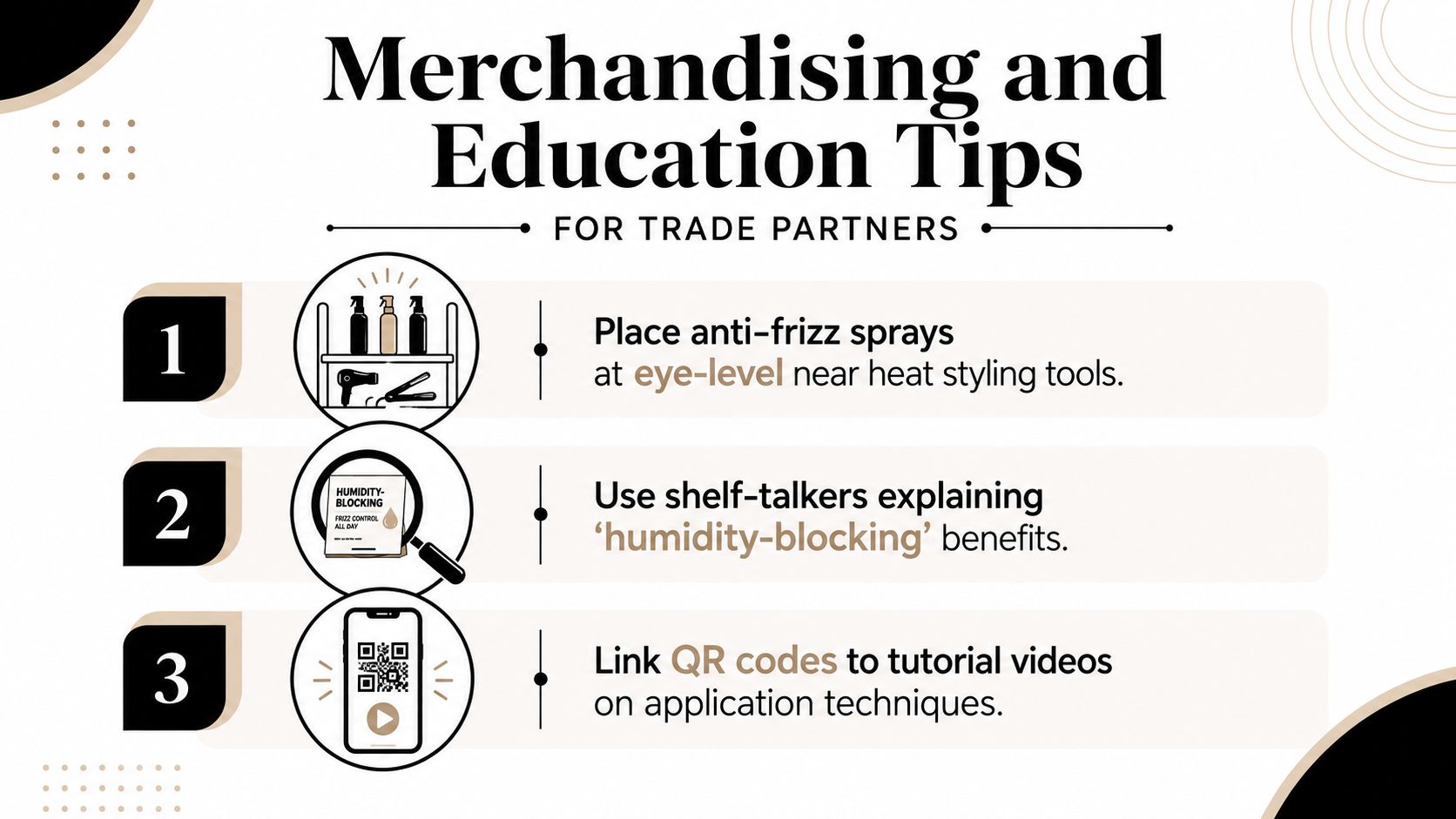
Place humidity blockers near heat styling tools, not across the aisle from shampoo. Put wet-hair prep sprays beside leave-ins and detanglers. That cross-merchandising makes the routine obvious and supports attachment sales without aggressive selling.
Give staff a short script
Use three phrases and stop there. “For damp hair before blow-drying.” “For dry hair as the final anti-humidity step.” “For fine hair, choose lighter textures.” That's enough for most consultations, and it keeps staff from overexplaining the formula.
Make the product page do the heavy lifting
For e-commerce, filter by hair type, application moment, and finish. Add QR codes or short videos that show how much to spray and when to use it. Customers don't need a chemistry lecture, they need reassurance that they can use the product correctly the first time.
If you manage pricing across multiple channels, monitor MAP pricing compliance before promo season starts. Anti-frizz products often sit in premium ladders, and sloppy discounting trains shoppers to wait instead of buy.
Seasonal rotation should be blunt. Push lighter daily sprays in shoulder seasons, then move your stronger humidity blockers forward as weather turns sticky. Track sell-through, attachment rate with styling tools, and repeat purchase patterns. Those are the signals that tell you whether the assortment is doing its job.
If you want a Swiss-ready assortment strategy for anti frizz spray, beautysecrets.agency can help you build it around certified sourcing, premium positioning, and retail logic that fits the market. Visit beautysecrets.agency to review distribution options that match your pharmacy, spa, or e-commerce channel.