A toothpaste tube can look straightforward, but the question is harder: what is doing the protective work once fluoride is removed? In Switzerland, that question is no longer theoretical. A major 2024 paediatric study found 15% of families used non-fluoridated toothpaste and 12% used toothpaste with less than 1000 ppm fluoride. That means the category is already part of ordinary household routines, not just a niche buying choice.
For pharmacy owners and careful consumers, the decision is rarely about the wording on the front of the pack. It is about whether a toothpaste is fluoride free, whether it includes a replacement system that can support enamel, and whether that system holds up in daily use. A low-fluoride product and a fluoride-free product are different categories, and a natural-looking label does not show how the formula behaves on teeth.
A useful way to frame the issue is direct. Fluoride-free does not automatically mean weak, and natural does not automatically mean effective. The quality of the replacement actives, the abrasivity of the base, and the intended user group matter more than the branding language.
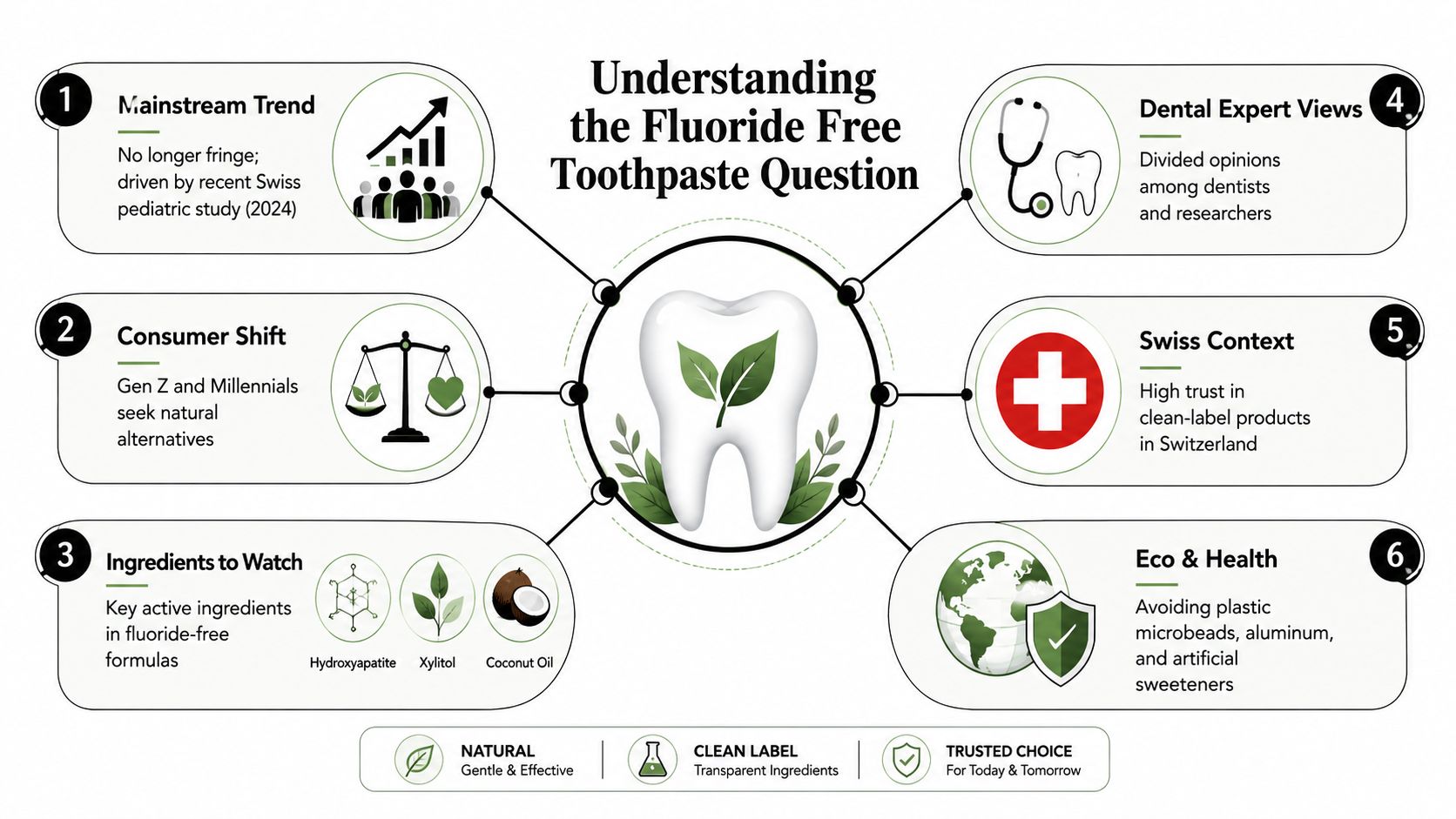
Understanding the Fluoride Free Toothpaste Question
A family standing in a Swiss pharmacy often faces a quiet conflict. One parent wants to avoid fluoride because their child still swallows toothpaste. The other wants cavity protection that feels medically credible, not marketing-led. That tension is exactly why fluoride free toothpaste has moved from fringe curiosity to a real shelf category.
The Swiss data makes that shift hard to dismiss. A major 2024 paediatric study found that 15% of families were already using non-fluoridated toothpaste (study). Among preschoolers in comparable European settings, low-fluoride and fluoride-free use was also visible, reaching 42% in Latvia and 28.7% in Lithuania (study). For retailers, that means the question is already part of ordinary purchasing, not a niche preference that only appears in specialist shops.
What changes when fluoride is removed
Fluoride in conventional toothpaste helps enamel remineralise after acid exposure. Remove it, and the formula has to depend on other mechanisms to support the tooth surface. The label fluoride free therefore signals a formulation review, not a quick assumption about safety or quality.
The key distinction for shoppers is between fluoride-free products and toothpaste that contains a lower fluoride level. A product with less than 1000 ppm fluoride is still a fluoride product. A genuine fluoride-free formula has to rely on another active system, often one built around hydroxyapatite, calcium-phosphate compounds, xylitol, or related mineral-support ingredients. For a plain-language comparison, compare toothpaste with vs without fluoride helps readers separate the ingredient story from the marketing label.
Practical rule: if the front label says “natural” but the back label does not show the active system, you are still guessing.
Consumers often ask whether fluoride-free means inactive, but that is the wrong lens. The better question is whether the toothpaste contains a credible replacement mechanism and whether that mechanism fits the user's risk profile. A low-risk adult with strong oral hygiene habits is not the same as a child, an orthodontic patient, or someone with dry mouth.
Alternative Ingredients and How They Work
The strongest fluoride-free formulas do not try to copy fluoride ingredient for ingredient. They use a different route altogether. That matters, because a toothpaste can clean well without offering the same mineral logic, and it can also promise mineral support without delivering it in a form the teeth can use.
The main active systems to look for
Hydroxyapatite is the best-known replacement approach. It delivers mineral material directly to the enamel surface instead of relying on fluoride-mediated remineralisation. Calcium carbonate adds gentle cleaning and some mineral support. Calcium lactate appears in some formulas as a calcium source. Xylitol changes the oral environment by making plaque conditions less favourable. Hydrated silica helps with cleaning and polishing, but its value depends on the full formula and how abrasive it is overall.
For readers comparing options, this resource is useful: compare toothpaste with vs without fluoride. It helps separate the ingredient story from the marketing label before a shopper starts judging a tube by the front panel alone.
| Alternative Active Ingredient in Fluoride Free Toothpaste | Mechanism | Evidence Strength | Best For |
|---|---|---|---|
| Nano-hydroxyapatite | Supplies mineral ions directly to the enamel surface | Emerging and increasingly studied, especially in newer formulas | Users who want a mineral-based approach, often for sensitivity or daily maintenance |
| Calcium carbonate | Mild polishing and mineral contribution | Established as a cleaning base, but not a full cavity-prevention substitute | Everyday cleaning, simple formulas |
| Calcium lactate | Calcium delivery support | Less widely discussed in consumer content, used as part of mineral blends | Formulas aiming for broader mineral support |
| Xylitol | Supports an oral environment less friendly to plaque build-up | Commonly used as a supportive ingredient, not a stand-alone cavity solution | Users who want a gentler, sweetened formula |
| Hydrated silica | Mechanical cleaning and stain removal | Depends heavily on particle structure and total abrasivity | Whitening-leaning or polished-finish formulas |
The judgement is not whether an ingredient sounds natural. It is whether the actives are present at a meaningful level and whether the rest of the formula lets them do their job. A well-designed fluoride-free toothpaste should balance cleaning, mineral delivery, and tolerance for daily use. If the abrasive system is too aggressive, the formula can work against the same benefits it claims to offer.
Evaluating the Evidence on Effectiveness and Safety
The evidence on fluoride-free toothpaste is stronger than it used to be, but it is still uneven. That difference matters for anyone choosing products for a shelf or a patient profile. A formula can show biological activity without yet having the kind of long-term evidence needed before it is recommended broadly for higher-risk patients.
A 2026 evidence map concluded that fluoride-free formulations, especially hydroxyapatite-based toothpastes, show measurable biological effects, but the evidence base is still dominated by short-term studies and surrogate outcomes rather than long-term caries-prevention data in children (evidence map). In practical terms, the category is scientifically active, yet that does not mean every product has proved itself as a full substitute for fluoride in every setting.
What the evidence does and doesn't answer
The biggest gap is still cavity prevention in higher-risk groups. The question is whether fluoride-free toothpaste can serve as a safe replacement for children, orthodontic patients, and adults with dry mouth or a history of caries. Current guidance stays cautious, and cavity-protection claims tied to the ADA still require fluoride (review).
That does not make fluoride-free toothpaste irrelevant. It means the claim has to be narrower and more precise. Hydroxyapatite-based products remain the most promising non-fluoride class in the current literature, while older “natural” toothpastes often rely more on branding appeal than well-documented efficacy data. Buyers should separate evidence-backed mineral systems from broad wellness language, because those are not the same thing.
A practical reading rule helps here.
If the claim is about cavity protection, ask what the formula uses instead of fluoride, and what kind of evidence supports that active.
That lens protects both consumers and retailers from overpromising. The safest interpretation is not that fluoride-free toothpaste is ineffective. It is that the category contains a spectrum, and the science is strongest where the replacement system is specific, measurable, and plausibly mineral-based.
Swiss and EU Regulatory and Certification Framework
Retailers in Switzerland need to treat toothpaste as a compliance item, not just a wellness product. The category sits inside cosmetic regulation, so labelling, ingredient disclosure, and claim discipline all matter. For a Swiss buyer, that matters twice over, because trust depends on both product quality and the proof behind the label.
At a regulatory level, the EU Cosmetics Regulation (EC) No 1223/2009 and the Swiss Ordinance on Cosmetic Products (VKos) shape how these products are placed on the market. Independent certifications can add reassurance, but they do not replace basic compliance. In practice, that means checking the formula, the label, and the positioning claim before a product ever reaches the shelf.
What a retailer should verify
Ingredient disclosure comes first. A fluoride-free product should clearly avoid fluoride salts and identify the replacement actives. Active load matters too, because a token amount of hydroxyapatite or xylitol is not the same as a formula built around them. Abrasivity also deserves review, because a harsh polishing system can work against long-term oral-care goals (review).
The certifications that matter most for Swiss natural-positioned assortments are the ones that signal real formulation standards. ECOCERT can support organic-style positioning. PETA and Cruelty Free International help with cruelty-free commitments. These seals are useful only when they match the product's actual formulation and documentation.
The composition question is what separates a credible product from a marketing label. Swiss consumers may see formulas based on nano-hydroxyapatite, calcium carbonate, calcium lactate, or xylitol, but those names only help if the product is stable, shelf-safe, and correctly positioned for sensitivity, whitening, or cavity-risk reduction. A clean label is not enough on its own (composition review).
Consumer Use Cases and Who Should Be Cautious
Families usually choose fluoride-free toothpaste for a few clear reasons. Some want to reduce fluoride exposure in young children. Others react badly to conventional ingredients. A third group prefers a clean-beauty routine that matches the rest of the household's personal-care products. Those motivations are understandable, but they do not carry the same oral-health risk.
A good fit is a low-risk user with steady oral hygiene who wants a gentler or mineral-based formula. In that setting, a fluoride-free toothpaste built around a credible hydroxyapatite or xylitol system can make sense. The weaker fit is someone with active decay, frequent caries, dry mouth, orthodontic appliances, or a history that already raises cavity risk. For those users, a more conservative dental plan is usually the safer choice.
Where caution matters most
The caution point is clearest with children, because long-term cavity-prevention data for fluoride-free routines are still limited (review). It also shows up in how products hold up on the shelf and in use. A peer-reviewed study on toothpastes sold across multiple markets found that formulation stability and free available fluoride can vary substantially, and it advises checking expiry dates and recognising that some abrasive systems can reduce anticaries performance (study).
For higher-risk mouths, the best toothpaste is the one that matches the risk profile, not the branding preference.
That is the question consumer content often skips. It keeps the debate at fluoride versus no fluoride, while the more useful question is which non-fluoride actives may help, for whom, and where the evidence is still thin. For Swiss retailers, that nuance protects patient trust and store credibility. For content teams, practical dental SEO tips can help turn that nuance into pages shoppers use.
Retail and Merchandising Strategy for Pharmacies and Clean Beauty Stores
Fluoride-free toothpaste sells best when the shelf tells the truth. If the assortment is filled with generic natural toothpaste, shoppers will treat it like a lifestyle aisle. If the assortment includes credible actives, clear shelf labels, and a few disciplined comparisons, the category starts to look like informed care.
A strong Swiss edit should separate well-formulated fluoride-free products from vague “natural” pastes. That means giving space to formulas built around nano-hydroxyapatite, calcium-based systems, or xylitol-led blends, while being careful about products that lean only on flavour, branding, or loose wellness language. Independent pharmacies can use a simple decision rule. If the formula can't explain what replaces fluoride, it probably shouldn't take premium shelf space.
For digital visibility, this guide from LLMrefs is useful when you're building category pages and educational content: practical dental SEO tips. The point isn't to chase keywords. It's to publish pages that answer the questions customers are already asking at the counter.
Shelf strategy that works
Group by function, not only by brand. Put sensitivity formulas together, whitening formulas together, and family-friendly options together. Use short shelf talkers that say what the active system is. Show certification marks only when they're supported by documentation, not as decoration.
A simple compliance checklist helps staff avoid vague claims.
- Check the active system: confirm whether the formula uses hydroxyapatite, calcium carbonate, xylitol, or another identified replacement.
- Check batch and expiry dates: unstable products should not be sold as premium options.
- Check the claim language: cavity-protection messaging needs careful wording when fluoride is absent.
- Check the user group: keep high-risk recommendations tied to professional advice rather than general merchandising.
Fluoride-free toothpaste stops being a trend item and becomes a disciplined category. Retailers who explain the differences clearly tend to earn more trust than those who let the packaging do all the work.
Content Marketing and Product Positioning Strategies
The strongest content for this category doesn't scare people away from fluoride. It explains why some shoppers want alternatives, then shows how to evaluate those alternatives properly. That tone works especially well in Switzerland, where consumers expect premium products to justify themselves with clarity, not hype.
For educational content, the best formats are comparison pages, ingredient explainers, and label-reading guides. A comparison between fluoride and hydroxyapatite toothpaste helps readers understand that the question is not just "natural or not". A short video showing how to read oral-care labels can make the active system visible, especially for shoppers who assume every fluoride-free tube is doing the same job. Seasonal campaigns around children's dental routines also work because they connect the product choice to a real family moment, not an abstract wellness claim.
The article and product page language should stay specific. Say “hydroxyapatite-based formula for mineral support” instead of “advanced natural protection”. Say “fluoride free” only when the back label supports it. Avoid fear-led language about fluoride, because that tends to reduce trust in both the brand and the retailer. Better positioning is more disciplined. It shows what the formula does, what it doesn't prove, and who it suits best.
For beauty and wellness brands building this kind of education-led visibility, social media and SEO for beauty is a useful companion read. The right content structure turns a technical category into a confident buying decision.
A simple positioning framework
Lead with function. Tell shoppers whether the product is for sensitivity, daily maintenance, or whitening support.
Then name the active. Hydroxyapatite, xylitol, calcium carbonate, or another system should be visible.
Finally, define the limit. If the formula isn't meant for high-caries-risk users, say so clearly.
That approach works because it respects the customer. It also helps pharmacies and clean-beauty stores avoid the biggest mistake in this category, which is treating fluoride-free as a universal solution. It isn't. It's a legitimate choice for many users, a nuanced one for some, and a poor fit for others. When the alternative system is credible, the label matters less than the formulation behind it.
Frequently Asked Questions
Is fluoride-free toothpaste safe for daily use in adults who are cavity-free?
Often, yes, if the person has a low cavity risk and uses a formula with a credible active system rather than an empty natural label. The key is risk assessment, because daily use is only part of the picture. Diet, oral hygiene, saliva flow, and past caries history still matter.
Can children switch from fluoride toothpaste to fluoride-free toothpaste?
They can, but the decision should be tied to age, swallowing habits, and dental history. For young children, the swallowing issue is real, which is one reason families look at fluoride-free options. For children with higher cavity risk, professional guidance is still the safer route.
Can fluoride-free toothpaste reverse early cavities?
It can support remineralisation in some cases, especially when the formula uses mineral-based actives, but that's not the same as reversing established decay. Early surface changes and true cavities are different problems. If a lesion is already progressing, a dentist should guide the treatment plan.
beautysecrets.agency helps Swiss pharmacies, premium retailers, and clean-beauty partners choose formulations that are credible, compliant, and easy for customers to understand. If you're building a fluoride-free oral-care assortment or refining how you explain it, visit beautysecrets.agency to explore a curated approach to natural, ethically sourced products.