You cleared the breakout. The inflamed spot settled. Then the mark stayed.
That's the moment many begin buying blindly. One serum promises radiance, another promises clinical correction, and a third adds retinol, acids, fragrance, and exfoliants into one bottle. For stubborn hyperpigmentation, especially post-acne marks and uneven tone in deeper skin tones, that approach usually wastes time and can easily make skin more reactive.
A good dark spot serum isn't just a “brightening” extra. It's a targeted treatment. It should interrupt pigment formation, reduce the visibility of existing marks, and do it without creating the irritation that often triggers more discolouration.
In practice, the best results usually come from restraint. Fewer, better-chosen actives. A formula matched to the type of mark you have. And if you're already using a prescription retinoid, a serum that doesn't duplicate that stress on the skin.
The Search for a Solution to Stubborn Dark Spots
A person doesn't typically start searching for a dark spot serum because of one faint freckle. They start when a mark outstays its welcome. A post-acne patch lingers for months. A sun spot becomes more obvious in bathroom lighting. Melasma shifts with the season and refuses to behave like a simple blemish.
I see the same mistake repeatedly. Someone treats all pigmentation as if it were one problem, then wonders why the product that worked for a friend does nothing for them. Post-inflammatory hyperpigmentation, solar lentigines, and diffuse uneven tone don't respond in exactly the same way. They can overlap, but they don't behave identically.
Why serums have become the format people reach for
Serums now lead this category for a reason. In the global hyperpigmentation skincare market, serums hold a 34.2% revenue share in 2025 and are forecast to grow at the fastest rate among product types at 8.4% CAGR through 2034, largely because they deliver high concentrations of brightening actives in lighter textures, according to Dataintelo's hyperpigmentation skincare market report.
That lines up with what formulators and skin professionals see on the ground. When a product is meant to target a narrow problem, a serum format often makes sense. It can be layered, it can be used precisely, and it doesn't need the heavier waxes and occlusives that often belong in a moisturiser.
Stubborn pigmentation rarely needs “more skincare”. It needs a better-targeted formula and a calmer routine.
What people get wrong
The worst dark spot routines usually have one of these problems:
- Too many actives at once. Acids, retinol, scrubs, vitamin C, and pigment inhibitors all piled together.
- No daily sun protection. Progress fades fast when skin keeps getting triggered.
- The wrong target. A serum for general glow won't always shift entrenched post-acne marks.
- No respect for skin tone differences. Advice built around lighter skin often misses how easily irritation can leave marks behind in deeper tones.
A dark spot serum can help. But only when it's chosen for the actual biology of the mark, not the marketing on the carton.
How Dark Spot Serums Work Their Magic
Hyperpigmentation starts when pigment cells behave as if they've been given an overactive instruction. Sun exposure, inflammation from acne, friction, or a procedural trigger can push melanocytes to produce more melanin than the surrounding skin needs.
Think of it as traffic control gone wrong. Pigment production speeds up, pigment gets distributed where it shouldn't, and the skin surface then holds onto the evidence.
The three jobs a serum needs to do
A well-designed dark spot serum usually works across more than one pathway.
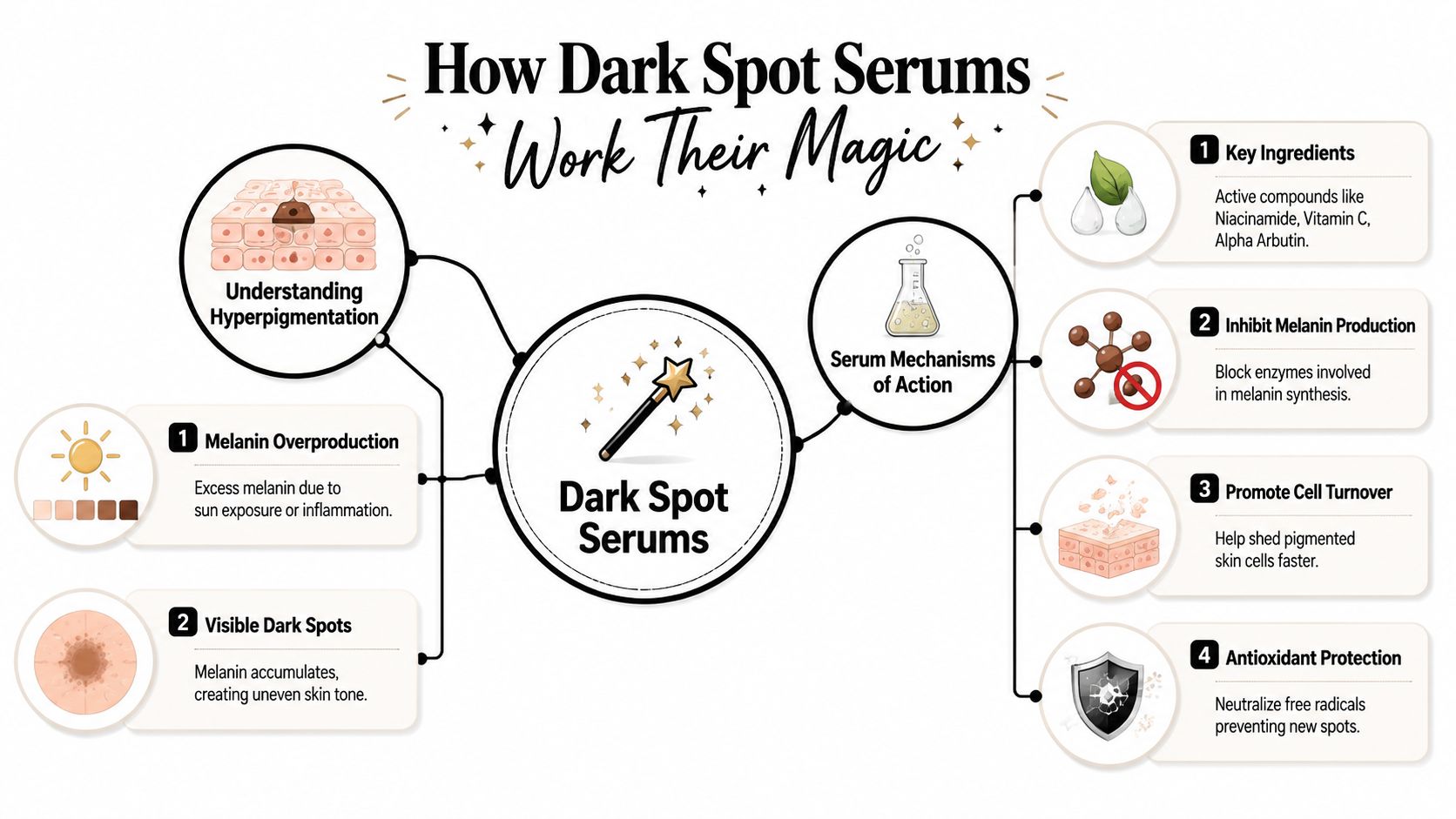
First, it can slow pigment formation. Ingredients that interfere with tyrosinase activity or related pigment pathways are essential for this action.
Second, it can reduce pigment transfer into surrounding skin cells. Visible darkening isn't just about melanin being made; it's also about where that pigment ends up.
Third, it can support turnover and recovery so marked skin is replaced more evenly over time. This must be done carefully. Aggressive exfoliation can backfire, especially in sensitive or melanin-rich skin.
Why some formulas work faster than others
The biggest difference between average and strong formulas is usually not hype. It's pathway coverage. A serum that tackles only one mechanism may help mild dullness. A serum that addresses inflammatory signalling, pigment production, and skin barrier support tends to do better on persistent marks.
That's one reason multi-active formulas keep showing up in clinical work. In a 12-week clinical study, a proprietary dark spot serum showed a statistically significant reduction in overall hyperpigmentation and improved skin tone evenness starting at Week 2, confirmed by quantitative image analysis with p-value ≤ 0.018, as reported in this clinical study on a proprietary dark spot serum.
Practical rule: If a serum promises overnight fading, ignore it. Pigment correction is gradual because skin biology is gradual.
What a serum can and can't do
A dark spot serum can improve the appearance of many common forms of uneven pigmentation. It can't replace diagnosis. If someone has patchy, recurrent pigmentation that behaves hormonally or worsens despite careful use, a dermatologist should evaluate it.
It also can't overcome a damaging routine. If skin is constantly being over-exfoliated, picked, inflamed, or exposed to UV without protection, even a good formula struggles.
A serum's role is narrower and more useful than most marketing suggests. It helps create consistent pressure in the right direction. Less new pigment. Less visible residue from old inflammation. More even turnover. Better odds that the mark finally fades instead of lingering.
Decoding the Most Effective Active Ingredients
Not every celebrated brightening ingredient deserves space in every formula. For dark spots, I care less about trend value and more about mechanism, tolerance, and whether the ingredient still makes sense in a real routine that a person can stick to.
The best formulas often combine proven actives with gentler botanical support. That's especially important in the Swiss premium market, where shoppers often want efficacy without a harsh sensory profile and where retailers increasingly need products that align with natural and ECOCERT-friendly positioning.
The actives with the strongest practical value
A useful reference point comes from a 12-week study in deeper skin tones, Fitzpatrick V to VI, where a formula containing 3% tranexamic acid, 1% kojic acid, and 5% niacinamide achieved a significant reduction in discolouration and post-inflammatory marks, with visible results appearing as early as 2 weeks, according to the published product study details for this dark spot corrector.
That ingredient combination makes practical sense.
- Tranexamic acid is one of the most useful non-retinoid actives for persistent uneven pigmentation. It's especially relevant when inflammation plays a role.
- Niacinamide supports barrier function and helps reduce the visible unevenness that often follows breakouts or irritation.
- Kojic acid can be effective, but it needs careful formulation because some skin types tolerate it better than others.
Evidence-based naturals and gentler alternatives
Natural doesn't automatically mean weak. It also doesn't automatically mean suitable for sensitive skin. The right question is whether a natural or naturally derived ingredient performs a useful role in a stable, well-balanced system.
Here's where I see the best fit:
| Ingredient | Primary Mechanism | Best For | Natural/Ecocert-Friendly? |
|---|---|---|---|
| Tranexamic Acid | Helps interrupt pathways involved in excess pigmentation | Post-acne marks, persistent uneven tone | No, not typically ECOCERT-positioned |
| Niacinamide | Supports barrier function and helps reduce visible uneven tone | Most skin types, especially reactive or blemish-prone skin | Not typically framed as ECOCERT, but widely formulation-friendly |
| Kojic Acid | Targets pigment formation | Distinct dark spots and stubborn marks | Not usually a core ECOCERT-style active |
| Alpha Arbutin | Helps reduce visible discolouration through pigment pathway control | Uneven tone and early dark spots | Sometimes compatible with cleaner positioning, depends on formula standard |
| Liquorice Root Extract | Helps calm and brighten with a gentler profile | Sensitive skin, diffuse unevenness | Often suitable for natural positioning |
| Lotus Sprout Extract | Botanical support for tone correction in multi-active brightening systems | Retinol-free correction formulas | Can fit a more botanical story |
| Vitamin C derivatives | Antioxidant support and visible brightening | Dullness plus uneven tone | Depends on derivative and certification pathway |
| Bakuchiol | Supports smoother-looking skin without being retinol | People avoiding retinoids in the same routine step | More aligned with natural positioning than retinol |
| Azelaic Acid | Helps with blemish-related unevenness and visible redness | Acne-prone skin with post-mark marks | Effective, but not typically an ECOCERT headline ingredient |
Trade-offs that matter in real life
A strong ingredient list can still fail in use.
Kojic acid may work well, but some users find it irritating if the rest of the formula is poorly cushioned. Vitamin C can be excellent for overall brightness, yet some forms are unstable or too stingy for compromised skin. Bakuchiol sounds attractive for natural positioning, but it doesn't do the same job as a dedicated pigment-correcting system.
For retail education, I'd keep the message simple:
If the skin is already irritated, the “most active” serum is often the wrong serum.
That's also why ingredient literacy matters more than buzzwords. If you want a plain-language companion resource on one commonly discussed pigment-correcting ingredient, ALODERMA's expert tips for radiant skin offer a useful consumer-facing overview.
What I'd prioritise by concern
For post-acne marks, I'd lean first toward niacinamide, tranexamic acid, azelaic acid, and carefully chosen botanical anti-inflammatory support.
For sun spots, I'd look for a formula with stronger pigment-inhibition logic and excellent daytime compatibility.
For sensitive skin or anyone trying to stay close to a natural brief, liquorice root extract, lotus sprout extract, niacinamide, and well-formulated vitamin C derivatives often make more sense than an aggressive cocktail.
The strongest formulations aren't those with the most ingredients. They're the ones where each active has a clear job, and none of them sabotages the skin barrier while trying to fix the pigment.
How to Choose the Right Serum for Your Skin
Buying a dark spot serum by review count is one of the fastest ways to get the wrong product. Start with two filters instead. What is your skin like every day? And what kind of mark are you trying to fade?
Match the texture to the skin you actually have
An oily or acne-prone person often does best with a lighter serum that sinks in quickly and doesn't leave a waxy film. Heavy textures can be perfectly good formulations, but they're harder to stick with if the skin already feels congested.
Dry skin needs something else. A correcting serum for dry skin should still be targeted, but it benefits from humectants and a barrier-supportive base. Without that support, people often stop using the product because the skin starts to feel tight, flaky, or overworked.
Sensitive skin needs the strictest editing. Fewer perfume components. Fewer unnecessary exfoliants. Fewer “all-in-one” claims.
Match the formula to the mark
Not all hyperpigmentation behaves the same way.
- Fresh post-acne marks often respond well to anti-inflammatory pigment control and patient daily use.
- Older sun spots usually need a more disciplined long-term plan and very good UV protection.
- Patchy uneven tone in deeper skin tones needs formulas that respect the risk of irritation-driven rebound marking.
This last point is still under-addressed in mainstream skincare content. Many social recommendations are built around lighter skin and don't translate well. In practice, deeper skin tones often need a serum that is both effective and calm. If the formula creates repeated irritation, it can prolong the problem it claims to solve.
Choose the serum that your skin can tolerate for months, not the one that sounds most dramatic on day one.
A simple buying framework
If I were advising a shopper or training a pharmacy team, I'd use this checklist:
Identify the trigger
Acne marks, sun exposure, friction, or general uneven tone all point to slightly different priorities.Read the first active story, not just the front label
“Brightening” is vague. Look for actual correcting ingredients.Check for routine conflicts
If the customer already uses prescription tretinoin or adapalene, avoid needless retinol overlap.Respect skin tone diversity
Don't assume a viral favourite is a universal fit.Favour consistency over intensity
The best serum is the one someone will use properly, with SPF, for long enough to matter.
That framework tends to outperform trend-driven buying every time.
Building Your Routine for Maximum Results
A dark spot serum doesn't need a complicated routine around it. It needs a disciplined one.
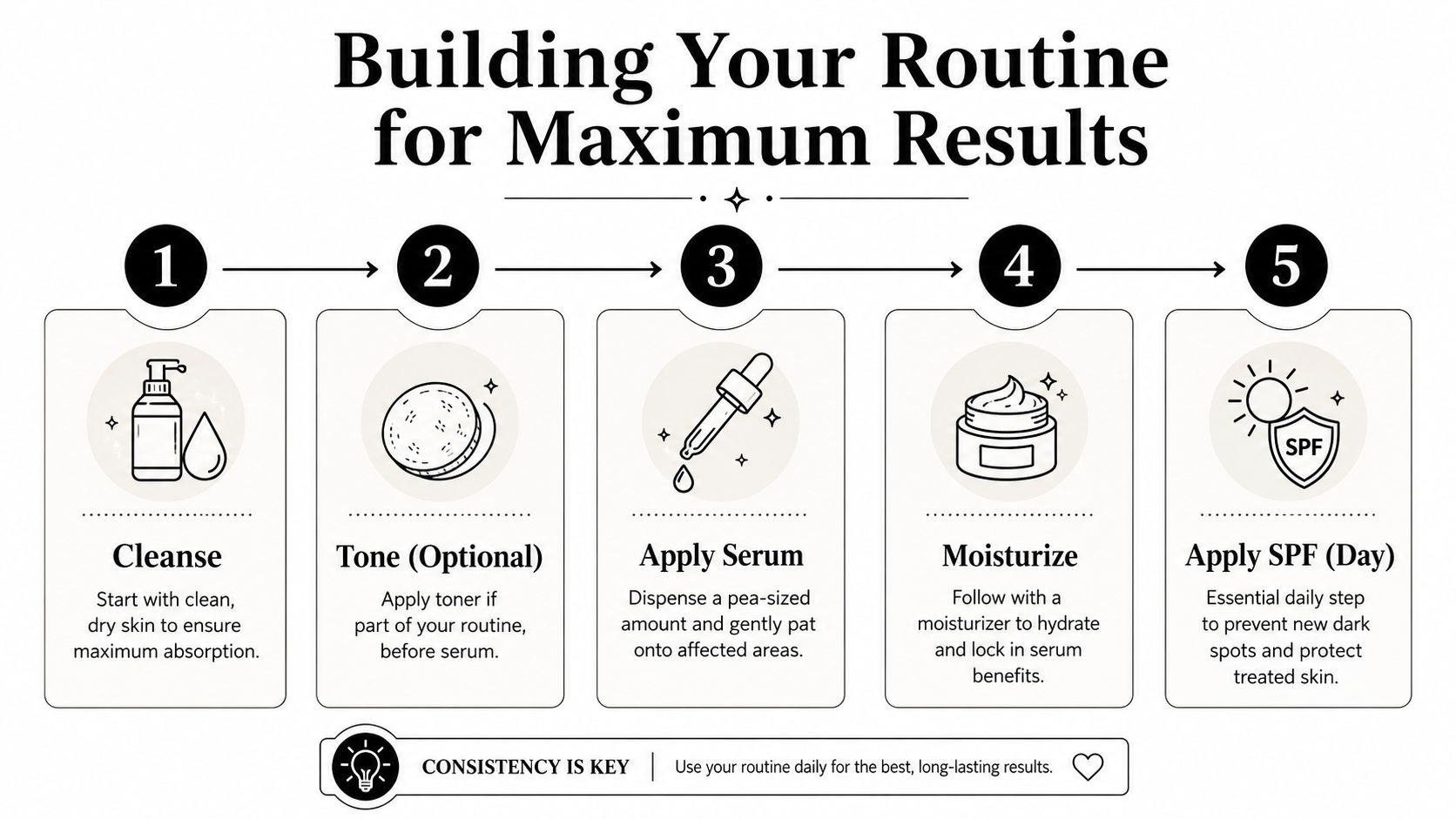
The core order is straightforward. Cleanse. Apply the serum to dry skin. Add moisturiser if needed. In the morning, finish with sunscreen. Most application mistakes happen because people keep changing products, over-applying, or layering too many strong actives in the same sitting.
This visual sums up the basic flow well.
The non-negotiables
Use a small amount. More product doesn't mean faster fading. It usually just means a stickier face or a more reactive barrier.
Be patient. Visible pigment correction happens over repeated skin cycles, not after three enthusiastic applications.
And protect the work. Daily broad-spectrum SPF matters because UV exposure can keep stimulating pigment pathways while you're trying to quiet them down.
If you already use a prescription retinoid
A common pitfall in many routines occurs when people using tretinoin or another prescription retinoid often buy a dark spot serum that also includes retinol. That creates redundancy and can push the skin into chronic irritation.
There's a clear unmet need here. Consumers using prescription retinoids actively look for retinol-free dark spot serums to avoid irritation and overlap, and clinical data supports retinol-free combinations such as tranexamic acid and niacinamide, with visible improvements reported by Week 2, as discussed in this Doctorly video on retinol-free dark spot serums.
A simple routine usually works best:
Morning
Gentle cleanse, dark spot serum, moisturiser if needed, sunscreenEvening
Gentle cleanse, moisturiser if needed, prescription retinoid as directed
That split reduces conflict. It also makes it easier to tell what's helping and what's irritating.
Keep the routine boring enough to succeed
This short explainer is useful if you want to see a routine demonstrated visually.
People often expect pigment correction to feel active. Tingling, peeling, heat. In reality, the better routine often feels uneventful. Skin stays comfortable. New breakouts are limited. Marks fade gradually instead of being chased by new inflammation.
Calm skin usually corrects colour better than stressed skin.
If irritation starts rising, the answer usually isn't to push harder. It's to simplify, reduce frequency, and remove conflicting actives.
A Guide for Swiss Retail and Pharmacy Partners
For Swiss retailers, pharmacies, and clinic-adjacent partners, dark spot serums sit at a valuable intersection. They answer a visible concern, they fit premium skincare baskets well, and they allow for meaningful staff guidance rather than simple shelf selling.
The commercial direction is favourable. In Switzerland, the natural and organic cosmetics segment is projected to grow at 5.81% CAGR through 2031, the highest among nature categories, while premium lines are advancing at 5.65% CAGR, according to Mordor Intelligence's Switzerland cosmetics products market analysis. That supports what many buyers already feel in store. Customers want cleaner positioning without giving up performance.
What staff should be trained to ask first
The first question shouldn't be “What's your budget?” It should be “What kind of mark are you treating?”
Then ask:
Is the customer using a prescription retinoid?
This changes what a sensible serum recommendation looks like.Does the skin react easily?
Sensitive, inflamed skin needs a quieter formula.Is the concern post-acne or sun-related?
The education angle differs.Is the shopper specifically asking for natural, cruelty-free, or ECOCERT-aligned options?
That shapes the shortlist immediately.
Better retail language
Swiss partners should avoid overclaiming. Don't promise erasure. Don't imply medical treatment from a cosmetic product. Sell the routine discipline as much as the serum itself.
Useful talking points include:
| Retail situation | Better guidance |
|---|---|
| Customer wants fast results | Explain that visible improvement is gradual and consistency matters |
| Customer uses tretinoin | Recommend a retinol-free correction serum approach |
| Customer has deeper skin tone with acne marks | Prioritise calm, pigment-focused formulas over aggressive exfoliation |
| Customer wants clean beauty | Focus on evidence-backed, ethically sourced, well-tolerated formulations |
This category rewards thoughtful curation. The strongest assortments don't just stock “brightening”. They cover existing gaps. Diverse skin tones. Post-inflammatory marks. Retinoid users. Customers who want premium natural positioning without a vague wellness story and no evidence behind it.
For Swiss retailers, pharmacies, clinics, and e-commerce partners looking to build a more credible dark spot serum assortment, beautysecrets.agency offers access to natural, ethically sourced skincare brands aligned with premium positioning, clean formulation standards, and the practical needs of today's pigmentation-conscious customer.