The most profitable version of lymphatic drainage face in Switzerland usually isn't the flashiest one. It's the one delivered with medical-grade discipline, clear client screening, and a retail strategy that supports the result at home.
That matters because this treatment has already moved well beyond social media de-puffing. In Switzerland, clinics position facial and body lymphatic drainage as a premium skincare staple linked to improved tissue quality and superficial tissue decongestion, and the Brazilian Lymphatic Drainage variant is increasingly used in Swiss beauty centres, according to Swiss clinic guidance on lymphatic drainage protocols. For spa owners, pharmacies, wellness centres, and aesthetic practices, that creates a useful commercial reality. Clients already recognise the service category. What they often don't recognise is the difference between trend-led massage and a protocol that's structured, safe, and worth paying for repeatedly.
Introduction Beyond the Hype to High-Value Service
Why this treatment holds its value
Facial lymphatic drainage works best when practitioners stop selling it as a miracle and start positioning it as a targeted fluid-management treatment. That shift changes everything. It improves consultation quality, sharpens treatment design, and makes pricing easier to defend.
Swiss clients are already comfortable with treatments that sit between wellness and aesthetics. Facial lymphatic drainage fits that space well because it can support visible concerns such as puffiness, heaviness, and post-procedure congestion while still feeling gentle and restorative. That combination gives it staying power in premium service menus.
The strongest operators also understand that this isn't just a cabin treatment. It can sit inside multiple business models:
- Spa menus: as a sculpting facial enhancement or stand-alone express treatment
- Dermatology and aesthetic practices: as supportive care around swelling-prone procedures
- Pharmacies and drugstores: as a consultation-led retail category with home-care tools and oils
- Hotels and wellness centres: as a recovery treatment for travel-related facial fluid retention
What separates a premium service from a basic massage
A profitable lymphatic drainage face service depends on control. Practitioners need control over pressure, sequence, contraindications, home care, and client expectations. If any one of those is weak, the result becomes inconsistent, and inconsistent services are difficult to rebook and even harder to retail around.
Practical rule: Clients don't pay premium prices for vague “detox” language. They pay for a treatment that feels specialised, safe, and visibly organised.
That's also why the service belongs in the hands of trained professionals. The facial lymphatic system responds to gentle, directional work. Hard pressure, poor sequence, or a rushed finish can leave clients underwhelmed even if the treatment feels relaxing.
Where the Swiss market creates opportunity
In Switzerland, premium skincare buyers often look for treatments that align with ecological formulations, sensorial quality, and visible but natural-looking results. Facial lymphatic drainage meets those expectations unusually well. It doesn't require aggressive devices, and it pairs naturally with oils, serums, and aftercare routines that a partner can merchandise elegantly.
For new spa partners, the opportunity is bigger than a treatment room upsell. A well-built lymphatic drainage face offer can create:
| Business lever | How the service helps |
|---|---|
| Menu differentiation | Adds a recognisable premium treatment without a highly technical machine purchase |
| Repeat bookings | Supports course-based selling when protocols are structured |
| Retail attachment | Pairs naturally with facial oils, balms, rollers, and gua sha |
| Cross-referrals | Fits wellness, post-procedure support, and anti-ageing positioning |
The operators who do best with this category keep two ideas in balance. They respect the treatment's clinical roots, and they package it with the polish of modern luxury skincare.
The Science Behind the Glow Evidence and Client Benefits
What the treatment is actually doing
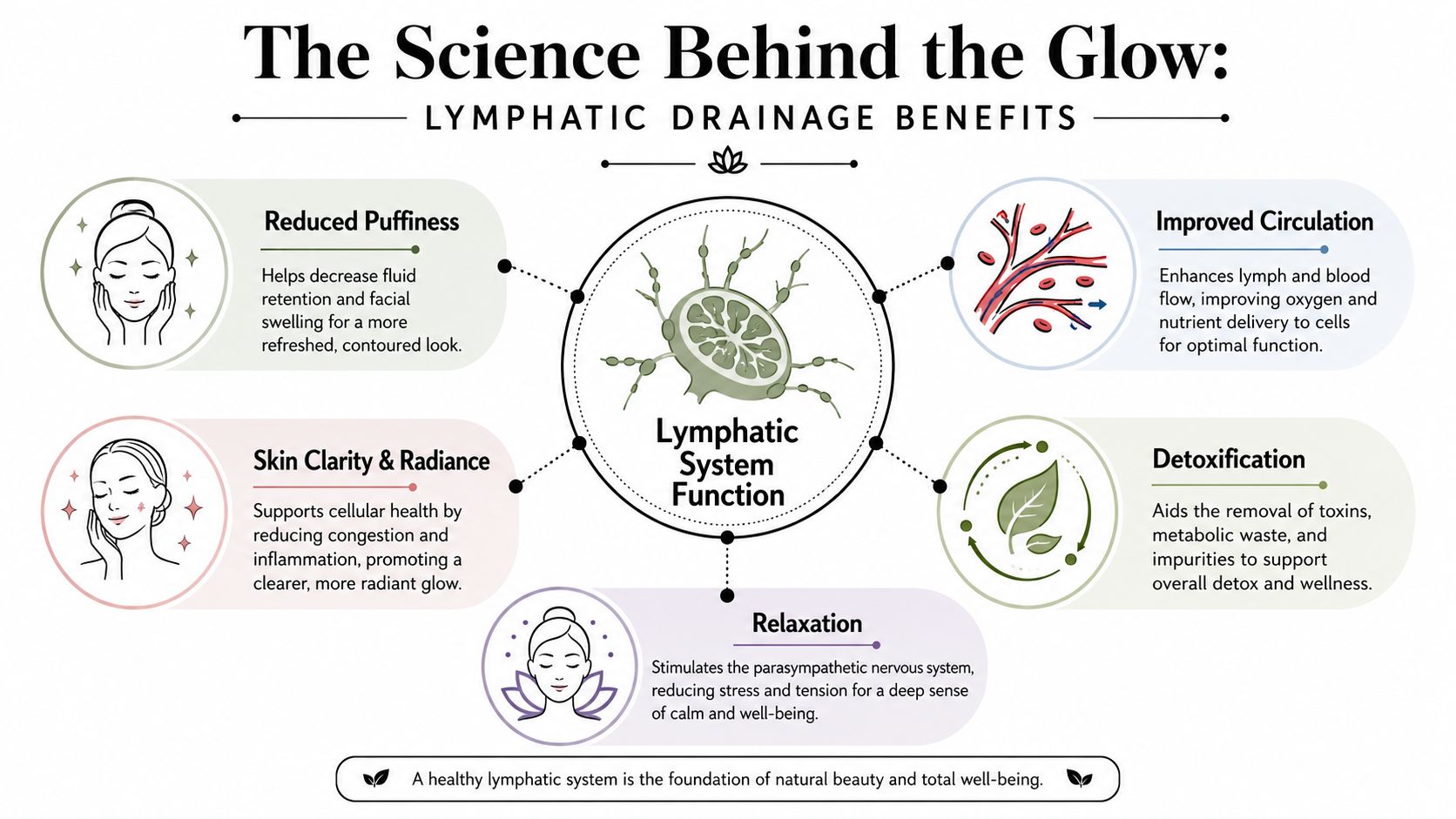
Facial lymphatic drainage is a manual technique designed to encourage lymph circulation through very light, directional contact. For clients, that usually translates into less visible fluid retention and a fresher-looking face. For practitioners, it means working with superficial pathways rather than chasing tension deep in the muscle.
That distinction matters in consultation. A lifting massage and lymphatic drainage may look similar to a client, but they're not the same treatment logic. One focuses on muscular manipulation and contouring. The other focuses on fluid movement and decongestion.
What evidence you can say with confidence
Beauty marketing often outruns the evidence. That's why practitioners should be precise. Some consumer-facing sources still note that beauty benefits need more research. At the same time, emerging 2025 to 2026 data attributed to ETH Zurich reported a 28% increase in microcirculation and a 22% reduction in under-eye fluid retention after 10 minutes of consistent manual facial drainage in 850 healthy adults, as discussed in Healthline's overview of facial lymphatic drainage.
That gives professionals a stronger education angle than vague “detox” claims. It also helps reposition the service as evidence-informed rather than purely anecdotal.
A useful consultation script is simple:
- For puffiness: explain that the treatment is designed to support fluid movement
- For dullness: explain that improved circulation can contribute to a fresher appearance
- For contour expectations: explain that visible definition may come from reduced swelling, not structural change
If you also retail brightening products, clients often need help understanding the difference between drainage and pigment-focused skincare. A good companion resource on topical radiance support is this guide on how to brighten dull skin with Japanese skincare, which helps separate surface brightness goals from fluid-retention concerns.
Beauty benefits are easiest to defend when you describe what clients may see, not what the treatment supposedly cures.
What not to promise
Professional credibility is won or lost here. Don't promise fat loss. Don't promise “flushing toxins” in healthy clients as if that were settled fact. Don't imply that one session changes face shape permanently.
You can say the treatment may leave the face looking slimmer or tighter temporarily because reduced swelling changes how contours present. You can also say it's widely used in lymphedema care and in post-surgical support. But your wording should stay within that lane.
Contraindications that need a hard stop
Not every puffy face is a good candidate. According to guidance on facial lymphatic drainage technique and precautions, contraindications include:
- Sinus infection: active congestion or infection can make treatment inappropriate
- Cancerous tissues: avoid working over these areas
- Damaged skin: compromised skin barriers need a different plan
That screening step is part of the service. It protects the client and protects the business.
Mastering the Method Professional Manual Protocols
Start by opening the drainage route
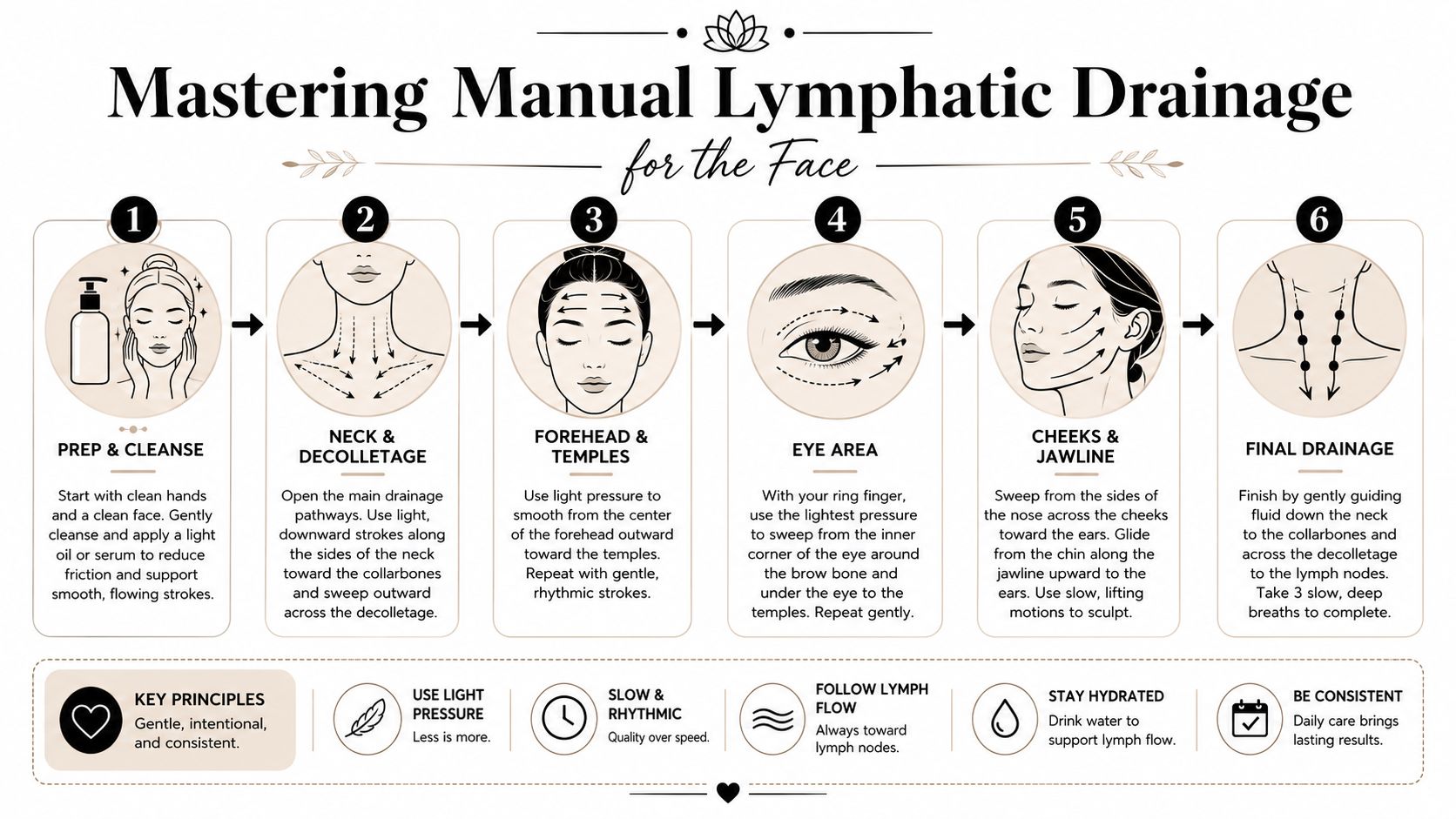
The most common technical mistake is starting on the face because that's where the client sees the problem. Proper work starts lower. The protocol begins with neck prep, using gentle gliding movements downward from the jaw toward the collarbone to open the pathway before facial fluid is directed into it.
If the neck isn't prepared first, the rest of the treatment often feels pleasant but performs poorly. You can move fluid, but you haven't created a clean route for it.
Build the sequence with slow, directional work
Once the neck is prepared, the rest of the protocol follows a deliberate map rather than improvisation.
Jawline sculpting
Use the knuckles to glide from the chin toward the ear in slow outward motions. The pressure should stay light. This isn't a deep sculpting pass. It's a directional sweep that helps move congestion laterally before it can be cleared downward.
Cheek drainage
Use flat fingers from the nose toward the ears, then down the neck. During this step, many therapists push too hard because the cheeks seem fuller and easier to manipulate. Resist that instinct. The tissue should never look dragged or overworked.
Under-eye drainage
Use the ring finger with feather-light pressure from the inner corner toward the temple. The under-eye area punishes heavy hands quickly. If you stretch the skin, you've missed the technique entirely.
Forehead release
Move from the centre of the forehead toward the hairline, then sweep down the side of the face to the collarbone. The finish matters. Every zone eventually needs to be guided downward toward the supraclavicular nodes.
A helpful visual reference for teams that also work with medically informed swelling management is this piece of expert lymphedema guidance from Lake City PT. It's useful for reinforcing why sequence and light pressure matter.
The product slip rule isn't optional
One of the biggest practical failures in treatment rooms is performing a lymphatic drainage face massage on dry skin. That creates pulling and tugging, especially around the eye contour, jaw hinge, and lateral cheeks. The system sits just below the skin surface, so harsh friction works against the treatment.
Use enough slip from an oil or serum to keep the hands gliding cleanly without flooding the skin. The ideal texture lets you maintain feather-light contact and directional control.
Dry massage is one of the fastest ways to turn a technically good sequence into a poor result.
The source material on protocol and pitfalls is clear about this point. Sufficient slip is mandatory, not a luxury add-on.
Rhythm, frequency, and professional judgement
The technical guidance for facial lymphatic drainage supports a routine of 2 to 4 times weekly, or daily if pressure is gentle. In professional practice, that doesn't mean every client needs the same frequency. It means the tissue tolerates regular work when technique is correct.
For treatment planning, think in terms of presentation:
| Client presentation | Best practitioner response |
|---|---|
| Morning puffiness | Short, focused drainage sequence with strong home-care guidance |
| Post-travel heaviness | Full decongestive facial with neck emphasis |
| Sensitive eye area | Minimal pressure, slower pacing, shorter eye passes |
| Post-procedure swelling support | Work only within approved scope and timing |
The final pass should always feel like a clearing action, not a flourish. If therapists remember one principle, it should be this: open, direct, clear.
Tools and Product Pairings for Enhanced Results
Manual first, tools second
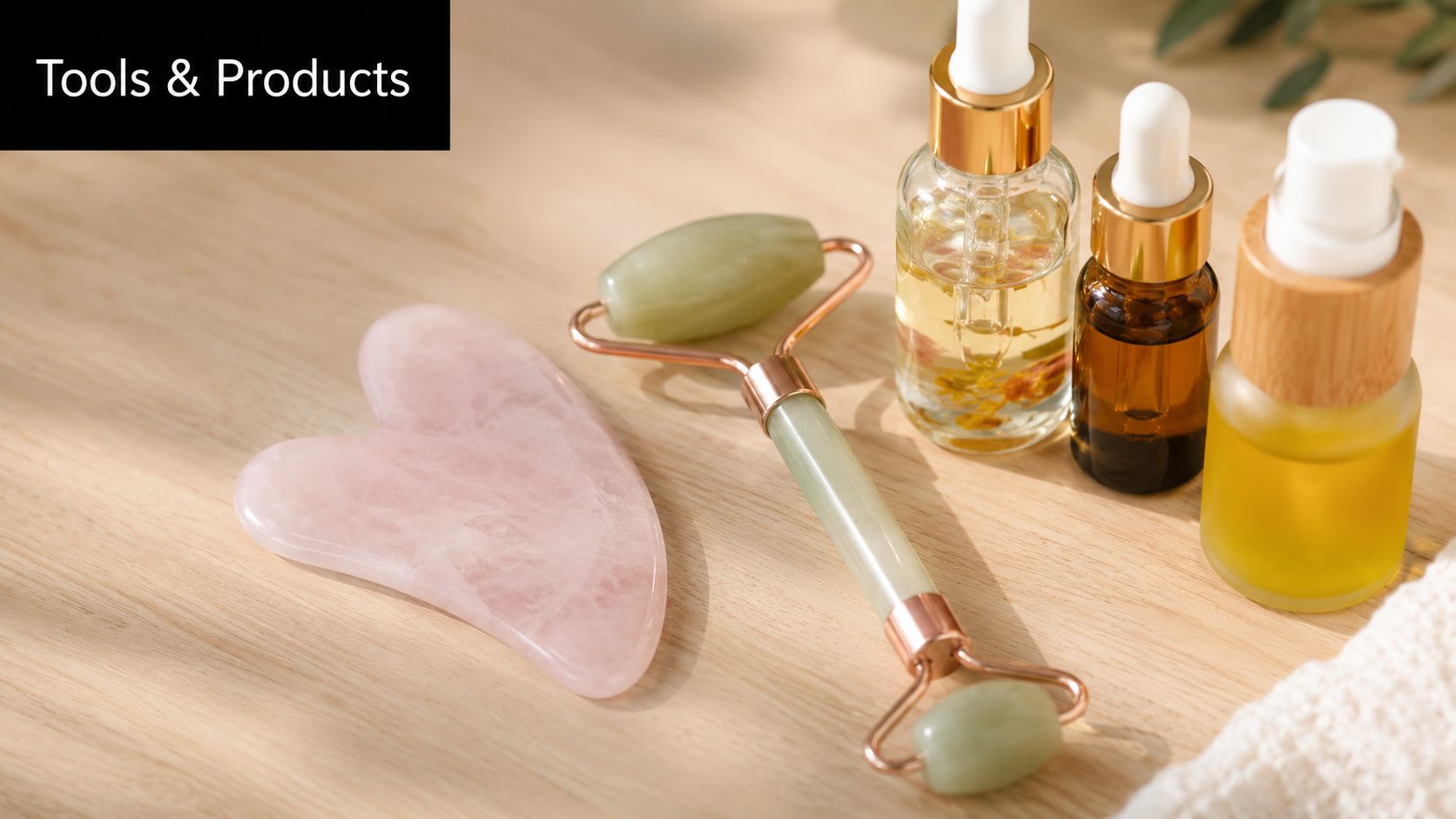
Tools can enhance a lymphatic drainage face service, but they shouldn't replace manual understanding. A gua sha stone in untrained hands often becomes a scraping ritual. A roller can become little more than a cooling prop. Used properly, both can support drainage and improve client adherence at home.
The choice comes down to treatment goal and operator control. Gua sha offers more directional precision along the jawline, cheek, and side of the neck. Rollers are easier for retail because clients tend to use them more consistently and with less pressure.
What each tool does well
A simple way to train staff is to assign each tool a job.
- Gua sha: best when you want controlled, deliberate passes along the jaw, cheeks, and forehead
- Jade or metal roller: best for simple home maintenance, especially around the eye contour and cheeks
- Hands only: best for first treatments, sensitive clients, and any client who needs careful assessment during the session
This comparison keeps the conversation practical. You aren't asking whether one tool is “better”. You're asking which tool fits the client, the therapist, and the moment.
Tools should make technique easier to execute. If they make pressure control worse, leave them out.
Why product pairing changes the outcome
The right topical product does more than add luxury. It determines whether the technique can be delivered safely and elegantly. For this service, the formula must create glide without causing a heavy, blocked finish.
Fresh-pressed facial oils are often the most useful option because they provide consistent slip with a small application amount. In treatment rooms, that allows long, connected passes from face to neck without repeated grabbing. At retail, it gives clients a clear reason to continue the method at home.
A poor pairing usually shows up in one of three ways:
| Product type | Common issue in drainage work |
|---|---|
| Fast-drying gel serum | Loses slip too quickly |
| Rich occlusive balm | Can feel too draggy unless warmed carefully |
| Fragranced dry oil | May spread quickly but lack cushion for delicate areas |
Clean Product Pairings for Lymphatic Drainage
| Client Concern | Recommended Tool | Recommended Product Pairing | Rationale |
|---|---|---|---|
| Morning under-eye puffiness | Small roller | Lightweight facial oil or oil-serum blend | Helps maintain feather-light glide around delicate skin |
| Jawline heaviness | Gua sha | Medium-slip botanical oil | Supports slow directional passes without tugging |
| Sensitive, reactive skin | Hands only | Minimal-ingredient nourishing oil | Reduces friction while limiting unnecessary sensory load |
| Dull, tired-looking skin | Hands or roller | Fresh facial oil under a radiance-focused routine | Supports massage glide while fitting a glow-oriented home ritual |
| Travel-related facial congestion | Gua sha plus hands | Cushioning oil with good spread | Helps the therapist cover face-to-neck transitions smoothly |
Retail logic that actually works
Retailing around this treatment should feel like continuation, not upselling. The strongest recommendation is usually a single home-care product plus one simple tool. That keeps compliance high.
A practical script sounds like this: use the clinic treatment to create immediate decongestion, then recommend a facial oil and either a roller or gua sha for maintenance. If the client struggles with consistency, sell the oil first and postpone the tool. Product adherence matters more than basket size.
For pharmacies and premium retailers, merchandising also matters. Place drainage-compatible oils near face tools, not in a separate category aisle. The client needs to see the method as a set.
Integrating FLD Into Your Business Consultation and Aftercare
Consultation should lead the service
Facial lymphatic drainage becomes more commercially stable when the consultation is structured. Staff should not directly ask, “Would you like de-puffing today?” They should assess timing, symptoms, skin condition, sensitivity, and expectations.
That creates safer treatment decisions and better rebooking conversations. It also gives the client language to describe what they're experiencing, which is often the first step to loyalty.
Questions worth training into every consultation
The best consultation forms are short, but the verbal follow-up needs depth. Focus on four areas:
- Current presentation: where does the client notice puffiness or heaviness most clearly
- Pattern: is the concern mainly morning, post-travel, post-treatment, or persistent
- Skin status: is there irritation, damage, active congestion, or sensitivity today
- Expectation: does the client want relief, visible refinement, recovery support, or relaxation
This changes how you frame the treatment. A client who wants contour for an event needs a different conversation from a client who wants ongoing maintenance.
The aftercare that preserves the result
Aftercare doesn't need to be complicated. It needs to be repeatable. Give clients a clear home routine that supports the treatment rather than overwhelming them.
A useful aftercare plan usually includes:
| Aftercare focus | What to recommend |
|---|---|
| Home massage | Gentle, short drainage movements only if they've been shown correct pressure |
| Product use | One glide product suitable for feather-light self-massage |
| Timing | Morning use for puffiness-prone clients often improves consistency |
| Rebooking | Book the next session before visible congestion fully returns |
The abdominal prep add-on few businesses use well
One of the most overlooked service upgrades is abdominal preparation before facial drainage. Beauty content rarely addresses it, but the concept is commercially powerful because it gives your service a more systemic and professional feel.
A 2025 Swiss wellness study reported that clients who did 4 to 5 minutes of abdominal breathing and pressure point stimulation before facial massage saw a 34% greater reduction in morning puffiness than those who skipped that preparation step, according to guidance discussing face, head, and neck lymphatic self-massage.
That finding supports a premium add-on in several settings:
- Express facial upgrade: brief abdominal prep before a short de-puffing facial
- Morning recovery ritual: especially useful in hotel spas
- Post-flight treatment: combines breathing, grounding, and decongestion
- Membership perk: reserved for repeat clients seeking more refined results
A small protocol detail can justify a premium position when it changes the result and the client can feel the difference.
Train teams to explain abdominal prep clearly. It isn't mystical. It's a preparatory step that may improve how the overall drainage routine performs.
Marketing and Retailing Your Lymphatic Drainage Service
Price around the protocol, not the trend
Many businesses underprice facial lymphatic drainage because the treatment looks gentle. That's the wrong benchmark. The value sits in sequencing, screening, and repeatability.
In the Swiss market, manual lymphatic drainage sessions for facial applications are priced from CHF 120 in cities such as Zurich and Geneva, and a standardised protocol often involves 5 weekly sessions for optimal efficacy, according to Swiss pricing and protocol guidance for facial lymphatic drainage. That gives partners a clear commercial model. Don't sell this only as a one-off indulgence. Sell it as a course when the presentation justifies it.
Service packages that are easy to sell
A strong menu doesn't need endless options. It needs names and structures clients understand.
Consider offers such as:
- Event Sculpt Facial for clients wanting short-term refinement before photography or occasions
- Recovery Drainage Series for clients managing visible congestion over several appointments
- Travel Reset Treatment for hotel spas and airport-adjacent wellness businesses
- Eye and Jawline Express for time-poor repeat clients
Course-selling works particularly well here because the treatment category already supports repeated visits. Package language should stay grounded. Avoid miracle wording. Focus on decongestion, refinement, and maintenance.
Market it with education, not hype
The best-performing content usually shows your hands, your sequence, and your standards. Explain what clients can expect to feel, who the service suits, and why pressure stays light. That builds trust faster than dramatic before-and-after claims.
For smaller operators who need outside help shaping campaigns, landing pages, and local ads, it's worth reviewing marketing solutions for business owners that specialise in service-based visibility. The goal isn't louder promotion. It's clearer positioning.
A practical content mix looks like this:
| Content type | Purpose |
|---|---|
| Short treatment clips | Show technique quality and calm pacing |
| Consultation posts | Demonstrate professionalism and safety |
| Tool and oil education | Support retail sales without hard selling |
| Series-based offers | Encourage commitment beyond one appointment |
Retail the maintenance, not the fantasy
The retail close should answer one question: how does the client maintain the result between appointments? Keep the answer narrow. A treatment-compatible oil plus one easy tool is usually enough.
That's also where pharmacies and premium e-commerce partners can compete well. They don't need to mimic a spa room. They need to offer a curated continuation set with clear instructions and a credible reason for each item.
When the service is marketed appropriately, priced as a protocol, and supported by home care, lymphatic drainage face stops being a trend line on the menu. It becomes a reliable revenue category.
If you're building a premium Swiss offer around facial lymphatic drainage, beautysecrets.agency can help you pair the service with natural, ethically sourced skincare that fits professional protocols, elegant retail storytelling, and the expectations of pharmacies, spas, wellness centres, and aesthetic partners.