Most peptide advice starts from the wrong premise. It treats peptides for skin as a universal upgrade, as if adding any peptide serum automatically makes a regimen more advanced, more clinical, and more effective. That's not how formulation science works, and it's not how serious retail curation works either.
For Swiss pharmacies, spas, clinics, and premium retailers, the question isn't whether peptides are fashionable. They are. The question is whether a given peptide product deserves shelf space, treatment-room use, or professional recommendation. A peptide can be well chosen but poorly stabilised. It can be chemically elegant but commercially incoherent. It can also be marketed far beyond what the evidence supports.
That gap between ingredient-story and product reality matters. Professionals who merchandise on hype end up with slow sellers, confused staff, and clients who expect injectable-level outcomes from a cosmetic serum. Professionals who evaluate peptide skincare properly can position it far more effectively, often alongside modalities such as Beaconsfield anti-ageing skin treatments, where topical support makes sense as part of a broader age-management strategy rather than a miracle in a bottle.
Beyond the Hype The Truth About Peptides in Skincare
The market talks about peptides as if they're one thing. They're not. Peptide is a category, not a verdict on efficacy.
Two products can both say “with peptides” on pack and have very different commercial value. One may contain a peptide with a clear role in wrinkle-focused positioning. The other may use the term mainly as a prestige signal, with little transparency around function, stability, or why that peptide was selected in the first place. For buyers in Switzerland, that distinction is where margin and credibility are won or lost.
Why the miracle narrative fails
Retail copy often implies that peptides sit at the centre of every anti-ageing routine. The evidence supports a narrower view. Peptides can contribute to visible improvement, but they work best when professionals treat them as specialised supporting actives rather than foundational cure-alls.
Peptides deserve the same scrutiny you'd give retinoids, acids, or vitamin C. Ingredient class alone doesn't tell you whether the finished product will perform.
That perspective is especially useful in the Swiss clean beauty channel. Clients increasingly expect efficacy, but they also expect restraint, ingredient intelligibility, and ethical consistency. A peptide SKU that overpromises and under-explains clashes with all three.
What professionals should evaluate instead
When assessing peptides for skin, start with four practical filters:
- Function before buzzword: Ask what the peptide is meant to do. Support firmness, address expression lines, improve skin feel, or act as a carrier?
- Formula architecture: Check whether the surrounding base supports the peptide's use case. Texture, packaging, and routine fit matter.
- Claim discipline: Compare the brand story with what can be said from available evidence.
- Merchandising logic: Decide where the product belongs. Pharmacy anti-ageing shelf, spa recovery protocol, minimalist clean beauty edit, or clinic-adjacent cosmeceutical category.
Peptides aren't the hero of every story. Often, they're the finishing instrument in a well-built range.
The Cellular Messengers How Peptides Work
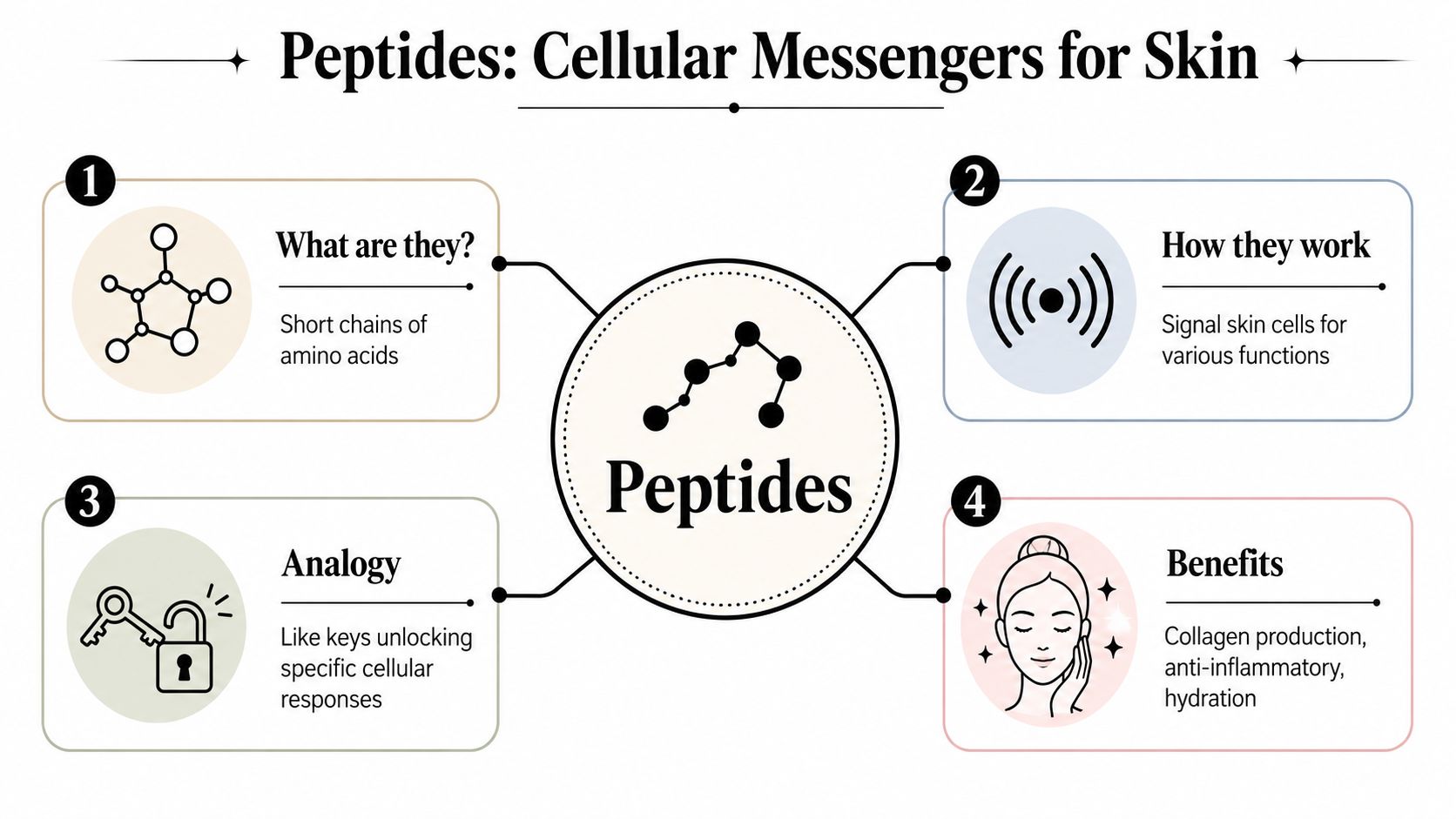
At a practical level, peptides are short chains of amino acids. If amino acids are letters, peptides are short messages built from those letters. Proteins such as collagen and elastin are the longer, complex structures made from many amino acids arranged in specific ways.
For retail and treatment teams, the simplest useful analogy is a cellular postal system. A peptide doesn't replace the skin wholesale. It delivers a signal. The skin “reads” that message and responds, depending on the peptide's design and whether the formula gets it to the right place in usable condition.
A visual helps fix that concept quickly:
Amino acids peptides and proteins
Amino acids are the raw units. Link a few together and you get a peptide. Build much larger, highly organised chains and you get proteins. In skin, those proteins include structural components that influence firmness, elasticity, and resilience.
That's why peptide communication matters commercially. Many peptide claims are really shorthand for a more precise idea: the formula is trying to encourage a skin response associated with healthier-looking structure or smoother appearance.
Why the messenger analogy matters
Not every message is the same. Some peptides are associated with signalling pathways linked to collagen support. Others are used to target expression-related concerns. Some are selected because they help carry another element into the skin environment.
Practical rule: Teach staff to avoid saying “peptides build collagen” as a blanket statement. Better phrasing is “certain peptides are designed to signal specific skin responses linked to firmness or wrinkle appearance”.
That wording is more accurate, easier to defend, and far better aligned with compliant selling.
For teams that need a quick educational asset, this overview video works well in onboarding or client education settings:
The commercial implication
Once you understand peptides as messengers, one strategic conclusion follows. The formula is at least as important as the peptide name. If the message degrades, never reaches its target environment, or sits inside an incoherent routine, the product may still feel premium while delivering little beyond moisturisation and expectation.
That's why peptide buying should never stop at INCI recognition.
Decoding The Four Main Peptide Families
The most useful way to evaluate peptides for skin is by function. Professionals don't need to memorise every trade name on the market. They do need to recognise the main functional families and what each is intended to do.
The quick-reference view
| Peptide Family | Mechanism of Action | Primary Target Concern | Example INCI Name |
|---|---|---|---|
| Signal | Sends cues associated with skin renewal processes, often linked to collagen and elastin support | Fine lines, loss of firmness, early visible ageing | Palmitoyl Tripeptide-5 |
| Carrier | Helps deliver trace elements used in skin processes | Dullness, compromised-looking skin, recovery-focused positioning | Copper Tripeptide-1 |
| Neurotransmitter-Inhibiting | Used in products targeting expression-related lines by influencing surface-level communication pathways associated with muscle contraction signals | Expression lines, forehead and eye-area smoothing claims | Acetyl Hexapeptide-8 |
| Enzyme-Inhibiting | Designed to reduce processes associated with breakdown of skin-supporting components | Loss of elasticity, texture decline, mature skin support | Rice Tripeptide-1 |
Signal peptides
These are the workhorses of many anti-ageing serums. Their role in positioning is straightforward. They're usually chosen for formulas aimed at firmness, visible wrinkle reduction, and overall skin quality.
For Swiss retailers, signal peptides often fit best in pharmacy-led anti-ageing, premium clean beauty, and maintenance regimens after in-clinic procedures. They're easier to explain than more technical peptide categories and tend to integrate well into conservative skincare routines.
Carrier peptides
Carrier peptides matter because they shift the conversation from “anti-wrinkle” to skin support logistics. Copper peptides are the best-known commercial example. They're often positioned around revitalisation, recovery, and skin conditioning.
That said, carrier peptides also attract more myth-making than most categories. Buyers should separate topical cosmetic logic from the much murkier world of injectable peptide trends, which belongs under a very different evidence and compliance standard.
Neurotransmitter-inhibiting peptides
These are the peptides most likely to be marketed with “needle-free” language. That's where disciplined merchandising matters. The compliant approach is to present them as cosmetic options for expression-line-focused routines, not as substitutes for medical interventions.
Their best commercial use is targeted. A serum for forehead lines or crow's feet can make sense. A whole brand story built on pseudo-procedure comparison usually doesn't.
Enzyme-inhibiting peptides
This group gets less airtime, but it can be useful in formulations designed around preserving skin quality over time. Their role is often more strategic than dramatic. Think longer-horizon support rather than instant transformation.
Buyers should match peptide family to treatment concept. A hotel spa recovery facial, a pharmacy wrinkle serum, and a minimalist clean beauty routine do not need the same peptide story.
The strongest assortments don't stock “a peptide product”. They stock the right peptide format for the right retail context.
Evaluating the Clinical Evidence on Peptide Efficacy
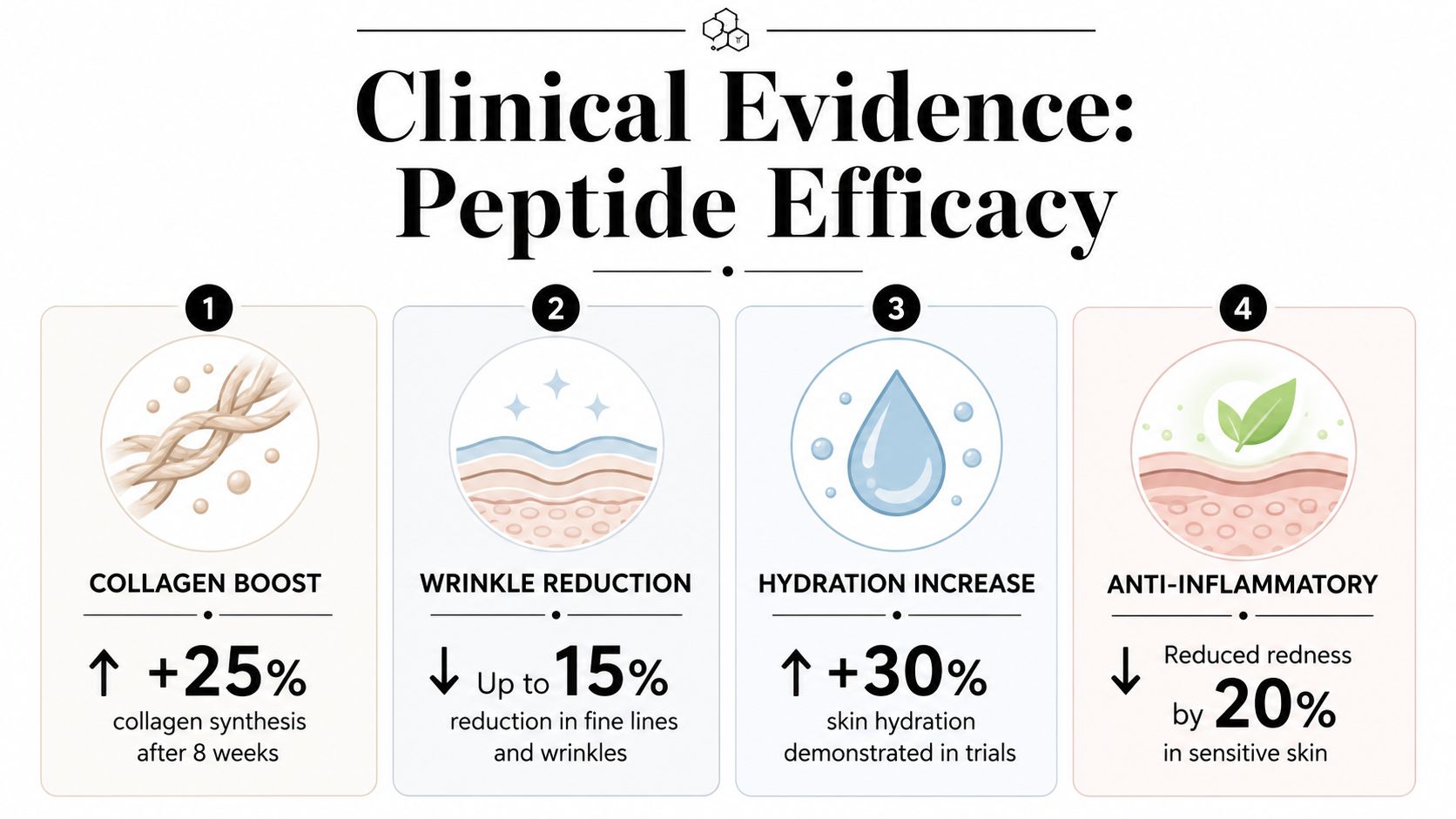
The evidence on peptides is promising, but it isn't a licence for grandiose claims. The most commercially useful reading is this: peptides can deliver measurable benefit, yet the average outcome is usually incremental rather than transformational.
One frequently cited bright spot comes from a clinical study involving 45 subjects, where Tripeptide-3 reduced fine lines in the forehead skin area by up to 52% over 4 weeks. The same paper also states that at a 4% concentration, certain peptides achieved up to a 52% diminution in perceived wrinkle dimensions within 4 weeks (clinical peptide study on PubMed Central). For product strategists, that's useful because it ties efficacy to a named peptide, a time frame, and a visible endpoint.
What the stronger data actually supports
That result doesn't mean every peptide serum deserves equivalent claims. It means a specific peptide, under study conditions, produced a measurable effect. Professionals should translate that into a simple rule: borrow confidence from data only at the same level of specificity that the data earned.
A broader view comes from a systematic review and meta-analysis of 19 randomised controlled trials involving 1,341 participants. It found that peptides significantly reduced skin roughness with a mean difference of −8.47 (p = 0.05) and improved hydration and brightness, particularly with oral formulations. The pooled wrinkle effect was modest at MD = 0.27 (p = 0.04), while oral polypeptides showed a stronger wrinkle reduction of MD = 1.5 (p = 0.01). The review also reported that peptides were safe, well tolerated, and associated with minimal adverse events (meta-analysis in Frontiers in Medicine).
The strategic interpretation
For Swiss clinics and premium retailers, the message isn't “peptides don't work”. It's more useful than that. Peptides work best as refiners. They may improve texture, hydration, brightness, and visible ageing markers without the risk profile or tolerance issues associated with more aggressive actives.
The most credible peptide claim is often not “dramatic wrinkle reversal” but “measurable support for skin quality, especially in longer-term maintenance routines”.
That makes peptides commercially attractive in three scenarios:
- Sensitive-skin anti-ageing: A lower-drama pathway for clients who won't tolerate stronger actives.
- Adjunct merchandising: A product that complements treatment plans rather than competes with them.
- Routine completion: The “extra polish” category for clients already using core actives.
For teams evaluating copper peptide stories specifically, these Novagenesis Biopharma GHK-Cu insights can help frame what brands often emphasise, though buyers should still distinguish topical cosmetic storytelling from rigorous human evidence standards.
Formulation Compatibility and Application Strategy
A peptide on an ingredient list isn't the product. The product is the whole delivery system. Buyers who ignore that usually end up overvaluing INCI theatre and undervaluing execution.
Why formula architecture decides performance
Peptides are chosen for a reason, but they still need a vehicle that protects them, presents them well, and fits real routines. Packaging matters. Texture matters. So does how the formula sits next to niacinamide, hyaluronic acid, exfoliating acids, and vitamin C in a client's actual regimen.
For professional recommendation, the operational question is simple. Can this peptide formula survive storage, make sense in layering, and be used consistently enough for its intended positioning? If the answer is uncertain, the product may create more confusion than loyalty.
The layering mistake many brands ignore
The consumer market often treats “more peptides” as automatically better. That's poor guidance. The “peptide uglies” phenomenon, involving redness, dryness, and breakouts from over-layering peptides, is a documented risk for sensitive or acne-prone users, and it confirms that overuse can overwhelm the skin barrier (dermatologist discussion of peptide overuse).
This has direct retail implications. A peptide serum doesn't always need to be paired with a peptide cream, peptide mist, and peptide eye product. In some clients, that stack is more likely to erode confidence than enhance outcomes.
Stockists should train teams to ask what the client is already using before adding another peptide layer. Barrier stress often looks like “the product isn't working”, when the routine itself is the problem.
A professional application framework
Use this as a practical screen for merchandising and recommendation:
- Keep one peptide lead product: Choose the formula that carries the main peptide story in the regimen. Don't duplicate the same message across four steps unless there's a clear rationale.
- Pair with supportives: Niacinamide and humectant-led formulas often make commercial sense beside peptide products because they support barrier comfort and routine adherence.
- Be careful with actives overload: A client using multiple exfoliating or high-intensity anti-ageing products may need simplification before a peptide addition makes sense.
- Match format to environment: A pharmacy client may prefer a daily leave-on serum. A spa may do better with a peptide mask or finishing product integrated into a treatment ritual.
The strongest peptide strategies are conservative in the best sense. They respect the skin barrier, protect brand trust, and create room for repeat purchase instead of rebound irritation.
A Retailers Guide to Vetting Peptide Skincare Brands
Swiss buyers need a tougher filter for peptide brands than “contains advanced actives”. In this category, weak vetting produces assortments full of expensive ambiguity.
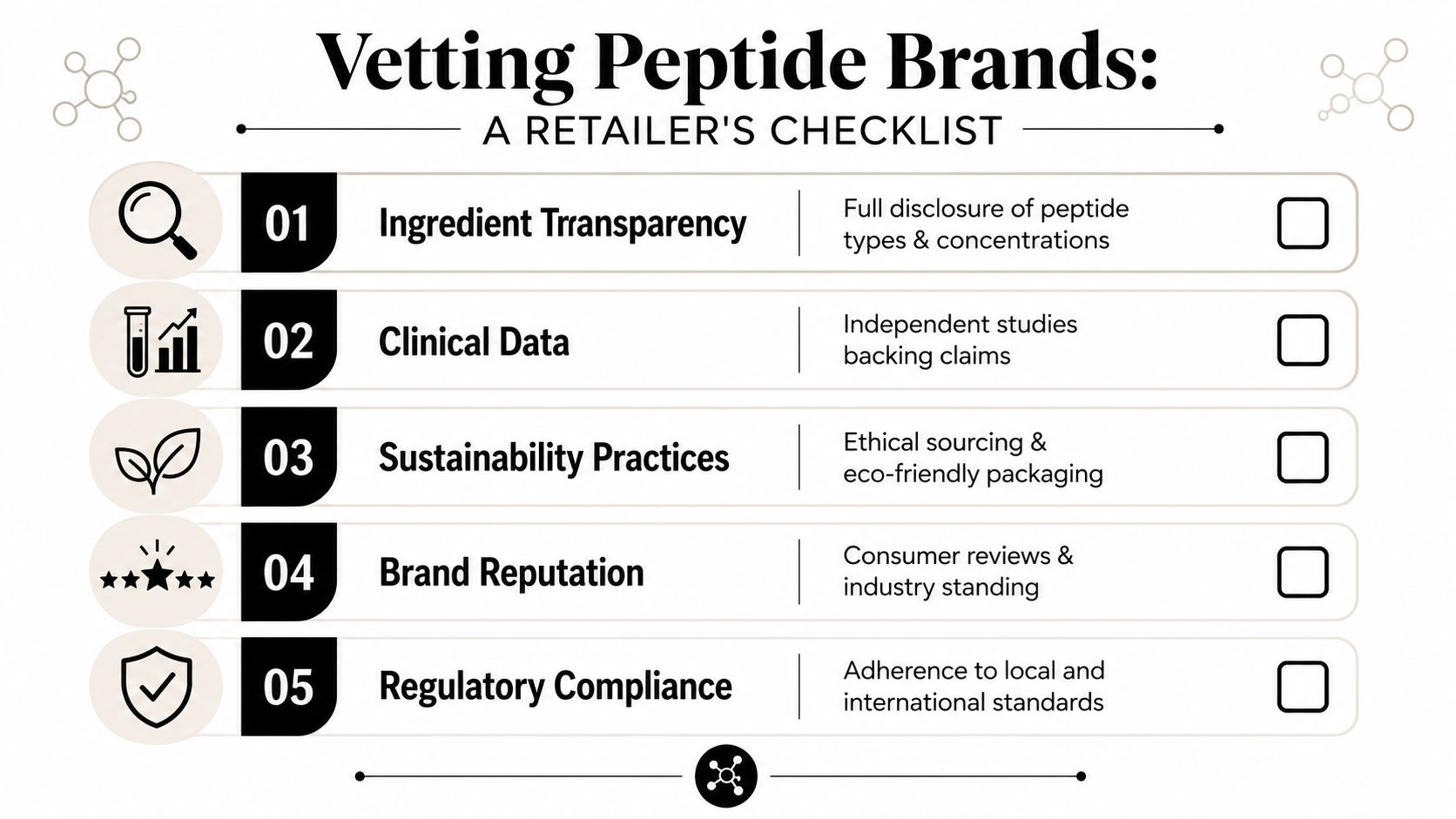
Start with claim quality
A credible brand should tell you which peptide, why it's there, and what level of claim support exists. If the language is all broad terms like “biomimetic technology” with no peptide identity or no clear cosmetic endpoint, treat that as a merchandising risk.
Ask for final-product evidence where possible, not just ingredient-level storytelling. Ingredient data can be useful, but your client buys the finished serum, not the laboratory concept.
Then test the business fundamentals
Use a practical procurement checklist:
- Transparency: The brand should disclose the active peptide names clearly enough for a buyer or trainer to evaluate them.
- Stability thinking: Ask how the brand protects peptide integrity through packaging and shelf-life strategy.
- Routine logic: Check whether the product has a realistic place in a standard regimen or treatment menu.
- Certification coherence: In the Swiss clean beauty channel, ethical sourcing and recognised standards need to align with the brand's positioning.
- Training support: If the peptide story is complex, the brand should supply usable education for staff, not only marketing adjectives.
Watch the injectable halo effect
One of the biggest current mistakes is letting interest in injectable peptides distort how topical products are judged. For popular injectable peptides like GHK-Cu, high-quality human evidence is scarce, and a 2026 warning from UNSW notes risks including contamination and unintended effects (UNSW warning on injectable peptide evidence and safety). That doesn't invalidate topical cosmetic use, but it does show how quickly the peptide category can drift into evidence-poor territory.
If a brand borrows authority from injectable peptide culture without matching that with compliant cosmetic evidence, it's signalling a governance problem, not innovation.
A Swiss-specific decision lens
For Switzerland, peptide vetting should sit at the intersection of evidence, ethics, and regulatory prudence. That means resisting trend pressure when a product's narrative outpaces its substantiation. It also means favouring brands that can support premium pricing with disciplined claims, ingredient clarity, and sourcing credibility.
The commercial upside is significant. Curated peptide assortments can differentiate a retailer or spa. But only if the assortment is curated like a professional range, not assembled like a social media wishlist.
Merchandising Clean and Sustainable Peptide Products
The most effective peptide merchandising in Switzerland doesn't start with “high-tech anti-ageing”. It starts with trust. Clients in the clean and premium channel want efficacy, but they also want to understand what they're buying and why it fits a responsible routine.

Sell the role not just the ingredient
Peptides for skin are easier to merchandise when teams describe them by function. A signal peptide serum can be presented as a firmness-supporting step. A copper peptide product may sit better in a skin-conditioning or recovery-support story. That language is clearer, more compliant, and less likely to inflate expectations.
This also helps with assortment architecture. Instead of building a generic “peptide shelf”, build distinct micro-stories:
- Minimalist age support
- Post-treatment skin comfort
- Luxury maintenance skincare
- Sensitive-skin texture refinement
Connect sustainability to formulation seriousness
In clean beauty, sustainability claims often sit in one silo and efficacy claims in another. Better merchandising combines them. If a brand uses ethical sourcing, cruelty-free positioning, or recognised certification frameworks, staff should link that story to product discipline, not treat it as separate moral decoration.
Clients respond well when they hear a coherent message: the formula is carefully selected, the sourcing is responsible, and the claim language is restrained because the brand respects both skin and standards.
Build better retail communication assets
Merchandising succeeds when every touchpoint says the same thing. Product page, shelf talker, staff script, spa menu note, and consultation language should all reinforce one concise promise. Not “peptides transform everything”. More like “targeted peptide support for smoother-looking, well-maintained skin”.
For e-commerce teams managing paid visibility and range structure, this kind of message discipline also improves campaign organisation. A useful reference is this Guide to Amazon beauty campaign structure, especially for thinking about how product intent, audience segmentation, and search behaviour should shape peptide category presentation.
The strongest peptide merchandising doesn't make the ingredient sound magical. It makes the recommendation sound intelligent.
That's the key opportunity. Not louder claims, but better curation.
Swiss retailers, pharmacies, spas, and e-commerce partners that want cleaner assortments, sharper claim discipline, and commercially credible beauty brands can explore how beautysecrets.agency supports professional partners with ethically sourced, certification-conscious skincare and wellness lines suited for the Swiss market.