The strongest commercial story for Chios Mastic Gum isn't that it's ancient. It's that an ancient resin now has quantifiable anti-ageing markers that cosmetic buyers can use. Recent work on Chios mastic identified elastase inhibition at IC50 17.30 μg/mL and collagenase inhibition at IC50 31.07 μg/mL, giving formulators a far more precise efficacy language than the usual vague claims about “skin renewal” or “botanical resilience” (reported here).
For Swiss pharmacies, dermo-cosmetic retailers, and premium clean-beauty buyers, that changes the conversation. Chios Mastic Gum can be positioned not just as a romantic Mediterranean ingredient, but as a traceable, technically relevant, evidence-backed resin with clear formulation logic, strong provenance, and a credible premium story.
The Protected Origin of Chios Mastic
A lot of botanical ingredients claim heritage. Very few are still inseparable from one small production geography. Chios Mastic Gum belongs to that rarer category.
Its use stretches back about 2,500 years, and meaningful production remains tied to the southern part of Chios island in Greece. One historical account notes that Chios offers the specific microclimate and limestone-rich soils required for significant resin production, which is why this resin is not broadly replicated elsewhere. That same continuity matters commercially. The cultivation tradition persisted even after Ottoman rule began in 1566, and the growers' association reports that the practice was later recognised by UNESCO as intangible heritage. The product also crossed into formal modern recognition in 2005, when the European Medicines Agency acknowledged mastic resin as a traditional herbal medicinal product for mild dyspeptic disorders and for the symptomatic treatment of minor skin inflammation or wounds (historical and regulatory background).

Why origin changes the value equation
In premium retail, provenance only helps if it affects quality perception and buyer confidence. With Chios mastic, it does.
When a pharmacy buyer sees a resin tied to one origin rather than a generic gum traded across multiple regions, three advantages appear:
- Authenticity is easier to communicate. The ingredient story is specific, not interchangeable.
- Premium positioning becomes defensible. Rarity and cultural continuity support a higher shelf narrative.
- Supplier scrutiny gets sharper. If the raw material is supposed to come from southern Chios, documentation matters more.
That last point is where many brands fail. They use “mastic” as a broad descriptor and strip away the place-based identity that gives the ingredient its commercial force.
Practical rule: If the product story doesn't clearly tie the resin back to Chios, the brand loses one of the few origin narratives that buyers immediately understand.
What works in Swiss retail
Swiss retail partners usually respond well when the ingredient story stays disciplined. The best language is not mystical. It is concrete. Chios Mastic Gum is a resin with a singular production identity, a long-use tradition, and a recognised bridge into regulated herbal medicine.
What doesn't work is overplaying folklore. “Ancient secret” language may catch attention online, but it weakens credibility in pharmacies and specialist drugstores. Buyers in those channels want a chain of logic. Origin, continuity, recognised use, formulation relevance.
That combination is what turns Chios mastic from a curiosity into a serious catalogue candidate.
The Bioactive Chemistry of Mastic Resin
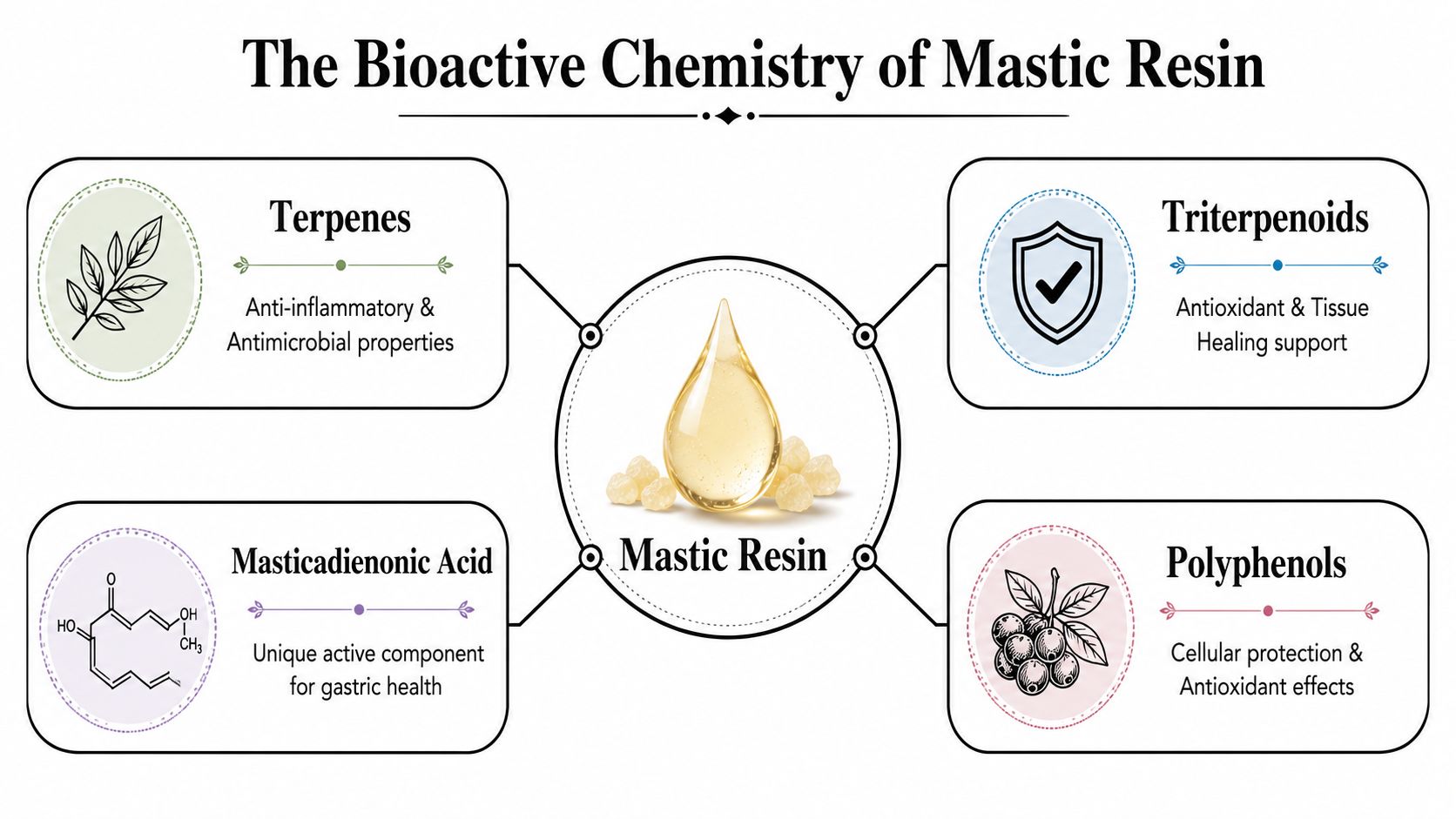
The resin matters because its chemistry is unusually rich, not because it sounds exotic. In practice, Chios Mastic Gum performs best when buyers understand it as a multi-component bioactive system.
A review article reports that more than 120 chemical compounds have been identified in the resin, while another source notes over 70 ingredients, including triterpenes and volatile compounds associated with anti-inflammatory and anti-oxidative effects (scientific review summary). For a formulator, that tells you two things immediately. First, this is not a one-molecule ingredient. Second, its effects are likely driven by fractions and families of compounds rather than a single headline constituent.
The main chemical families that matter
For commercial and formulation discussions, it helps to simplify the resin into functional groups rather than overwhelm buyers with a long analytical list.
- Triterpenes and related resin acids drive much of the technical interest. These are the fractions most often linked with anti-inflammatory, skin-conditioning, and protective effects.
- Volatile aromatic compounds contribute the characteristic sensory profile. They also influence how the ingredient is perceived in oral-care and balm-style systems.
- Minor supportive constituents shape the full activity profile. In natural ingredients, these often affect how “round” or “complete” the performance feels in real formulas.
This is why Chios mastic shouldn't be sold as a generic fragrance resin. It behaves more like a structured active raw material that also happens to bring aroma and story.
How to explain the chemistry without sounding academic
Retail partners don't need a lecture in natural product chemistry. They need language that survives customer questions and internal buying meetings.
A useful explanation sounds like this: Chios Mastic Gum contains a broad mix of resin acids, triterpenic compounds, and volatile molecules. That complexity helps explain why it has attracted attention in digestive health, oral care, and skin applications rather than staying confined to one narrow use.
That is a stronger position than saying it is “rich in natural antioxidants” and leaving it there. The phrase is common, but it doesn't help a pharmacist, category manager, or educator distinguish this resin from the next botanical extract.
Chios mastic works best when it is presented as a resin with identifiable active fractions, not as a vague Mediterranean plant ingredient.
What works and what doesn't in product development
In development meetings, I'd treat Chios mastic as an ingredient with three overlapping roles:
| Role in formula | Why it matters | Common mistake |
|---|---|---|
| Bioactive support | Gives the formula a science-backed efficacy story | Treating it as decorative label copy |
| Sensory signature | Adds character and distinction | Letting the aroma dominate the product |
| Brand narrative | Supports premium provenance | Replacing specificity with generic “natural” claims |
The trade-off is straightforward. The more precisely a brand talks about the resin's chemistry, the easier it becomes to justify premium positioning. The less precise it is, the more the ingredient collapses into lifestyle marketing.
Summary of Clinical and Traditional Uses
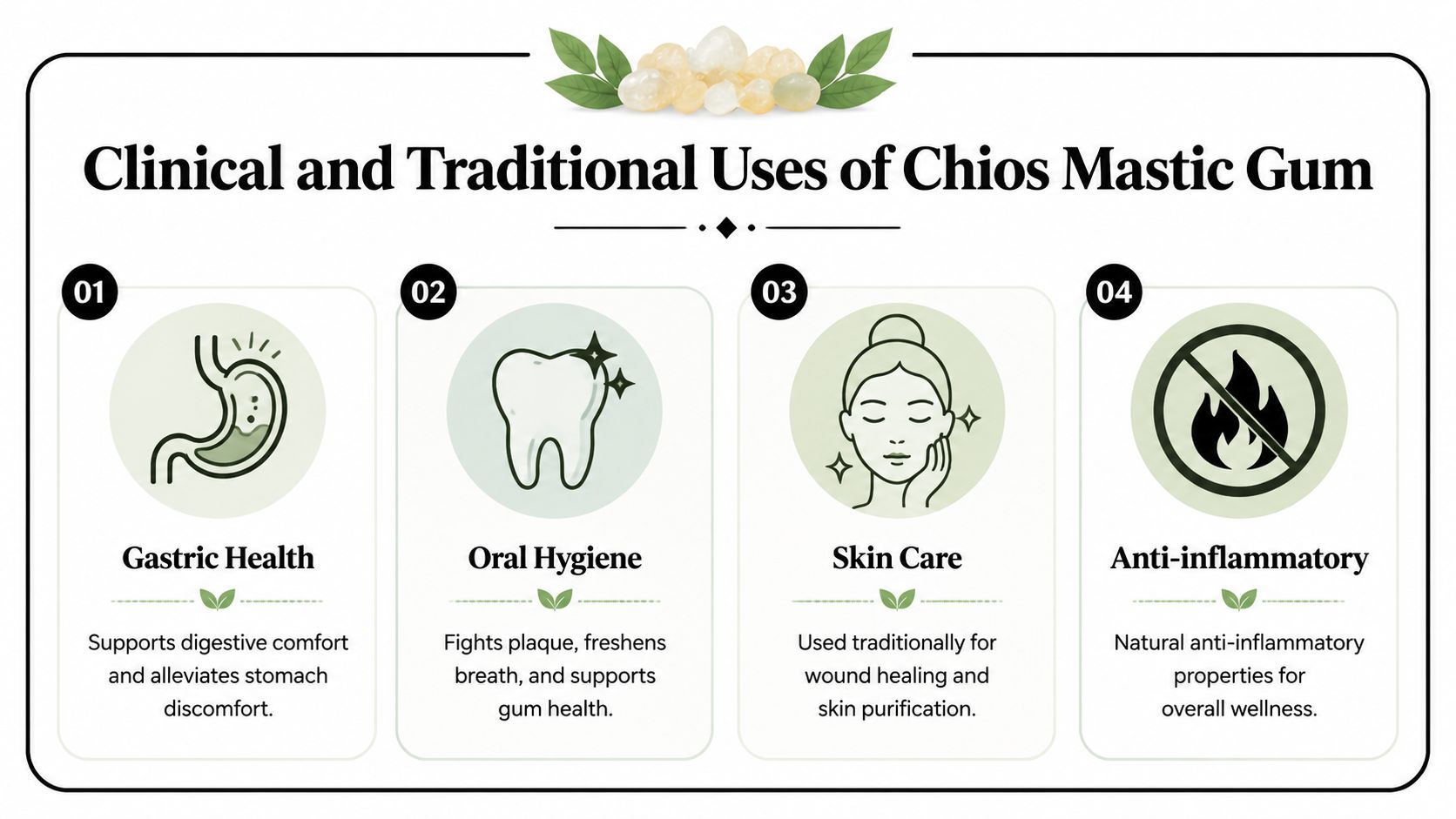
Chios Mastic Gum earns shelf space because it can support three commercially relevant stories at once: digestive credibility, oral-care relevance, and a more technical skin-ageing narrative. Very few natural resins carry all three without collapsing into folklore or generic antioxidant copy.
For Swiss retail partners, the practical task is to rank the evidence correctly. Digestive use has the strongest human history and the clearest clinical support. Oral care has good sensory and category fit. Skin use becomes persuasive once teams describe the mechanism precisely, especially in premium anti-ageing ranges where enzyme language helps justify price architecture and staff recommendations.
Digestive use has the strongest clinical base
If a buyer asks where mastic is most established, start with digestive support. Human research and broader ethnobotanical use align here, which gives the ingredient more credibility than many botanicals that rely on tradition alone.
A review of clinical and laboratory findings reports improvement in functional dyspepsia symptoms in a randomized controlled setting, alongside in vitro activity against isolated H. pylori strains (clinical and laboratory findings). For category planning, that supports a disciplined message: mastic belongs naturally in ingestible wellness, chewables, and oral-care adjacent concepts with a gastrointestinal heritage story.
That distinction matters in training.
- Human use case: support around dyspeptic discomfort
- Laboratory relevance: antimicrobial interest tied to gastric organisms
- Commercial use: stronger footing for supplement and oral wellness formats than for broad beauty-first claims
Oral care is commercially logical if the wording stays controlled
Mastic makes immediate sense in oral care because the sensory profile and traditional chewing use already fit the category. Toothpaste, gum, lozenges, mouth gels, and breath-freshening products all benefit from that natural coherence.
The common mistake is claim inflation. Teams move too quickly from traditional chewing resin to implied therapeutic dental performance. A better retail script focuses on freshness, cleansing support, and maintenance of a clean-feeling oral environment. That language is easier to defend, and it still gives premium products enough character to stand apart from standard mint systems.
This video gives a helpful visual reference for how the ingredient is often introduced in wider consumer education.
Skin use is strongest in targeted formats, especially anti-ageing
Skin is the most interesting area commercially, but only if the product team avoids vague rejuvenation language. Mastic is better positioned in concentrated, rationale-led formats such as balms, repair creams, spot treatments, and premium serums than in lightweight concept products that use the resin as decorative label copy.
For anti-ageing, the useful sales language is mechanistic. Buyers and trained pharmacy staff respond better to specific explanations around the preservation of skin structure than to another generic claim about glow or renewal. In practice, that means discussing mastic in relation to elastase and collagenase inhibition, because those mechanisms connect directly to the visible issues consumers understand: firmness, elasticity, and the appearance of structural decline over time.
I would keep the range architecture tight here. Use mastic where a resin ingredient makes sensory and technical sense, then support the story with precise efficacy language rather than broad promises.
A good shortlist looks like this:
- Soothing leave-on care for stressed or reactive-looking skin
- Purifying blemish products where resin chemistry fits the formula logic
- Barrier balms and rich creams where film-forming character is an advantage
- Premium anti-ageing treatments built around elastase and collagenase inhibition language
Traditional relevance still helps, but it should not carry the whole claim
Traditional use remains commercially useful because it adds depth and memorability. It helps explain why consumers in the Mediterranean have kept the ingredient in oral and digestive routines for generations. For Swiss partners, that supports staff education and premium provenance storytelling.
Still, tradition should support the sell, not replace evidence. Once a brand asks consumers to pay a premium, the conversation needs to move from heritage into function. That is especially true in dermocosmetic retail, where staff will expect a clear answer to a simple question: what does this resin do, and why is it in this formula at this level?
Where buyers should stay disciplined
The strongest mastic products usually share the same traits. They use the ingredient in categories that fit its character, they keep claims within the evidence, and they avoid token inclusion levels that do nothing for efficacy or credibility.
What tends to work:
- provenance-led pharmacy and premium wellness positioning
- oral-care and digestive concepts with a coherent use story
- targeted skin products built around soothing, purifying, or structural-support language
- anti-ageing narratives that explain elastase and collagenase relevance clearly
What tends to underperform:
- broad cure-all positioning
- medical-sounding claims without regulatory support
- generic natural beauty messaging with no mechanistic explanation
- front-of-pack hero positioning when the formula uses mastic at a decorative level
If Chios Mastic Gum appears on the front of pack, the formula and claim set need to justify that choice. Swiss buyers and retail educators will test that logic quickly.
Advanced Cosmetic Formulation Guide
Chios mastic earns a premium place in anti-ageing formulas only when the mechanism is explained properly. The useful commercial language is not vague “repair” positioning. It is controlled support for skin structure, grounded in earlier-cited findings on elastase and collagenase inhibition.
For Swiss retail partners, that distinction matters. Firmness, elasticity, and skin resilience are crowded claim areas, and buyers hear the same generic botanical promises every week. Mastic gives formulators a tighter story if the formula, dose, and texture are handled with discipline.
Mechanism first, then claim language
Elastase contributes to elastin breakdown. Collagenase contributes to collagen degradation. Earlier in this article, the cited study reported inhibitory activity from specific Chios mastic fractions against both enzymes. That is the part worth carrying into product training, because it supports a premium anti-ageing narrative with a real biochemical rationale.
Use that rationale carefully. The strongest claims stay close to what the ingredient is doing in the evidence base.
Suitable phrasing includes:
- supports skin firmness
- helps maintain the look of elasticity
- helps protect a smoother-looking skin surface
- supports skin resilience against visible structural ageing
Avoid overclaiming. Chios mastic is a credible structural-support active. It is not a free pass to claim collagen rebuilding, wrinkle reversal, or clinical lifting unless the finished product has its own substantiation.
How the resin behaves on the bench
Formulation work starts with the physical character of the material. The published technical specification lists a density of 0.96 to 1.08 g/mL at 20°C, a softening point of 45 to 55°C, and a melting range of 85 to 105°C in the technical specification. Those numbers are not academic. They affect heating profile, processing order, clarity, and the final sensory signature.
In practice, Chios mastic behaves as both a bioactive resin and a texture contributor. That dual role is useful, but it creates trade-offs. Push too hard on sensorial richness and the product can feel heavy or medicinal. Chase a very clean finish without planning your dispersion system and you risk uneven incorporation or a weak ingredient story at a decorative dose.
I would treat mastic early as a system decision, not a last-minute marketing add-on.
Chios Mastic Gum formulation guide
The right inclusion level depends on the base, the claim target, and how central mastic is to the concept. These ranges are practical starting points for development work, not a substitute for stability, compatibility, and sensory validation in your own formula.
| Application Type | Recommended Concentration (% w/w) | Key Formulation Notes (Stability, Sensory) |
|---|---|---|
| Anti-ageing serum | 0.1-0.5 | Best suited to light emulsions or gel-serum systems where the finish stays refined. Resin odour and clarity need active management. |
| Firming cream | 0.2-1.0 | Performs well in richer emulsions where slight film formation supports the positioning. Balance with elegant emollients to avoid drag. |
| Soothing balm | 0.5-2.0 | A natural technical fit. Watch stickiness, spread, and payoff carefully during scale-up. |
| Blemish treatment | 0.2-1.0 | Works best in focused spot or targeted care concepts. Keep the texture fresh and controlled rather than occlusive. |
| Oral-care gel | 0.1-0.5 | Flavour compatibility and aftertaste are as important as the efficacy story. Validate sensory acceptance early. |
Pairings that strengthen the concept
In anti-ageing systems, mastic pairs well with humectants, barrier-support lipids, and elegant emollients that soften the resin profile without diluting the premium story. In blemish or purifying products, it works better beside calming and sebum-conscious support actives than alongside aggressive exfoliation stacks that make the formula feel punitive.
This is also where supplier documentation starts to matter at formulation stage, not just at procurement stage. Teams that are solving common supplier data problems usually move faster on specifications, claim support, and formula sign-off because batch data and technical files are easier to compare.
Common formulation mistakes
Three errors show up repeatedly in mastic concepts.
- Decorative dosing. If front-of-pack messaging highlights Chios mastic, the use level and formula role need to justify that choice.
- Poor resin management. In the wrong base, mastic can leave tack, drag, haze, or an overly balsamic odour profile.
- Claim overload. A single SKU should not try to be firming, blemish-correcting, microbiome-supporting, barrier-repairing, and radiance-focused at the same time.
Better products stay narrow and coherent. A firming cream can use mastic to support structural-ageing language. A balm can use it for resin character and skin-comfort positioning. A targeted serum can build around enzyme-inhibition logic and premium evidence-led storytelling.
That is usually where the ingredient performs best commercially and technically.
Sourcing Sustainability and Supplier Vetting
With Chios Mastic Gum, sloppy sourcing undermines the entire proposition. This isn't a commodity botanical where origin can stay fuzzy. If the product is supposed to carry the prestige of Chios, procurement has to prove it.
That means buyers should evaluate authenticity, technical quality, and documentation at the same time. A beautiful ingredient story is worth very little if the supplier cannot support it with batch records, specifications, contaminant controls, and origin clarity.
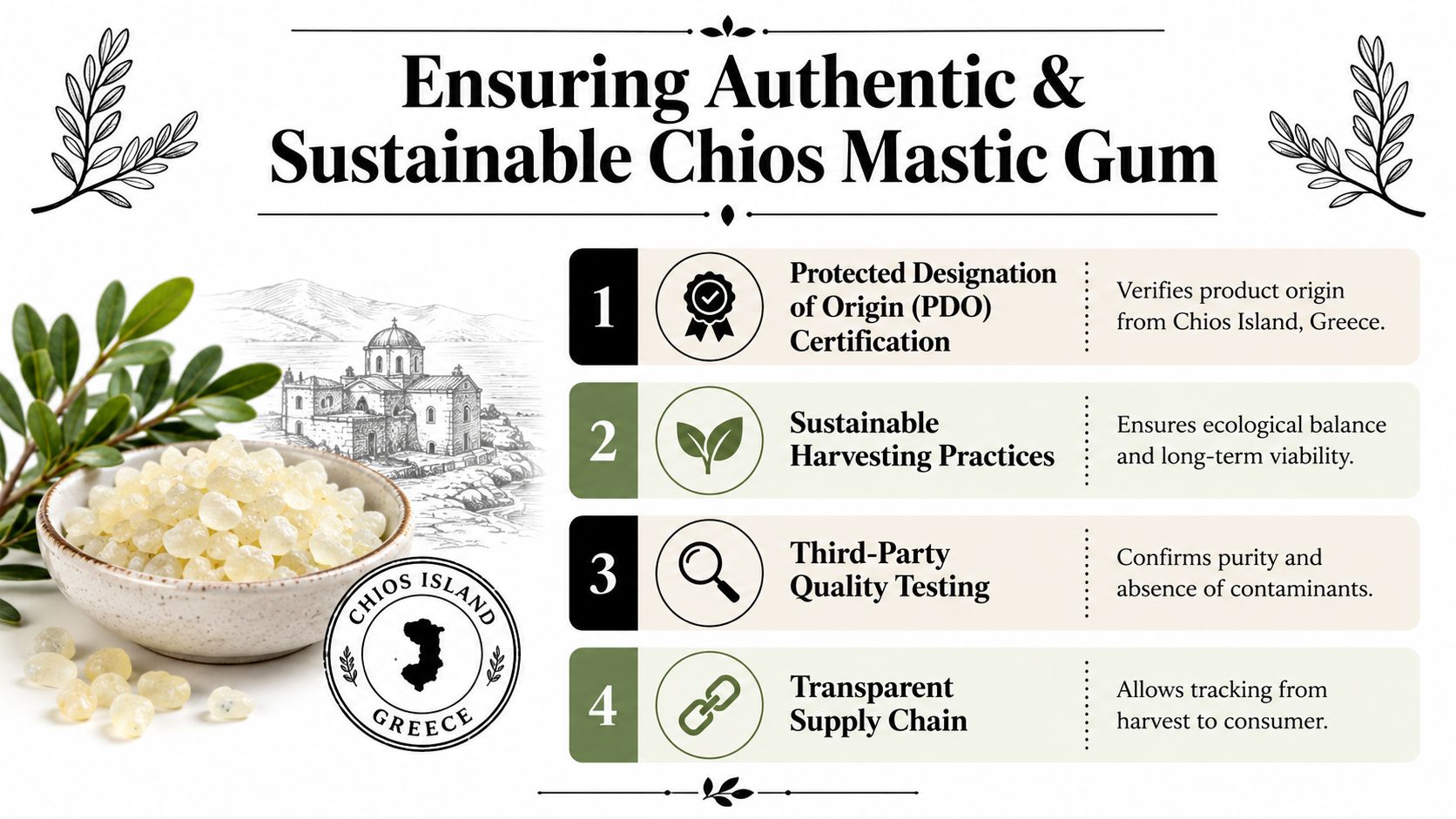
What a serious supplier should provide
The baseline starts with technical and identity documents. Earlier technical specifications already show the importance of properties such as density, softening point, melting range, and the declarations that the material is 100% natural and non-GMO. A supplier should be able to produce equivalent current documentation for the exact material offered, not just a generic marketing sheet.
A credible dossier should include:
- Origin clarity: documentation that ties the material back to Chios rather than a broad regional broker claim
- Batch-level specification: physical characteristics, organoleptic profile, and purity markers
- Microbiological and safety support: evidence that the ingredient is suitable for its intended cosmetic or oral-care use
- Regulatory readiness: documentation aligned with EU cosmetic compliance work
For larger assortments, supplier information often becomes the bottleneck rather than the ingredient itself. Teams handling multiple natural actives usually benefit from better systems for solving common supplier data problems, especially when origin claims and technical files need to stay synchronised across SKUs, markets, and labels.
A practical vetting checklist
Use this checklist before range approval.
| Checkpoint | What to ask | Why it matters |
|---|---|---|
| Identity | Is the material clearly described as Chios mastic from the correct origin? | Prevents generic substitution |
| Technical fit | Are physical specs suitable for your formula type? | Reduces reformulation surprises |
| Purity | Is there evidence of appropriate contaminant control? | Protects safety and brand trust |
| Documentation | Are current specifications and declarations available? | Supports compliance and retailer review |
| Supply continuity | Can the supplier maintain consistent batches? | Avoids quality drift in repeat production |
Buyers should treat Chios mastic as a documented origin ingredient first and a romantic story second.
Where procurement often goes wrong
The usual mistake is choosing on price before choosing on evidence. That approach can work for basic emollients. It does not work for identity-driven actives.
Another common problem is confusing “natural” with “self-explanatory”. Natural materials need more supplier discipline, not less. Variation, sensory shifts, and documentation gaps all become more important when a brand is trying to sell authenticity at the premium end of the market.
If a supplier cannot answer clear questions about origin, specification, and batch consistency, move on. Chios Mastic Gum only earns its margin when the supply chain protects the claim.
Market Opportunities and Product Concepts
Chios Mastic Gum fits best where the assortment already values provenance, sensoriality, and technical differentiation. It is not a mass-market filler ingredient. It belongs in edited ranges where staff can explain why it is there.
In Switzerland, I'd look at three channel types first. Pharmacies and drugstores can support dermo-cosmetic education. Prestige beauty retail can use the origin and anti-ageing language. Wellness and spa settings can turn the resin's aromatic identity into a treatment experience.
Product concepts that have real shelf logic
Dermo-cosmetic skin rescue balm
This is the most intuitive pharmacy concept. The format suits the resin. The consumer problem is easy to understand. The language can stay disciplined: soothing care, protective comfort, and support for stressed-looking skin.
Best use case:
- winter skin
- local dry patches
- post-exposure comfort care
- handbag or cabinet staple
Why it works:
The texture and ingredient story align. A balm invites the customer to accept a richer, more resinous sensorial profile.
Hellenic firming night cream
This concept works for premium beauty counters and curated e-commerce. The value comes from combining Chios origin with the enzyme-inhibition story already discussed in the formulation section.
The strongest messaging angles are:
- support for skin resilience
- care for visible firmness
- premium Mediterranean active with evidence-led positioning
What I wouldn't do is make this a hyper-trendy glass-skin product. Chios mastic has more gravitas than that. It performs better in a cream that feels composed, restorative, and structurally focused.
Purifying oral-care set
This can include toothpaste, mouth gel, or breath-freshening support products depending on the regulatory frame and brand portfolio. The concept suits wellness stores and premium pharmacy merchandising alike.
A clean concept stack would be:
- resin-based freshness
- purifying oral ritual
- Mediterranean identity with traditional roots
The key point is coherence. Mint, herbal notes, and resin freshness belong together. Sweet, playful confectionery styling usually doesn't.
How to premiumise without overclaiming
Retailers often ask what exactly allows a mastic-based product to sit above a standard botanical line. The answer isn't one thing. It is a stack.
- Distinct origin story: not just Mediterranean, but specifically Chios
- Technical relevance: resin fractions with documented anti-ageing language
- Sensory identity: recognisable, memorable, and less generic than many plant extracts
- Channel fit: especially strong in advisory retail
Best channel match by concept
| Retail channel | Strongest concept | Why it fits |
|---|---|---|
| Pharmacy | Skin rescue balm | Clear problem-solution logic |
| Premium beauty boutique | Firming night cream | Supports higher-value anti-ageing storytelling |
| Wellness store or spa | Purifying ritual set | Combines sensory experience with heritage |
| Dermatology-adjacent retail | Targeted serum or balm | Benefits from more technical explanation |
What doesn't work is forcing Chios mastic into every category merely because the ingredient is fashionable in specialist circles. It needs the right format, the right narrative, and a retailer willing to educate. When those three line up, the ingredient can carry a meaningful premium.
Frequently Asked Questions for Partners
Retail teams usually ask the same question in different forms. Is Chios Mastic Gum suitable for repeated topical use, or is the story stronger than the safety profile?
The useful answer is that recent 2024 clinical data confirms Chios mastic is non-cytotoxic to human skin cells, supporting its safety for topical use on sensitive skin while also showing inhibition of pathogens without harming surrounding tissue (clinical safety note). That's a much better basis for discussion than relying only on “it has been used for centuries”.
Is it suitable for sensitive skin?
Potentially yes, and the non-cytotoxic finding is the most relevant evidence point for that conversation. Still, sensitive skin is not one condition. Final tolerance depends on the complete formulation, concentration, fragrance load, and delivery system.
A well-built product with Chios mastic can be suitable for sensitive-skin positioning. A heavily fragranced or poorly balanced formula can still fail.
Is it only for anti-ageing products?
No. That's one of the common assumptions worth pushing back on.
The anti-ageing story is commercially strong because the enzyme-inhibition language is precise. But Chios mastic also makes sense in soothing balms, purifying care, and oral-care adjacent concepts. The ingredient is versatile. The claim strategy should stay narrow even if the ingredient itself can do several jobs.
Can staff describe it as healing?
Be careful. In consumer-facing cosmetic language, “healing” often pushes the conversation into medicinal territory. It is safer and more accurate to say the ingredient is used in products designed to soothe, comfort, purify, or support skin resilience, depending on the product type.
If your team needs one rule, use this one: describe the finished product, not your hopes for the raw material.
Is daily use realistic?
In the right formula, yes. Daily use depends less on the romance of the ingredient and more on competent product design. Texture, residue, aroma, and compatibility with the rest of the regimen decide whether consumers keep using it.
What should retail staff say in one sentence?
Use a line like this:
Chios Mastic Gum is a distinctive resin from southern Chios with a strong provenance story, useful bioactive research behind it, and good premium potential in targeted skin and oral-care products.
That sentence is credible, compact, and easy to defend in front of informed customers.
If you're building a Swiss retail assortment around evidence-led natural actives, beautysecrets.agency can help you identify premium cosmetic and pharmacy-ready concepts that combine strong provenance, clean formulation logic, and credible market positioning.