The most repeated advice about Dragon Blood serum is also the least useful for a buyer. You'll hear that it “soothes, firms, hydrates, repairs, calms redness, supports collagen, and helps anti-ageing”. That bundle of claims sounds commercial. It isn't scientific.
For Swiss pharmacy, spa, and dermo-cosmetic channels, the pertinent question is narrower. What does the resin plausibly do in a cosmetic serum, what evidence supports that use, and where does the claim set drift beyond the data? If you stock this category, that distinction affects merchandising, staff training, treatment-room use, and compliance language.
Dragon's blood is not a fantasy ingredient. It is a botanical resin with a long medicinal history and a credible repair-oriented story. But a credible story isn't the same as a proven anti-ageing serum claim. Buyers who treat those as interchangeable risk overpromising to a customer base that increasingly expects evidence, especially in premium and pharmacy-led environments.
Dragon Blood serum becomes commercially interesting. Its strongest rationale is not “miracle serum” positioning. It is barrier support, comfort-focused recovery, and adjunct use around dryness or stressed skin states, provided the formula is sound and the messaging stays disciplined.
Beyond the Hype of Dragon Blood Serum
The name does a lot of the selling. “Dragon's blood” sounds rare, potent, and almost medicinal before anyone examines the INCI list or the delivery system. That's precisely why buyers should slow down.
In consumer marketing, the ingredient is often presented as if the name itself guarantees efficacy. It doesn't. A Dragon Blood serum may be excellent, mediocre, or largely theatrical depending on extraction quality, solvent system, supporting ingredients, and claim discipline. The resin can contribute value, but it doesn't exempt a formulation from basic cosmetic science.
What buyers should challenge first
The first assumption to discard is that all benefits claimed for wound care translate directly into a facial serum. They don't. A resin associated with wound-healing activity may still be useful in cosmetics, but the application context changes. Open or damaged tissue, controlled studies, and consumer leave-on skincare are different use cases.
The second assumption is that “natural” means low risk. It doesn't. Plant resins can be active, reactive, and formulation-sensitive. That matters in pharmacy and spa settings where customers may already be using acids, retinoids, post-procedure routines, or products for sensitised skin.
Buying rule: Treat Dragon Blood serum as an active botanical category with a repair narrative, not as a decorative exotic ingredient.
A better commercial lens
For Swiss trade buyers, the more useful lens is operational:
- Barrier support positioning: Can the serum help create a more comfortable surface layer for dry or compromised skin?
- Routine compatibility: Does it layer well with humectants, ceramides, or stronger actives?
- Evidence hierarchy: Are the claims tied to cosmetic outcomes, or borrowed from wound-focused literature?
- Retail safety: Can your team explain patch testing, appropriate use, and claim boundaries clearly?
That approach changes the category from impulse trend-buying to rational assortment building. In practice, Dragon Blood serum works best when it is sold as a supportive format for skin that needs protection and tolerability, not as a catch-all youth serum.
The Botanical Source of a Legendary Resin
Dragon's blood is a deep red botanical resin, not a pigment effect created for beauty branding. The name comes from the resin's appearance when the tree is cut and the sap flows.
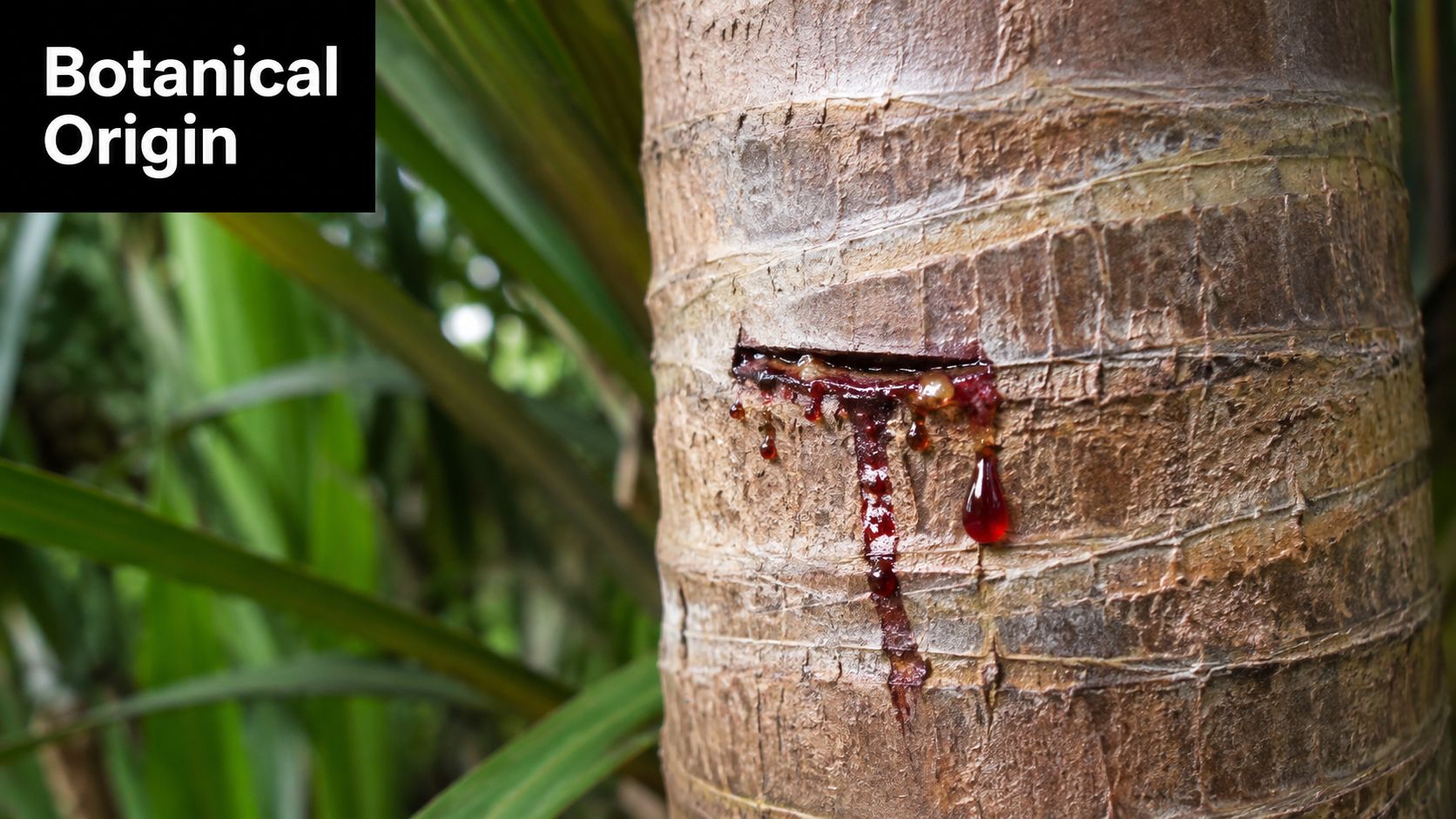
A useful point for buyers is that “dragon's blood” isn't always a precise commercial term. In the market, it can refer to resins from different botanical sources. That naming looseness matters because ingredient identity affects both evidence quality and product storytelling. If a brand leans heavily on science, it should also be specific about the resin source.
Why the history matters
Dragon's blood has a documented historical record in the CH region through its use in Traditional Chinese Medicine during the Han Dynasty (206 BCE to 220 CE), placing its recorded use at least 1,800 years before modern skincare marketing adopted the name, as described in this history of dragon's blood use in traditional practice. That same ingredient history also notes use for wound healing and as an astringent.
For a buyer, that historical point is not just colour for a product card. It explains why the resin entered modern skincare through a repair and protection narrative, rather than through brightening, exfoliation, or pigment correction.
What this means for product evaluation
A strong brand presentation should connect three things clearly:
- Botanical source clarity: The brand should identify what resin it uses, rather than relying on the romantic name alone.
- Traditional logic: Historical use supports a repair-oriented heritage story.
- Modern restraint: Heritage should inform positioning, not replace evidence.
Long use in traditional systems can justify interest in an ingredient. It can't, by itself, justify every modern cosmetic claim attached to it.
That distinction matters in Switzerland. Premium customers often appreciate ingredient provenance, but they also expect precision. A product that tells a vivid origin story while staying careful about efficacy claims will usually feel more credible than one that treats tradition as proof of anti-ageing performance.
How Dragon Blood Serum Works on the Skin
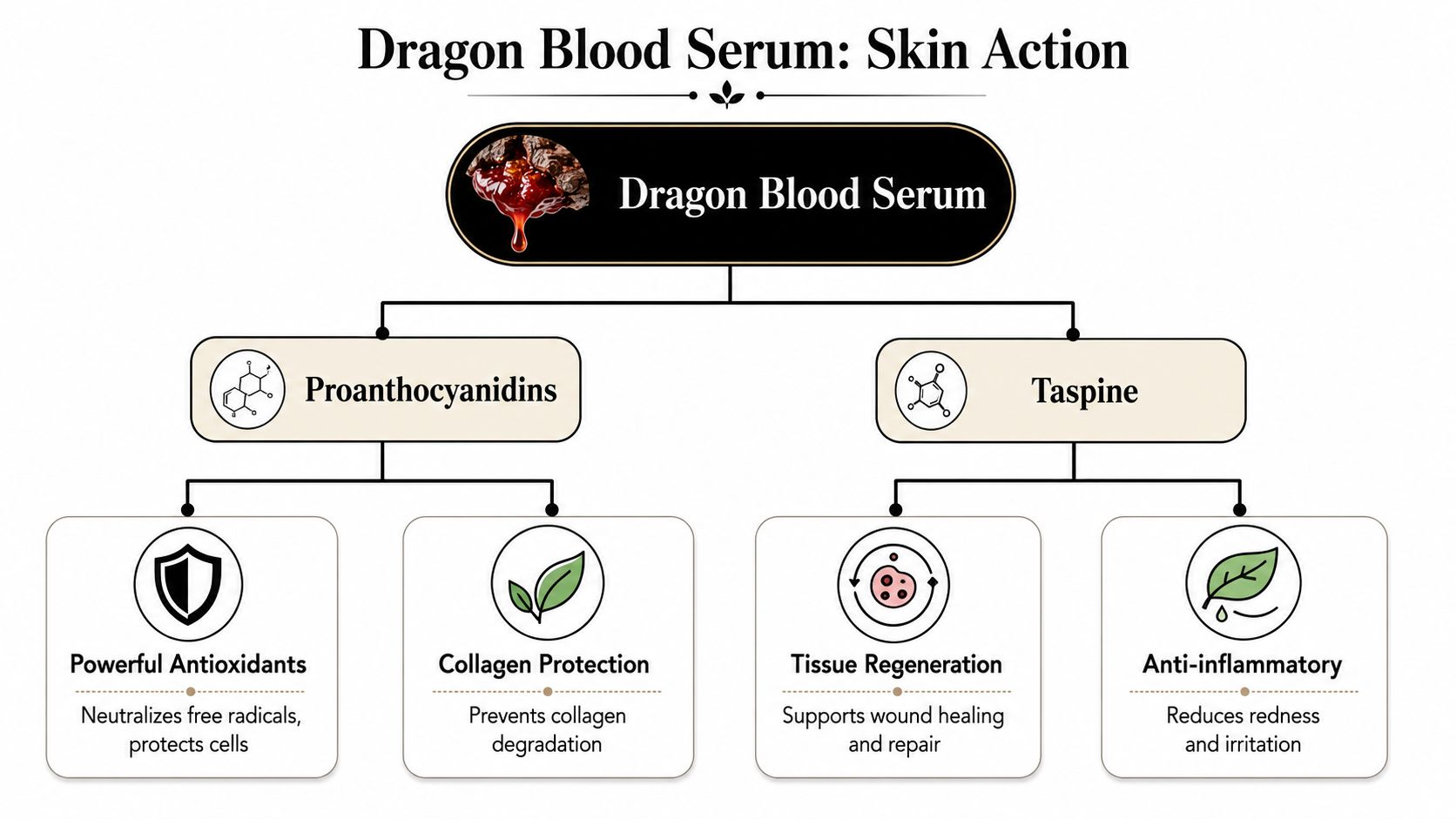
The most technically relevant feature of Dragon Blood serum is not its colour. It is its role as a film-forming botanical resin.
Independent ingredient discussions describe dragon's blood as forming a thin, flexible, breathable surface layer that can help reduce transepidermal water loss and create an occlusive-but-comfortable barrier, as outlined in this cosmetic ingredient review of dragon blood extract. In practical terms, that makes it relevant for dry environments, barrier-impaired skin, and routines built around stronger actives.
Think of it as a cosmetic surface shield
The easiest way to explain the mechanism to staff is this: a good Dragon Blood serum can act a bit like a breathable liquid dressing. Not a medical dressing, and not a full substitute for moisturiser, but a lightweight film that sits on the skin and helps it hold on to comfort.
That matters in several retail scenarios:
- Dry winter skin: The film can support routines where indoor heating and cold outdoor air increase discomfort.
- Layering with actives: A protective surface feel may improve tolerability when customers use retinoid-style or exfoliating routines.
- Post-treatment support: In spa or clinic-adjacent retail, the category makes the most sense when positioned around comfort and barrier-minded aftercare.
Why formulation decides the outcome
The resin doesn't work in isolation. The same ingredient review notes that performance depends on the solvent system, resin concentration, and compatibility with humectants such as hyaluronic acid, not on the resin alone. That is an important buying point.
Two serums can both feature dragon's blood and behave very differently. One may create an elegant, flexible finish. Another may feel sticky, under-dosed, or cosmetically redundant if the rest of the base is poorly built.
A useful evaluation framework for buyers is:
| Formulation question | Why it matters | What to look for |
|---|---|---|
| Is the texture elegant enough for repeat use | Film-formers fail commercially if they pill or feel heavy | Fast-set finish, low tack, good layering |
| Does it include complementary hydrators | Barrier support is stronger when film-formers work with water-binding ingredients | Humectants such as hyaluronic acid |
| Is the serum positioned for comfort rather than miracle claims | Mechanism supports protection more than dramatic transformation | Repair, barrier, recovery language |
| Does it fit a routine logically | Customers need to know when and why to use it | After cleansing, before heavier creams |
Practical translation for retail teams: Sell the mechanism, not the myth. Customers understand “protective breathable layer” far better than vague claims about ancient magic.
Decoding the Clinical Evidence for Skin Benefits
Many Dragon Blood serum launches become less rigorous than they appear. The independent evidence base is most persuasive when the conversation stays close to wound-healing and anti-inflammatory activity. It becomes less secure when marketing expands that into broad anti-ageing language for normal day-to-day facial use.
A key review of Croton lechleri resin highlights the strongest independent support around wound contraction, collagen-related effects, infection barrier formation, and anti-inflammatory activity in a clinical context, as discussed in this review of Croton lechleri evidence. That is meaningful. It suggests the resin has genuine biological interest.
It does not automatically prove that a cosmetic Dragon Blood serum reduces everyday facial redness, lifts sagging skin, smooths wrinkles, or produces visible firming in ordinary consumer use.
The evidence hierarchy buyers should use
Trade buyers often need one clear question answered: what can the sales team say without drifting into inference? The answer depends on the type of data behind each claim.
| Claim | Level of Evidence | Primary Application |
|---|---|---|
| Wound-healing support analogues | Strongest support among available uses | Repair-oriented interpretation |
| Anti-inflammatory activity | Supported, but context matters | Soothing and comfort positioning |
| Barrier support through film formation | Mechanistically plausible in cosmetics | Dry or stressed skin routines |
| Hydration support | Plausible when paired with suitable humectants | Surface comfort and routine support |
| Anti-ageing and firming | Marketing extrapolation unless a brand has direct cosmetic data | Consumer-facing beauty claims |
| Redness reduction in everyday facial skincare | Not clearly established by the strongest cited evidence | Use cautious wording |
What that means commercially
A buyer who recognises this hierarchy can merchandise the category more effectively than a buyer who accepts the entire claim set at face value.
The strongest product concepts are usually those that say something like:
- support the skin barrier
- help protect against moisture loss
- comfort skin that feels stressed
- complement recovery-focused routines
The weakest concepts are those that jump straight to “face-lifting”, “wrinkle-erasing”, or “clinically proven firming” without direct cosmetic evidence.
A better briefing for pharmacists and spa staff
Staff should be trained to separate medical-style analogue evidence from cosmetic endpoint proof. That distinction protects the retailer and improves credibility with knowledgeable clients.
For example, if a customer asks whether Dragon Blood serum is “anti-ageing”, a careful answer is more persuasive than a loose one. You can say that the ingredient has a repair-oriented reputation and a barrier-support role, but that the strongest independent evidence sits closer to wound-healing and anti-inflammatory contexts than to classic anti-ageing serum trials.
The most credible sale is often the more modest one. Customers who hear precise language are more likely to trust the broader recommendation.
For Swiss channels, this creates a practical advantage. Pharmacies, spas, and dermo-cosmetic counters can position Dragon Blood serum as a recovery-support and comfort category without needing to borrow claims that aren't clearly established for standard facial skincare.
Formulation Notes and Practical Application
Once you strip away the mythology, Dragon Blood serum becomes easier to place in a routine. It is usually best treated as a supportive layer rather than the centrepiece active in a results-driven regimen.
That makes it suitable for customers who complain less about “ageing” in the abstract and more about practical symptoms. Skin feels tight. It reacts after weather shifts. It becomes less tolerant during retinoid use. It needs a softer routine after treatment-room services.
Who it fits best
Some retail matches are stronger than others:
- Barrier-impaired clients: People whose skin feels fragile, dry, or overworked by active routines often understand the value fastest.
- Post-procedure shoppers: In spa and clinic-adjacent retail, the category sits naturally alongside recovery-oriented home care.
- Cold-weather users: Customers dealing with winter dryness often respond well to film-forming support.
- Sensitive routine builders: Those who can't tolerate aggressive textures may prefer a comfort-led serum.
Where it sits in a regimen
Placement matters because the resin's value is partly mechanical.
- Cleanse with a non-stripping formula.
- Apply lighter hydration first if the routine includes a watery humectant layer.
- Use Dragon Blood serum before heavier creams or balms.
- Seal with a moisturiser when the skin needs extra lipid support.
This logic makes the serum especially compatible with formulas built around hyaluronic acid or ceramides. The resin can help hold a comfortable finish on the skin, while humectants and barrier lipids do the rest of the structural work.
What buyers should test in sample review
A formula can be conceptually strong and still fail in use. During product review, assess:
- Layering behaviour: Does it pill under cream or sunscreen?
- Finish quality: Is the film flexible, or does it feel lacquered?
- Use-case clarity: Is it clearly positioned for stressed, dry, or recovery-phase skin?
- Claim discipline: Does packaging stay cosmetic, or does it drift towards medical implication?
A Dragon Blood serum earns shelf space when its sensorial profile supports the science story. If the texture is wrong, the mechanism may be plausible but the commercial sell-through will still suffer.
Sourcing Safety and the Swiss Market
Dragon Blood serum is the kind of category that can look clean and natural on shelf while carrying avoidable sourcing and compliance risk behind the scenes. That's why due diligence matters more here than with more standardised synthetic actives.
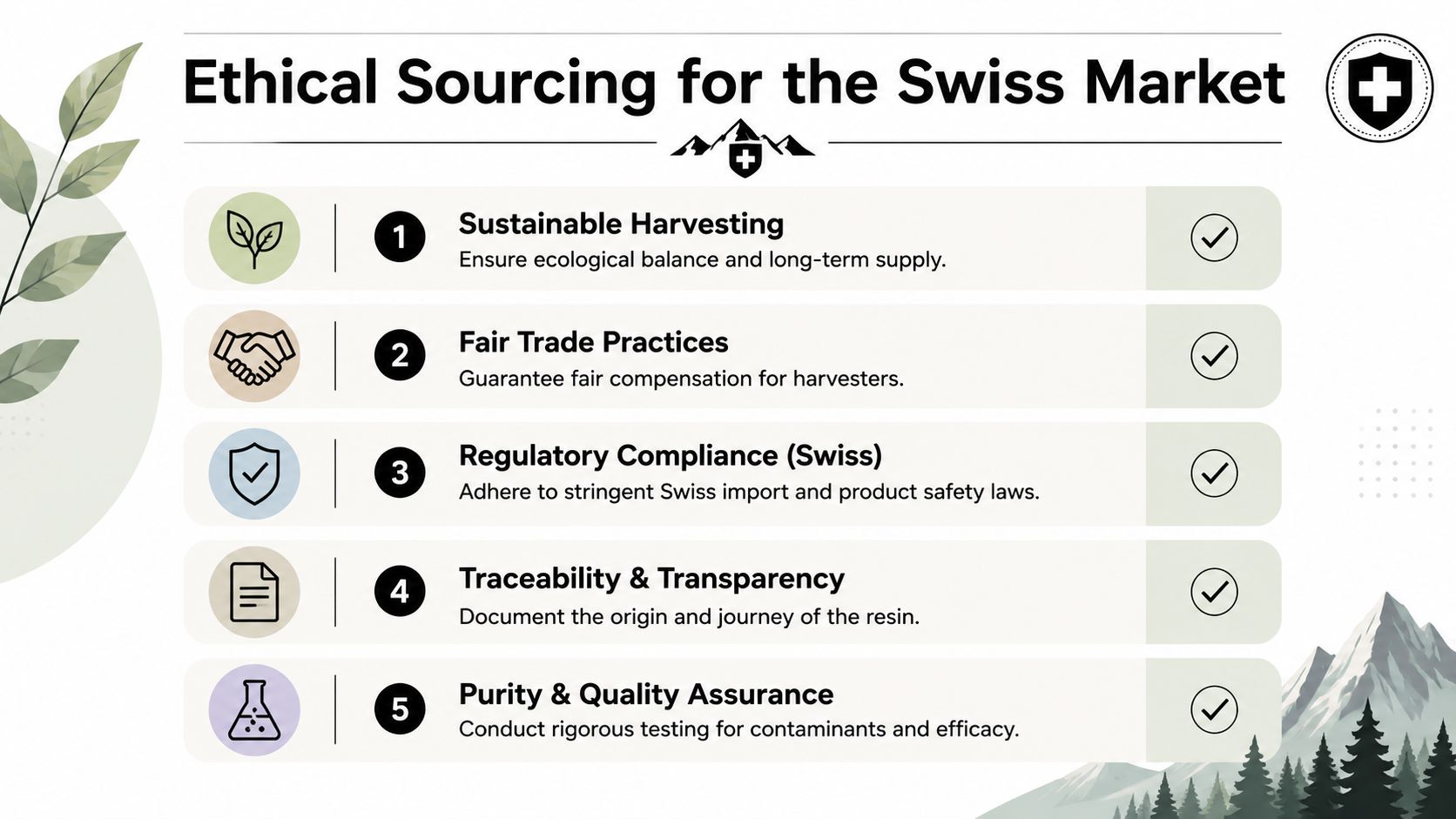
Buyers should expect suppliers to show traceability, resin identity, extraction logic, and contaminant control. A dramatic ingredient story can distract from those basics. It shouldn't.
Why safety language must be tighter than usual
Sources note that dragon's blood may have anti-inflammatory, antioxidant, and wound-healing activity, but they also flag potential anticoagulant, hypoglycaemic, and hormone-like effects, which is why this overview of dragon's blood health applications supports treating it as an active product rather than a benign botanical blend.
For Swiss pharmacies and dermo-cosmetic channels, that has immediate implications:
- Patch testing should be advised for sensitive or reactive skin.
- Concurrent use concerns should be signposted where blood thinners or hormone-sensitive conditions are relevant.
- Medical claims should be avoided, even when the underlying ingredient has a medicinal history.
- Short-contact caution in very reactive clients can be a sensible practical recommendation before routine leave-on use.
What good sourcing and compliance look like
A disciplined sourcing checklist should include:
- Traceable origin: The supplier can identify where the resin comes from and how it was harvested.
- Ethical harvesting standards: The brand can explain how it avoids extractive storytelling without responsible procurement.
- Quality testing: There is evidence of purity and consistency.
- Claim governance: Product copy doesn't imply drug-like treatment.
- Channel-fit training: Sales teams receive usage boundaries, not just marketing adjectives.
Swiss buyers don't need the most dramatic natural story. They need the one they can defend under scrutiny.
This is especially important in pharmacy-led retail. Once staff begin discussing wound healing, inflammation, or treatment support too loosely, the line between cosmetic communication and medical implication narrows. A safer route is to focus on barrier support, comfort, and careful use guidance. That keeps the category commercially attractive without creating unnecessary regulatory tension.
Merchandising and Marketing for Discerning Clients
The most effective Dragon Blood serum merchandising doesn't start with anti-ageing. It starts with a problem the client already recognises: skin that feels stripped, weather-stressed, less tolerant, or in need of recovery support.
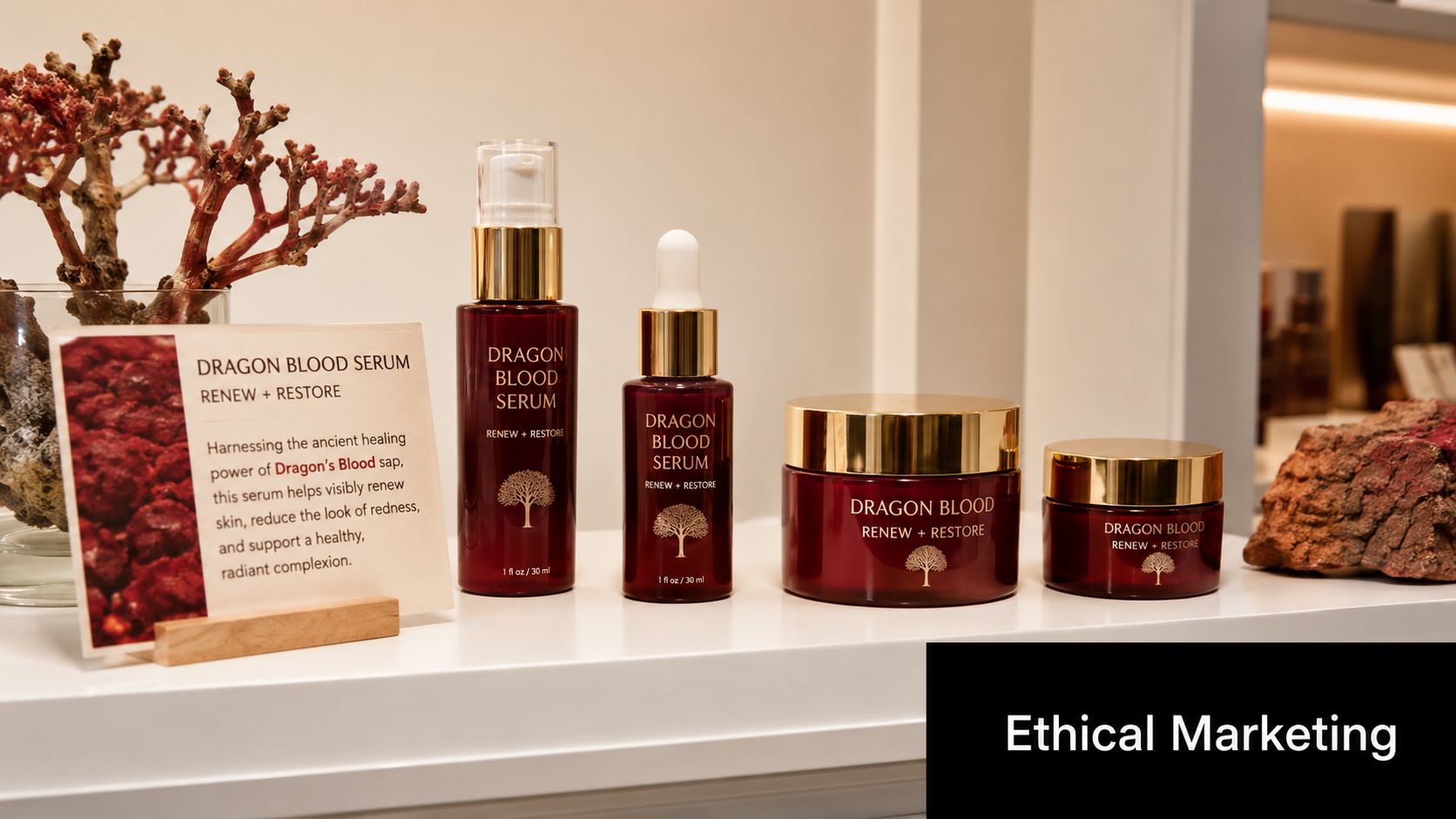
A premium retailer can build that story without exaggeration. For example, a shelf card might describe the serum as a film-forming botanical layer designed to support comfort and help protect the skin barrier, then pair it with adjacent products built around hydration and barrier lipids. That gives the customer a routine, not just a hero ingredient.
The story can also borrow from regional ingredient heritage carefully. A skincare summary notes that dragon's blood from trees grown in Yunnan province showed efficacy in two burn studies, covering both superficial and deeper burns, as described in this overview of dragon's blood skincare and Yunnan burn studies. Used well, that doesn't become a retail claim about curing skin problems. It becomes evidence that the ingredient's reputation in topical repair contexts is not purely folkloric.
For e-commerce teams, merchandising should group Dragon Blood serum with barrier-focused routines, post-procedure care edits, and dry-season essentials. Teams refining those category pages may also benefit from these actionable e-commerce growth practices, especially around assortment logic and product discovery.
A concise consultation script works best: this is a comfort-led serum for skin that needs support, not a miracle anti-ageing shortcut. That message sells with more integrity, and usually with better long-term trust.
If you're building a Swiss assortment around evidence-aware, naturally positioned skincare, beautysecrets.agency can help you evaluate brands with stronger sourcing, cleaner compliance language, and channel-ready positioning for pharmacies, spas, and premium retail.