A customer walks into a Swiss pharmacy after a week in the mountains and points to new brown marks on her cheeks. She doesn't want a lecture. She wants an anti pigmentation cream that works, won't irritate her skin, and ideally fits her preference for natural or certified products.
That moment is where many retailers lose credibility. The shelf offers “brightening”, “glow”, and “radiance”, but the customer's problem is more specific. She may have UV-driven spots, melasma, or post-inflammatory marks from acne or irritation. Those aren't the same condition, and they shouldn't be merchandised or counselled as if they are.
For Swiss pharmacies and premium retailers, anti pigmentation cream is a category where cosmetic science and commercial execution have to work together. If the assortment is built on vague claims, staff end up guessing. If it's built on mechanism, tolerability, and expectation-setting, the category becomes easier to trust, easier to sell, and more likely to generate repeat purchase.
The Growing Demand for Pigmentation Solutions in Switzerland
A Swiss customer who notices more visible spots after hiking, skiing, or a summer holiday isn't imagining a pattern. In Switzerland, pigment-disorder care is closely tied to UV exposure. The Swiss Federal Office of Public Health notes that UV radiation reaches a maximum in late spring and summer, and that altitude increases UV intensity by about 10% to 12% per 1,000 metres according to Eucerin's hyperpigmentation science overview.

That changes how Swiss retailers should treat the category. A dark-spot cream isn't just a corrective product. In this market, it sits inside a prevention-and-correction routine that has to acknowledge outdoor lifestyles, winter sports, lake holidays, and day-to-day commuting at altitude.
Why the category deserves better than generic brightening
Many shelves still group pigmentation products under a vague promise of “even tone”. That's too broad for a concern that customers experience very personally. A customer buying for new cheek spots after sun exposure needs different guidance from someone dealing with stubborn acne marks or hormonally driven melasma.
Swiss pharmacy teams also see another reality. Customers increasingly want both efficacy and reassurance. They ask for cleaner ingredient profiles, ethical sourcing, or certification. At the same time, they expect visible change, not just a pleasant texture and a botanical story.
Practical rule: In Switzerland, position anti pigmentation cream next to daily UV protection and calming support products, not as a standalone miracle fix.
What a strong retail response looks like
A credible pigmentation category has three characteristics:
- Cause-led selection. Products should map to common triggers such as sun exposure, inflammation, and sensitivity.
- Mechanism-led education. Staff should understand whether a formula slows pigment production, limits pigment transfer, or helps fade existing marks.
- Routine-led merchandising. Treatment, sunscreen, and barrier support should appear together because customers need the full system.
Retailers that get this right don't just sell a cream. They become the place customers return to when the first product works, or when it doesn't and they need a smarter next step.
Understanding How Hyperpigmentation Forms
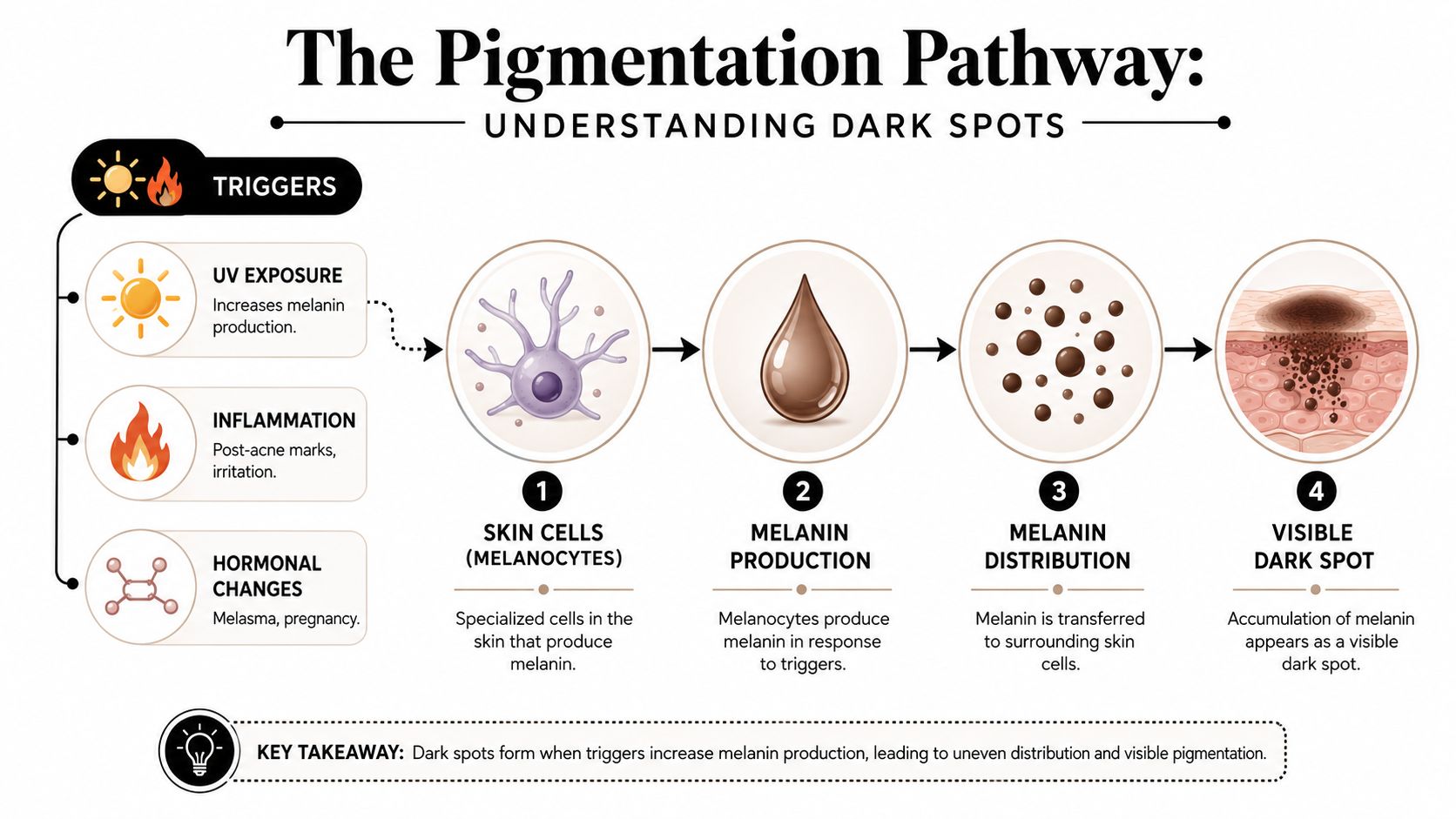
Customers often describe every mark as an “age spot”. That's understandable, but it isn't accurate enough for good advice. Hyperpigmentation forms when the skin's pigment system starts producing or distributing too much melanin in certain areas.
Think of the melanocyte as a tiny pigment factory. When the skin is triggered by UV, inflammation, or hormonal change, that factory shifts into overproduction mode. The result is visible excess pigment, but the path it takes matters because different triggers respond better to different kinds of formulas.
The three patterns retailers see most often
Sun spots are usually linked to repeated UV exposure. They often appear on cheeks, forehead, hands, and other exposed areas. These customers usually want visible fading, but they also need help understanding that continued sun exposure can keep feeding the problem.
Melasma is different. It often presents as broader patches rather than isolated marks, frequently on the forehead, upper lip, or cheeks. Hormonal influence is common, and these cases can be more frustrating because they tend to recur.
Post-inflammatory hyperpigmentation, often shortened to PIH, follows skin inflammation. Acne is a common trigger, but so are over-exfoliation, aggressive treatments, and friction. In retail, this is one of the easiest concerns to mishandle because staff may recommend strong brightening or peeling products that create more irritation and potentially more pigment.
Why diagnosis by pattern matters in retail
Pharmacy staff aren't diagnosing disease, but they are helping customers choose products responsibly. The wrong recommendation usually fails in one of two ways:
- Too weak for the mechanism. The formula sounds appealing but doesn't target pigment formation in a meaningful way.
- Too aggressive for the skin state. The customer has inflammatory marks, yet the routine increases irritation.
A useful counselling line is simple: “Do your marks appear after sun, after breakouts, or as larger patches that seem to come back?” That question often gets you closer to the right category choice than asking what “skin type” they have.
For customers who are considering procedural options as well as topical care, a practical resource on advanced aesthetic pigmentation treatments can help frame where creams fit versus in-clinic interventions.
Pigmentation is never just a colour issue. It's a trigger issue, a tolerability issue, and a routine issue.
The Retailer's Guide to Active Ingredients
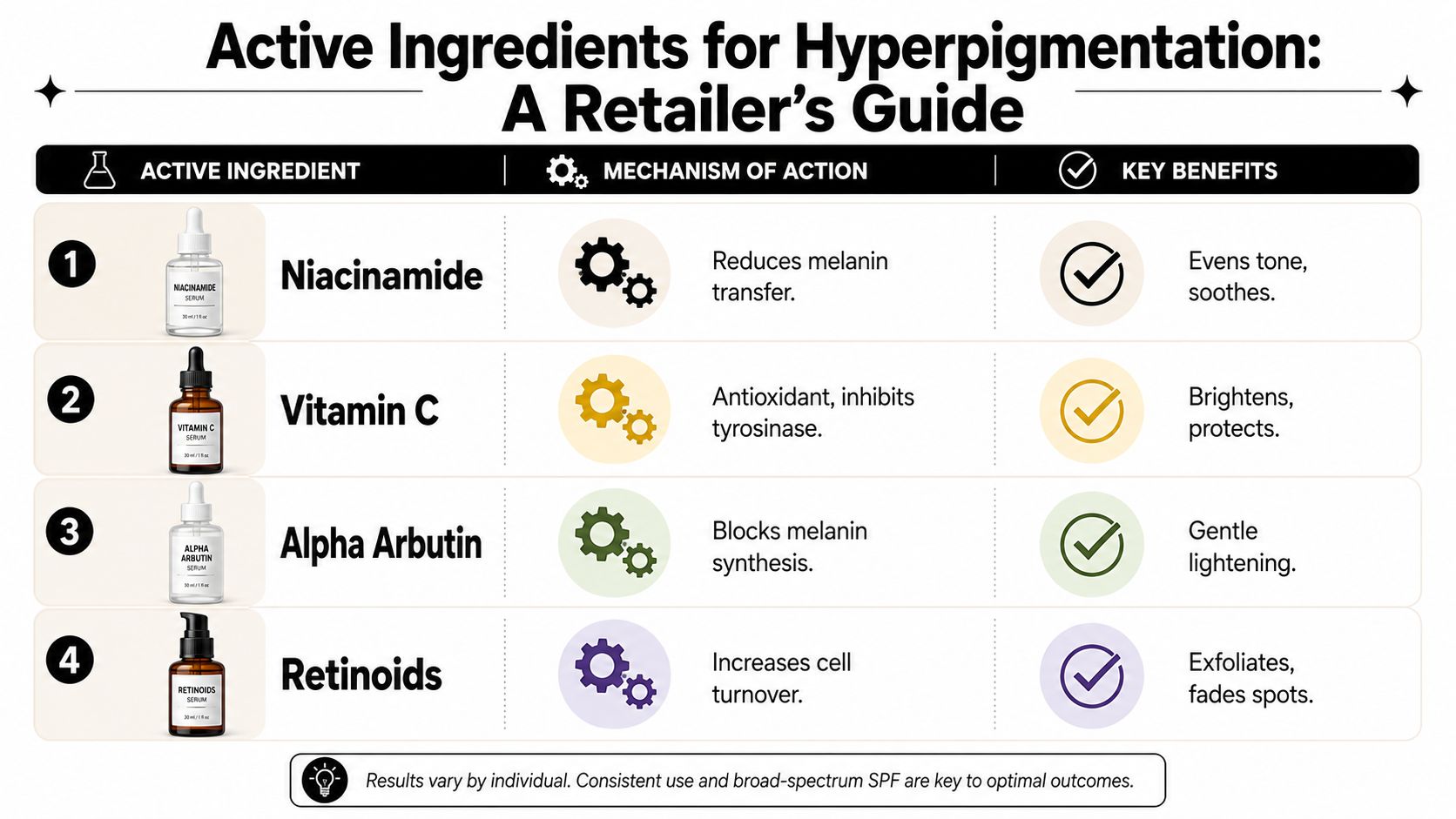
The most useful way to evaluate anti pigmentation cream isn't by marketing language. It's by mechanism of action. In the Swiss market, the most technically defensible actives are tyrosinase inhibitors and melanosome-transfer inhibitors rather than generic brightening agents. A review in the Journal of Clinical and Aesthetic Dermatology also identifies natural actives with evidence in pigment control, including niacinamide, azelaic acid, ascorbic acid, licorice, emblica, and belides, while noting that the evidence base is small and that formulation quality matters more than ingredient marketing claims in this review of natural cosmeceutical ingredients for hyperpigmentation.
Production blockers
These ingredients try to reduce pigment creation at the source.
Hydroquinone remains the clinical gold standard for hyperpigmentation, but it doesn't fit every retail strategy, especially where the assortment leans natural, certified, or lower-irritation. It belongs in the conversation as a benchmark, even if it isn't the centre of a pharmacy's non-prescription assortment.
Azelaic acid is one of the most commercially useful bridges between efficacy and tolerability. It suits customers who want serious pigment care but are worried about irritation, acne-prone skin, or post-inflammatory marks.
Licorice, emblica, and belides fit natural positioning more easily. They can support a certified or botanical-led assortment, but buyers should treat them as formulation-dependent tools, not automatic proof of efficacy.
A quick way to compare these options:
| Ingredient group | What it does | Best retail use case | Main caution |
|---|---|---|---|
| Tyrosinase inhibitors | Reduce pigment production | Sun spots, melasma support, uneven tone | Results depend heavily on formula quality |
| Natural pigment-control actives | Support pigment correction in gentler positioning | Certified and botanical assortments | Evidence is narrower, so weak formulas are common |
| Multi-function acids | Address pigment plus blemish-prone skin | PIH and congested skin | Tolerance still needs monitoring |
Later in the customer journey, this explainer can help staff visualise ingredients in a more consumer-friendly way:
Transport blockers and support actives
Not all effective pigment care has to shut down production directly.
Niacinamide is especially useful because it works as a melanosome-transfer inhibitor. In plain terms, it helps reduce the transfer of pigment between skin cells. That makes it a strong option for customers who want lower irritation and broader cosmetic benefits such as improved skin comfort and a more even appearance.
Ascorbic acid, the classic form of vitamin C, is appealing because it combines antioxidant logic with pigment support. In retail practice, though, vitamin C only works as well as its formulation. A poor formula can oxidise, disappoint, and train customers to believe vitamin C “does nothing”.
What usually doesn't work well
The weakest anti pigmentation category builds itself around words like glow, radiance, or luminous skin without linking those claims to a real pathway. Those products may feel elegant, but they rarely solve a stubborn pigmentation concern.
Watch for these assortment traps:
- Single-hero storytelling. One botanical on the front of pack doesn't tell you whether the formula is potent, stable, or compatible with sensitive skin.
- Overlapping weak products. Five near-identical brightening creams don't create choice. They create confusion.
- No route for sensitive customers. If every formula relies on strong resurfacing, you'll lose customers with PIH risk or reactive skin.
For Swiss pharmacy chains, the winning assortment isn't the broadest. It's the one that clearly separates stronger treatment options, gentler natural options, and supportive products for maintenance.
Beyond the Actives Formulation and Certification
A strong ingredient on a carton doesn't guarantee a strong result on skin. Buyers often focus on the hero active and miss the parts that determine whether the formula can perform. With anti pigmentation cream, delivery, stability, and tolerability matter as much as the ingredient list headline.
Why formulation decides whether an active earns shelf space
Vitamin C is the classic example. Customers recognise it, but many formulations are unstable, unpleasant, or too weak in use. If the product discolours quickly, stings easily, or sits in packaging that doesn't protect the formula well, the active's theoretical value doesn't translate into real retail performance.
Niacinamide and azelaic-acid-led formulas tend to be easier to position because they can sit in more tolerant, everyday routines. That doesn't mean every version is equally good. Texture, pH environment, preservative system, and the interaction with other actives all shape whether a product feels elegant enough for repeat use.
What certification can and cannot signal
For Swiss customers who prefer natural or certified products, standards such as ECOCERT and cruelty-free commitments can improve trust. They speak to sourcing, processing, and ethical expectations. They do not, by themselves, prove that a pigmentation cream will visibly reduce marks.
That distinction matters on the shop floor. Staff should be able to say, with confidence, that certification supports a product's values profile, while formulation and evidence support its performance profile.
A simple retail framework helps:
- Ask whether the active is credible. Does the formula use a pigment-relevant ingredient, not just a glow ingredient?
- Ask whether the format protects it. Airless packaging, light protection, and sensible texture design all matter.
- Ask whether the positioning is honest. A certified-natural cream may be a good maintenance or early-intervention option, but not every customer will get the same level of correction from it as from a more treatment-led formula.
A natural claim can open the sale. Only a well-built formula keeps the customer coming back.
A pharmacy chain has an opportunity to differentiate. Don't let certification replace efficacy screening. Use it as one layer in a broader buying standard.
Evaluating Efficacy and Clinical Proof
Retailers hear “clinically proven” so often that the phrase can lose meaning. It shouldn't. In pigmentation care, evidence is one of the clearest ways to separate products that are likely to perform from products that borrow scientific language.
A credible claim usually has three parts. It should come from human use, it should measure a visible pigmentation outcome, and it should show results in a time frame customers can understand.
What a realistic benchmark looks like
Eucerin reports that its Anti-Pigment range, powered by Thiamidol, was clinically and dermatologically proven to reduce dark spots and prevent their re-appearance, and consumer testing showed 97% of users said the product made their skin more even after 2 and 4 weeks in the evidence discussed by Dr M Macdonald's review of anti-ageing treatment statistics. The same review summarises controlled studies in the PubMed Central literature showing measurable improvements over 4 to 12 weeks, including one dataset where 77% of patients showed significant improvement by week 8 and week 12.
Those figures are useful because they set a commercial expectation. Effective anti pigmentation cream should usually show visible change within weeks, not after an indefinite “keep using it and see” period.
Questions buyers should ask every brand
When a supplier presents a pigment product, ask for specifics rather than broad reassurance.
- What was tested. The finished formula matters more than a raw ingredient dossier.
- How was improvement assessed. Self-assessment has value, but objective evaluation matters too.
- Which pigmentation type was included. A formula that works for mild sun-induced unevenness may not be the right benchmark for melasma or PIH.
- How was tolerability handled. Pigment correction that inflames the skin can undermine the result.
A product doesn't need to be prescription-adjacent to deserve shelf space. It does need evidence that aligns with the claims on pack.
If a brand can't explain who improved, how they improved, and over what period, the claim is probably too soft for a serious pigmentation shelf.
The commercial benefit is straightforward. Better evidence gives staff something concrete to say. That improves confidence during the consultation and reduces disappointment-driven returns.
Expert Customer Counselling and Merchandising Strategy
A customer walks into a Swiss pharmacy after summer with patchy marks on the cheeks, asks for a natural anti pigmentation cream, then adds that her skin reacts to acids and she does not want anything “too aggressive.” This is a significant retail test. The sale depends less on having another brightening SKU and more on whether staff can identify the likely pigment pattern, judge tolerance, and recommend a routine that the customer will consistently follow.
For Swiss chains, cosmetic science and merchandising must work together. Customers want clean positioning, certification, and good skin tolerance. They also expect visible progress and honest guidance on when a pharmacy product is suitable and when the case should be referred.
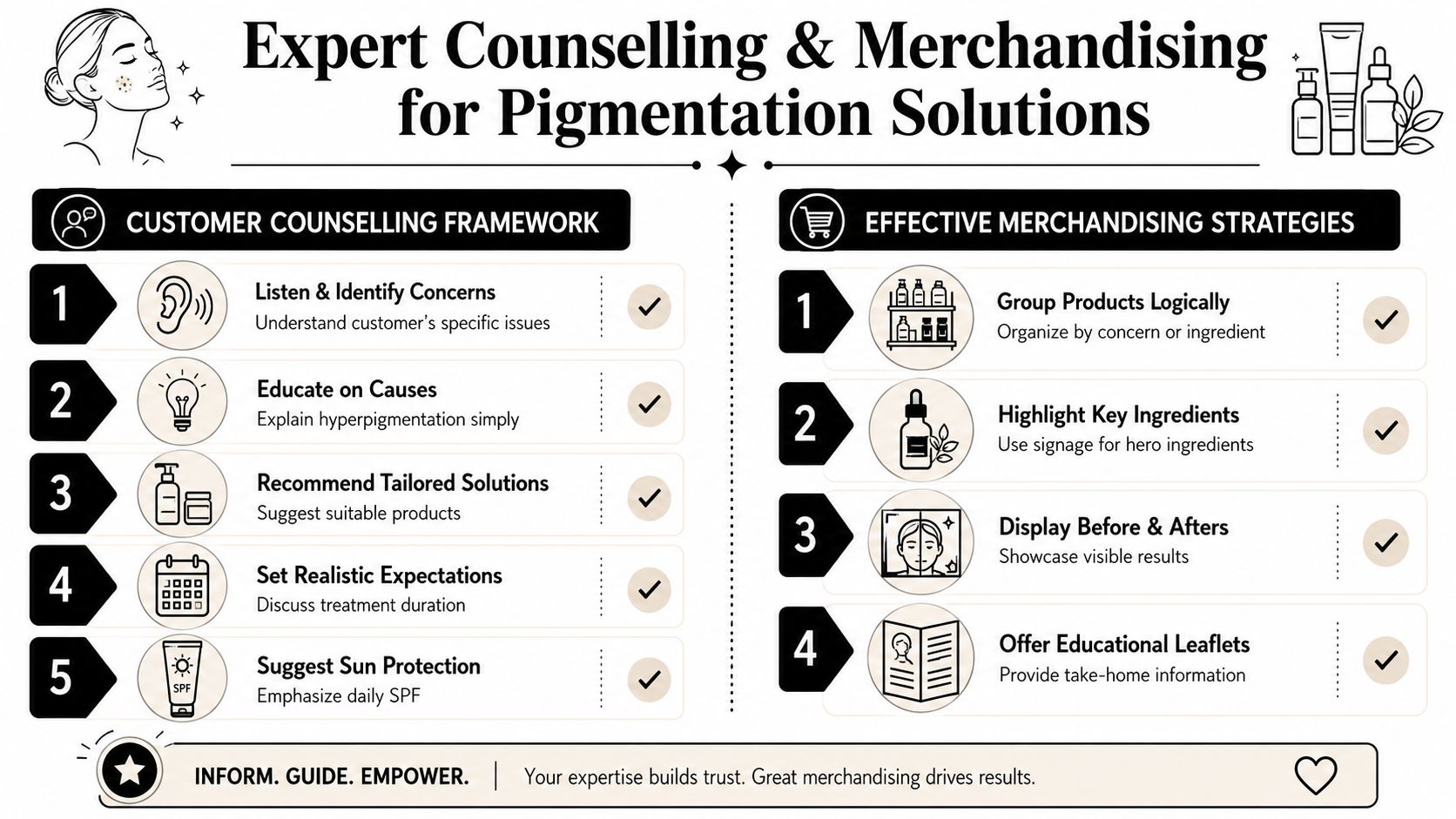
A consultation framework staff can actually use
A good pigment consultation should be brief, structured, and specific enough to avoid poor matching.
Start with five questions:
When did the marks appear?
After UV exposure, post-acne, during pregnancy, or after irritation from strong exfoliants?Where are they located?
Isolated sun-exposed spots suggest one pattern. Symmetrical facial patches suggest another. Clusters around previous breakouts point more strongly to PIH.What has the customer already tried?
This shows whether they have only used general brighteners, whether they stopped too early, or whether irritation has already made the problem harder to treat.How reactive is the skin?
Frequent stinging, redness, or overuse of acids should shift the recommendation toward lower-irritancy formulas and stronger barrier support.What is their real sunscreen habit?
Occasional SPF use is not enough for a pigment routine. Staff need a clear yes or no.
This framework also matters commercially. It reduces random trial-and-error selling, gives staff a repeatable script, and helps the chain build trust with customers who often return after a disappointing previous purchase.
How to answer the difficult questions
Customers usually want a clear recommendation, not a lecture on melanogenesis.
“Is this safe for darker skin?”
The right answer is cautious and specific. Darker skin tones are often more vulnerable to post-inflammatory marks, so irritation control matters more, not less. Choose pigment-targeting products with good tolerability and avoid pushing the strongest option as the default.“Will a natural anti pigmentation cream actually work?”
Sometimes yes, with limits. Natural and certified formulas can suit mild uneven tone, maintenance, or reactive skin, but performance depends on the full formula, concentration, and daily use. Staff should avoid overselling botanical positioning as if it guarantees the same outcome as more aggressive treatment routes.“Why didn't my last dark-spot cream work?”
The common reasons are straightforward. The formula was not well targeted to the pigment type, the customer stopped before visible change was likely, or UV exposure kept triggering recurrence.
For customers who need context on where pharmacy care ends and clinic-led care begins, this guide to advanced hyperpigmentation treatments is a useful reference.
Merchandising that improves trust and basket value
Brand-blocked shelving rarely works well for pigmentation. Customers do not shop this category by logo first. They shop by concern, urgency, skin sensitivity, and preferred product philosophy.
A stronger Swiss setup uses need-state zoning:
- Sun spots and uneven tone. Correction serum or cream, antioxidant support, and SPF.
- Post-acne marks and reactive skin. Gentler pigment care, barrier-support products, and non-stripping cleansing.
- Natural and certified options. Clearly marked products for customers who prioritise certification, origin, and lower-irritancy positioning.
- Referral cases. Clear in-store guidance for persistent, spreading, unusual, or hormonally driven pigmentation that may need medical review.
The category should also be merchandised as a regimen, not a hero cream sitting alone. Place treatment beside compatible sunscreen and a barrier-support step. That physical adjacency improves attachment rates because it matches how pigment routines work.
The required attachment sale
Sunscreen is part of the pigment recommendation, not an optional add-on.
Train staff to say it plainly: the treatment helps reduce visible marks, and daily UV protection helps prevent new discoloration and limits relapse. In retail terms, that is good basket building. In clinical terms, it is responsible advice. Both matter if a Swiss pharmacy chain wants a category that is credible, natural where appropriate, and still effective enough to earn repeat purchase.
Building a Credible Pigmentation Category
A credible pigmentation category doesn't need endless SKUs. It needs clear roles. One group of products should target pigment production or transfer. Another should support sensitive or post-inflammatory cases. A third should meet the demand for natural and certified positioning without pretending that every botanical cream will perform like a more aggressive treatment option.
The strongest Swiss retailers also treat counselling as part of the product. Staff need a repeatable way to identify the likely pattern, choose an anti pigmentation cream that fits the customer's tolerance and goals, and set expectations around daily use and UV protection. That's what turns a one-time purchase into category trust.
Online execution matters too. If your chain is improving education, routine-building, and product comparison online, many of the same principles used to boost D2C skincare brand CRO can help structure cleaner navigation, stronger regimen merchandising, and more useful product pages.
In practice, the business opportunity is simple. Curate fewer, better products. Train teams to explain what works, for whom, and why. Merchandise anti pigmentation cream as part of a complete routine, not as a lone promise in a carton.
If you're building or refining a Swiss pigmentation category and need support with natural, certified, retail-ready assortments, beautysecrets.agency can help evaluate product fit, merchandising logic, and partner strategy for pharmacies, premium retailers, spas, and e-commerce channels.