Your curls might be doing that familiar in-between thing right now. They're not flat, but they're not shaped either. The top feels bulky, the ends feel heavy, and every wash day turns into a debate between leaving them wild or trying to force them into a silhouette they don't naturally want.
That's exactly why so many curl clients get curious about the wolf cut. It isn't just a trend cut. On curly hair, it can turn a dense, one-shape mass into something lifted, deliberate and expressive. When it's done properly, the shape looks airy at the crown, softer through the mid-lengths and still full of movement at the perimeter.
A good wolf cut on curly hair doesn't fight texture. It uses texture as the design tool. That's the difference that matters.
Embracing the Untamed Shape of the Wolf Cut
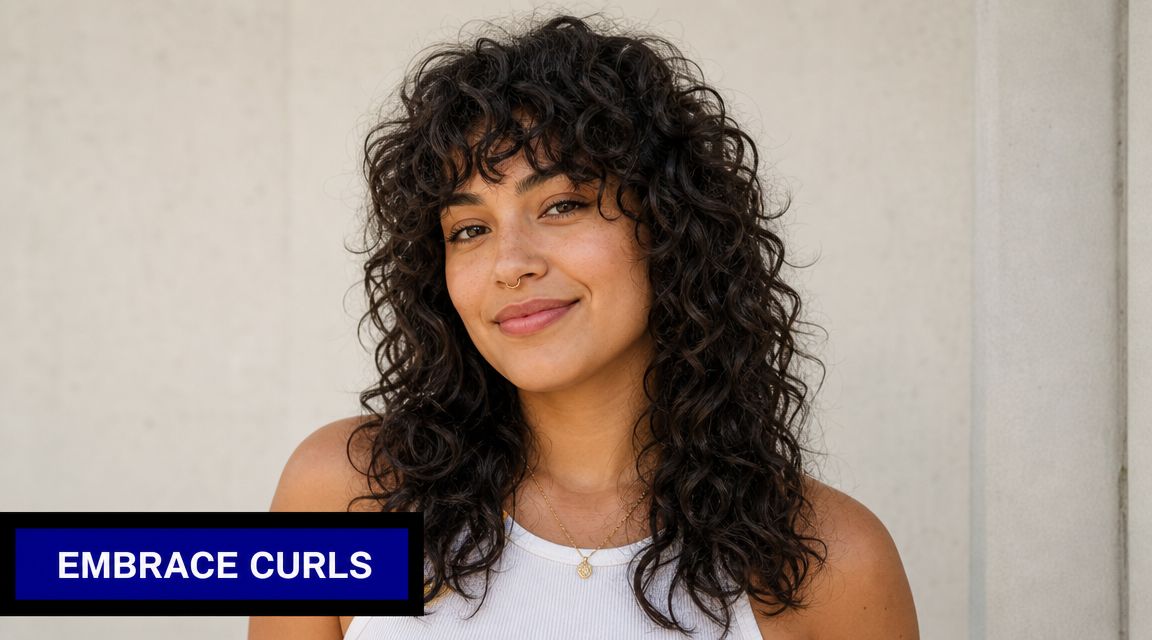
You wash your curls, diffuse for a few minutes, and the shape already has a point of view. That is why the wolf cut suits curly hair so well. Its shag-meets-mullet structure gives the crown lift, keeps movement through the mid-lengths, and leaves enough length at the perimeter so the outline still feels soft.
Why curls make this cut look better
Curly hair supplies what this shape needs. Separation, height, and bend are already present, so the layers read clearly without heavy heat styling or a lot of product buildup. On the right head of curls, the cut looks alive on day one and still looks like itself a few days later.
That said, curls do not all behave the same way. Loose curls often need enough layering to stop the shape from dropping flat at the crown. Tighter curls and coils usually need more restraint, because every short layer springs up faster and can throw the silhouette off if the cut is too aggressive.
This is a shape-driven haircut.
What the shape actually does
A strong curly wolf cut is built from the top down. The crown is cut to create lift and release bulk. The face frame opens the cheekbone and eye area. The lower section keeps support, which matters on curly hair because the ends are what stop layered shapes from turning airy in the wrong places.
The cutting method matters as much as the concept. I prefer to build this shape on dry or mostly dry curls whenever possible, then refine once the pattern is visible. Curl-by-curl placement shows where each section lives, how much it shrinks, and whether a layer will add bounce or remove too much weight. That is the difference between a wolf cut that feels intentional and one that just feels chopped up.
Product choices affect the finished shape too. Heavy silicones, waxy creams, and stiff hold products can collapse crown volume or make the ends clump into thick pieces. Clean, lightweight stylers usually show the cut better because they support definition without coating the hair. The shape needs touchable hold, not a cast that hides the layers.
The main appeal
The main appeal is controlled wildness. A curly wolf cut keeps personality in the hair while giving it a visible structure. You still get softness and movement, but the volume sits in more flattering places.
It is also one of the few layered cuts that can make natural texture feel easier to wear, provided the curl pattern, density, and cutting technique all line up. If those pieces are off, the cut can turn bulky, top-heavy, or too sparse at the ends. When they are right, the result feels expressive, modern, and surprisingly wearable.
Will the Wolf Cut Flatter Your Curls and Face Shape
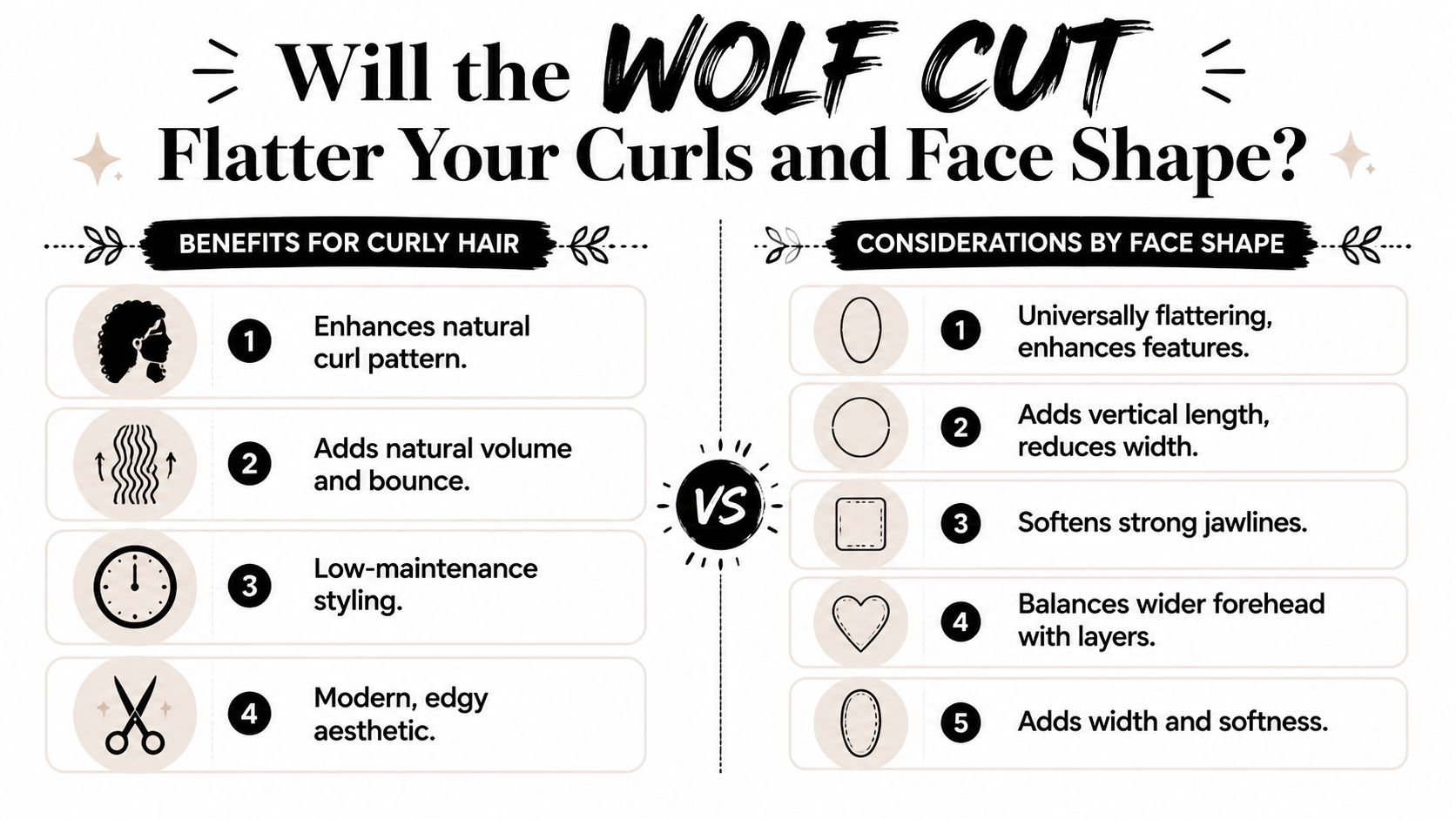
A wolf cut can be flattering on many curl patterns, but it isn't one standard haircut. The same layering that gives one person brilliant crown lift can give another person a top-heavy triangle if the cut ignores density, shrinkage and where the face needs softness.
By curl pattern
Here's the practical way I assess it in the chair.
| Curl pattern feel | What usually works | Watch out for |
|---|---|---|
| Loose waves to soft curls | More visible layering through the crown and cheekbone area | Too much razoring can make ends look stringy |
| Medium curls with strong spring | A classic wolf shape often sits beautifully here | Short crown layers can jump higher than expected |
| Tight curls and coils | A customised version with controlled internal layering can look striking | Over-layering creates imbalance and can remove too much support |
With looser textures, the cut often needs enough layering to stop the shape collapsing. With springier curls, less can be more. The silhouette appears quickly, so every removed section matters.
Dense hair usually benefits from shape removal, not random thinning. Fine curly hair needs more restraint. If you take too much from the crown, you can lose the fullness that makes the style convincing.
A wolf cut should look airy, not hollow.
By face shape
Face shape doesn't decide whether you can wear the cut. It helps decide where the volume should live.
- Oval faces usually handle most versions well. The main choice is how bold to make the fringe and cheekbone layers.
- Round faces often suit a little height at the crown and longer pieces around the cheeks. That keeps the shape from widening the face too much.
- Square faces often look great with softer edges around the temples and jaw. A rigid, heavy fringe can make the whole look feel blocky.
- Heart-shaped faces usually benefit from fullness through the lower sides and softer fringe work so the forehead and chin feel more balanced.
- Long faces often suit width through the sides and a fringe or broken front section, rather than very tall crown volume alone.
The fringe question
The success or failure of many wolf cuts often hinges on the bangs. Curly bangs can be brilliant in this shape, but only when they belong to the rest of the haircut. If the fringe is too disconnected, it looks like an add-on. If it's too heavy, it can pull the whole cut forward.
The best fringe for curly hair usually feels broken, soft and mobile. You want movement across the brow area, not a thick block.
A good consultation should answer these questions:
- Where do your curls spring most strongly? That tells you how short the crown can safely go.
- Where is your bulk sitting now? Often it's at the sides or lower lengths.
- Do you want edge or softness first? The answer changes the face frame.
- Are you willing to style a fringe? If not, keep the front longer and looser.
If your curls are highly inconsistent, very fragile, or you're growing out a previous over-layered cut, a gentler version is often wiser than a dramatic wolf shape. The best result is one that suits your actual hair, not a reference photo taken on a completely different curl pattern.
Getting the Cut Professional Salon vs The DIY Method
You wash, diffuse, fluff the crown, and the shape still sits wrong. The top looks flat, the sides feel bulky, and one eager snip at home can turn a shaggy wolf cut into a shelf. Curly hair gives this cut its best character, but it also makes the cutting process far less forgiving.
A good curly wolf cut is not just “more layers.” It is controlled weight removal, planned around spring factor, density, and where your curl pattern breaks apart. I love this cut, but I am honest about it. On loose waves, a home trim can be manageable. On dense curls, mixed patterns, or hair with strong shrinkage, salon work usually saves you from months of awkward grow-out.
What to ask for in the salon
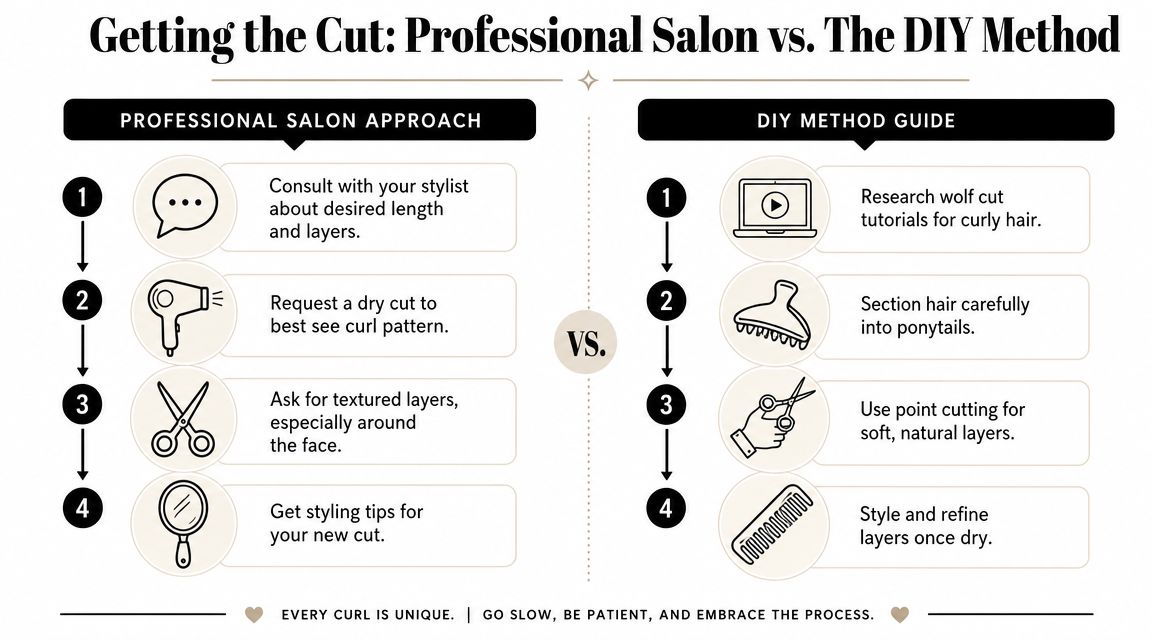
Ask for the method, not just the vibe. A curl-aware stylist should cut your hair dry or mostly dry in its natural state, then refine after cleansing if needed. That lets them read each curl family properly instead of guessing where it will bounce.
Be specific about the shape you want:
- Dry cutting on your natural texture
- Shorter layers through the crown
- A soft, blended face frame
- Weight removal without blowing out the curl pattern
- A soft perimeter instead of a blunt, heavy base
Reference photos still help, but translate them into haircut language. Say you want cheekbone movement, a lighter crown, or less length removed at the nape. That gives your stylist something usable.
What skilled curly cutting looks like
A strong wolf cut on curls is built in zones. The crown needs lift, but it cannot be chopped so short that it spikes or separates. The sides need debulking, but not so much that the haircut turns hollow. The perimeter has to stay soft enough to move, while still giving the shape a clear outline.
That balance usually comes from careful sectioning, overdirection, and point cutting. A stylist may cut some areas curl by curl and others in small sections, depending on how consistent your pattern is. On fragile or overprocessed hair, I prefer softer texturising methods and fewer aggressive passes. If the ends are rough, porosity is high, or old colour is chewing up definition, it also helps to understand how to smooth damaged hair before asking for lots of airy separation.
The cut should also be checked in motion. Shake the hair. Let it settle. Reassess bulk at the crown, temples, and lower sides. Curly wolf cuts rarely come together from one angle alone.
A visual demo helps if you want to understand the mechanics before booking or trimming.
If you're doing it yourself
DIY works best as maintenance, not invention. If you already have a layered curly cut and just want a little more crown movement or face framing, you may get a decent result at home. If you are building a wolf cut from a one-length shape, the risk goes up fast.
Use a clean setup. Hair should be dry, detangled, and styled as you normally wear it. Do not stretch it straight to cut it, then expect the shape to behave once it recoils.
Keep the process disciplined:
- Section with intention. Separate crown, front, sides, and back so you can see where weight is sitting.
- Cut less than you think. Curly hair hides length until it springs back.
- Use point cutting on the ends. Blunt snips create hard lines that show up once the curls dry.
- Check balance, not perfect matching. The goal is an even silhouette, not identical curls on both sides.
- Stop early. You can always remove more weight tomorrow. You cannot glue length back on tonight.
One more reality check. Razor work at home is where many DIY wolf cuts go wrong, especially on drier curl types. If your hair frays easily, stick to sharp shears and a lighter hand.
Salon vs DIY at a glance
| Option | Best for | Main advantage | Main risk |
|---|---|---|---|
| Professional salon cut | First-time wolf cuts, dense curls, strong shrinkage, fringe work | Better shape control and curl-specific customisation | Finding a stylist who truly cuts curls well |
| DIY method | Minor reshaping, confident home cutters, already layered curls | Convenience and slower decision-making at your own pace | Taking too much from the crown or leaving disconnected corners |
If your curls vary a lot from section to section, book the salon. If your pattern is more predictable and you only need a small adjustment, DIY can be reasonable. The line between brave and overconfident is usually about two snips.
Daily Styling and Natural Product Rituals
The best wolf cut doesn't need a pile of product. It needs the right product behaviour. That means moisture where curls need slip, hold where the layers need structure, and a finish that lets the shape stay touchable instead of sticky.
Build the style from clean hydration
Start with a cleanser that leaves the scalp fresh but doesn't rough up the cuticle. Follow with a conditioner that gives enough slip for detangling without coating the hair so heavily that your crown collapses.
On soaking wet hair, apply a silicone-free leave-in first if your curls lose moisture quickly. Then go in with either a curl cream for softness or a botanical gel if you want stronger definition and shape retention. On most wolf cuts, I prefer lighter layering over one heavy product. Heavy creams can drag down the crown and erase the airy top that makes the cut look modern.
If your ends are rough from previous colour, heat use or mechanical damage, improving surface smoothness can help the layers separate more cleanly. A resource on smooth damaged hair can be useful if you're trying to understand how to support a softer finish without making curls feel greasy.
Product categories that suit this cut
I think in functions, not hype.
- Leave-in conditioner keeps the mid-lengths flexible and helps reduce dry frizz.
- Curl cream adds softness and clumping, but use a light hand near the roots.
- Botanical gel gives shape memory. This is what keeps the crown from falling flat by midday.
- Cold-pressed oil or lightweight finishing oil works last, once dry, to soften any cast and add sheen to the ends.
What doesn't usually help is piling on mousse, cream, gel, oil and serum all in one wash day. That often turns a wolf cut into a coated shape with no bounce.
Clean styling isn't about using less product for the sake of it. It's about using fewer, better-chosen layers so the curl pattern can still move.
Drying matters more than people think
Application alone won't create the finished result. Drying decides the silhouette.
Try this sequence:
- Micro-plop first. Use a soft cotton cloth or T-shirt to remove excess water without roughing up the curls.
- Set the root direction. Lift sections at the crown so they don't dry flat to the scalp.
- Diffuse with intention. Hover first for cast formation, then cup sections if you want stronger definition.
- Stop before over-drying. Too much diffusing can create frizz in the shortest layers.
If you like a more natural finish, air-drying can work, but the top often needs manual encouragement. Root clips or flipping the part while drying can stop the crown from settling too close to the head.
A simple routine that respects texture
For most curly wolf cuts, this is enough:
- Cleanse and condition gently.
- Apply leave-in to the lengths that need moisture most.
- Use a curl cream sparingly, or skip it if your gel already has enough slip.
- Layer gel through the crown and top sections where shape matters most.
- Diffuse or air-dry without touching constantly.
- Scrunch out the cast with a drop of oil only when fully dry.
That routine works because it supports the haircut instead of trying to override it. A wolf cut on curly hair should never feel lacquered into place. It should look like your texture is having a very good day.
Mastering Styling Variations and Refreshing Your Look
One reason this cut stays interesting is that it doesn't lock you into one mood. The same shape can read polished, soft, rebellious or romantic depending on how much definition you leave in and how much volume you encourage.
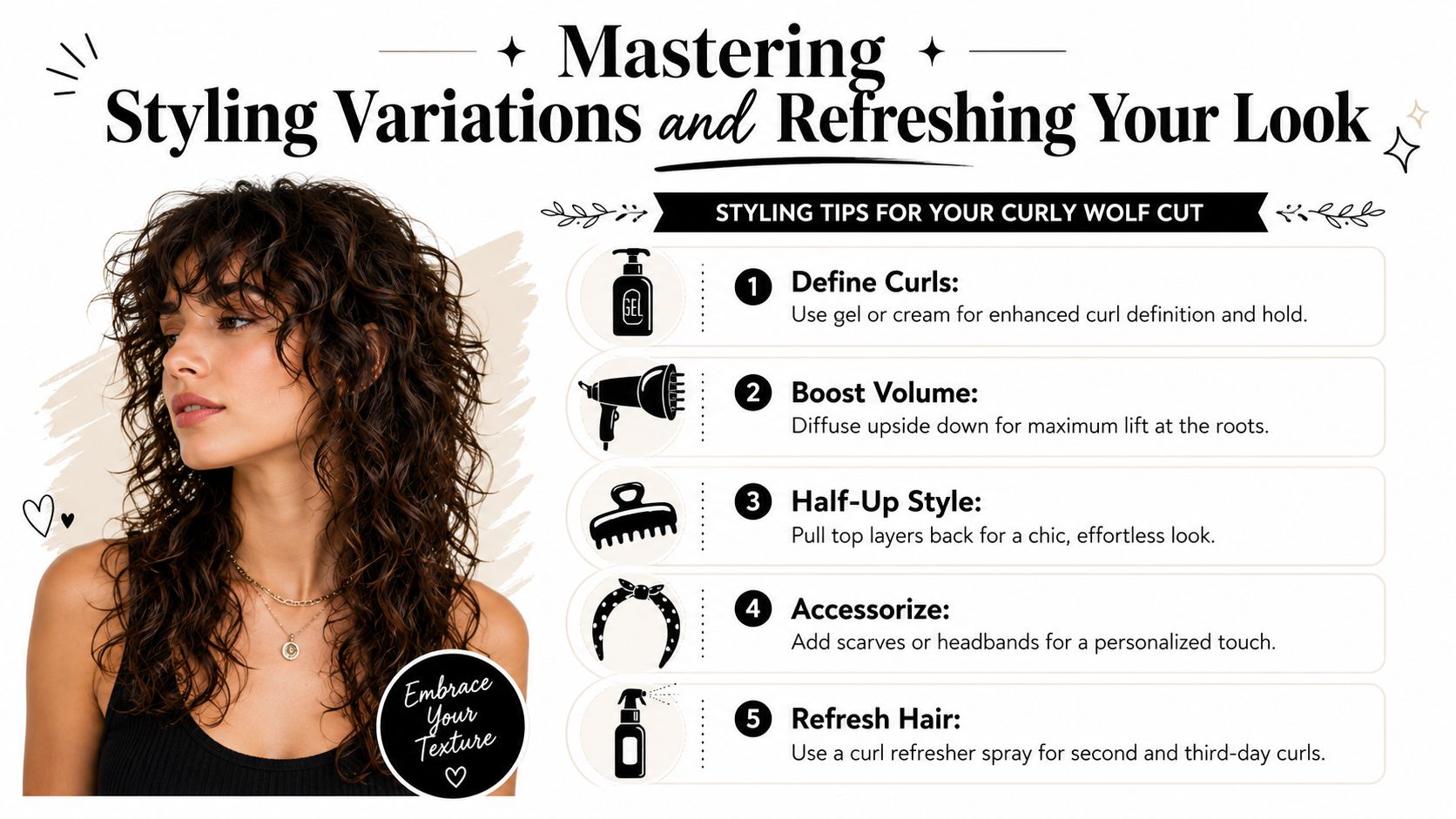
Three ways the same cut can wear
On one client, a damp-set gel routine with careful diffusing creates a neat, sculpted version. The fringe sits more clearly, the cheek layers read stronger, and the whole finish looks organised without becoming stiff.
On another day, that same person might skip some gel, use more water during refresh, and rough-diffuse upside down for a fluffier crown. Suddenly the cut feels more rock-and-roll. More cloud-like. Less defined, but fuller.
Then there's the half-up version, which suits wolf cuts beautifully. Pulling back the top layers lets the lower shape spread out and shows off the taper at the back without making the look feel severe.
How to refresh second-day curls
The refresh should be light. Many ruin their second day by over-wetting or adding too much product.
Try this:
- Mist the areas that lost shape first, usually fringe, crown and outer canopy.
- Smooth a tiny amount of leave-in or gel between wet palms.
- Press or scrunch only where the curl pattern has opened up.
- Diffuse briefly, or let it dry untouched.
- Lift the roots with fingers once fully dry.
Refresh the visible shape, not every strand.
If the crown is flat but the ends still look good, don't soak the whole head. Target the top. If the fringe has split oddly, re-wet only that section and twist a few curls back into place.
Keeping the cut sharp between appointments
A wolf cut grows out more gracefully than many blunt cuts, but the silhouette still needs upkeep. Tiny split or frayed ends around the face can blur the shape quickly.
Some people do a careful micro-dusting at home on fully dry hair. That means removing only the obvious rough tips that disrupt the curl grouping. It is not a full reshape. If you start shortening internal layers on impulse, the whole balance can shift.
For bigger maintenance, regular trims are what keep the top from becoming too heavy and the perimeter from turning straggly. The goal isn't to make it look freshly cut every week. The goal is to preserve the architecture that made the style flattering in the first place.
Troubleshooting Common Wolf Cut Challenges
Even a well-cut wolf shape has a learning curve. The cut changes how your curls sit, so the first few wash days are often about adjusting product placement and drying habits rather than deciding the cut has failed.
When the back feels too mullet-like
This usually happens when the crown is very short and the lower back keeps too much visual length. The answer isn't always taking off lots more hair. Often the fix is softer blending through the area where the crown meets the back.
Styling can help too. Add more definition through the nape and lower lengths so the back looks intentional, not stringy. If the perimeter is blunt or disconnected, ask for soft refinement rather than a dramatic chop.
When the crown frizzes or puffs out
Shorter layers catch friction fast. If your crown looks fuzzy, check technique before blaming the cut.
Common causes include:
- Too much towel friction after washing
- Applying product too late after the hair has already started drying
- Diffusing too aggressively with constant movement
- Not enough hold in the top layers
A small amount of stronger-hold gel through the crown, followed by hands-off drying, usually gives a cleaner result.
When the top falls flat
This is usually a styling problem or a weight problem. If your roots lie close to the scalp, look at where your products are landing. Rich cream at the root is one of the fastest ways to flatten a wolf cut.
Try:
- Applying cream from mid-lengths down
- Using gel higher up
- Diffusing with the head tilted
- Setting root clips while drying
If none of that changes the result, the top may be carrying too much length for your curl pattern. That's a shaping issue for your next trim.
When the ends look thin
Some separation at the ends suits this haircut. Sparse, wispy ends that feel accidental don't.
This often means the layering went too far, or the hair was texturised without enough respect for curl grouping. Focus on moisture, gentle clumping and a softer finish while it grows. At your next appointment, ask for density to be preserved in the lower outline.
The best wolf cut curly hair still has softness and support. It should feel wild in spirit, not chaotic in construction. If you respect your texture, use clean supportive products and make peace with a little movement, this cut can be one of the most flattering shapes curly hair can wear.
If you source beauty with the same care you give your curls, beautysecrets.agency is worth knowing. They specialise in natural, ethically sourced beauty and wellness brands for the Swiss market, with a sharp focus on quality, transparency and premium clean formulations for retailers, pharmacies, spas and e-commerce partners.