USD 10.2 billion in cosmetics exports and 18.5% of that volume going to Europe in 2023 changes the conversation around Koreanische make up. This isn't niche curiosity anymore. It's a scaled export category with real European traction, which is exactly why Swiss retailers should treat it as a buying strategy, not a trend chase, according to K-beauty export context for Europe.
My advice is simple. If you run a Swiss pharmacy, boutique, spa shop, or premium e-commerce store, don't import the loudest version of K-beauty. Import the most relevant one. The winning assortment for Switzerland is natural-looking, skin-first, easy to explain, and disciplined in its merchandising. Koreanische make up performs best here when you position it as refined complexion enhancement with skincare logic behind it.
Swiss consumers don't need another full-coverage wall of foundation. They need better texture, lighter finishes, gentler routines, and formats that feel modern. That's where Korean makeup is strongest.
The Commercial Case for Korean Makeup in Switzerland
Swiss retailers should give koreanische make up proper category space because it matches how premium beauty is bought in this market. Customers in Switzerland reward products that feel credible, refined, and easy to fit into a daily routine. Korean makeup answers that brief better than many legacy color lines that still rely on heavy coverage and trend-led storytelling.
The commercial advantage is clear. This category lets pharmacies, boutiques, and premium e-commerce players sell makeup through a skincare lens, which is far easier to justify in a natural retail environment than dramatic transformation claims.
Why this fits Swiss premium retail
Swiss premium customers buy with discipline. They want texture, comfort, and a visible benefit they can understand in seconds. Koreanische make up gives retailers a tighter proposition: better-looking skin, lighter wear, and formats that feel current without looking theatrical.
That matters for margin and sell-through. A natural retailer can place Korean makeup beside sensitive-skin care, SPF, facial mists, and botanical skincare without creating a visual or philosophical mismatch. The assortment feels coherent. Staff can explain it without scripts full of trend jargon.
Commercial view: In Switzerland, koreanische make up performs best as a premium natural-beauty extension with skincare credibility and everyday usability.
It also solves a common retail problem. Many makeup fixtures intimidate the customer. K-beauty simplifies the decision by focusing on a few high-conviction results: fresher skin, softer definition, and easy touch-up formats.
What buyers should actually do
Build the range around use case, not around hype.
Use a tight launch plan:
- Lead with the formats Swiss customers understand quickly: BB creams, cushion foundations, lip tints, cream blush, and brow products.
- Set a disciplined value proposition: healthy-looking skin, comfortable wear, portable application, and a natural finish.
- Train staff to sell by benefit: explain texture, finish, and skin feel before talking about trend names.
- Edit shade depth carefully: prioritise your real customer base and avoid overloading the fixture with weak-turning SKUs.
- Place the category near skincare and SPF: that context improves conversion because the logic is immediately clear.
Buyers who overbuild this category usually get the same result. Too many novelty items, weak staff confidence, and poor repeat purchase. Buyers who edit hard and merchandise with intent get a cleaner outcome. Higher trial, faster understanding, and a stronger fit with Swiss premium and natural retail.
Building the Canvas The Skin-First Philosophy
Koreanische make up starts before makeup. If your retail team skips skin prep, they'll sell the category badly.
The base doesn't look luminous because of a miracle foundation. It looks luminous because the skin has been prepared properly, with cleansing and hydration treated as part of the makeup ritual. That's the philosophy Swiss retailers need to adopt if they want natural K-beauty to land with credibility.
Double cleansing isn't optional
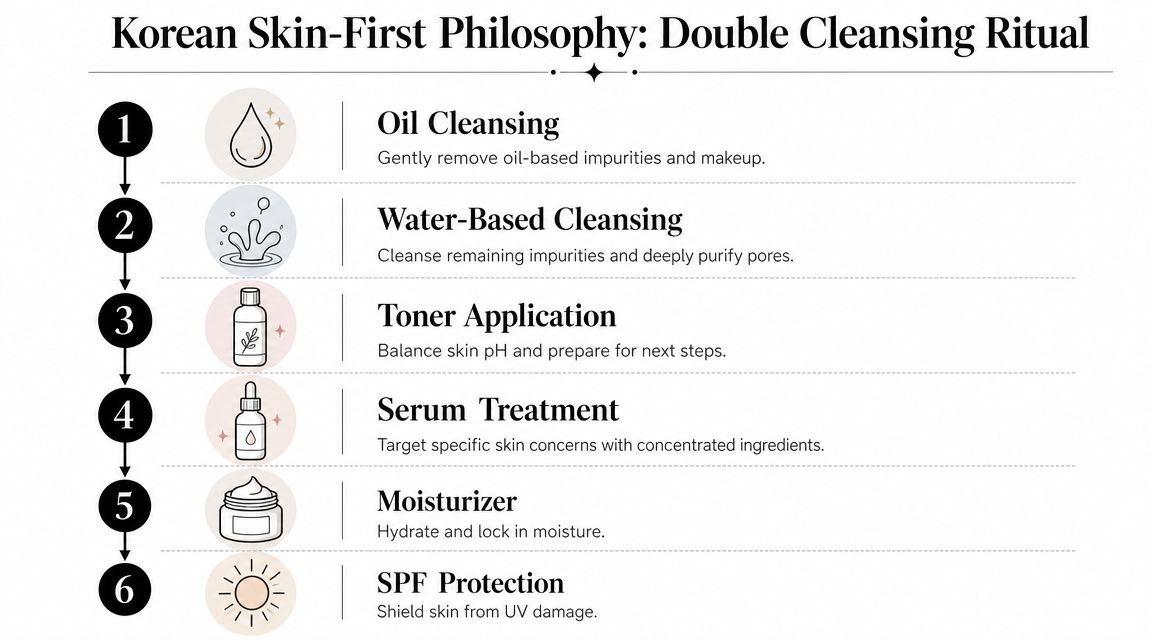
A technically sound Korean workflow starts with double cleansing. An oil or balm cleanser is massaged onto dry skin for 30–60 seconds, then emulsified and rinsed. After that, a water-based cleanser is used for 20–30 seconds. The point is to remove makeup and sunscreen with less friction than a single-step cleanse, and the main mistake is over-rubbing, which can aggravate sensitive skin, as outlined in this guide to the Korean double-cleansing method.
That sequence matters commercially. If a customer complains that cushions or tints “sit oddly”, the problem often starts with poor prep or residue left on skin. Staff need to know that.
Use a training script like this:
- First cleanse: remove oil-based residue, makeup, and SPF without dragging the skin.
- Second cleanse: clear remaining impurities so the base sits evenly.
- Avoid friction: rubbing harder doesn't clean better. It just irritates.
- Follow immediately with hydration: don't leave skin bare and tight.
Hydration creates the finish
After cleansing, the skin should feel comfortable, not stripped. That's where premium natural retail has an advantage.
Swiss boutiques and pharmacies can adapt this ritual using gentle product families they already understand: cleansing balms, facial mists, essences, light serums, and moisturisers with a soft sensorial profile. You don't need to mimic every Korean shelf. You need to build the right skin-prep sequence.
A practical routine looks like this:
| Step | What to stock | What staff should say |
|---|---|---|
| Cleanse 1 | Oil or balm cleanser | “This dissolves makeup and SPF without harsh rubbing.” |
| Cleanse 2 | Mild water-based cleanser | “This finishes the cleanse and leaves skin fresh.” |
| Rebalance | Toner or mist | “This preps the skin so makeup applies more smoothly.” |
| Treat | Hydrating serum | “Think comfort and bounce, not heavy actives before makeup.” |
| Seal | Lightweight cream | “Lock in moisture so the base stays even.” |
Skin prep sells makeup. If the complexion category underperforms, check the cleansing and hydration story first.
What Swiss retailers should merchandise
Don't isolate makeup from skincare. Pair them.
Bundle products around routines rather than categories:
- Clean start duo: oil cleanser plus gentle second cleanse
- Glass-skin prep: mist, serum, and light cream
- Sensitive morning edit: low-friction prep for reactive skin
- Travel ritual: mini cleanser, mist, tinted base
That approach does two things. It raises basket value, and it makes Koreanische make up easier for cautious customers to understand. They don't need all the jargon. They need a ritual that works.
Curating the Luminous Base BB Creams and Cushion Foundations
The heart of Koreanische make up is the base. Get this right and the category looks modern. Get it wrong and it looks underpowered, confusing, or irrelevant.
Korean makeup is consistently defined by a light, dewy finish, with core formats such as BB creams, cushion foundations, tints, and gradient lips replacing heavier Western-style coverage. That structure matters because it shows this isn't just a look. It's a stable product architecture built around hybrid skincare-makeup formats, as described in this Korean makeup routine guide.

Stop comparing them to classic foundation
This is the sales mistake I see most often. Staff present BB creams and cushions as weaker versions of foundation. That's lazy selling.
They should be framed as different tools for a different result. The customer isn't buying less product. They're buying a different finish, texture, and routine.
Here's the clean comparison Swiss teams need:
| Format | Best for | Finish | Retail explanation |
|---|---|---|---|
| BB cream | Everyday wear, quick routine | Light, skin-like, dewy | “A flexible base for people who want polish without heaviness.” |
| CC cream | Tone balancing, redness correction | Sheer to light, radiant | “Useful when the customer wants to even tone more than cover texture.” |
| Cushion foundation | Portable application and touch-ups | Luminous, buildable | “Ideal for clients who want convenience and controlled layering.” |
What to stock in Switzerland
Be selective. The wrong assortment kills confidence.
Swiss premium retail doesn't need a huge wall of similar beige products. It needs a compact, edited complexion offer for the main use cases. Choose formulas that align with a natural positioning: breathable texture, skincare-adjacent feel, easy blendability, and a finish that looks expensive in daylight.
Prioritise:
- A strong BB cream edit: this is the easiest entry point for customers new to Korean base makeup.
- One or two cushion options: enough to demonstrate the format without overcomplicating shade management.
- A clear correction product: a CC option can help bridge customers who are nervous about sheer coverage.
- Tester support: these formats need touch, not just shelf cards.
How staff should explain each format
Make the conversation practical. Customers respond to use-case language.
A pharmacy consultant might say:
“If you dislike traditional foundation because it feels visible on the skin, start with a BB cream.”
A boutique advisor might say:
“If you reapply during the day or travel often, the cushion compact is the smarter format.”
That's stronger than reciting ingredient lists with no context.
Shade strategy matters more than trend language
Don't overbuy shades just to look complete. Buy intelligently and train aggressively.
Your team should know how to assess undertone, finish preference, and tolerance for glow. In Swiss retail, many customers still associate “coverage” with quality. You need to reframe that. Explain that a lighter base can still look more polished because it respects skin texture instead of flattening it.
Use these conversion cues:
- For matte-foundation users: show how dewy doesn't mean greasy. It means alive.
- For mature customers: emphasise flexibility and reduced heaviness.
- For sensitive-skin shoppers: link the format to gentle, skin-first routines.
- For younger customers: position cushions and BB creams as everyday complexion tools, not special-occasion products.
The strongest premium assortments don't imitate Seoul retail. They translate Korean logic into Swiss buying behaviour. That means fewer SKUs, clearer education, and a relentless focus on finish.
Achieving Subtle Definition for Eyes and Brows
The eye and brow category should support the complexion, not fight it. That's the rule.
Too many retailers sabotage a clean Koreanische make up offer by pairing a fresh base with harsh brows, dense liner, and overworked shadow stories. The Korean approach is softer and smarter. It frames the face without making the features look rigid.

Brows should look calm, not sharp
The most useful brow lesson from Korean makeup is restraint. A straighter, softer brow shape reads younger, cleaner, and more contemporary than an aggressively sculpted arch in many everyday retail settings.
For Swiss stores, that means stocking and recommending products that diffuse easily:
- Brow pencils with controlled payoff: better than ultra-waxy, dramatic formats
- Soft powders: ideal for clients who want fullness without graphic definition
- Clear or lightly tinted gels: enough hold to tidy, not laminate
Train staff to build brows from the centre outward, keeping the front lighter and the tail soft. If the brow looks “done”, they've usually gone too far.
Eyes need definition without weight
Don't lead with black liquid liner unless the customer asks for it. Lead with subtle structure.
The most wearable Korean-inspired eye look uses a thin line close to the lash root, neutral shadow washed over the lid, and mascara that lengthens more than it thickens. The point is clarity, not drama.
A simple in-store method works well:
- Sweep a neutral beige, taupe, or soft peach across the lid.
- Tightline close to the lashes with a soft pencil.
- Smudge gently if needed.
- Add mascara to open the eye, not overload it.
A good Korean-inspired eye look should make the customer look rested and polished. It shouldn't be the first thing you notice.
What to merchandise in premium natural retail
This category performs better when it's edited around comfort and ease. Swiss customers shopping in pharmacies and premium clean-beauty boutiques often care as much about tolerance as colour payoff.
Build the offer around:
| Category | Best format | Why it works |
|---|---|---|
| Brows | Pencil plus powder | Natural fullness with control |
| Eyeliner | Soft brown or charcoal pencil | Cleaner than liquid liner for everyday wear |
| Shadow | Neutral singles or small quads | Less intimidating, more versatile |
| Mascara | Defining formula | Supports the “less but better” philosophy |
A strong display should show one finished look, not ten. Keep the message disciplined: soft brow, defined lash line, neutral lid, fresh face. That's how this category becomes usable for real customers instead of aspirational content that never converts.
Mastering the Gradient Lip and Youthful Blush
If you want one visual signature for Koreanische make up, it's this: blurred colour placed with intention.
The lip isn't sharply outlined. The blush isn't carved under the cheekbone. Both are designed to look lived-in, fresh, and slightly diffused. That softness is exactly why these techniques translate so well to Swiss premium retail. They're flattering, approachable, and easy to recreate with a small number of products.

The gradient lip is easier than customers think
Retail teams often over-explain this technique. Don't.
A gradient lip is concentrated colour in the centre of the mouth, softened outward so the edge looks blurred rather than defined. It works especially well with tints, balms, and soft matte or jelly-like textures.
Use this in-store application sequence:
- Prep first: smooth the lips with a nourishing balm so dry patches don't catch.
- Neutralise slightly if needed: a touch of base around the lip line can mute strong natural pigment.
- Apply colour at the centre: upper and lower lip.
- Diffuse outward with fingertip or brush: keep the perimeter soft.
- Finish according to the look: balm for freshness, or leave it softly stained.
This is also a strong upsell opportunity. A lip prep product plus tint plus finishing balm creates a natural bundle without feeling forced.
Blush placement should lift freshness
Swiss consumers often default to classic apple-of-cheek placement. Korean-inspired blush placement can be more expressive without becoming theatrical.
The most commercially useful options are:
- High cheek placement for a clean, youthful flush
- Soft nose bridge drape to make the look feel relaxed and modern
- Blended cheek-to-temple wash for customers who want more presence without contour
Cream and balm textures are easiest to sell here because they connect naturally with the skin-first makeup story.
Don't sell blush as colour. Sell it as energy. A good placement makes the whole face look more awake.
A short visual demo helps more than any shelf talker:
Multi-use products win on the shop floor
In this context, natural retail can outperform larger chains. Customers increasingly value simplicity, and Koreanische make up supports that beautifully.
A single tint or balm can often be demonstrated across multiple zones:
| Product type | Lip use | Cheek use | Why it converts |
|---|---|---|---|
| Tinted balm | Soft stain or shine | Sheer flush | Easy, low-commitment entry |
| Liquid tint | Defined centre colour | Watercolour cheek effect | Distinctive result, modern feel |
| Cream colour pot | Blurred lip finish | Buildable blush | Great for travel and touch-ups |
When staff show one product in two ways, they remove resistance. The customer sees value, not complexity.
The best merchandising move is to build a “fresh colour” fixture rather than splitting lips and cheeks too rigidly. Korean makeup rewards cross-use. Your display should too.
How to Merchandise and Sell Natural K-Beauty in Your Store
A good K-beauty launch doesn't need hundreds of SKUs. It needs a point of view.
For Swiss pharmacies, boutiques, and spas, the winning position is natural-looking Korean makeup adapted for premium local retail. That means skin prep, light complexion, soft definition, and multi-use colour. Keep the category coherent. If you mix it with heavy glamour merchandising, you'll confuse the customer and weaken sell-through.
Build the category around routines
Routine-led merchandising beats brand-led shelving for Koreanische make up.
Create compact stories such as:
- Glass skin routine: cleanser, hydrator, BB cream or cushion
- Soft office face: light base, brow product, tint, mascara
- Weekend fresh-up: balm, blush tint, cushion compact
- Sensitive-skin edit: low-friction prep plus gentle complexion products
This works particularly well in pharmacies, where customers already trust step-based recommendations. It also helps boutiques avoid the mistake of presenting K-beauty as a chaotic trend corner.
Train staff to translate, not perform
Retail teams don't need a lecture on Korean beauty culture. They need practical language that converts.
Give them short selling lines:
| Customer objection | Better response |
|---|---|
| “I need more coverage.” | “Let's start with a base that perfects without sitting heavily on the skin.” |
| “It looks too shiny.” | “The finish is meant to look healthy, not flat. We can control placement and prep.” |
| “I don't know how to use this.” | “I'll show you a two-minute routine you can repeat at home.” |
That last line matters. Korean makeup sells when it feels repeatable.
Use content outside the store
In-store education is powerful, but it won't carry the whole launch. You also need digital reinforcement. For retailers building awareness through creators, this guide to planning effective influencer campaigns is useful because it forces discipline around message, creator fit, and campaign structure. That matters with K-beauty. The wrong creator turns it into costume. The right one makes it aspirational but usable.
One more hard truth. Don't let social content drift into novelty. Swiss premium customers respond better to demonstrations they can copy than to viral spectacle.
What actually drives repeat purchase
Repeat purchase comes from habit, not hype.
A customer returns when the routine is easy, the result is flattering, and the products fit daily life. That's why the smartest stock strategy includes refillable or repurchasable essentials, makeup-prep pairings, and simple kits such as a cleanse duo or lip-and-cheek edit.
If you want this category to last, sell the ritual first and the trend second. Koreanische make up has already proven it can travel. Now Swiss retailers need to prove they can curate it properly.
If you're building a Swiss-ready K-beauty assortment and want expert support with premium, natural, ethically sourced brands, beautysecrets.agency can help you shape a sharper retail offer for pharmacies, boutiques, spas, and clean-beauty e-commerce.