Most advice about DHT blocker shampoo starts in the wrong place. It starts with ingredients, trend terms such as “natural DHT defence”, or before-and-after promises that a Swiss pharmacy or premium retailer shouldn't repeat.
A professional buyer needs a stricter question: what can a rinse-off product honestly do, how should it be positioned in Switzerland, and what claims can staff make without drifting into medicinal territory? Once you ask that, the category becomes clearer. DHT blocker shampoos aren't strongest when sold as miracle anti-hair-loss products. They're strongest when selected and merchandised as evidence-aware scalp-care products with modest, support-oriented benefits.
That distinction matters in the Swiss market. Pharmacies want medical credibility, but they also need claim discipline. Premium retailers want clean formulations and natural storytelling, but they can't let “natural” become a substitute for evidence. The best assortments reconcile both. They favour ingredients with at least some recognised support, use language that stays within cosmetic boundaries, and train staff to guide customers toward realistic expectations.
The Science of DHT and Hair Loss Explained
A customer asking for a DHT blocker shampoo is usually asking a deeper question: why is my hair getting finer at all? If your team can explain the biology clearly, they'll sound more credible than any shelf talker.
Dihydrotestosterone, or DHT, is a hormone derived from testosterone. The conversion happens through the 5-alpha reductase enzyme. In people who are genetically susceptible to androgenetic alopecia, DHT interacts with receptors in the hair follicle and gradually changes how that follicle behaves.

How follicle miniaturisation happens
A useful analogy is a light dimmer. The follicle doesn't usually switch off in one step. DHT acts more like a signal that keeps turning the power down. Over time, the follicle produces hairs that are shorter, finer, and weaker.
That process is called miniaturisation. The visible result is thinning, especially in patterns associated with androgenetic alopecia. Retail staff don't need to overcomplicate it. They need to explain that the issue isn't only hair breakage or poor cleansing. It's a biologic process at the follicle level.
For teams who want a plain-language refresher, these insights on hair loss hormones are useful because they help frame DHT as one part of a hormonal pathway rather than a vague “toxin on the scalp”.
Why this matters for shampoo selection
This biology also explains why the shampoo category is tricky. If DHT-related thinning involves signalling inside and around the follicle, then a rinse-off product has a harder job than a leave-on or systemic treatment. That doesn't make shampoo irrelevant. It means the role is narrower.
Practical rule: A DHT blocker shampoo is best discussed as support for the scalp environment and maintenance of fuller-looking hair, not as a direct equivalent to prescription or leave-on treatment approaches.
For Swiss advisors, the most useful explanation is this:
- DHT is the hormonal trigger: It's linked to follicle sensitivity in androgenetic alopecia.
- The follicle changes gradually: Hair becomes finer before loss becomes obvious.
- Shampoo works at surface level first: It can influence scalp condition and ingredient exposure, but it doesn't automatically deliver the level of intervention implied by the term “blocker”.
- Customers hear “blocker” as certainty: Staff should translate that into more accurate language such as support, maintenance, scalp care, and cosmetic improvement in hair feel or appearance.
That shift in language helps both compliance and trust. In Swiss retail, trust is usually worth more than dramatic wording.
Evaluating Key Active Ingredients and Their Evidence
The ingredient list is where many buyers get misled. A formula may contain five or six “hair loss” actives, but that doesn't mean each has meaningful support in a shampoo format. For Swiss pharmacies, the better approach is to separate ingredient plausibility from format-specific evidence.
Ketoconazole as the historical benchmark
If one ingredient sets the benchmark for this category, it's ketoconazole. In the CH region, the most relevant historical benchmark for DHT blocker shampoo is the clinical evidence base for ketoconazole shampoo. A 1998 controlled trial published in the Journal of Dermatology found that 2% ketoconazole shampoo improved hair parameters in androgenetic alopecia, and later reviews have continued to cite ketoconazole as one of the better-studied shampoo ingredients for hair-loss support, as summarised in this ketoconazole overview for DHT-blocking shampoo.
That doesn't make ketoconazole a standalone cure. Even supportive discussions of the ingredient note that shampoo evidence remains limited compared with oral finasteride or topical minoxidil. Still, for buyers evaluating supplier claims, ketoconazole is one of the few shampoo actives with a recognisable clinical foothold.
Natural actives need stricter interpretation
Natural positioning can work in Switzerland, but only if expectations stay controlled. The strongest natural anchors in this category are saw palmetto and pumpkin seed oil. They have enough relevance to justify inclusion and shelf storytelling, but not enough to justify curative claims.
Caffeine often appears in the same conversation, yet the practical issue for all these ingredients is similar: a shampoo is a rinse-off vehicle. A plausible mechanism is not the same as solid evidence in actual retail use.
Here is a buyer-oriented evidence profile.
| Ingredient | Proposed Mechanism | Evidence in Shampoo Format |
|---|---|---|
| Ketoconazole | Topical scalp-care active often discussed for supportive use in androgenetic alopecia contexts | Best historical benchmark among common shampoo ingredients, with controlled-trial support noted above |
| Saw palmetto | Commonly positioned as a natural ingredient associated with DHT-related pathways | Credible as a natural anchor, but evidence in shampoo delivery is weak and inconsistent |
| Pumpkin seed oil | Natural oil often used in DHT-support narratives | Credible in positioning, but expected effect in shampoo is modest |
| Caffeine | Frequently marketed for follicle stimulation or hair vitality | Common in products, but buyers should ask for format-specific substantiation rather than rely on broad ingredient hype |
The job of a pharmacy buyer isn't to ask, “Does this ingredient sound scientific?” It's to ask, “What can this ingredient plausibly contribute in a rinse-off cosmetic formula?”
What to ask suppliers
When a brand pitches a DHT blocker shampoo, ask questions that reveal whether the formulation is credible or just trend-led:
- Which active leads the formula: A product built around ketoconazole has a different evidence profile from one built around botanical storytelling alone.
- What is the intended claim space: Cosmetic support, scalp comfort, hair-density maintenance, and fuller-looking hair are very different from treatment claims.
- How does the brand discuss limitations: Reliable suppliers acknowledge that shampoo is supportive, not definitive therapy.
- Is the formula coherent: A long list of fashionable extracts often signals marketing-first development.
The best products in this category don't pretend all actives are equal. They use a few ingredients with a defensible rationale, then let the rest of the formula do the supporting work.
The Efficacy Question Rinse-Off vs Leave-On
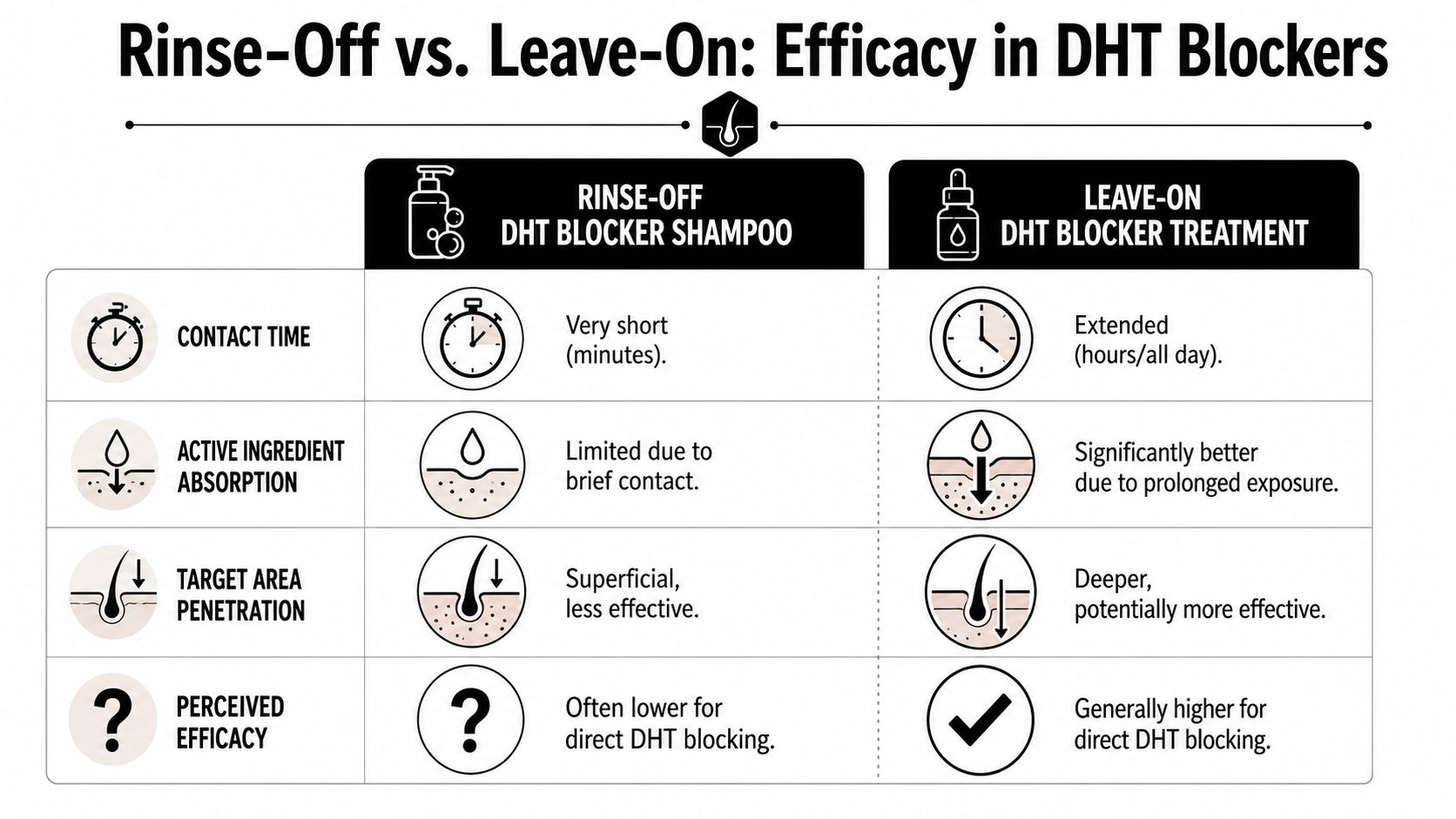
The most important commercial truth about DHT blocker shampoo is also the least marketable one. Rinse-off delivery limits efficacy. That isn't a brand failure. It's a physical constraint of the format.
A 2023 systematic review in the Journal of Cosmetic Dermatology found that shampoo-format ingredients have limited high-quality clinical evidence because contact time on the scalp is short, while the strongest evidence for androgenetic alopecia still centers on minoxidil and finasteride rather than rinse-off cleansing products, as described in this summary of shampoo evidence and androgenetic alopecia treatment hierarchy.
Why contact time changes the answer
A shampoo sits on the scalp briefly, then it's washed away. A leave-on topical remains in contact for much longer. That difference affects how much active can interact with the scalp and how practical it is to expect a meaningful biologic effect.
For pharmacy counselling, this gives you a clean framework:
- Rinse-off shampoos fit best into scalp maintenance and routine support.
- Leave-on topicals are more logically suited to targeted action because they remain in place longer.
- Systemic options sit in a different category altogether and shouldn't be blurred together with cosmetic cleansing products.
Here's a useful explainer to support staff training:
What this means for counselling
A good Swiss pharmacy conversation doesn't dismiss the category. It places it correctly.
A DHT blocker shampoo can be worth stocking when it is sold as part of a routine. It becomes problematic when the shelf message implies it can do the same job as proven therapies.
That distinction helps in three common scenarios.
First, the customer with early cosmetic thinning may appreciate a supportive shampoo that improves scalp feel and hair appearance while they decide whether to seek medical advice.
Second, the customer already using a proven therapy may want a compatible cleansing product that doesn't undermine a broader regimen.
Third, the customer with obvious progression of androgenetic alopecia needs honest signposting. In that case, a shampoo may still have a place, but it shouldn't be presented as the main intervention.
A better hierarchy for retail
Instead of asking whether DHT blocker shampoos “work”, ask where they fit:
- As a primary solution: weak position.
- As a complementary product: reasonable position.
- As a scalp-health and routine-compliance tool: often the most commercially and ethically defensible position.
That's the version of the category that survives scrutiny from both pharmacists and informed consumers.
Formulation and the Appeal of Natural Brands
Buyers often over-focus on the hero active and under-evaluate the base. In shampoo, the base matters a great deal. The surfactant system, fragrance strategy, preservative choice, and overall scalp feel can determine whether customers continue using the product long enough to notice any benefit at all.
For natural-positioned brands, real value can be created, but only if the promise is framed correctly. Natural DHT-blocker positioning in the Swiss CH market is most credible when the formula is anchored by saw palmetto or pumpkin seed oil, but the expected effect size is modest. These shampoos should be marketed as scalp-support and hair-density maintenance products, not as curative anti-alopecia therapies, according to this review of common DHT-blocking shampoo ingredients and realistic positioning.
Why the whole formula matters
A scalp that feels tight, irritated, over-cleansed, or heavily fragranced is less likely to support routine adherence. In practice, many customers abandon “treatment shampoos” because the use experience is poor. That means a buyer should evaluate:
- Cleansing balance: Is the shampoo likely to leave the scalp comfortable enough for repeated use?
- Tolerance profile: Does the formula avoid obvious sources of unnecessary irritation for a sensitive-scalp audience?
- Positioning coherence: Do the natural credentials align with the actual sensory and ingredient design?
A premium natural shampoo doesn't need to promise dramatic anti-alopecia outcomes to earn shelf space. It can justify itself through better scalp compatibility, ingredient transparency, and a more advanced maintenance story.
Natural credibility comes from restraint
The Swiss market tends to reward brands that sound measured. A formula with saw palmetto or pumpkin seed oil can be attractive, especially in premium retail, but the messaging should stay close to cosmetic language: support, appearance, balance, scalp care, comfort, and maintenance.
This is similar to how responsible teams approach adjacent categories. In supplements, for example, serious product developers start with formulation logic, delivery format, and substantiation rather than marketing slogans. That mindset is well reflected in this definitive guide on supplement development, and the same discipline applies to shampoo: ingredient romance is not enough without delivery realism and claim control.
Buyer lens: In a natural DHT blocker shampoo, the most defensible premium value often comes from formula quality and user tolerance, not from a promise of strong DHT suppression.
That gives premium retailers a stronger merchandising story. You're not selling a weak substitute for medical therapy. You're selling a better-designed scalp-care product for customers who want a credible, non-hype routine.
Merchandising and Claims in the Swiss Market
In Switzerland, shelf placement communicates almost as much as packaging. Put a DHT blocker shampoo beside medicine-adjacent hair-loss products, and customers may assume therapeutic equivalence. Put it with generic daily shampoos, and you lose the category cue entirely. The best location is usually a scalp-care or thinning-hair support zone that signals seriousness without implying medicinal authorisation.

Position the category as scalp support
The Swiss claim environment makes this more than a merchandising preference. Swiss consumer and health data show scalp sensitivity is a common reason for switching haircare, and the Swiss Federal Office of Public Health continues to emphasize that cosmetic claims must be supportable and not imply medicinal effects unless the product is authorized accordingly, as outlined in this discussion of Swiss cosmetic claim boundaries and scalp-sensitivity relevance.
That means the retail frame should favour:
- Scalp comfort and care
- Hair-density maintenance
- Fuller-looking hair
- Ingredient transparency
- Routine compatibility for regular use
It should avoid a visual or verbal drift toward “hair-loss treatment” unless the product's regulatory status supports that.
Claims that help and claims that create risk
A simple test works well in staff training. Ask whether the phrase sounds cosmetic or medicinal.
Safer examples include language such as “supports scalp condition”, “for thinning-looking hair”, “helps hair feel stronger”, or “designed for regular scalp-care routines”. Riskier language includes “treats alopecia”, “stops hair loss”, “blocks DHT at the follicle”, or “regrows hair”.
Shelf copy should promise what a cosmetic can reasonably deliver. If the sentence would fit better on a medicinal product information sheet, don't use it on a shampoo display.
A practical merchandising model
For pharmacies and premium retailers, a three-part merchandising structure works well:
| Retail area | Purpose | Suitable message |
|---|---|---|
| Scalp-care section | Bridges cosmetic and problem-solution shopping | For scalp balance, comfort, and thinning-hair support |
| Premium natural haircare | Appeals to ingredient-conscious shoppers | Botanical-led formulas with transparent positioning |
| Adjunct to clinic-recommended routines | Supports professional referral pathways | Complements broader hair and scalp routines |
This approach also helps staff triage shoppers more responsibly.
- Cosmetic shopper: Wants cleaner ingredients, better scalp feel, and fuller-looking hair. A DHT blocker shampoo may fit.
- Concerned hair-loss shopper: Reports progressive thinning. Staff should discuss limitations and suggest professional evaluation when appropriate.
- Sensitive-scalp shopper: May respond more to gentle formulation and tolerance than to “DHT blocker” branding itself.
For Swiss buyers, the opportunity isn't in louder claims. It's in clearer category architecture.
FAQs for Swiss Retail Partners
How should I train staff to talk about a DHT blocker shampoo without overpromising
Give staff a short script built around three points: what it is, what it may help with, and what it won't replace.
A useful phrasing is: this shampoo is designed to support the scalp environment and the appearance of thinning hair, but it isn't the same as a proven medical hair-loss treatment. That keeps the conversation accurate and still commercially useful.
Train teams to avoid absolute verbs such as “stop”, “reverse”, and “regrow” unless the product's regulatory status clearly allows that language. Encourage them to use terms such as support, maintenance, appearance, routine, and scalp care.
Who is the best customer for this category
The best fit is usually a customer with early concerns, cosmetic thinning, scalp discomfort, or a preference for non-prescription support products. These shoppers often want an accessible first step.
A weaker fit is the customer with obvious progression who expects a shampoo to perform like a therapeutic intervention. In that situation, the right move is still empathetic selling, but with clearer boundaries. Offer the shampoo as an adjunct if appropriate, not as the whole answer.
When should staff suggest referral to a dermatologist or clinic
Referral makes sense when the presentation sounds more medical than cosmetic. Examples include sudden shedding, rapid visible change, patchy loss, scalp symptoms that sound inflammatory, or customers who are distressed and looking for a treatment outcome rather than a cosmetic support product.
You don't need to diagnose. You need to recognise when the shopper's expectation exceeds what a retail shampoo can reasonably do.
Some of the best customer service in pharmacy is a well-timed referral. It protects trust and often strengthens future loyalty.
Can these shampoos be used alongside other hair routines
In many cases, yes. The practical role of a DHT blocker shampoo is often as a supportive cleansing step within a broader regimen. For retail staff, the important message is compatibility and gentleness. The shampoo should not create additional scalp stress for someone already using more targeted products.
This is also why formulation quality matters so much. A harsh shampoo can undermine adherence to an otherwise sensible routine. A well-designed one can make the overall regimen easier to maintain.
What red flags should I look for in a new brand presentation
Professional buyers should be cautious when a brand does any of the following:
- Uses medicinal language casually: Phrases like “treats androgenetic alopecia” or “clinically blocks DHT” need a very high level of substantiation and may be inappropriate for a cosmetic product.
- Builds the whole story around one botanical: A single plant ingredient doesn't automatically create a credible anti-hair-loss proposition.
- Avoids discussing delivery limitations: If the sales deck never mentions rinse-off constraints, the brand may be selling aspiration rather than evidence.
- Relies on vague science wording: “Backed by research” is weak unless the supplier can explain what evidence applies to shampoo use.
- Equates natural with superior efficacy: Natural ingredients may support the proposition, but they don't remove the need for disciplined claims.
What's the right shelf message for a Swiss premium retailer
Use language that blends credibility with restraint. Good examples include:
- For thinning-looking hair and scalp care
- Supports a healthy scalp routine
- Designed for hair-density maintenance
- Botanical-led formula with transparent ingredient positioning
- Suitable for customers seeking a non-prescription support option
These phrases keep the message commercially useful without stepping into treatment territory.
Should pharmacies stock a ketoconazole-led option and a natural-led option
From a category management perspective, that's often a sensible structure because the two speak to different shopper motivations. One customer values a more medically familiar active. Another prefers a botanical and premium-clean positioning. The key is not to present them as equal in every respect. Their evidence profiles and customer expectations differ.
Staff should understand that distinction so they can explain why one product may feel more pharmacy-led while another suits a premium natural assortment.
How can I judge whether the category is worth carrying at all
Don't judge it by whether shampoo can solve androgenetic alopecia on its own. Judge it by whether your assortment needs a credible support product between everyday shampoo and more treatment-oriented recommendations.
If your business serves customers who ask for non-prescription scalp and thinning-hair options, the category can make sense. If you carry it, the success factor won't be hype. It will be tight claim language, good staff training, and product selection based on formulation quality and realistic positioning.
For Swiss retailers, pharmacies, and clinic-adjacent partners looking to build that kind of credible, premium assortment, beautysecrets.agency can help source natural and ethically positioned cosmetic brands that fit modern expectations around transparency, compliance, and clean formulation quality.