A client walks into a Zurich salon or pharmacy corner consultation and asks for three things at once. She wants fuller hair that does not look “done”, she wants a premium service rather than a quick fix, and she does not want to abandon her clean beauty routine to get it.
That request is where many businesses hesitate. Bond hair extensions sit at the intersection of craftsmanship, retail trust, and compliance. They can raise the standard of a salon menu or create a serious premium category inside a wellness-led retail environment, but only if the team understands the technical method and the product logic behind it.
In Switzerland, that matters more than most operators realise. Clients often expect performance and ingredient scrutiny in the same conversation. They ask about sourcing, cruelty-free standards, sulphates, oils, scalp sensitivity, and whether a luxury result can still fit inside a natural-care philosophy.
The short answer is yes, but not with a generic approach. Bond hair extensions work best when the business treats them as a system: consultation, strand selection, bond method, aftercare, removal, and home product guidance all have to align.
Elevating Your Offering with Bond Hair Extensions
The businesses that succeed with bond hair extensions rarely sell them as “extra hair”. They position them as a precision service for clients who care about finish, comfort, discretion, and long wear.
A premium Swiss client often arrives with conflicting demands. She may colour her hair less frequently, buy ECOCERT-led products, avoid harsh cleansers, and still want a polished result for work, travel, or events. Clip-ins feel temporary. Bulky wefts may feel too visible for fine hair. Tape systems can be excellent in the right setting, but some clients want movement that feels less panel-based and more individual.
Bonded systems answer that need because the work is customized strand by strand. That changes how the service is perceived. It feels closer to couture than commodity.
For salons, spas, and premium retailers, that shift matters commercially. A bonded extension service encourages longer consultations, more educated homecare, and stronger follow-up discipline. It also attracts a client who tends to value expertise over discounting.
Key takeaway: Bond hair extensions do not elevate a business because they are fashionable. They elevate a business when the team can explain why this method suits a specific client better than a faster or cheaper alternative.
The service also carries a reputational test. If the placement is poor, if the hair quality is inconsistent, or if the aftercare conflicts with the client’s natural product habits, the premium promise collapses. That is why bond hair extensions belong in businesses that are prepared to train properly, stock carefully, and speak openly about trade-offs.
Understanding the Art of Individual Strand Extensions
A client with fine hair sits in your chair in Zürich, wants discreet fullness, uses natural haircare, and does not want anyone to spot attachment points in daylight. Individual strand extensions exist for that client profile. They give the stylist control at the level that premium work demands.
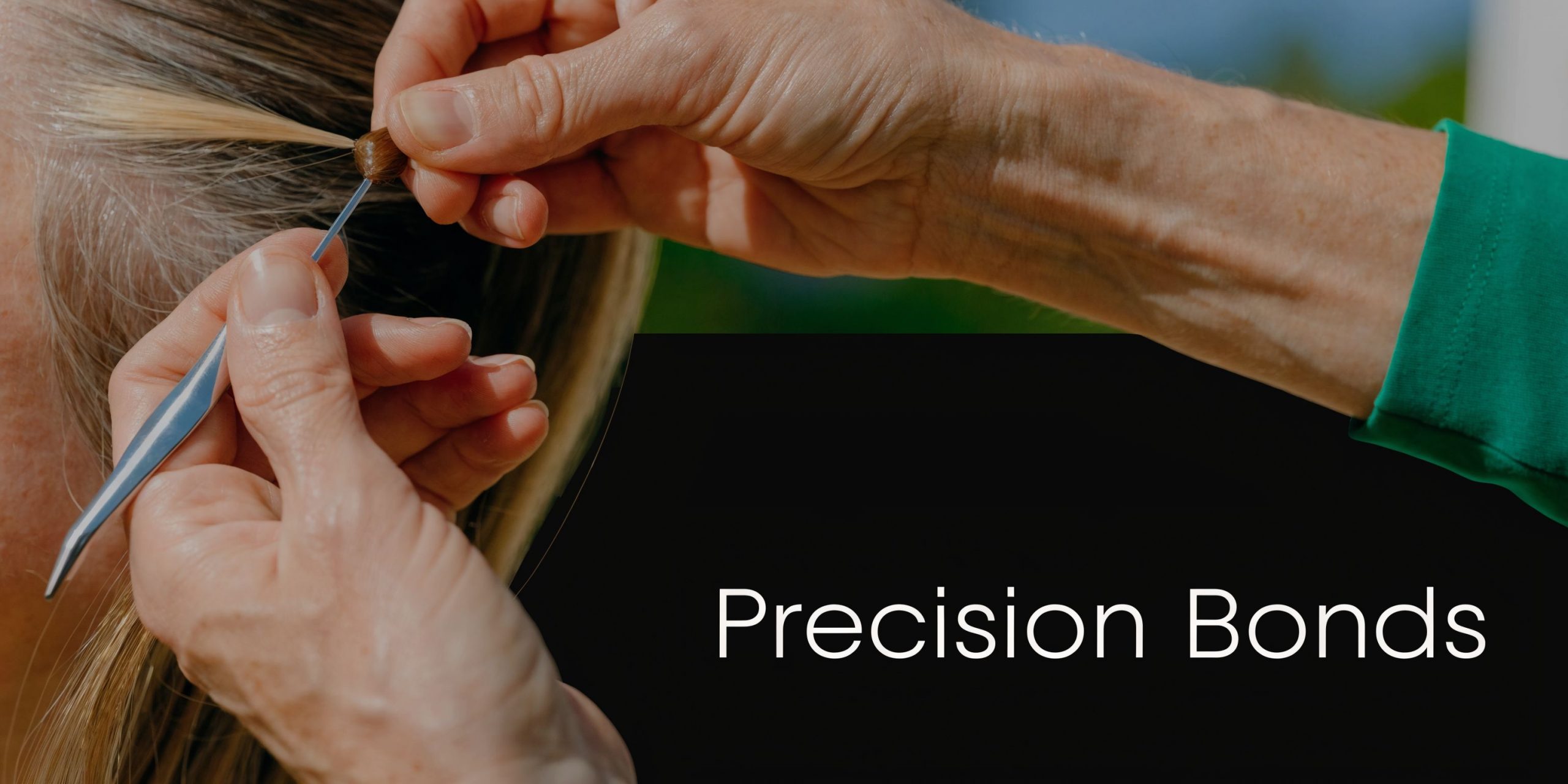
The method is simple in principle and exacting in practice. One extension strand is attached to one small, cleanly sectioned portion of natural hair. The result depends less on the product description and more on section size, bond size, distribution, and tension control.
That precision changes the visual outcome. Hair separates more naturally. Partings stay believable. Ponytails and soft updos expose fewer obvious rows. In a premium Swiss setting, that matters because clients often ask for polish without visible artifice.
Why strand by strand matters
Individual bonding creates many small attachment points across the head instead of a single broad area of weight. That gives the stylist room to place volume where it improves the shape and to keep other zones deliberately light.
Placement has to reflect anatomy, density, and lifestyle.
- At the front hairline: smaller sections and fewer bonds preserve softness.
- Through the parietal ridge and sides: controlled density avoids a blocky outline.
- At the crown and interior: distribution must support movement without creating gaps.
- At the nape: placement needs enough coverage for fullness but enough clearance for comfort and clean removal later.
This is skilled mapping work. It is one reason bonded services suit salons that want a more customized, consultation-led offer rather than a quick add-on menu item.
Keratin-tipped strands are widely used in this category because keratin-based adhesives are designed to sit close to the character of the natural hair fibre. In salon practice, that can produce a small, discreet bond when the stylist works with correct heat, clean sections, and appropriate hair-to-extension balance. The key point for client education is practical: a small bond is not automatically a safe bond. If the sectioning is too sparse or the placement is too close to the scalp, even a premium bond can create unnecessary stress.
What clients are paying for
Clients pay for hair, but the premium sits in the decision-making.
A trained extension specialist assesses whether the client can carry individual bonds comfortably, how much added hair the existing density can support, and where the service should remain conservative. Good bonded work often involves saying no to extra length, extra grams, or a full-head application that would photograph well on day one and wear poorly by week six.
That judgement is especially important in businesses that position themselves around natural or ethical beauty. Clients who choose low-silicone, oil-rich, or organic retail products often assume all gentle-feeling products are extension-safe. They are not. Many botanical oils, heavy masks, and residue-building cleansers can soften bonds, swell the attachment area, or make separation harder during maintenance. If a salon sells both extensions and natural retail, the team has to explain compatibility clearly before application, not after the first slippage complaint.
Later in the consultation, showing the process helps clients understand the precision involved.
What bond hair extensions require from the client
Bonded extensions suit clients who accept upkeep as part of the result. They need regular brushing technique, product discipline, separation checks, and timely maintenance planning around work trips, ski weekends, and holiday sun exposure. In Switzerland, where clients often expect high discretion and low drama from beauty services, that expectation has to be set with precision.
Suitability also has an ethical and regulatory side. A premium salon should be able to explain where the hair came from, how it was processed, and what adhesive ingredients are being used near the scalp. That standard protects the client and it protects the retailer. In this category, trust is built through technical honesty, not through promising that bonded extensions suit everyone.
Practical rule for staff training: position bond hair extensions as a high-precision service for suitable clients with compatible homecare habits. That protects results, protects margins, and protects trust.
A Professional Comparison of Bonding Methods
A Swiss client sits in the chair asking for three things at once. Invisible bonds, low ingredient concern, and homecare that still works with the organic shampoo already in the shower. The method you choose decides whether that promise holds up after six weeks or starts to fail after the first ski weekend, sauna visit, or oily scalp treatment.
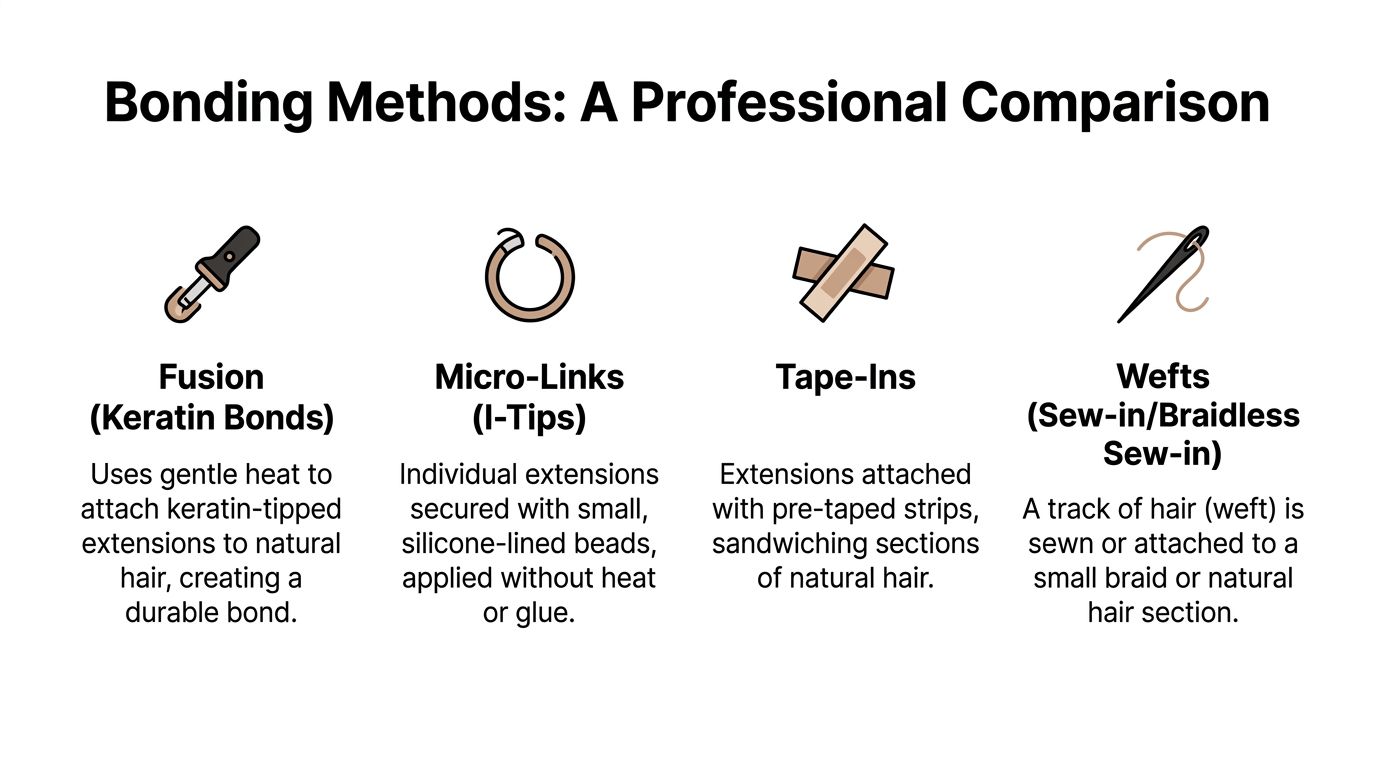
For a premium bond menu, the comparison usually comes down to hot fusion keratin bonds and cold fusion keratin bonds. Both are strand-by-strand systems. Both can look refined. Their differences show up in application speed, training demands, removal discipline, product compatibility, and how well they fit a natural-led retail concept.
Hot fusion keratin bonds
Hot fusion remains the reference method in many salons because it gives the stylist direct control over bond size, shape, and placement. A pre-tipped keratin strand is softened with a heat tool and moulded around a clean, well-measured section of natural hair.
Done properly, hot fusion produces small attachment points with excellent movement. That is why it still performs well for clients who want a discreet result through the sides, crown, and hairline, not only bulk through the back.
Where hot fusion works well
- Clients who prioritise longevity: this method is widely chosen for longer wear between maintenance visits.
- Dense placement plans: experienced stylists can customise bond direction and spacing with high precision.
- Luxury finish work: the bonds can be kept small enough to support soft movement and polished blending.
The trade-off is technical. Heat itself is not the problem. Poor sectioning, oversized bonds, rushed rolling, and weak isolation are the problem. In training, I see more issues from operator inconsistency than from the method itself.
Hot fusion also needs a stricter conversation in salons that retail natural or organic haircare. Many oil-rich masks, scalp serums, and silicone-heavy leave-ins soften or contaminate the bond area over time. If the retail team sells “nourishing” products without explaining placement rules, the extension service carries the cost.
Where caution is needed
Clients with very fragile hair, highly reactive scalps, or a strong preference for low-heat services may not be the best candidates. Salons also need clear standards for tool temperature, section size, and bond distance from the scalp. Those are not small details. They determine comfort, growth support, and whether the installation still looks clean at week ten.
Cold fusion keratin bonds
Cold fusion answers a different set of objections. It is often chosen for clients who want strand extensions without the feel of a heat-based installation story. Depending on the system, the bond is formed with ultrasonic or other low-heat technology that softens keratin with less direct thermal exposure than classic hot fusion. Great Lengths describes ultrasonic application as a way to fuse the keratin polymer while keeping the result small and discreet (Great Lengths on ultrasonic extension application).
In practice, cold fusion suits a premium consultation where the client is already ingredient-aware, asks detailed questions, and expects the salon to justify every step. That makes it particularly relevant in Swiss retail environments that position themselves around clean formulations, botanical care, or lower-intervention services.
Technical advantages of cold fusion
- Lower perceived heat exposure during application: useful for clients who are nervous about thermal processes.
- Strong consultation value in natural-led environments: the method often aligns better with a gentler service narrative.
- Neat, discreet bonds: suitable for visible zones when placement is handled carefully.
Cold fusion is not automatically the safer choice for every head of hair. The equipment is more specialised, the timing can be slower, and poor training still creates tension, slippage, or difficult removals. A salon should only offer it if the team can install and remove it consistently, not because the phrase "cold fusion" sounds softer on a brochure.
It also deserves a realistic retail warning. Clients often assume that a lower-heat application means broad product freedom at home. That is rarely true. Bond integrity still depends on disciplined product placement, moderate oil use near the root, and shampoos that do not leave heavy residue around the attachment points.
Side by side business view
| Method | Best suited to | Main strength | Main limitation |
|---|---|---|---|
| Hot fusion keratin bonds | Clients who want classic long-wear strand extensions and maximum placement control | Precise manual shaping and strong customisation | Higher operator sensitivity. Heat, sectioning, and bond sizing must be consistent |
| Cold fusion keratin bonds | Fine, delicate, or heat-conscious clients, especially in natural-led retail settings | Lower-heat consultation story and discreet bond finish | Higher equipment and training demands, with less room for weak technique |
| Tape-ins | Clients who want quicker installation and simpler maintenance planning | Fast service flow and easy visual explanation | Less individual movement and less custom placement around complex growth patterns |
| Wefts | Clients who want larger density changes quickly | Efficient volume building | Can feel heavier and less discreet on finer Swiss client profiles |
The business decision is simple. Offer the bonded method your team can execute cleanly, remove safely, and support with compatible retail. For many Swiss salons, that means one primary bonded system, one clear suitability filter, and the confidence to redirect clients toward tape or weft when strand bonds are not the right fit. That protects margins, reputation, and client trust.
Sourcing Ethical and High-Quality Hair
Technique can rescue poor consultation. It cannot rescue poor hair.
When a business introduces bond hair extensions into a natural or ethical retail environment, the sourcing question becomes as important as the installation method. Clients who already read cosmetic labels will also ask where the hair came from, how it was processed, and whether the brand’s ethics end at the packaging.
Why Remy matters in bonded work
In bonded systems, strand quality is exposed. There is nowhere to hide rough cuticle behaviour. If the hair tangles, dehydrates oddly, or reacts badly to professional styling, the client notices quickly because each strand moves independently.
That is why 100% Remy human hair is not a luxury phrase to decorate a brochure. It is the baseline for a credible premium result. Remy hair keeps the cuticle aligned in the same direction, which supports smoother blending and more predictable wear. In practical terms, that means less friction, better polish, and easier maintenance for the client.
The bond itself may be small, but the material quality drives the whole service reputation.
Ethical sourcing is a retail issue, not only a salon issue
Swiss premium consumers increasingly connect beauty quality with supply chain integrity. If your business already stocks cruelty-free, ECOCERT-oriented, or ingredient-conscious ranges, an extension line that lacks transparency creates a visible contradiction.
The problem is not only moral. It is commercial.
A business that cannot answer basic sourcing questions puts staff in a defensive position during consultation. That weakens confidence in the service before application even begins.
Look for suppliers who can explain:
- Origin transparency: where the hair is collected and processed
- Processing discipline: whether over-acid treatment, heavy silicone masking, or aggressive coating is used to create superficial shine
- Consistency: whether colour, texture, and strand quality stay stable across deliveries
- Ethical standards: how consent, traceability, and cruelty-free positioning are handled in their documentation and brand communication
Red flags that experienced buyers catch early
Some extension brands sell “ethical” as a mood rather than a standard. You can usually spot that quickly.
A cautious buyer should pause if the supplier:
- avoids clear answers on origin
- relies on glossy imagery but gives no technical information
- offers hair that feels over-coated and unusually slippery at first touch
- cannot explain how its quality behaves after repeated washing and professional styling
- uses vague language around “premium”, “raw”, or “natural” without evidencing handling standards
Retail principle: if the sourcing story would not stand beside your clean skincare portfolio, it should not sit beside it on shelf or in consultation.
The Swiss fit
The most overlooked opportunity in Switzerland is not just offering bonded extensions. It is offering them without breaking the retailer’s ethical identity.
A pharmacy, spa, or premium concept store that already curates natural cosmetics should not compromise that position for a fast-moving beauty trend. It should choose extension partners whose hair quality, bond quality, and ethics can survive informed client scrutiny.
That is what protects margin over time. Clients will forgive a waiting list. They will not forgive a mismatch between claimed values and what is applied to their hair.
The Professional Application and Removal Process
Owners who have never offered bonded work often underestimate two things. First, how much of the result is decided before the first strand is attached. Second, how much damage comes from poor removal rather than poor installation.
Application is a placement service
A serious bonded appointment begins with consultation, not with tools heating up on the trolley.
The stylist needs to assess density, scalp sensitivity, growth pattern, daily styling habits, and the client’s expectations around fullness and visibility. Colour matching matters, but so does movement matching. A beautifully matched shade can still look false if the extension texture behaves differently from the natural hair.
After that, sectioning and placement strategy determine whether the finished set feels expensive or obvious. A good stylist leaves enough perimeter and parting coverage to keep bonds hidden in natural movement. The final blending cut is not optional. It is what turns added hair into integrated hair.
During application, the team should control four things
Section size
Too much natural hair in one section weakens flexibility. Too little can increase stress.Bond spacing
Bonds need room to move independently and to grow out cleanly.Placement from the scalp
Too close creates discomfort. Too far causes flipping and visibility.Weight balance
The extension choice must suit the client’s density, not the brand’s standard pack size.
Removal must stay professional only
Clients often judge a bonded service by the removal experience. If take-down is rushed, if residue is left behind, or if the natural hair is roughly combed out, the business loses credibility immediately.
A professional removal uses the correct solvent for the bond type, controlled pressure to break down the attachment, and careful detangling of natural shed hair from the grown-out sections. In Swiss premium settings, I strongly prefer acetone-free and biodegradable options where the system allows, especially for clients with sensitive scalps.
For managers building service protocols, it can help to review products such as Hair Bond Remover Oil to understand how dedicated removal formulas are positioned and why clients should never improvise with household oils or random solvents.
Scheduling protects the hair and the reputation
Removal should be booked as part of the original treatment plan, not treated as an afterthought. When clients know from the start that maintenance and safe take-down are part of the service, compliance improves and unrealistic expectations drop.
A strong protocol usually includes:
- an initial consultation record
- a written homecare brief
- a maintenance booking before the client leaves
- a removal and refit discussion early, not when the bonds are already overdue
Professional standard: bond hair extensions are a complete service cycle. Consultation, fitting, maintenance, removal, and possible refit all belong to one premium promise.
Advanced Aftercare and Natural Product Compatibility
A client leaves the salon with flawless bonds, then washes at home with a rich organic mask, a botanical scalp oil, and a low-foam cleanser bought from a premium Swiss pharmacy. Two weeks later, the bonds feel sticky, the root area starts to tangle, and the client blames the extension method.
The problem is usually aftercare mismatch.
In Swiss premium retail, that mismatch appears often because many clients already follow a natural or low-tox routine. They are not wrong to want cleaner formulas. The salon has to separate what is clean from what is bond-safe, and explain the difference with precision.
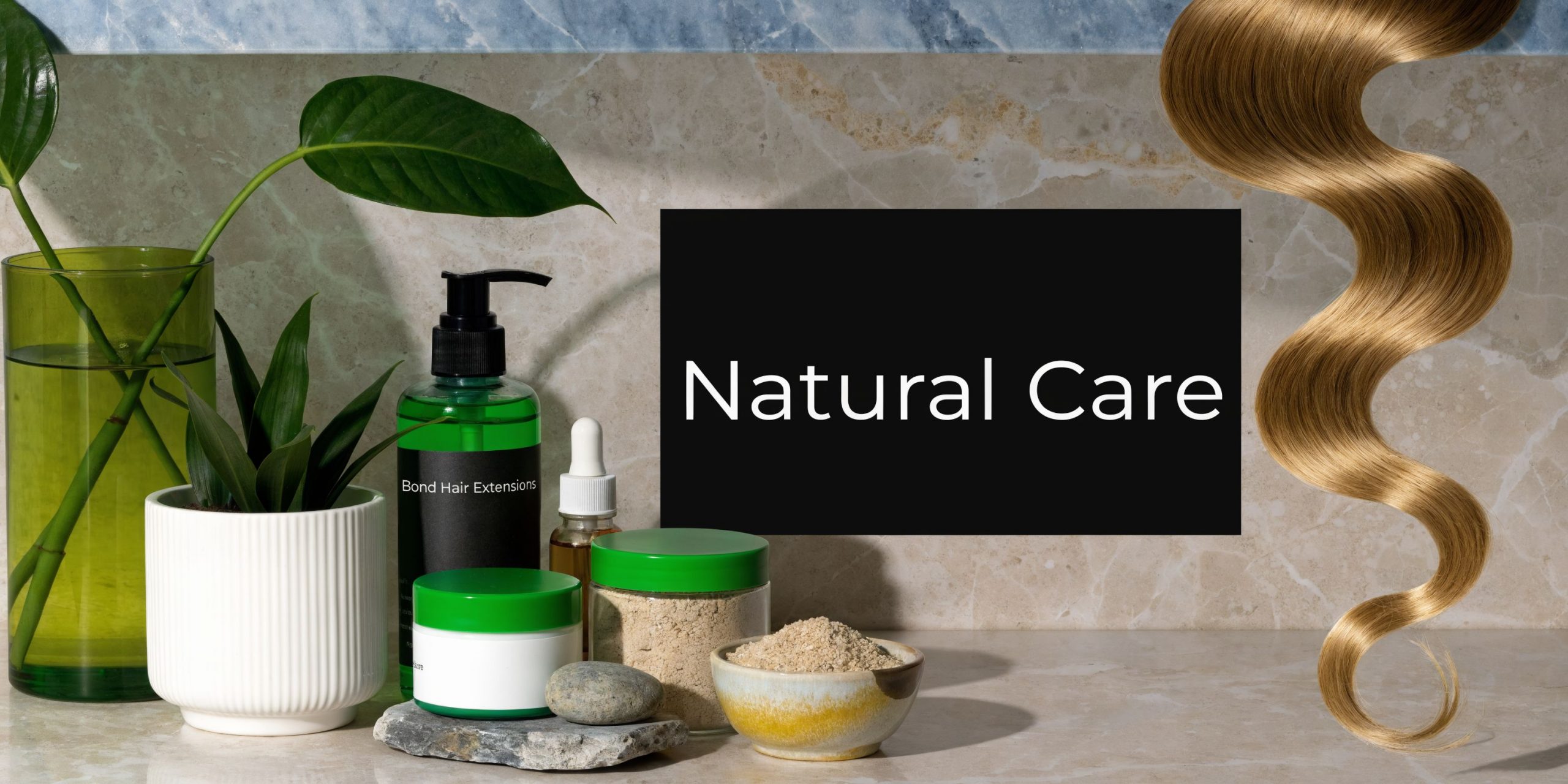
What the bonds need from homecare
Bond longevity depends less on marketing claims and more on chemistry, placement, and residue control. I train teams to assess products in three ways. How much oil or butter the formula carries, whether it leaves film at the root, and whether the client can realistically keep it off the attachment area.
pH matters. So does rinse quality. So does product weight.
For keratin and similar fusion systems, the safest retail advice is usually a gentle shampoo with a mildly acidic pH, low residue, and no heavy lipid load near the bond. For conditioners, the rule is simpler. Keep them from mid-length to ends unless the formula has been tested specifically for bonded wear.
Cold fusion clients often assume they can be more relaxed because there is less heat in the application stage. Homecare still needs discipline. Heavy marine blends, botanical masks, and scalp serums may perform well on natural lengths while still creating slippage or build-up around the attachment points.
Where natural routines create problems
The clean beauty category has one persistent blind spot. Natural does not automatically mean compatible with extensions.
In practice, trouble starts with migration. Fresh oils, herbal scalp treatments, and dense masks travel upward during washing, brushing, sleep, or heat styling. Once residue reaches the bond area, the result can be softening, sticking, poor separation, or matting at the root.
That is the trade-off many retailers miss. A product can be ethically positioned, beautifully formulated, and still be the wrong choice for a bonded client at the scalp area.
Swiss salons and premium retailers should address this openly because the local customer is often more ingredient-aware than extension-aware. Many clients read INCI lists carefully. Far fewer understand why fermented oils, waxes, hydrolysed proteins, aloe-heavy gels, or rich botanical concentrates may behave differently on extension wearers than on untreated hair.
A practical way to pair bond extensions with natural retail lines
The best solution is product zoning. That keeps the retail offer aligned with a natural brand identity without sacrificing wear time.
Use this framework in consultation and on the shop floor:
- Bond zone: light cleanser, clean rinse, minimal residue
- Scalp zone: only use targeted treatments after checking oil content, film-formers, and application pattern
- Mid-lengths: hydration matched to texture, colour work, and porosity
- Ends: richer nourishment where dryness appears
This is easier for clients to follow than a ban list. It also protects retail revenue because the team can recommend suitable products from the existing assortment instead of rejecting the whole natural category.
Product pairing logic that works in real salons
- Low-residue shampoos: suitable around attachment points if they rinse clean and do not leave a conditioning film
- Conditioners with marine extracts or plant proteins: often better through the lengths than at the root
- Fresh-pressed oils and balms: keep for the last third of the hair only
- Botanical scalp drops: approve case by case, not automatically
- Co-wash or very low-foam systems: use caution, especially for fine hair or clients prone to build-up
Clients with thirsty, fragile lengths often need help understanding why their ends need moisture while their bonds need restraint. This guide to a high porosity hair routine is useful for that conversation.
Daily habits that protect a premium result
Product choice is only half the aftercare plan. Daily handling determines whether the bond area stays clean and separated.
Brushing
Brush in sections and support the root with the hand. If grown-out bonds start to gather shed hair, separate them early instead of waiting for a maintenance visit.
Drying
Dry the bond area thoroughly after washing, training, or humid weather exposure. In Alpine and lake regions, clients often underestimate how long moisture lingers at the root, especially in winter under hats and scarves.
Sleeping
A loose braid or low ponytail reduces friction and root tangling. Silk helps, but consistent securing matters more than expensive accessories.
Styling
Heat tools belong on the lengths. Repeated direct heat at the attachment point shortens the life of many bond systems and can distort the bond shape.
Aftercare for bond hair extensions should feel precise, not restrictive. A salon that can combine ethical retail, natural product literacy, and bond-safe education will keep clients longer, reduce complaints, and protect the premium positioning of the service.
Swiss Retail Strategy and Safety Compliance
A Swiss client sits in consultation, asks whether the bond adhesive is compatible with her low-fragrance routine, whether the remover leaves residue, and whether the service belongs in a salon that presents itself as natural and ethically selective. That conversation decides the sale long before colour matching or length planning.
In Switzerland, compliance is part of premium positioning. This applies with particular force in salons attached to pharmacies, wellness operators, clean beauty retailers, and medically adjacent concepts, where staff are expected to answer practical safety questions with precision.
Compliance has to be visible in the retail model
For bond services, the compliance work starts at purchasing. It is not enough for a supplier to describe a system as gentle, clean, or professional. A Swiss operator needs clear product documentation, ingredient information for bond-related liquids, and packaging that supports correct retail handling under the Swiss framework for cosmetics and chemical products. The legal starting points are the Federal Food Safety and Veterinary Office guidance on cosmetics and the Swiss Chemicals Ordinance, especially where removers, solvents, and workplace handling are concerned (FSVO cosmetic products guidance) (Swiss Chemicals Ordinance, ChemO).
That matters commercially as well. If a retailer cannot obtain proper documentation from a supplier, the product should not sit in a premium Swiss environment.
Sensitivity screening belongs in the consultation, not in the complaint stage
Scalp comfort is often treated as an afterthought in extension retail. In practice, it belongs near the top of the consultation form, especially in businesses that also sell low-irritant or organic-positioned haircare. Fragrance sensitivity, known contact allergies, psoriasis, seborrhoeic dermatitis, and recent postpartum shedding all affect suitability. The consultation should also cover the likely interaction between the bond system and the client’s existing routine, because oil-heavy scalp products, herbal tonics, and aggressive exfoliating treatments can interfere with wear and make troubleshooting harder.
Swiss salons that position themselves around natural beauty have an extra responsibility here. Clients often assume that "organic" means extension-safe. It does not. Some natural formulas are excellent on mid-lengths and ends but too rich, acidic, or residue-forming around the bond area. Staff need language that protects both the result and the brand promise.
Merchandising should follow a care pathway
The strongest Swiss retail setups do not present bond hair extensions as a glamour add-on. They present them as a controlled service path with clear entry criteria, maintenance discipline, and product logic that fits the rest of the store.
A practical structure looks like this:
- Consultation first, including scalp history, lifestyle, and current product use
- Method selection based on hair density, sensitivity profile, and desired wear time
- A restricted homecare edit, with clear instructions on what stays away from the bond area
- Written maintenance timing and removal planning before the first installation is booked
This approach protects margins. It also reduces the common mismatch between a high-end extension service and a retail shelf full of unsuitable oils, masks, and scalp treatments.
Swiss premium clients expect documentation, not vague reassurance
For salon owners and premium retailers, the standard should be simple. Keep technical files from suppliers. Train the team on contraindications. Make patch-test and sensitivity protocols easy to follow. Separate bond-safe recommendations from general "natural haircare" advice. If a remover or support product falls under chemical handling requirements, store and use it accordingly.
That level of discipline builds trust faster than marketing language. In the Swiss market, where clients are used to reading labels and asking hard questions, that trust is a serious retail advantage.
Integrating Extensions into Your Business Model
Bond hair extensions make sense when the business already values expertise, consultation, and curated product logic. They are not a good fit for every floor plan or every team.
The upside is strong. This service can deepen loyalty, raise perceived authority, and create a more distinctive premium position than generic add-on beauty treatments. It also connects naturally with businesses that already sell disciplined homecare rather than impulse products.
The demands are equally real. Bonded work needs training, method selection, sourcing control, consultation time, and honest screening of unsuitable clients. A business that skips those steps will not enjoy the prestige associated with the category. It will inherit the complaints.
For Swiss salon owners, spa operators, and premium retailers, the strategic question is simple. Do your clients ask for natural-looking enhancement, long wear, and product ethics in the same breath? If they do, bond hair extensions deserve serious consideration.
The businesses that perform best with this category do not chase volume first. They build authority first. Then they scale carefully with the right hair, the right methods, and a retail edit that respects how their clients already live.
If your business serves Swiss clients who expect premium performance, ethical product thinking, and retailer-grade compliance, beautysecrets.agency is a strong partner to explore. Its focus on natural, ethically sourced formulations and support for pharmacies, spas, retailers, and e-commerce partners makes it especially relevant for businesses building a clean beauty environment where advanced services and curated homecare need to work together.