The most useful thing Swiss retailers can say about coconut oil for hair is also the least glamorous: it doesn't work equally well for every scalp, every fibre, or every shower. That's not a weakness in the category. It's the reason informed pharmacies, spas, and beauty retailers can position coconut oil more credibly than generic online sellers.
The evidence supports real value. Coconut oil can reduce protein loss in hair by up to 40% compared to mineral and sunflower oils when used before and after washing, according to a summary of the underlying research published by Healthline's review of coconut oil and hair. But Swiss practitioners also need to account for two local and clinical realities that broad consumer content usually ignores: calcaire can interfere with performance, and certain scalp conditions can make coconut oil the wrong recommendation.
That combination of efficacy and nuance is exactly what turns a simple jar into a profitable, consultative product.
The Science Inside the Jar How Coconut Oil Works
Coconut oil earns its place in hair care because it can move beyond the surface of the fibre and help limit wash-related structural loss. For Swiss retailers and spa teams, that is the useful claim. It gives staff a concrete mechanism to explain instead of vague language about “feeding” the hair.
As noted earlier, the key benefit is reduced protein loss. Protein loss is a primary cause of weak, rough, breakage-prone hair. Coconut oil performs differently from many finish oils because its fatty acid profile allows it to enter the strand more effectively, especially when used before washing rather than only after styling.
Why penetration matters more than shine
Shine is easy to fake. Fibre protection is harder to deliver, and more commercially credible.
A silicone serum can improve slip and gloss for a day. Coconut oil for hair serves a different purpose. It functions as a protective layer within the strand, not just a coating on top. That distinction becomes especially relevant in Switzerland, where calcaire often leaves hair feeling rigid, dull, and harder to detangle after rinsing. In hard-water areas, clients may blame the wrong product when the core issue is mineral buildup combined with repeated swelling and drying of the fibre.
In treatment terms, the stress cycle is simple. Hair absorbs water, swells, then contracts as it dries. Repeated washing, brushing, and towel friction increase that strain, particularly on bleached, coloured, or porous lengths. Coconut oil can help reduce that stress before it starts, which is why pre-wash use usually outperforms last-step application.
Practical rule: Position coconut oil first as a pre-wash protection treatment, not as a catch-all styling oil.
What this means in the treatment room
Use the mechanism to guide the protocol.
For damaged lengths, apply coconut oil before shampoo, leave it on long enough to spread through the mid-lengths, then cleanse with a mild formula. For clients dealing with hard water, pair that advice with periodic chelating or anti-calcaire care. Otherwise, mineral residue can leave the hair coated and uneven, which makes any oil treatment look less effective than it is.
That is also where professional advice outperforms mass retail. Fine hair can lose softness and movement if the dosage is too high. Low-porosity hair may resist heavy oils and feel coated quickly. Curly, high-porosity, or chemically processed hair often gets the clearest benefit, especially in routines built around wash protection rather than cosmetic shine alone. Retail teams that can explain this difference sell fewer false promises and get better repeat purchase behavior.
For broader regimen selling, coconut oil also sits well beside repair categories that address growth and fibre support from other angles, including education on how collagen supports hair growth.
The commercial takeaway for Swiss buyers
Swiss customers usually respond well to precise, functional positioning. The strongest message is not “deep nourishment.” It is “helps protect the hair fibre before washing stress and hard-water exposure leave lengths rougher and weaker.”
That wording gives pharmacies, spas, and selective beauty retailers a sharper shelf strategy. Merchandise coconut oil near gentle shampoos, repair masks, post-colour maintenance, and anti-calcaire support. Avoid presenting it as a universal scalp remedy or an all-hair-type styling shortcut. The product sells best when the mechanism, limits, and local water conditions are explained clearly.
Proven Benefits for Hair and Scalp Health
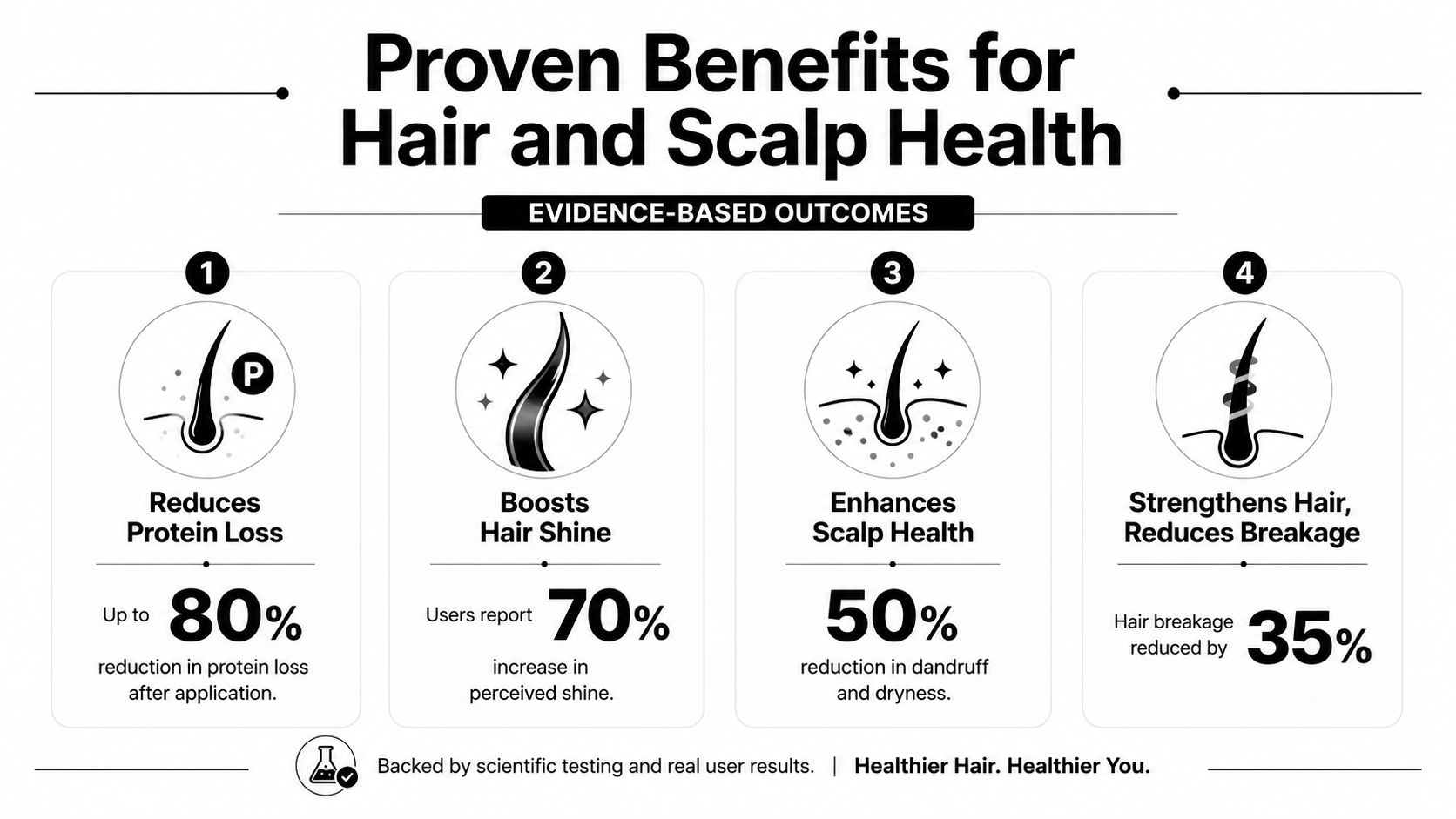
Once the fibre-level mechanism is clear, the retail message becomes easier to sharpen. Coconut oil for hair has two commercially meaningful benefit zones: hair shaft protection and scalp ecosystem support. Those are distinct conversations, and good advisors keep them separate.
The first benefit is structural. When hair loses less protein during washing, it usually feels stronger, less brittle, and more resilient in daily grooming. For retailers, that creates a credible bridge between ingredient education and visible consumer outcomes such as fewer rough ends and better flexibility in damaged lengths.
What the scalp evidence adds
The more overlooked opportunity sits on the scalp side. A 2022 scalp microbiome study found that coconut oil application significantly altered fungal and bacterial populations, reducing the ratio of dandruff-associated Malassezia species to match the composition found on healthy scalps, as detailed in the PMC publication on coconut oil and the scalp microbiome.
That matters because many Swiss consumers don't present with dramatic scalp disease. They present with mild flaking, periodic tightness, visible dryness at the hairline, or a scalp that feels “off” after weather changes, indoor heating, or aggressive cleansing. Coconut oil can sit credibly in that conversation when staff avoid overclaiming and frame it as support for scalp balance rather than a medical cure.
Healthy-looking hair usually starts with a scalp environment that isn't constantly irritated, overstripped, or destabilised.
How to translate benefits into retail language
Pharmacy and spa teams often undersell coconut oil by making it sound old-fashioned. The better positioning is clinical but accessible.
Use language like this:
- For damaged hair: “This is most useful when your lengths feel weak after washing.”
- For scalp discomfort: “This may support a drier, flaky scalp by helping restore a healthier environment.”
- For prevention: “It works best as part of a protective routine, not only as a rescue product.”
For customers asking broader questions about hair strength, pairing the topic with internal wellness education can also help. A concise explainer on how collagen supports hair growth gives staff a sensible way to distinguish between fibre protection, scalp care, and nutritional support without blurring the claims.
What works and what doesn't
What works is a focused recommendation. Suggest coconut oil where there's a clear issue: dryness, wash-related roughness, compromised ends, or a scalp that needs gentler support.
What doesn't work is promising every benefit at once. When teams claim shine, growth, scalp repair, curl definition, and anti-frizz performance in a single sentence, trust drops. Swiss consumers tend to reward precision. One strong claim, well explained, sells better than five inflated ones.
Choosing the Right Treatment for Every Hair Type
Coconut oil for hair is not a democratic ingredient. Some fibres welcome it. Others reject it almost immediately. The difference usually shows up through porosity, density, and scalp behaviour, not through trend-based categories like “dry hair” alone.
High-porosity hair usually responds best. That includes hair that has been coloured, lightened, heat-stressed, or chemically reworked. The fibre tends to lose moisture and structural integrity more easily, so a protective oil can feel useful rather than excessive.
Low-porosity or very fine hair is where disappointment happens. These clients often report that coconut oil leaves the surface heavy, dull, or difficult to cleanse. In a retail setting, that's where returns, product abandonment, and the phrase “too greasy for me” start appearing.
A practical diagnostic lens
Instead of asking whether someone has straight, wavy, or curly hair, ask three more profitable questions:
- Does the hair dry very quickly or very slowly after washing?
- Has it been bleached, coloured, relaxed, or frequently heat-styled?
- Does product tend to disappear into the hair or sit on top of it?
Those answers usually reveal whether coconut oil should be sold as a treatment staple, a limited-use rescue product, or not recommended at all.
| Hair Type | Primary Benefit | Recommended Use | Caution |
|---|---|---|---|
| High-porosity hair | Helps protect weakened lengths and reduce wash-related stress | Pre-wash treatment on mid-lengths and ends | Avoid overloading the scalp if the client is buildup-prone |
| Colour-treated or chemically processed hair | Supports better fibre resilience and softness | Use as a repair ritual before shampooing or as an occasional overnight mask | Patch test routines if the scalp is reactive |
| Thick, coarse, or very dry hair | Gives weight, slip, and better manageability | Small leave-in use on ends or richer mask application | Too much can still leave residue if cleansing is mild |
| Fine hair | Limited benefit unless used very sparingly | Apply only to the ends, occasionally | Can flatten the style and leave a greasy appearance |
| Low-porosity hair | Often better as an occasional pre-wash step than a leave-in | Short-contact treatment, then shampoo thoroughly | Surface buildup is common |
| Flaky or sensitive scalp | May support comfort in some cases | Only with condition-specific screening | Don't treat scalp flaking as one single problem |
Matching format to hair behaviour
Retailers do better when they decouple the ingredient from a single product format.
- Pure oil: Best for customers who already understand dosage and want a flexible pre-wash treatment.
- Oil-infused mask: Easier for mainstream users who need control and a cleaner rinse-out feel.
- Scalp product: Appropriate only when the scalp profile has been screened properly.
If the client's main complaint is flatness, limp roots, or difficulty rinsing products out, coconut oil probably isn't the hero item.
Better advice leads to better sell-through
A narrower recommendation often produces better repeat purchase. The right sale is not “everyone needs coconut oil”. The right sale is “this is excellent for your overprocessed lengths, but not ideal on your roots”.
That level of precision protects margin. It also protects trust, which matters more in Swiss pharmacy and premium spa retail than a quick one-product conversion.
Master Application Techniques for Best Results
Application determines whether coconut oil for hair feels effective or disappointing. The ingredient has clear strengths, but only when teams explain where to apply it, how long to leave it on, and when local water quality changes the result.
For Swiss businesses, the hard-water issue is not a footnote. In many areas, calcaire can leave mineral buildup that interferes with proper absorption, and local users report that an acidic vinegar rinse helps remove that coating before treatment, as discussed in this Swiss hard-water hair discussion.
The pre-wash method that suits most clients
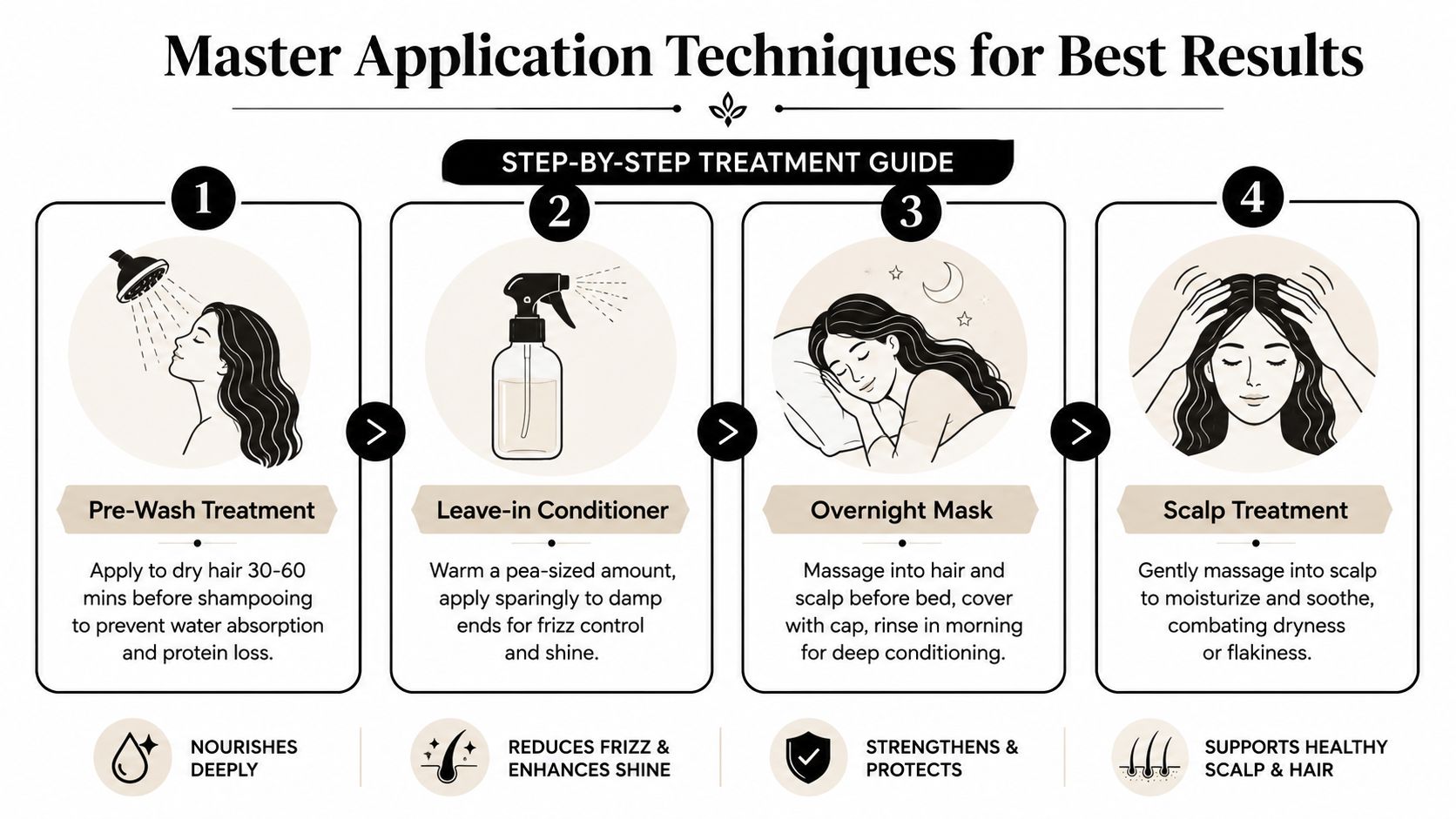
If you stock one use protocol in retail leaflets or treatment cards, make it the pre-wash routine. It's the most forgiving and the easiest to integrate into home care.
- Apply coconut oil to dry hair, focusing on mid-lengths and ends.
- Leave it on for 30 to 60 minutes.
- Shampoo thoroughly, and cleanse twice if needed.
- Follow with conditioner only where the hair still needs slip.
This method suits damaged, porous, and rough-textured hair best. It also reduces the common complaint that oil “just sat there” because the client isn't trying to wear it visibly on clean hair.
A short visual explainer can help staff demonstrate the routine in-store:
Leave-in and overnight use
Leave-in use should be framed as an advanced option, not the default advice. For most customers, the correct amount is tiny and limited to the ends.
Use it this way:
- For frizz control: Warm a very small amount between the palms and press it into dry or slightly damp ends.
- For coarse hair: A richer overnight application can work, especially on compromised lengths.
- For scalp use: Only recommend this after screening for scalp condition rather than assuming every flaky scalp wants oil.
In Swiss retail, “use less than you think” is often the most important instruction on the label.
Managing the calcaire problem
Local expertise separates a Swiss advisor from generic online content. A customer may apply a good oil correctly and still get poor results if mineral deposits are coating the hair shaft.
A practical protocol is simple:
- Before oiling: Use a mild acidic rinse, such as a vinegar-based rinse, if the hair feels coated or perpetually dull.
- Then apply the oil: Once the mineral film is reduced, the treatment usually behaves more predictably.
- Afterwards: Recommend a cleansing routine strong enough to remove residue without overstripping the lengths.
This local advice is commercially valuable because it explains failure without blaming the product. It also creates sensible cross-sell opportunities with clarifying products, acidic rinses, and hard-water-friendly cleansing systems.
Navigating Formulations and Quality Signals
Not all coconut oil products deserve the same shelf position. In B2B buying, the key question isn't whether coconut oil is fashionable. It's whether the formulation quality supports the claims your team will make in consultation.
For professional retail, simpler is often better. A clean, well-sourced coconut oil can be sold as a versatile treatment. A poorly processed one may still be usable, but it won't carry the same consumer confidence, sensory appeal, or premium margin.

What buyers should look for
Swiss clean-beauty customers tend to notice processing language. Teams should be able to explain the basics clearly.
- Virgin or unrefined: Better suited to a natural positioning, especially when transparency matters to the buyer.
- Cold-pressed: Stronger for premium storytelling because it signals minimal processing.
- Organic: Useful where the customer is ingredient-conscious and already shops by certification.
- Refined: Sometimes chosen for neutral scent or texture, but weaker for a natural hero-product narrative.
Those aren't just technical distinctions. They influence perceived authenticity, treatment-room credibility, and whether a product belongs in a pharmacy, a luxury spa, or a broad-volume beauty aisle.
Certifications, consistency, and trust
In Switzerland, trust markers matter. ECOCERT familiarity, cruelty-free positioning, and clear origin language often help customers make quick decisions, especially in pharmacies and premium e-commerce where they can't always test texture in advance.
For trade buyers, quality signalling shouldn't stop at the front label. Batch consistency, packaging integrity, and supplier documentation all shape whether a product performs reliably in the market. Teams reviewing sourcing standards may find this TradeAventus guide on quality control useful as a practical framework for evaluating supplier discipline beyond marketing claims.
Better assortment strategy
A sharp coconut oil assortment usually includes three levels:
- Pure treatment oil for ingredient-led shoppers.
- Blended repair product for clients who want easier use and easier rinse-out.
- Premium ritual item for spa retail, where texture, aroma, and packaging carry more weight.
That structure serves different customer behaviours without forcing one format to do everything. It also helps store teams recommend by use case rather than by vague quality adjectives.
Contraindications and Professional Retail Positioning
The fastest way to lose credibility with coconut oil for hair is to sell it as harmless for everyone. It isn't. A professional recommendation starts with where the product may fail, irritate, or be poorly matched.
The most important caution concerns seborrhoeic dermatitis. Medical commentary notes that while coconut oil is beneficial for many people, it can exacerbate seborrhoeic dermatitis by feeding the yeast that causes it, which is why condition-specific advice matters, as explained in this medical discussion of hair oils and seborrhoeic dermatitis. That point is often omitted in consumer marketing, and it shouldn't be omitted in pharmacy or clinic retail.
What to screen before recommending it
A simple consultation can prevent most mismatches.
Ask about:
- Flaking pattern: Dry powdery flakes and oily inflammatory flakes are not the same retail problem.
- Scalp history: If the client reports diagnosed seborrhoeic dermatitis or recurring inflamed patches, don't default to oil.
- Hair density and texture: Fine, easily weighed-down hair usually needs restraint or a different format.
- Buildup tendency: If the client already struggles to rinse products out, pure coconut oil may add friction rather than value.
Responsible advice often sounds less exciting at first, but it creates more repeat business than a blanket “yes”.
Turning caution into stronger positioning
Commercial skill plays its part. Warnings don't weaken the sale. They strengthen the authority behind it.
A pharmacy can say, “This is excellent for dry damaged lengths, but I wouldn't put it on a scalp with active seborrhoeic dermatitis.” A spa can say, “If your issue is calcaire buildup, let's fix that first so the oil can work.” A beauty retailer can bundle the oil with a clarifying or acidic-prep product and explain the logic clearly.
That approach creates three advantages:
- Higher trust: Customers remember when a team member advises against an unsuitable use.
- Smarter basket building: The recommendation naturally expands into prep, cleanse, and repair products.
- Lower dissatisfaction: Clients use the product in the context where it's most likely to perform well.
Suggested retail language for Swiss teams
Keep the phrasing direct.
- “Best for damaged lengths, not for every scalp.”
- “If you live with hard water, prep the hair first.”
- “If your flakes are linked to seborrhoeic dermatitis, let's choose more carefully.”
- “This is a protective treatment, not a cure-all.”
That's the right posture for pharmacies, clinics, spas, and premium retailers. It sounds informed because it is informed.
If you're building a more credible natural hair and scalp assortment for Swiss retail, beautysecrets.agency can help you source differentiated, ethically positioned brands that match pharmacy, spa, and premium beauty expectations. The advantage isn't just product access. It's curating ranges that your team can explain with confidence, sell with nuance, and integrate into a stronger consultative customer journey.