The most popular advice in this category is also the least helpful: “Fraxel is gentler, CO2 is stronger.” That shorthand causes real problems in Switzerland because it collapses different technologies into one vague idea of “laser resurfacing”.
For retail teams, pharmacists, spa managers, and clinic partners, that confusion matters. If you can't clearly explain what a client is asking for, you can't guide pre-care, post-care, realistic timelines, or the right home products. The result is disappointment, cancelled consultations, and support recommendations that don't match the procedure.
A strong advisor doesn't need to perform the laser. They need to translate it. That means understanding what Fractional CO2 is, where people confuse it with Fraxel, and why “tightening” is not the same thing as “lifting”.
Demystifying Fractional CO2 Laser Technology
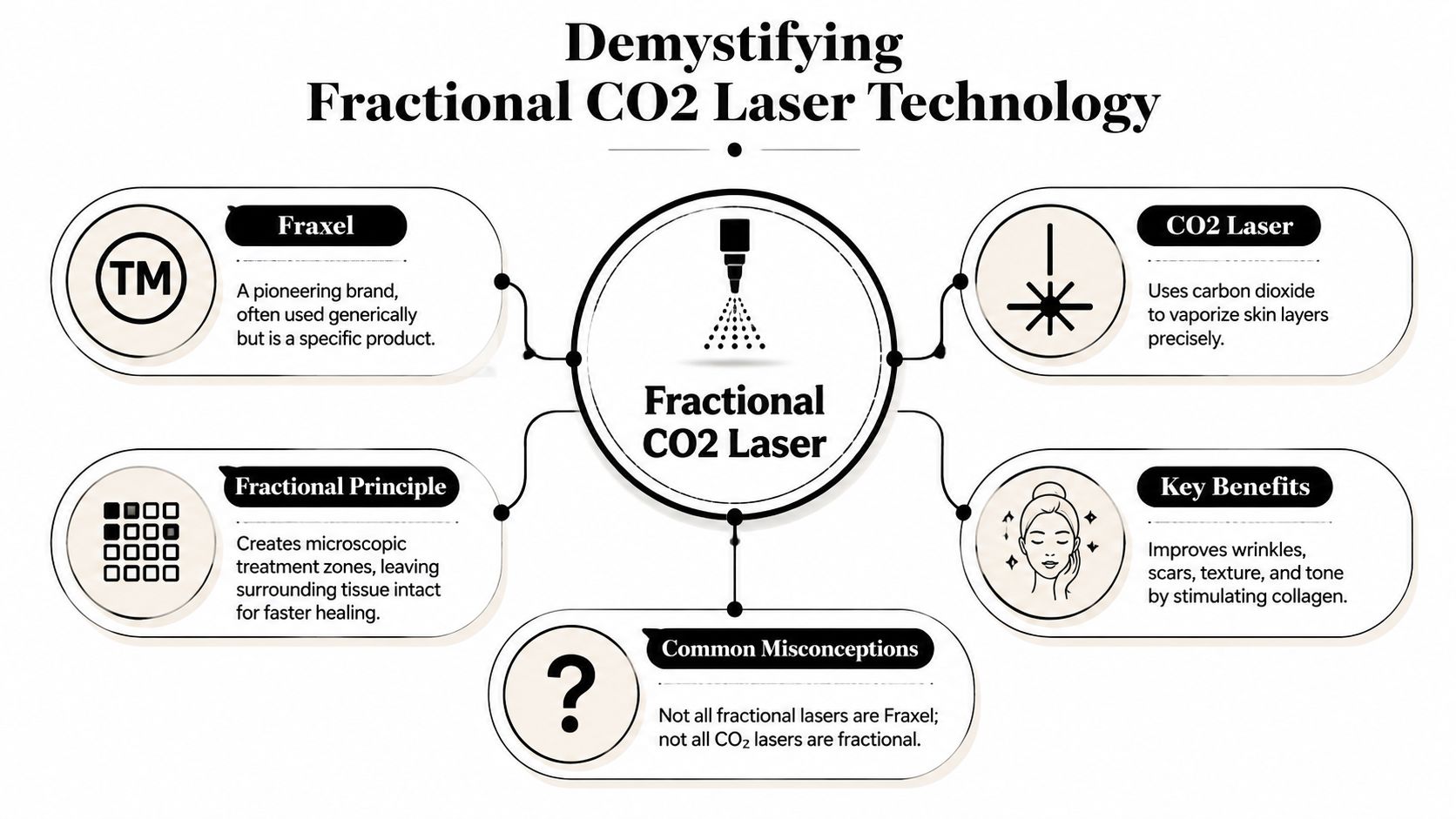
The first correction to make is simple. Fraxel is not a synonym for every fractional laser. In the Swiss market, many clients use “Fraxel” as a catch-all term, even when they're asking about an ablative Fractional CO2 treatment.
That distinction matters because the mechanism, intensity, and aftercare burden are different. A non-ablative Fraxel treatment generally leaves the skin surface more intact. Fractional CO2 removes microscopic portions of skin and creates a more demanding wound-healing response. If your partner staff use the names loosely, clients will expect the wrong recovery and the wrong result.
What fractional actually means
“Fractional” describes the treatment pattern. The laser doesn't treat every millimetre of skin in one pass. It creates many microscopic treatment zones while leaving surrounding tissue intact.
A simple way to explain this to clients is to compare it to aerating a lawn. You make controlled channels in a pattern, and the untreated areas around them help speed healing. That's why fractional technology became so important in resurfacing. It aims for visible change without the long recovery associated with older full-field approaches.
For a Swiss retail partner, this explanation is useful because it changes the conversation from brand language to tissue response. Clients stop asking, “Is this the famous laser?” and start asking the better question: “How much recovery does this version involve?”
What the CO2 part means
The CO2 laser works at 10,600 nm and that wavelength is strongly absorbed by water in the skin. Reported water absorption is 55 to 82%, with ablation depths ranging from 20 to 150 µm and thermal damage depths in the same range, according to the clinical review hosted by the US National Library of Medicine article on fractional carbon dioxide laser resurfacing.
That sounds technical, but the practical explanation is straightforward. Because skin contains water, the laser can vaporise tissue precisely. At the same time, it generates controlled heat in adjacent tissue. Those two actions are what make Fractional CO2 effective for deeper textural problems such as etched wrinkles and more severe scarring.
Practical rule: If a client's main concern is “surface glow” or very mild pigmentation, don't assume they mean Fractional CO2. Ask what result they want and how much downtime they can accept.
Why the results can look dramatic
Fractional CO2 is an ablative fractional treatment. “Ablative” means it removes microscopic columns of damaged skin. That creates a stronger remodelling signal than a non-ablative treatment.
In practice, that remodelling is driven by collagen stimulation and tissue contraction. This is why clinicians often reserve Fractional CO2 for concerns that need more than a light refresh. Think deeper wrinkles, established acne scarring, and pronounced textural sun damage.
A simple partner-ready explanation is this:
- Fractional means the skin is treated in a grid of tiny zones.
- CO2 means the laser targets water and removes tissue precisely.
- Ablative means the treatment creates a more intensive resurfacing effect.
- Collagen remodelling is why the skin can look smoother and firmer over time.
Where partners usually get caught out
The biggest error isn't lack of enthusiasm. It's using the right words for the wrong technology. If a pharmacist recommends a minimal-recovery soothing plan because the client said “Fraxel”, but the booked treatment is Fractional CO2, the support advice will be too light.
That's why your language must stay precise. In everyday conversation, clients may say “Fraxel CO2 laser” as if it's one category. Your job is to separate the terms and anchor them to what they mean clinically: brand versus technology, non-ablative versus ablative, refresh versus resurfacing.
Clinical Indications and Ideal Patient Profiles
Swiss partners usually hear the same request in different words. “I want smoother skin.” “I want my acne scars softened.” “I want lifting.” Those requests do not point to the same treatment goal, and your referral quality improves when you separate them early.
Fractional CO2 fits clients with a structural skin concern that topical skincare cannot realistically correct on its own. In practice, that usually means etched wrinkles, acne scarring, certain surgical or traumatic scars, marked photoageing, and coarse, uneven texture. The common thread is not simple dullness. It is visible change in the skin's surface architecture.

Who tends to benefit most
A practical training method is to sort clients by the problem they describe first, because the first complaint usually reveals both indication and expectation.
Texture-first clients
These clients describe skin as rough, leathery, sun-damaged, thickened, or uneven to the touch. They are often looking for resurfacing more than colour correction.Scar-first clients
Their main concern is irregular skin from acne, surgery, or injury. They often ask whether the skin can be made flatter or smoother, which is a more realistic laser conversation than asking whether a scar can be erased.Wrinkle-first clients
They are focused on lines that stay visible at rest. This group can be appropriate for referral when the issue is etched surface change rather than volume loss or lower-face descent.
That distinction matters in pharmacy and spa settings. A client with dehydration lines, mild pigment, or event-driven “glow” goals may be asking for laser by name while requiring a lighter treatment category or a skincare-led plan.
Tightening and lifting are not the same outcome
This is one of the biggest points of confusion in the Swiss market.
Fractional CO2 can tighten skin to a degree because ablative resurfacing triggers remodelling and some tissue contraction. It does not lift the face in the way clients often mean when they point to cheeks, jawline, or lower-face heaviness. Those concerns involve support structures beneath the surface, not only the skin itself.
A useful analogy for staff training is this: resurfacing works on the fabric. Lifting changes how the fabric hangs on the frame. If the client is really asking about tissue descent, laser language must stay precise.
Use wording such as tighten, smooth, refine texture, and soften the look of scars or lines. Avoid letting “collagen stimulation” turn into an implied promise of cheek lift or surgical-type repositioning.
If a client asks, “Will this lift my cheeks?”, treat that as an expectation-screening question, not a texture question.
That single phrase should prompt a better follow-up: “Are you hoping for firmer skin, or a visible repositioning of sagging tissue?” For partner teams, that question prevents many weak referrals.
The candidate who needs more careful screening
Some profiles call for slower counselling and clearer boundaries. Active inflammatory skin disease, a weakened barrier, poor sun compliance, and unrealistic recovery expectations can all complicate treatment planning and aftercare. Darker skin tones also need more careful discussion because post-inflammatory pigment changes are a greater concern after ablative procedures.
Behaviour can be as informative as skin type. Be cautious when a client:
- Wants a major result with almost no downtime.
- Describes surgery-level goals from one laser session.
- Shows little interest in strict aftercare.
- Uses “Fraxel” and “CO2” interchangeably while asking mainly about mild pigment or a quick refresh.
That fourth group is common. In many cases, they are not poor candidates for treatment in general. They are mismatched to this treatment category.
A practical referral mindset
For B2B partners, the goal is not to diagnose. The goal is to recognise fit.
Use the nature of the complaint to shape the conversation:
| Concern pattern | Better conversation starter |
|---|---|
| Deep lines and creases | “Are you open to a stronger resurfacing treatment with visible recovery?” |
| Acne or surgical scars | “Is smoother texture your main goal, even if recovery is more involved?” |
| Sagging or heaviness | “Are you expecting tighter skin, or an actual lift of facial tissue?” |
That last question is one of the highest-value scripts you can teach a frontline team. It helps the clinic receive better-informed referrals, and it helps your business recommend supportive skincare with more accuracy because the expected outcome is clear from the start.
The Complete Patient Treatment Journey
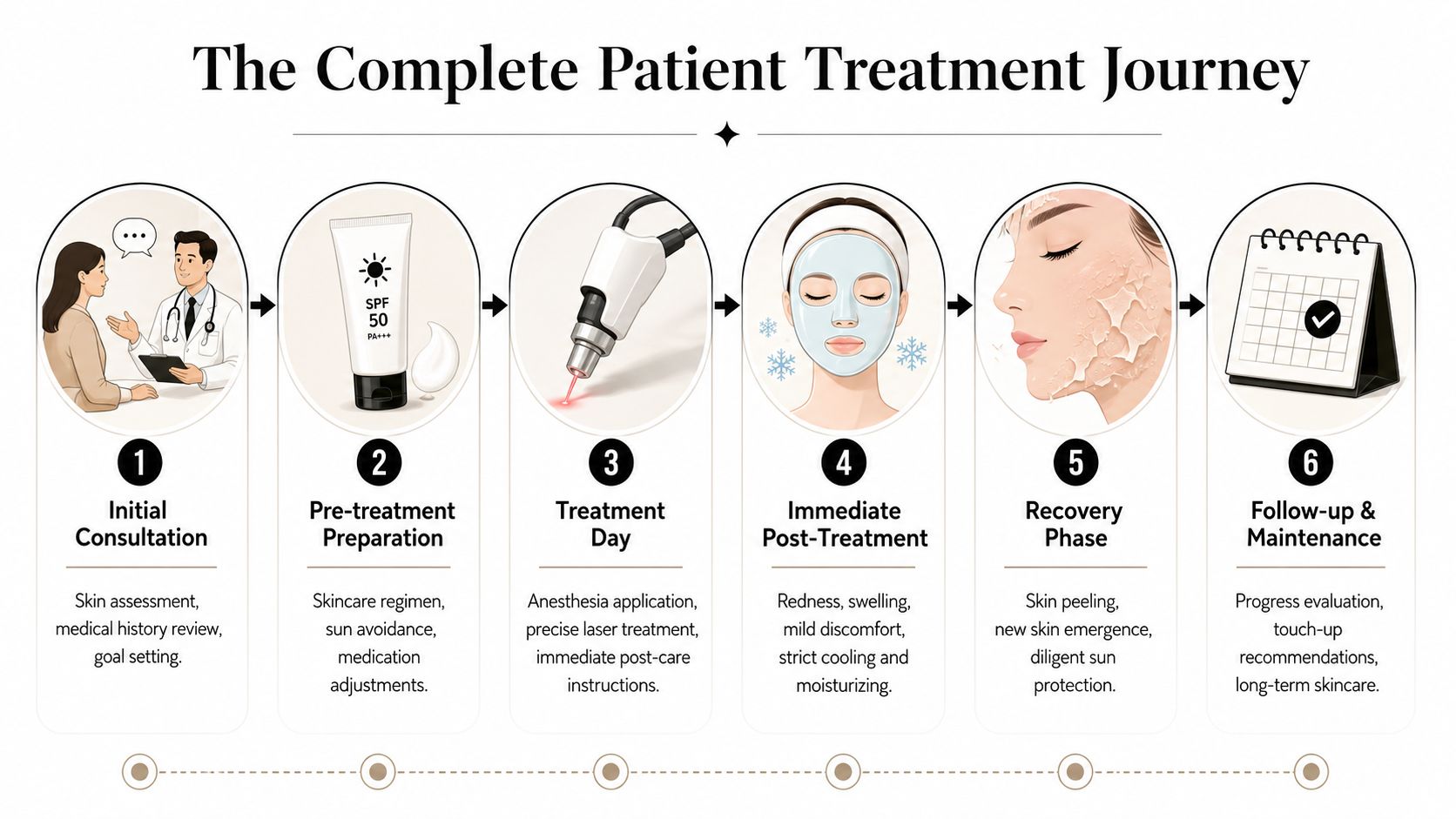
A client's experience with Fractional CO2 starts long before the laser fires. If your team understands that journey, your advice becomes more credible because it aligns with what happens in clinic.
Think of the process as a sequence of preparation, treatment, visible healing, and then delayed improvement. Retail and pharmacy support is most useful when it mirrors that sequence.
Before the appointment
The first consultation is where the clinic assesses skin condition, history, goals, contraindications, and whether the client wants resurfacing, tightening, pigment work, or something they're incorrectly calling “lifting”. Clinical photography is usually part of that process because delayed collagen remodelling can make changes easier to evaluate over time.
In Switzerland, treatment planning often varies by indication. For moderate wrinkles, fractional CO2 laser typically requires 3 sessions, while severe acne scars may involve 5 sessions. Social downtime is typically 5 to 8 days, and full-face treatment in Lausanne is around CHF 3,500, according to the Lausanne clinic overview of fractional CO2 laser sessions, downtime, and pricing.
For a partner, these details matter because they shape the client's buying behaviour. Someone planning multiple visits and a week of visible recovery needs a support routine, not a single hero product.
On treatment day
Most clients arrive having already discussed pre-care with their clinic. On the day itself, topical anaesthetic is commonly used, and the treatment time may sit within the broad range of approximately 30 to 60 minutes per session in the Swiss data already cited above.
Immediately afterwards, clients should expect the skin to look treated, not polished. They may describe heat, redness, swelling, and tenderness. At this juncture, pharmacy and spa staff can either help or accidentally undermine the process. If you characterize post-laser skin as requiring only “calming skincare”, you understate the intensity of early healing.
The first week from the client's perspective
The easiest way to explain the first phase is to describe what the client sees and feels:
Early phase
The skin can feel hot, tight, and reactive. Clients often need very simple support.Middle phase
Surface change becomes more visible. Texture can look rough, dry, and unsettled.Later phase
Flaking eases, but sensitivity may remain. Clients often feel the skin looks better before it feels fully normal.
Good support language is concrete. Say “expect visible healing” rather than “a little redness”.
Follow-up and delayed payoff
Fractional CO2 is not a same-week transformation. The visible wound-healing phase happens first. The more satisfying improvements often arrive later as collagen remodelling develops.
This point is especially helpful for teams working in premium retail. Clients often spend heavily on products right after a procedure because they want to accelerate the result. Your role isn't to promise speed. It's to protect healing, reinforce consistency, and prevent clients from interrupting their own recovery with active ingredients too soon.
Post-Procedure Care and Cosmeceutical Integration
Knowledgeable partners prove indispensable. Fractional CO2 creates a short-term retail opportunity, but its primary consequence is a care gap. Patients leave clinic needing the right textures, the right instructions, and the discipline to avoid products that feel attractive but behave badly on compromised skin.
If your team can guide that period well, you become more than a stockist. You become part of the treatment ecosystem.
The recovery window partners must understand
Fraxel CO2 laser recovery spans 7 to 14 days with initial redness, swelling, and possible oozing, followed by natural flaking around days 3 to 5, according to the clinical comparison of Fraxel versus CO2 laser recovery patterns. That's a very different support model from non-ablative Fraxel Restore, which usually involves less downtime.
The practical lesson is obvious. Don't build a post-care recommendation around “light comfort”. Build it around barrier protection, hydration, and strict simplicity.
What to recommend by phase
A good product strategy follows the biology of healing.
Early phase support
In the earliest stage, clients need products that don't compete with the wound response. They need bland, reliable, and easy-to-use formulas.
Prioritise:
Gentle cleansing
Use non-foaming, low-residue cleansers that remove debris without stinging or over-cleansing.Occlusive comfort
Rich balms and protective ointment-style products help reduce water loss and support surface comfort. This is the moment when a multi-purpose occlusive such as Egyptian Magic fits naturally into a recovery conversation.Hydration without stimulation
Simple hydrating serums can help later in recovery, but avoid pushing “active” hydration too early if the clinic has asked for a very minimal routine.
Mid-recovery support
As the skin moves into visible flaking, clients often panic and try to scrub, exfoliate, or restart normal skincare. That's when your team needs to intervene.
Recommend restraint:
- Keep cleansing gentle.
- Maintain moisturising generously.
- Do not pick, rub, or manually remove flaking skin.
- Keep sun exposure low and protection high.
This is also where some spa and retail teams make a commercial mistake. They upsell too broadly. A compromised barrier is not the moment for a ten-step ritual. It's the moment for a short protocol the client will follow.
Retail insight: The best post-laser basket often looks conservative. Fewer products, better compliance.
Ingredients and formats to avoid
Your teams should have a simple internal “not now” list for post-CO2 clients. The exact clinic instructions always come first, but as a general retail rule, be cautious with products that are heavily fragranced, strongly exfoliating, or designed to create deliberate tingling, peeling, or rapid turnover.
Hold back products positioned around:
- retinoid activity
- direct acids
- abrasive scrubs
- strong resurfacing masks
- highly perfumed formulas
- aggressive cleansing systems
Here, premium natural retail can either shine or fail. “Natural” doesn't automatically mean appropriate for freshly resurfaced skin. Essential oil-heavy blends, active botanical exfoliants, or stimulating masks may still be too much.
Sun protection is not an add-on
If your team remembers only one post-procedure rule, make it this one. A client recovering from Fractional CO2 must treat UV avoidance and sun protection as core aftercare, not optional skincare hygiene.
That means partners should discuss:
- broad-spectrum daily protection
- reapplication habits
- practical shade behaviour
- avoiding casual exposure during healing
In pharmacies and clinics, the discussion should be very specific. Ask what sunscreen texture the client will wear. Ask whether they walk to work. Ask whether they sit by a bright window. Good support isn't abstract.
Where long-term retail value comes from
The strongest commercial opportunity isn't the first balm sale. It's the maintenance pathway that follows healing. After resurfacing, many clients become more receptive to disciplined skincare because they've invested in the procedure and want to protect the result.
That creates room for a staged relationship:
- immediate barrier support
- later hydration and comfort
- eventual texture and radiance maintenance
- long-term sun discipline
Partners who understand this sequence tend to earn more trust than those who attach a generic “post-treatment kit” to every laser referral.
Comparing Aesthetic Resurfacing Modalities
Swiss partners often hear three terms used as if they mean the same thing: Fraxel, fractional laser, and Fractional CO2. They are not interchangeable. That confusion creates poor referrals and unrealistic client expectations.
A practical way to teach the difference is to separate the question into two parts. First, what kind of energy is being used? Second, how much recovery is the client willing to accept? Fraxel is a brand name commonly associated with fractional laser platforms, often non-ablative or less aggressive. Fractional CO2 describes an ablative laser category that removes columns of tissue and adds heat to drive stronger resurfacing. Those are different tools, even though both are "fractional."
For a pharmacy, medi-spa, or clinic partner, this matters because the client usually asks for a brand word, but the practitioner chooses a modality based on indication. The better your team understands that distinction, the better you can set expectations around visible change, recovery, and suitable homecare.
Aesthetic resurfacing modality comparison
| Modality | Mechanism | Best For | Downtime | Pain Level |
|---|---|---|---|---|
| Fractional CO2 laser | Ablative fractional resurfacing with controlled tissue removal and heat | Deeper wrinkles, acne scars, stronger textural change | Moderate. Visible social recovery is typical | Moderate to high, depending on settings and protocol |
| Fully ablative CO2 | Broad surface ablation across the treatment area | Severe photoageing when maximum resurfacing is the goal | Longer than fractional CO2 | High |
| Non-ablative fractional laser | Fractional thermal injury with less surface disruption | Mild to moderate texture, pigment, early ageing concerns | Shorter and easier to hide | Lower to moderate |
| Erbium laser | Resurfacing option often chosen for more superficial or specific resurfacing goals | Selected texture and ageing concerns where a different tissue interaction is preferred | Variable | Variable |
| Microneedling with radiofrequency | Needle-based energy delivery into skin | Clients seeking a non-laser pathway for texture and tightening support | Usually lighter than ablative laser recovery | Variable |
The easiest comparison model is strength versus disruption. Fractional CO2 usually sits in the middle of the resurfacing spectrum. It is stronger than many non-ablative fractional options, but less disruptive than full-field ablative CO2. That middle position explains why it is so often discussed in Swiss aesthetic consultations.
A second confusion point is "lifting" versus "tightening." Partners should use those words carefully. Fractional CO2 can support tightening by stimulating remodelling and improving surface quality. It does not create a surgical lift. If a client is describing jowls, heavier lower-face descent, or clear structural laxity, the conversation may need to move away from laser language and toward a medical assessment of what result is possible.
How to explain the choice simply
Use problem-solution language.
If the concern is shallow texture, early photoageing, or a client who cannot tolerate visible recovery, non-ablative fractional treatment may be the more realistic route.
If the concern is etched lines, acne scarring, or more advanced textural change, a dermatologist may prefer Fractional CO2 because the tissue effect is stronger.
If the client wants the strongest resurfacing available and accepts the heaviest recovery burden, fully ablative CO2 may enter the discussion.
If the client mainly wants tightening support with a non-laser path, microneedling with radiofrequency may be part of the comparison.
One sentence often works well at counter level: Fractional CO2 is usually chosen when the client needs more than a glow treatment, but is not a fit for the recovery of full ablative resurfacing.
That phrasing helps partners avoid two common mistakes. One is overselling Fractional CO2 as a lifting procedure. The other is underselling it by describing it as interchangeable with lighter fractional options.
Navigating Risks and the Swiss Market
The Swiss challenge is not a lack of interest in laser resurfacing. It is confusion at the point of decision.
A client asks for “Fraxel CO2,” expects lifting, then hears about visible healing, redness, pigment risk, and a result that improves texture more than facial descent. If your team cannot explain that gap clearly, trust drops quickly. Good partner education starts there.
The core risk profile
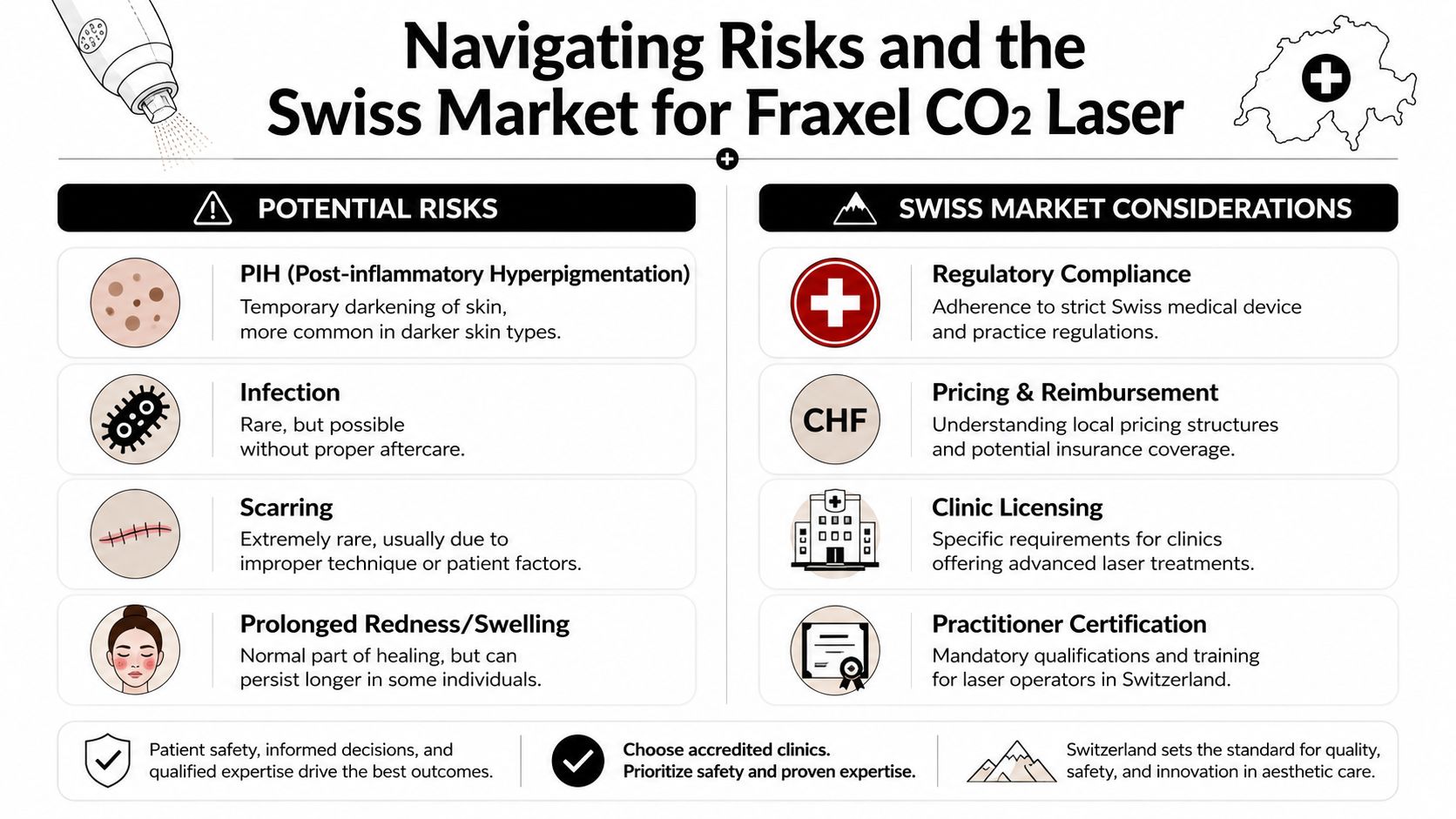
Fractional CO2 is used widely because it can deliver meaningful resurfacing. It also creates a real wound-healing response, which means risk discussions must stay concrete. Partners do not need to quote every possible complication from memory. They do need to explain the pattern accurately and without drama.
The practical pattern is straightforward:
- infection can occur, even though it is uncommon with proper care
- scarring is unusual, but no ablative treatment is risk-free
- pigment changes matter more in pigment-reactive skin
- aftercare and sun behaviour influence recovery quality
That last point is where retail and clinic-adjacent teams are useful. A well-chosen cleanser, barrier-focused moisturiser, and sunscreen routine support the treatment plan. A shelf full of “active” products used too early can work against it.
Where Swiss commercial reality enters the picture
Swiss partners see a specific type of misunderstanding. Clients often use “Fraxel” as if it means any fractional laser, while clinics use the term more precisely. The result is predictable. The client thinks “fractional” means lighter treatment and limited downtime, while the consultation may be about a stronger ablative CO2 approach with a very different recovery profile.
The explanation from Muggenthaler on Fraxel laser versus CO2 laser is useful here because it reflects the confusion many partners hear every week. For a pharmacy, spa, or clinic-adjacent retailer, this affects more than language. It shapes product recommendations, booking confidence, and whether the client feels the plan matches what they requested.
A simple way to train teams is to separate three questions:
- What word is the client using?
- What result are they hoping for?
- What level of downtime do they accept?
That sequence prevents a common Swiss retail error. Staff answer the brand word before clarifying the treatment reality.
What to say about pigment risk and skin type
This part needs precision. Broad reassurance is weak counselling, but broad exclusion is also poor practice.
Pigment-prone skin should trigger caution, better screening, and tighter alignment with the treating clinician. Partners should stay inside that boundary. Your role is to reinforce that assessment matters and that recovery habits matter.
Useful wording includes:
- “This treatment can be suitable for some clients, but pigment risk needs proper medical assessment.”
- “The clinic should decide the modality and settings. We can help you keep aftercare simple and skin-barrier focused.”
- “Sun protection and product discipline after treatment are part of the result, not an optional extra.”
That language protects the client and protects the partner. It also keeps the discussion in the right lane. Retail teams support preparation and recovery. Medical teams decide candidacy and treatment settings.
Operational boundaries for Swiss partners
Ablative laser resurfacing belongs in qualified medical hands. That point should sound ordinary in staff training, not dramatic. If a team member starts speaking as though they are selecting parameters or predicting outcomes, the role boundary has already slipped.
Use these operating rules:
- Do not diagnose suitability at counter level.
- Do not describe tightening as lifting.
- Do not improvise post-care with exfoliants, retinoids, or aggressive “repair” products.
- Do explain recovery time, barrier support, and why clinic instructions override retail habits.
Fractional CO2 works like a controlled renovation, not a quick polish. Swiss clients usually respond well when partners explain it that way. The treatment can improve texture, scarring, and surface ageing, but it asks for planning, healing time, and honest expectation-setting. That is where strong B2B partners help most.
Frequently Asked Questions for Retail Partners
How should I answer when a client asks for “Fraxel CO2 laser”?
Separate the terms politely. Explain that clients often use “Fraxel” generically, but the treatment they may have in mind could be non-ablative Fraxel or Fractional CO2, which have different recovery profiles and indications.
A useful script is: “Do you mean a lighter fractional treatment with minimal downtime, or a stronger CO2 resurfacing treatment with visible healing?” That question moves the conversation from brand confusion to practical reality.
What can I recommend before treatment?
Keep pre-care conservative unless the clinic has given a specific protocol. Barrier-supportive moisturisers, gentle cleansing, and dependable sun protection are usually sensible categories to discuss. The client should arrive with the skin stable, not irritated by experimentation.
Avoid encouraging them to start strong exfoliants or aggressive treatment products on their own. Retail support should make the skin quieter, not more reactive.
What should every post-procedure kit contain?
Think in layers of function rather than marketing categories. A sound post-procedure basket usually includes:
- a very gentle cleanser
- a rich moisturiser or occlusive balm
- a comfortable daily sunscreen
- a backup soothing product the client will reliably use
If you sell luxury or natural skincare, edit ruthlessly. The best recommendation is the one the skin can tolerate during recovery.
Which ingredients should my team flag as poor choices after Fractional CO2?
Create a staff list of pause categories rather than trying to remember every brand formula. Products marketed around resurfacing, exfoliation, rapid renewal, or intense stimulation usually need to wait until the skin has recovered and the clinic gives the green light.
Train staff to pause before recommending:
- retinoid-led products
- acid exfoliants
- physical scrubs
- strong peels
- heavily fragranced formulas
- “tingling” treatment masks
That internal discipline prevents well-meaning but unhelpful upselling.
How do I handle clients who expect lifting?
Use the exact language distinction your team should know by heart. Fractional CO2 can improve surface texture and create visible tightening. It does not reliably create true vertical facial lifting.
If the client's language focuses on jowls, dropping cheeks, hooding, or repositioning, they need a medical consultation framed around lifting options rather than a simple resurfacing conversation.
“Tighter skin” and “lifted face” are not interchangeable. Retail teams should never treat them as if they are.
Can spa services be integrated later?
Yes, but timing and intensity matter. Early healing is not the moment for active facials, scrubs, or stimulation-first services. Later, once the clinic confirms recovery, supportive maintenance such as gentle hydration-focused care may fit into a broader skin plan.
Retail partners should never rush this step. The safest approach is to ask what the treating clinic has cleared and then match your recommendation to that stage of healing.
What's the most valuable thing my team can do?
Become excellent translators. The clinic handles the laser. You handle understanding, reinforcement, and product fit.
When your staff can explain the difference between Fraxel and Fractional CO2, distinguish tightening from lifting, and recommend sensible recovery support, clients feel better prepared and clinicians see you as a stronger partner.
Swiss pharmacies, clinics, spas, and premium retailers that want sharper education around post-procedure skincare, natural recovery-support products, and partner-ready brand portfolios can explore beautysecrets.agency. The team supports Swiss trade partners with curated cosmetic and pharmaceutical lines suited to high-trust advisory environments.