A Swiss spa menu can look polished and still feel interchangeable. The facial is well designed. The body massage is reliable. The retail shelf is tidy. Yet the client who already knows premium wellness keeps asking the same question: what's distinctive here, and why should I book it with you rather than the hotel across town or the pharmacy-led beauty room nearby?
Gua Sha Corps answers that question well when it's treated as a professional protocol, not a social-media add-on. In the Swiss market, that distinction matters. Buyers and clients tend to respond to treatments that combine heritage, clear functional logic, visible ritual value, and disciplined safety standards.
Introducing Gua Sha Corps for Premium Wellness
A guest checks into a five-star property in Zürich, scans the treatment menu, and sees the usual lineup: massage, scrub, wrap, facial. A week later, that same guest walks into a pharmacy beauty cabin in Lausanne and sees nearly the same promises in different packaging. Gua sha corps gives Swiss operators a way to break that pattern with a service that feels skilled, visible, and worth discussing at the reception desk as well as on the retail shelf.
Its value starts with heritage, but heritage alone does not sell a cabin. Gua sha comes from Traditional Chinese Medicine and carries the cultural depth many Swiss clients, spa buyers, and pharmacy owners look for in premium wellness. The commercial advantage comes from how well that tradition translates into a modern protocol: guided strokes, clear product pairing, visible therapist skill, and a treatment structure that can be standardised without feeling generic.
That matters in practice.
A well-built gua sha corps service gives the therapist more than a tool. It gives the business a treatment category that sits between body massage, manual contouring, and ritual care. Clients can feel that distinction quickly because the service is specific. Pressure is adjusted by zone. Glide is chosen with intent. Tissue response is observed throughout the session rather than guessed at the start.
For Swiss spa managers and pharmacy owners, this opens several strong business uses:
- A signature stand-alone treatment for clients who want targeted bodywork with a more precise, sculpting feel than a standard massage
- An add-on module inside recovery, marine, slimming, or drainage-led rituals
- A product-led service concept built around oils, balms, and tools from lines such as Fushi or Les Thermes Marins de Saint-Malo
- A retail bridge that turns professional treatment into credible home-care recommendations rather than impulse tool sales
The essential rule: sell gua sha corps as a defined protocol with indications, limits, and a premium sensory identity. That protects trust and supports pricing.
I see the strongest results when teams stop describing body gua sha as a trend and start presenting it as trained manual work. In a Swiss setting, that shift affects everything from therapist training to room timing to average basket value. It also creates a credible place for cross-category conversations around complementary wellness. Some businesses already frame touch-based traditions within broader wellbeing support, including gentle relief for fertility challenges. Used carefully, that wider context helps clients understand gua sha corps as part of a serious wellness offering with lineage, method, and commercial depth.
The Science and Benefits of Body Gua Sha
A client walks into a Swiss spa asking for lighter legs, less shoulder tension, and a treatment that feels more precise than a standard body massage. If your team explains gua sha corps with loose language about detox or sculpting, confidence drops fast. If they explain the tissue response clearly, the service feels credible, premium, and worth the tariff.
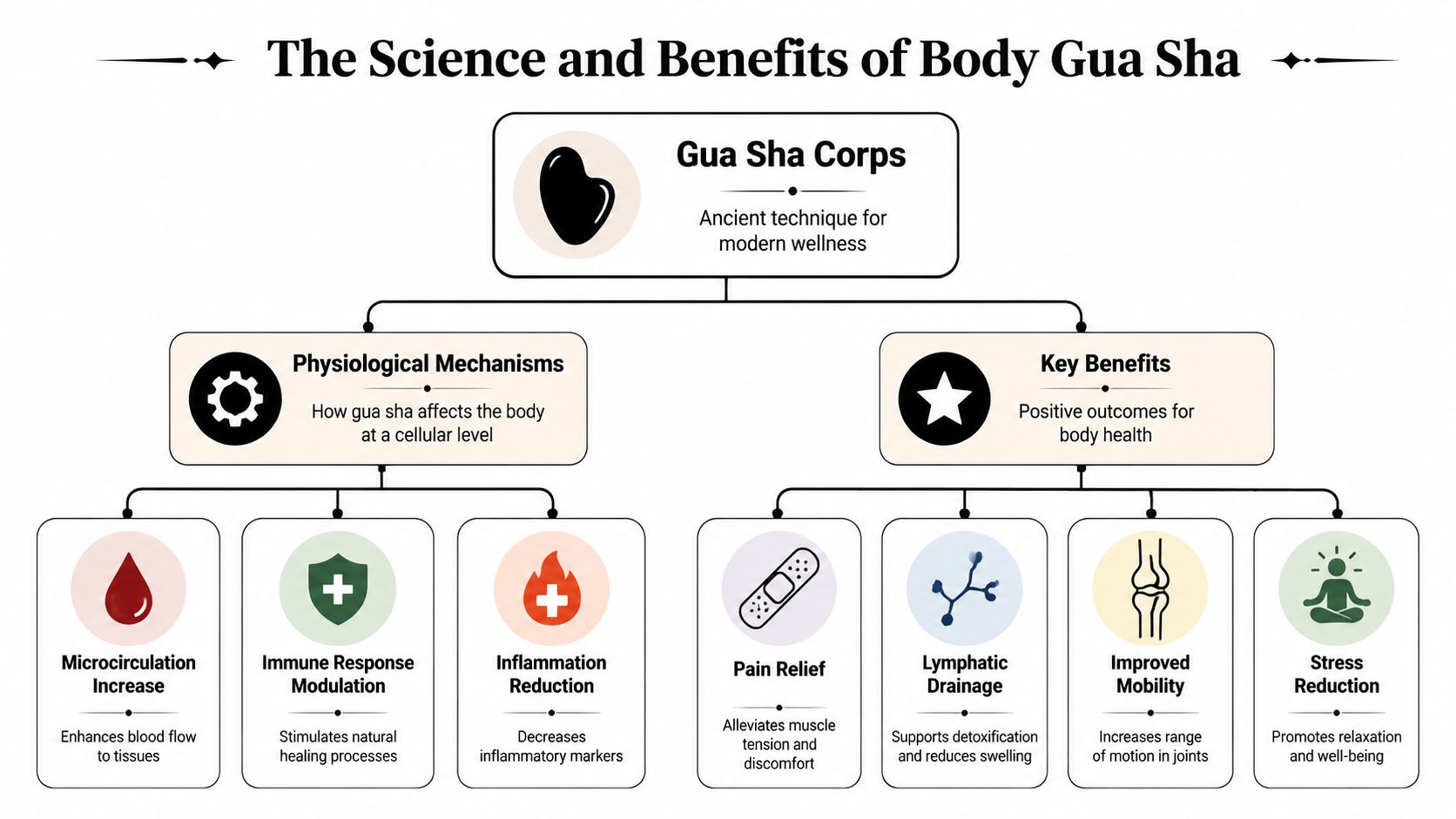
Body gua sha uses a smooth-edged tool over well-lubricated skin to create controlled friction and directional glide. In practice, the immediate effects are usually local warmth, temporary redness, and a clearer sense of tissue change under the hand. For trained therapists, that matters because the value of the treatment sits in what can be observed and adjusted during the session, not in vague wellness claims.
What happens under the tool
Good body gua sha works at the level of skin, superficial fascia, and local muscular tension. The tool is not there to force deep release. It is there to create consistent shear, organise the stroke direction, and improve how the tissue moves.
That distinction protects results.
On the body, the technique tends to perform best in areas where clients describe heaviness, congestion, stiffness, or dense texture. Thighs, calves, upper arms, shoulders, and the upper back respond well when pressure, angle, and product slip are chosen properly.
The main treatment effects a business can discuss with confidence are:
- Support for local circulation, seen as warmth, colour change, and a fresher tissue response
- Improved superficial tissue mobility, especially where the area feels bound or compacted
- Relief of muscular tightness, often noticeable in overworked backs, shoulders, and legs
- A lighter body feel after lymph-aware sequencing, especially in services aimed at comfort and recovery
In commercial terms, these effects are useful because they are tangible. Clients can feel them during the treatment and often notice them again when they stand up, walk out, or look at the treated area.
How to explain benefits without overselling
Swiss clients usually respond well to precise language. Pharmacy customers do too. They do not need dramatic promises. They need a clear explanation of what the treatment is designed to do, what they may feel, and what it does not claim to fix.
| Professional explanation | Client-facing version |
|---|---|
| Increased local circulation | “This helps the area feel warmer, more active, and less sluggish.” |
| Directional tissue work | “We use repeated strokes to improve glide and reduce that stuck feeling in the tissue.” |
| Superficial fascial release | “This is useful where the body feels tight, dense, or overworked.” |
| Lymph-aware treatment order | “The sequence is organised to support comfort and fluid movement.” |
This kind of wording also protects the therapist. It keeps the consultation inside a professional aesthetic and wellness frame rather than drifting into medical claims.
A useful positioning point for medically curious clients is that body care often sits inside a wider wellbeing strategy. Some clinics discussing hormone therapy and aesthetics present skin, body comfort, and appearance as connected concerns rather than isolated ones. Gua sha corps fits that logic well when it is presented as one method within a broader care plan.
Where evidence helps, and where restraint matters
The evidence base around gua sha is stronger for some applications than others, and a trained team should say that plainly. Mechanistic support around circulation and short-term tissue response is easier to discuss than bold body reshaping claims. That is the right standard for a premium Swiss offer.
There is also useful category evidence on the facial side. A 2025 PubMed Central study reported statistically significant facial contour improvements in a gua sha group, with reductions measured in millimetres and p < 0.001. That does not justify promising slimming or structural change on the body. It does show that gua sha belongs to a serious, studied category rather than a passing social media treatment.
For spas, this supports premium service design. For pharmacies, it supports informed recommendation.
The business advantage comes from disciplined translation of physiology into service outcomes: lighter-feeling legs, less resistant tissue, better comfort in high-tension areas, and a body ritual that feels more targeted than generic massage. Those are strong benefits. They are also benefits a skilled team can deliver repeatedly without overstating the science.
Essential Safety Protocols and Contraindications
Most gua sha content gets the order wrong. It starts with the tool, the angle, and the aspirational result. A professional service starts with screening.
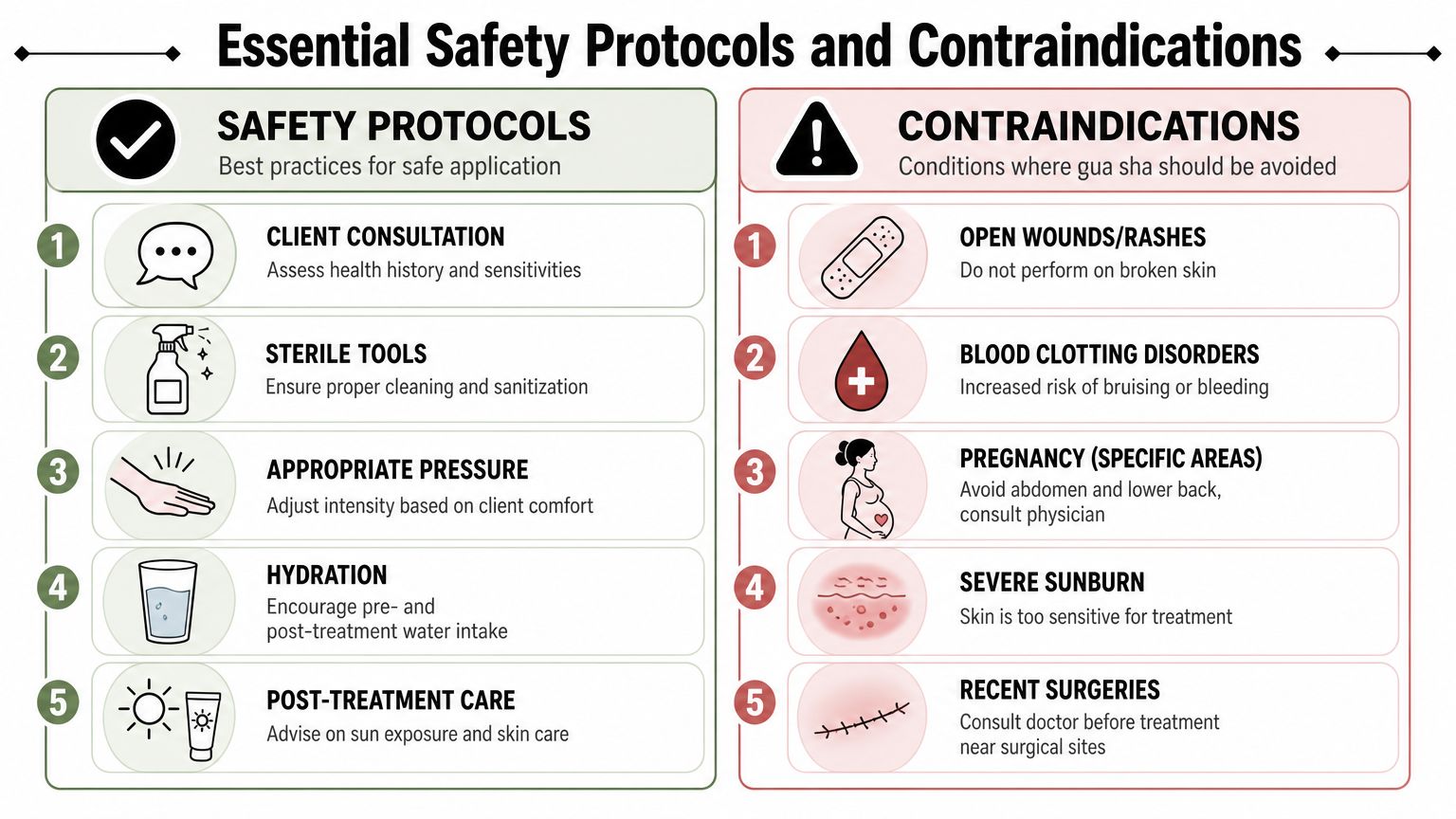
That's particularly important in Swiss settings where pharmacy owners, spa managers, and treatment-room teams are expected to give measured, responsible guidance. A key gap in most gua sha content is safety. The practice should be avoided over rashes, wounds, sunburns, or swollen areas, as noted in Healthline's safety guidance on gua sha. That one point alone disqualifies many clients from treatment on at least part of the body on a given day.
What the consultation must cover
A proper intake for gua sha corps shouldn't be a generic massage form. The therapist needs enough detail to decide whether to proceed, modify, or refuse treatment.
Use a screening process that checks:
- Current skin condition including irritation, barrier fragility, active breakouts on the body, recent sun exposure, and any area that feels hot or inflamed
- Recent procedures such as surgery, injectables in relevant areas, aggressive exfoliation, or medical treatment affecting skin response
- Bruising tendency because some clients mark very easily even under moderate pressure
- Pain patterns so the therapist can distinguish normal muscular tightness from pain that needs referral rather than treatment
- Client expectations especially if the client arrives expecting instant body sculpting instead of tissue-focused manual work
Where professionals often go wrong
The biggest mistake isn't usually poor intent. It's overconfidence. Teams assume that because gua sha looks simple, it is simple. It isn't.
A body service becomes risky when the therapist does any of the following:
- Works over compromised skin because they don't want to interrupt the booking
- Uses pressure to compensate for poor glide instead of adding more product
- Treats visible swelling as an invitation rather than asking why it's present
- Ignores client feedback because they think discomfort proves effectiveness
Non-negotiable rule: If the skin is inflamed, broken, sunburnt, or visibly reactive, skip the area. If several areas are affected, postpone the service.
Practical contraindication thinking
Not every concern is an automatic no for the whole appointment. Professional judgement often means narrowing the treatment zone, reducing intensity, or changing the service entirely.
A useful in-room framework looks like this:
| Situation | Best decision |
|---|---|
| Localised rash or wound | Exclude that area completely |
| Diffuse sunburn or widespread irritation | Reschedule |
| Unexplained swelling | Do not treat until the client has appropriate medical advice |
| Very reactive or fragile skin | Use a lighter, shorter protocol or choose another modality |
| Recent scar that still looks active | Avoid direct work nearby unless medically cleared |
Clients usually respect a therapist who sets boundaries well. They lose trust in one who pushes ahead when the tissue is clearly not suitable.
Protecting both client and brand reputation
Swiss premium businesses don't just sell results. They sell judgement. A well-run gua sha corps protocol should include documented consent, treatment notes, clear aftercare, and a defined escalation policy for anything unusual.
That level of discipline does two things. It lowers the chance of preventable irritation, and it tells the client your business takes hands-on wellness seriously. In the premium tier, that's part of the treatment value.
The Art of the Technique Strokes Pressure and Tools
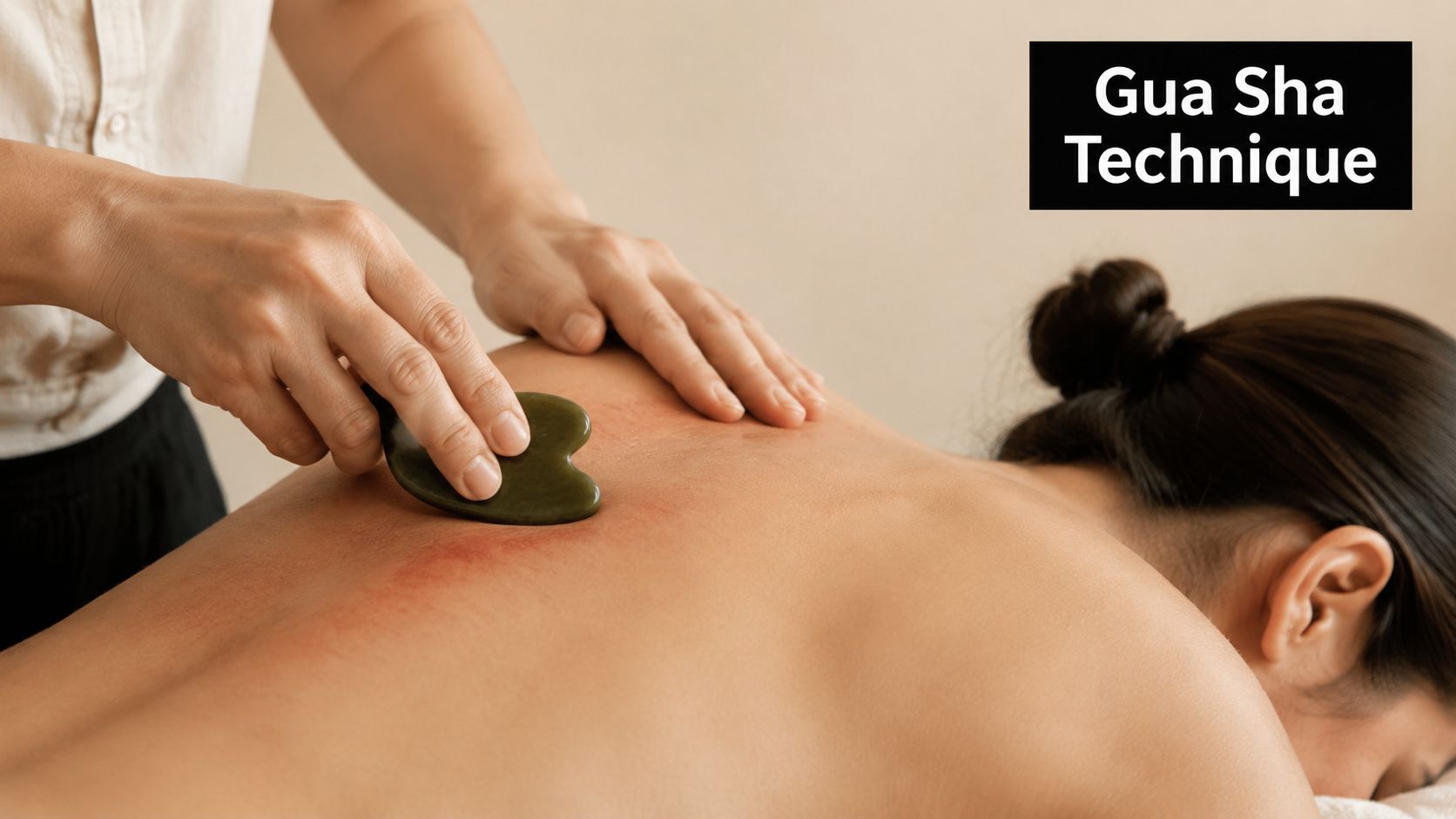
Technique is where gua sha corps becomes either elegant or disappointing. A beautiful tool won't rescue a poor protocol. The body responds best when the therapist controls three variables with precision: tool shape, slip, and pressure.
Choose the right tool for the body zone
Facial tools are often too small or too delicate for consistent body work. For gua sha corps, look for tools that give stable contact and allow the therapist to maintain a clean angle through longer strokes.
A practical tool matrix helps:
| Area | Useful tool style | Why it works |
|---|---|---|
| Upper back and shoulders | Larger curved stone or stainless steel board | Covers broader tissue and handles denser muscle |
| Thighs and calves | Wide-edged tool with a comfortable grip | Allows long directional strokes without hand fatigue |
| Arms | Medium-sized tool with a defined edge | Balances control and coverage |
| Abdomen | Smooth rounded edge | Encourages gentler, more cautious work |
Material matters less than handling quality. Stone feels premium and ritualistic. Stainless steel is easy to sanitise and often gives very consistent glide. What doesn't work is a tool selected only for appearance.
Slip is not optional
Many treatments fail to deliver results without proper technique. Proper technique requires the tool to glide without resistance. Practitioners should use 4–10 drops of facial oil and perform up to 10 slow, upward passes per zone, stopping immediately if any skin tugging occurs, according to Eminence Organics' guidance on gua sha application. Although that guidance is framed around face and neck, the underlying principle applies directly to body work: if the tool drags, the therapist must correct slip before correcting pressure.
For the body, that usually means using a generous, high-slip oil rather than a fast-absorbing dry oil. In premium cabins, pairings such as Fushi body oils make strategic sense because the product story supports the treatment story. In marine-led rituals, a finishing or complementary layer from Les Thermes Marins de Saint-Malo can reinforce the spa identity after the tool work is done.
If the skin tugs, the protocol is already off track. Add glide first. Don't push harder.
Pressure and angle
For body gua sha, therapists often improve faster when they think in ranges rather than one fixed rule. Swiss massage-training guidance for face and neck describes working with the tool at a 30–45° angle, using light-to-medium pressure, and repeating each stroke 3–5 times, with a short routine of 3–5 minutes and sequencing that supports drainage from neck to face, as taught in AIAM's gua sha technique guide. On the body, the exact sequence differs by area, but the operational lesson is useful: keep the angle shallow, repeat with control, and avoid steep scraping.
Three pressure bands are enough for training:
- Light pressure for clients with sensitivity, visible fluid retention concerns, or thin tissue
- Medium pressure for most general body rituals
- Selective firmer pressure only in strong muscular zones, and only when glide remains excellent
A steep angle and aggressive force are what make gua sha look crude. Premium gua sha corps should never look punitive.
Stroke direction by body area
Therapists need zone logic, not random movement. The stroke direction should be consistent and purposeful.
For example:
- Thighs work best with long, organised strokes that follow the line of the tissue rather than short, hurried scrapes
- Calves need a lighter hand than many therapists expect
- Upper arms respond well to controlled upward work with careful tissue support
- Upper back and shoulders often benefit from broader passes first, then more focused work along areas of tension
- Abdomen requires the most restraint. If there's any doubt about suitability, leave it out
A short visual demonstration can help teams refine hand positioning and body mechanics before they start offering the service more widely.
What works and what doesn't
A seasoned therapist quickly sees the difference.
What works
- Deliberate pace
- Continuous glide
- Area-specific tool choice
- Clear communication about sensation
- Respect for tissue response in real time
What doesn't
- Dry skin and decorative strokes
- One pressure level for every body
- Overworking the same patch to “chase” redness
- Selling the treatment as body sculpting instead of skilled manual care
Clients remember the feeling of precision. That's what turns gua sha corps from novelty into repeat booking.
Integrating Gua Sha Corps into Your Swiss Business
A Swiss client books a body ritual at CHF 180, enjoys the treatment, then leaves with no follow-up product, no next appointment, and no clear sense of why your version was different from the massage offered down the street. That is usually not a technique problem. It is a positioning problem.
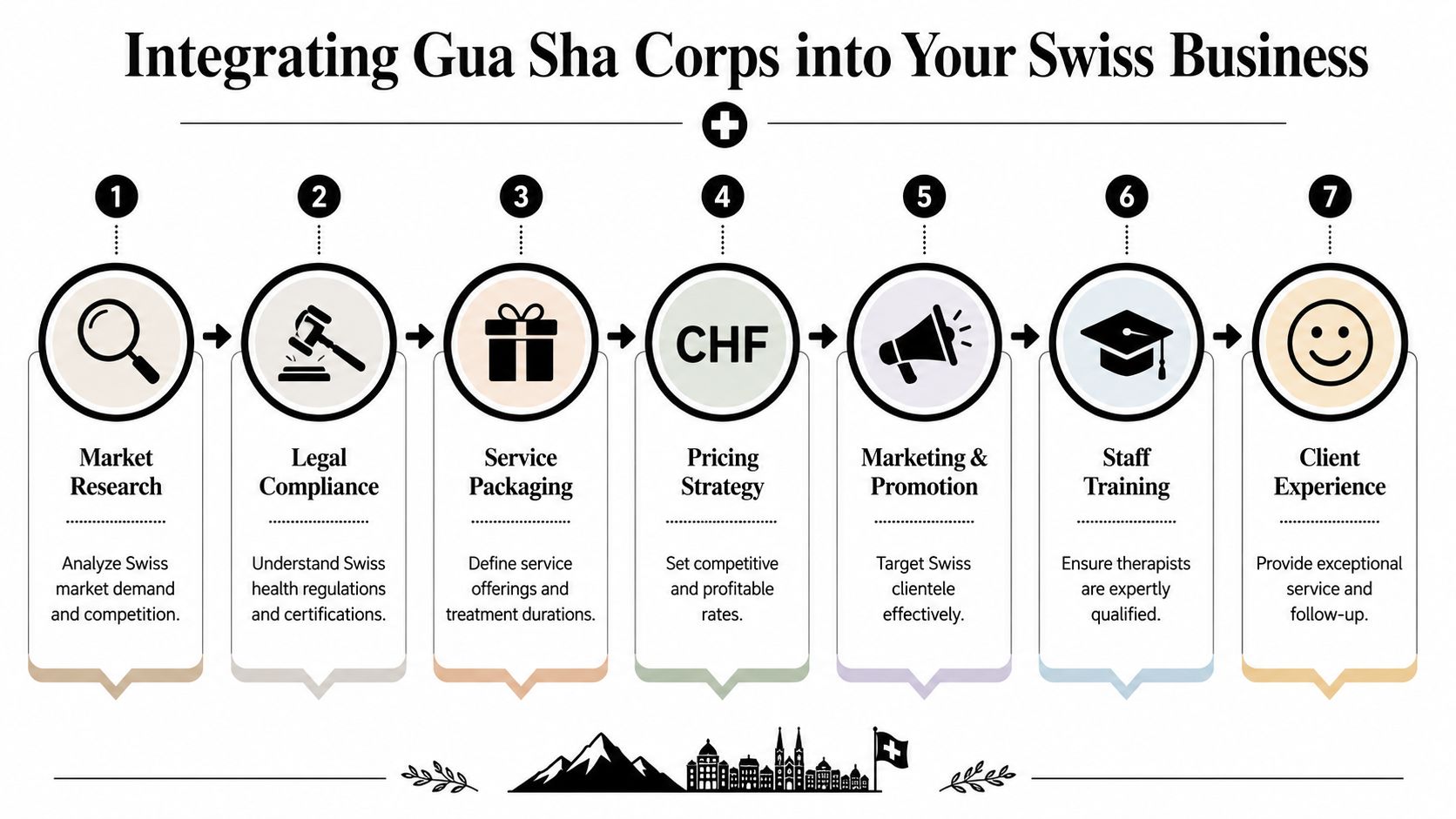
Gua sha corps earns its place when it is built as a premium manual service with a clear role on the menu, a disciplined protocol, and a retail offer that extends the result at home. Interest in gua sha as a category continues to grow, as noted earlier. For spas, pharmacies, and wellness retailers in Switzerland, that makes it commercially relevant, but only if the treatment is presented with professional clarity rather than trend language.
Position the service correctly
Menu naming affects conversion more than many managers expect. In Swiss premium settings, clients respond better to treatment names that signal method, comfort, and purpose.
These formats tend to work well:
- Alpine Recovery Gua Sha Ritual
- Marine Sculpting Body Gua Sha
- Tension Release Gua Sha Treatment
- Body Contour and Comfort Ritual
The name has to reflect the protocol. A restorative muscular treatment should be sold as recovery or release. A lighter, circulation-oriented protocol can sit under contour, comfort, or drainage support. That alignment protects trust and reduces complaints at reception.
Pharmacies need even tighter wording. The safest commercial position is adjunct wellness care, not therapeutic overclaim. Shelf talkers, staff scripts, and treatment menus should all use the same language.
Build retail into the treatment design
The margin usually improves at retail, not only in the cabin. Gua sha corps gives you a credible bridge into home care because the client has already felt the texture, glide, and pace of the ritual on the body.
A workable retail model includes:
- A tool and oil pairing for home continuation
- The same professional oil offered in retail so the sensory memory matches the purchase
- A short aftercare recommendation focused on comfort, skin feel, and treatment continuity
- A one-minute demonstration that staff can deliver without slowing checkout
I advise managers to keep the home ritual simple. One tool, one oil, two strokes per area. Compliance is better, returns are lower, and staff stay consistent.
Brand pairing matters. Fushi suits an oil-led, ingredient-conscious ritual. Les Thermes Marins de Saint-Malo fits marine body care, thalasso positioning, and hotel spa narratives. Choose one story per protocol. Mixed narratives weaken premium pricing.
The easiest retail sale follows a treatment the client understood and enjoyed.
Train staff on commercial language
Therapists do not need sales scripts that sound scripted. They need controlled, accurate language that protects the brand and makes the service easy to recommend.
| Topic | Better language |
|---|---|
| What it is | “A body treatment using a smooth tool and controlled strokes on oiled skin.” |
| What it's for | “Used to support circulation, address areas of tension, and create a lighter body feel.” |
| What it isn't | “It is not suitable on irritated skin, it does not replace medical care, and results vary by client.” |
| Why upgrade | “It adds focused manual work and gives the client a clear home-care continuation.” |
This point matters in pharmacies as much as in spas. A pharmacy team may only have 30 seconds to explain the category. If the language is vague, mystical, or too aggressive on body shaping, conversion drops and credibility goes with it.
Make the service easy to repeat
A profitable protocol must be easy to deliver the same way every day. Set treatment timing, approved body zones, oil quantity, tool selection, room setup, and charting requirements. Define when a therapist should modify the service and when they should stop.
That level of structure protects treatment quality and payroll efficiency. It also helps multi-site groups, hotel spas, and pharmacy treatment rooms keep the client experience consistent across teams.
From a brand strategy perspective, gua sha corps works best in one of three roles:
- Signature ritual for premium cabins and destination spas
- Targeted add-on for recovery, travel fatigue, or body tension menus
- Retail-led service in pharmacies or concept stores where the treatment supports product sales
Each model can work. Problems start when the business tries to make one protocol serve every pricing tier, every therapist style, and every client expectation. Clear boundaries usually produce better rebooking, better retail attachment, and fewer service corrections.
Elevating the Client Experience and Final Takeaways
The best gua sha corps services don't feel like isolated technique. They feel like a coherent client journey. That starts before the first stroke and continues after the treatment ends.
Pre-treatment, the client needs concise guidance. Ask about skin condition that day. Check for irritation, recent sun exposure, and any areas that feel unusually tender. Explain the sensation clearly. The skin may flush temporarily, and the treatment should feel purposeful but not abrasive. That short conversation lowers anxiety and improves compliance.
Create a service flow clients remember
A premium gua sha corps appointment usually lands better when it has a clear rhythm:
- Arrival and consultation with focused screening rather than a rushed handover
- Warm oil application that establishes comfort and glide before tool contact
- Targeted gua sha sequence adapted to the client's body priorities
- Finishing layer with cream or body oil that seals in the sensory value
- Home-care recommendation limited to what the client is likely to use
This is also where treatment combinations become commercially smart. Gua sha corps pairs well with body wraps, marine body care, recovery-led massage, and post-travel heaviness rituals. The key is coherence. Don't stack services just to inflate ticket value. Combine them because the treatment logic is clear.
The three pillars that decide success
If a Swiss business wants gua sha corps to become a premium service rather than a short-lived menu addition, three principles decide the outcome.
Safety first. Clients trust businesses that know when not to treat.
Technical mastery. Tool choice, pressure control, and glide determine whether the service feels refined.
Strategic integration. The treatment has to connect to menu design, team language, and retail follow-through.
A premium gua sha corps service isn't built by buying tools. It's built by standardising judgement.
That's the prime opportunity. Not to add another trend, but to install a disciplined manual ritual that clients can feel immediately and understand clearly. In Swiss spas, pharmacies, and wellness spaces, that combination still stands out.
For Swiss partners looking to build a premium, compliant, and retail-ready wellness offer, beautysecrets.agency provides access to natural, high-performance beauty and body-care brands suited to spa cabins, pharmacy environments, and curated clean-beauty assortments.