A Swiss spa buyer or pharmacy category manager usually reaches the same point with natural skincare. The shelves are full of products that look clean, sound ethical, and blur together the moment a client asks a sharper question. Where was this made. Who made it. Why does it work. Is it compliant for Swiss sale. Will it suit a client whose skin is already dry from indoor heating and winter air.
That’s where african black soap becomes interesting. It has heritage, recognisable raw materials, and a formulation story that clients remember. It also brings risk. Authentic bars vary. Poorly made versions can irritate. Handmade products that feel appealing in a clean-beauty assortment still have to satisfy Swiss expectations around labelling, safety, and responsible claims.
Swiss retailers and spas don't need another generic article that treats african black soap as a trend item. They need a buying, education, and compliance lens. Before adding any culturally rooted product, it helps to ground the decision in essential market research, especially if you're balancing premium positioning, customer trust, and operational risk in a tightly regulated market.
Introducing an Ancient Ritual to the Modern Swiss Market
African black soap sits at a useful intersection for Swiss trade buyers. It speaks to demand for natural formulations, it carries a real cultural lineage, and it gives staff a product story richer than “plant-based cleanser”. In a pharmacy, that matters because clients often want a reason to switch. In a spa, it matters because treatment menus need products with both sensorial character and a believable function.
The opportunity is clear, but it isn’t simple. A good bar can support a curated assortment for blemish-prone, combination, or uneven-looking skin. A bad bar can create complaints within days because the formula is too rough, too alkaline in feel, or too inconsistent from batch to batch. The commercial difference often comes down to sourcing discipline, not marketing copy.
What Swiss buyers are really evaluating
A retailer rarely buys african black soap just because it’s traditional. They’re evaluating four things at once.
- Client fit: Will this work for acne-prone, melanin-rich, sensitive, or winter-stressed skin in Switzerland.
- Story integrity: Can the team explain what makes it authentic without reducing it to exotic packaging.
- Claim discipline: Can the product be sold with accurate language rather than overpromised results.
- Regulatory readiness: Does the supplier provide the documentation needed for Swiss distribution.
Those questions separate a credible premium listing from a novelty launch.
Swiss clients don’t just buy ingredients. They buy confidence in how those ingredients were sourced, explained, and matched to their skin.
For spas, african black soap can also fill a category gap. Many treatment rooms already stock marine, botanical, or aromatherapy-led products. Far fewer offer a cleansing bar with a deep artisanal identity and a practical role in body rituals, back treatments, or targeted facial protocols for the right skin types. That difference can be commercially useful if it’s handled with care.
The Rich History and Tradition of Ose Dudu
A Swiss buyer reviews a sample labelled “African Black Soap” and sees a perfectly uniform bar with a heavy perfume note and no clear origin file. That is usually the first warning sign. With Ose Dudu, history is not a decorative story for packaging. It is one of the clearest tools for checking whether a product belongs in a serious retail or spa assortment.
Ose Dudu is the Yoruba name commonly associated with traditional black soap from Nigeria. Historical writing on West African soap traditions also notes the related Ghanaian name Alata Samina and links both to long-standing regional trade and domestic production practices, as outlined by the Encyclopaedia Britannica entry on Yoruba people and culture.
That background matters in Switzerland because “authentic” is not a legal category. Under Swiss cosmetics compliance, what matters is accurate presentation, traceable composition, and claims that match the product placed on the market. Heritage can support premium positioning, but only if the supplier can document what the bar is, where it was made, and how far the modern formula departs from the traditional method.

A soap shaped by women’s knowledge
In practice, Ose Dudu comes out of women-led household and village production systems across West Africa. That point matters because it changes how buyers assess provenance. A credible supplier should be able to explain who makes the soap, which plant materials are used for the ash, how the oils are selected, and whether the producer is still working within a recognised local method or manufacturing a cosmetic bar inspired by it.
Traditional methods rely on agricultural materials such as plantain skins, cocoa pods, palm matter, and local woods or bark that are dried and roasted to produce ash. The ash is then combined with water and oils or butters to create the cleansing base. The result is rarely identical from one batch to the next. Colour shifts. Texture varies. The scent is earthy rather than polished.
That irregularity is not automatically a defect.
For Swiss retailers, the trade-off is straightforward. The more artisanal the soap, the more variation the team must be ready to explain and control. The more standardised the bar, the more carefully the team should ask what was changed, whether preservatives or fragrance were added, and whether the product is still being marketed with culturally accurate language.
The Ghana connection and why naming matters
The Ghanaian term Alata Samina is often translated as “pepper traders’ soap,” reflecting the role of regional trade in spreading the product beyond one community. That commercial history still matters. It shows that african black soap was never one fixed industrial formula. It developed through movement, exchange, and local adaptation.
That is useful on shelf and in treatment rooms. Staff can explain that “african black soap” is a broad market label, while Ose Dudu and Alata Samina refer to specific cultural traditions and naming systems. This gives clients context without turning the product into an exotic prop.
Swiss merchandising often fails at this point. Brands either flatten the soap into a generic “natural cleansing bar” or overstate cultural claims they cannot substantiate. Neither approach holds up well with educated clients, especially in premium pharmacy, spa, and concept retail settings where origin stories are expected to be precise.
If a brand uses the language of tradition, it should also state the place of production, the maker or cooperative, and the actual formulation approach.
What history tells you about authenticity today
History gives buyers a practical filter for current sourcing decisions. Authentic traditional-style bars often show some or all of these characteristics:
- Visible batch variation: slight differences in colour, density, or surface texture
- An earthy odour profile: little or no added perfume
- Ash-based construction: plant-derived ash remains central to the cleansing system
- Manual finishing: cut, pressed, or formed bars that do not look factory-perfect
- Local material logic: ingredients that reflect West African agricultural inputs rather than a generic “botanical” blend
None of this means a refined modern version is unacceptable. Swiss distributors often need better consistency, microbial control, cleaner labelling, and supporting documents that artisanal producers do not always have in export-ready form. The key is honest classification. Sell a traditional bar as a traditional bar. Sell a reformulated cosmetic bar as a reformulated cosmetic bar.
That distinction protects more than brand credibility. It supports compliant product information, reduces staff confusion, and lowers the risk of misleading cultural or dermatological claims under Swiss rules. In my experience, the best-performing listings are usually the least theatrical. They respect the soap’s West African roots, explain what has been preserved, and state clearly what has been modernised.
Decoding the Natural Formulation and Skin Effects
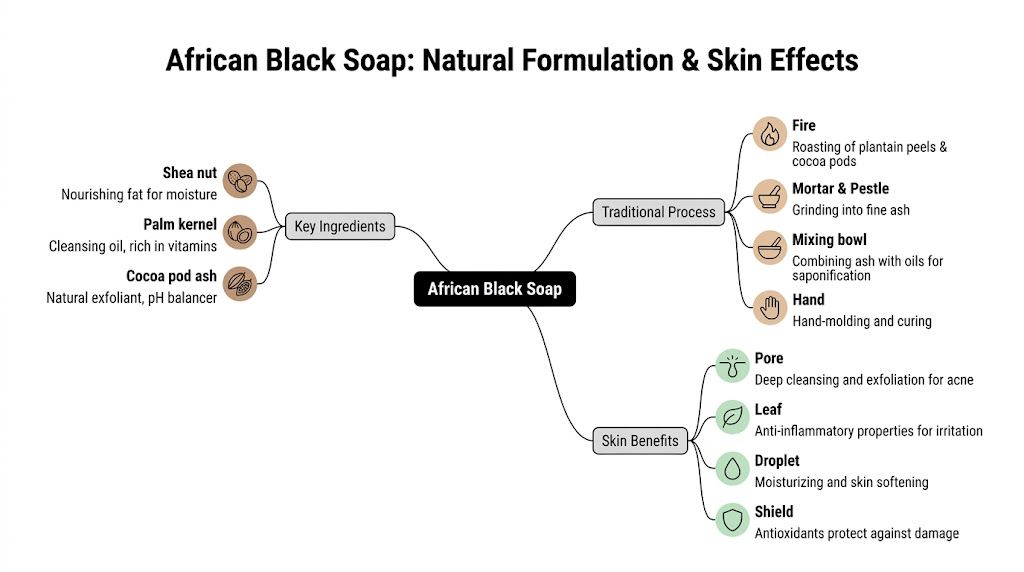
The easiest mistake with african black soap is to explain it as “just natural soap”. It isn’t. Its behaviour on skin comes from a specific combination of ash, oils, and suspended plant-derived matter. If you’re training pharmacy staff or spa therapists, that distinction matters because it helps them explain both the benefits and the limitations.
The soap’s best-supported functional explanation is a dual mechanism. Its ash-derived alkalinity and coconut oil’s lauric acid contribute antimicrobial activity against gram-positive pathogens such as Staphylococcal species, while fine ash particles and vitamin A from plantain skins support gentle exfoliation and skin renewal, as described in this PubMed-indexed discussion of african black soap’s antimicrobial properties.
What each material is doing
A good way to teach this is to treat the bar like a simple system with three jobs. It cleanses, it loosens surface build-up, and it leaves behind some lipid support from the oils and butters used in the formula.
| Ingredient | Primary Function | Key Compounds / Properties |
|---|---|---|
| Plantain skin ash | Cleansing and exfoliating support | Ash-derived alkalinity, vitamin A contribution, fine particulates |
| Cocoa pod ash | Cleansing support and texture | Polyphenolic compounds, ash structure |
| Coconut oil | Antimicrobial and cleansing support | Lauric acid, capric acid, fatty acid profile |
| Shea butter | Emollient support | Rich fatty phase, conditioning feel |
| Palm oil or palm kernel oil | Structure and cleansing support | Oleic and stearic acid contributions |
| Water | Enables ash dissolution and mixing | Supports saponification process |
This is also why a well-made bar feels different from a conventional syndet cleanser. It tends to lather less uniformly, may feel more “active” on first use, and often leaves the skin feeling very clean. Some clients love that. Others read it as stripping.
Why ash matters more than marketing
Many natural soap claims focus on oils because oils are easy to recognise and sell. With african black soap, the ash is central. Roasted plant matter creates the alkaline element that drives saponification and contributes to the bar’s cleansing character.
In practical terms, that ash does two things a Swiss client can feel. First, it helps break down oil and grime. Second, the fine suspended particles provide a mild physical exfoliating effect. That combination can be helpful for clients who complain that creamy cleansers leave residue or that scrub products feel too abrasive.
A useful staff analogy is this. Think of authentic african black soap as sitting between a cleansing bar and a light resurfacing wash. It isn’t a peel. It isn’t a polish. It’s a hybrid cleanser with some textural activity built in.
Why some skin types respond well
The formulation can suit clients who need a cleanser that feels clarifying without depending on synthetic antibacterial positioning. For acne-prone or congestion-prone users, the combination of ash-derived alkalinity and coconut oil’s fatty acid profile gives staff a credible way to explain why the product may feel particularly effective on oily zones.
For body use, that matters even more. Back, chest, and shaving-related roughness often respond well to cleansers that remove build-up decisively and leave less residue from heavy surfactant systems or film-forming additives.
A good african black soap usually performs best when the user wants a cleaner finish, not a plush after-feel.
Where formulation quality changes the experience
Not every bar behaves the same. The category includes traditional village-made bars, export-oriented artisanal bars, and commercial versions inspired by the tradition. The gap between them is wide.
What improves the user experience:
- Balanced oil phase: Enough shea butter or similar lipids to stop the bar feeling harsh.
- Fine ash dispersion: A smoother lathering feel and less scratchiness.
- Clear ingredient disclosure: Buyers can judge whether the bar reflects traditional materials or marketing shortcuts.
What usually weakens it:
- Heavy added fragrance: This can mask the earthy profile but raises irritation risk.
- Over-hardened, over-refined bars: These may lose the sensory cues that signal authenticity.
- Unclear processing: If the supplier can’t explain how the ash is made and incorporated, quality control is probably weak.
For Swiss professionals, the scientific value isn’t in turning african black soap into a miracle product. It’s in understanding why a traditional formula can still make sense in a modern assortment when the sourcing is disciplined and the usage advice is precise.
Proven Skin Benefits and Important Contraindications
A Swiss retailer usually sees the same pattern. A client asks for african black soap for acne, marks, or shaving bumps because social media has framed it as a natural fix. The right response is narrower and more useful. Match the product to the skin concern, explain the cleansing profile clearly, and rule out the clients who are likely to react badly.
Published dermatology literature supports that this soap is used for a range of concerns, including acne, post-inflammatory marks, razor bumps, and eczema, while user satisfaction can be high in the right group, as described in the Journal of Clinical and Aesthetic Dermatology survey on black soap attitudes and practices. For Swiss stockists, that matters less as a sales hook than as a reminder that demand is coming from real consumer behavior, not just trend language.

Where it tends to help
In practice, the strongest fit is with skin that tolerates active cleansing and benefits from less residue on the surface. I usually place african black soap in a clarifying category, not a comfort-cleansing one.
Three use cases make commercial sense:
- Blemish-prone skin: Some clients prefer a cleanser that cuts oil and rinse-off residue more decisively than creamy syndets or heavily conditioned washes.
- Post-breakout marks: A well-made bar can support a routine for uneven-looking skin, especially when the client also uses sunscreen and does not expect the soap itself to treat pigmentation.
- Shaving zones and rough body areas: Chest, back, neck, and ingrown-prone areas often respond better than delicate facial skin.
The trade-off is simple. The same cleansing strength that appeals to oily or congestion-prone users can push dry or reactive skin too far.
Who needs caution
This is the part many generic articles miss. African black soap is not automatically mild because it is traditional, plant-derived, or sold in an artisanal format. For a Swiss spa, boutique, or e-commerce retailer, poor candidate selection creates more problems than weak merchandising.
Use extra caution with:
- Highly reactive skin: Clients who already sting with water, fragrance, exfoliants, or basic cleansers often do poorly with ash-based soap.
- Compromised barriers: Skin under retinoid use, after peels, during dermatitis flares, or after aggressive acne routines usually needs lower-activity cleansing.
- Rosacea-prone or very dry skin: The product can leave these users feeling overly stripped, especially in heated indoor environments and alpine winter conditions.
- Clients seeking a treatment claim: Under Swiss cosmetics rules, including Ordinance SR 817.023.31, retailers should avoid drifting from cosmetic language into implied medical treatment for eczema, acne, or other skin disease states.
A careful recommendation protects both the client and the seller.
A short visual explainer can help staff show the product in context before recommending it widely.
Claims that work and claims to avoid
Claim discipline matters in Switzerland because the marketing risk is real. A product page, shelf talker, or staff recommendation that slips into therapeutic language can create compliance problems, especially if the product is also presented as natural, certified, or suitable for sensitive skin without qualification.
Safer wording includes:
- Clarifying cleanser for oily or congestion-prone skin
- Traditional ash-based soap with an exfoliating feel
- Suitable for some users seeking a cleaner finish and less residue
- Can be used on selected body areas prone to roughness or shaving-related bumps
Claims to avoid are just as clear:
- Promises to treat acne, eczema, fungal conditions, or razor burn
- Assurances that every authentic bar is gentle
- Implied suitability for daily facial use across all skin types
- “Hypoallergenic” or “dermatologist approved” language without proper substantiation
For retailers working with certified natural positioning, ECOCERT status on a finished product or ingredient set does not remove the need for restrained claims, full INCI transparency, and clear usage instructions.
The practical trade-off
African black soap earns its place in a curated Swiss assortment when it is sold with precision. It can suit clients who want a thorough, traditional cleanser and who tolerate a more active wash step. It performs poorly when sold as a universal facial soap, or when staff confuse popularity with broad suitability.
That is the commercial reality. Better client education usually reduces returns, irritation complaints, and unrealistic expectations.
Professional Usage Guidelines for the Swiss Climate
Usage advice for african black soap has to change when you’re selling in Switzerland. Generic online instructions usually assume moderate humidity and a broad consumer audience. They don’t address indoor heating, mountain air, or the reality that many clients already arrive with a fragile barrier from winter dryness.
The local concern is straightforward. African black soap may help some users with skin concerns such as eczema, which was reported by 7% of users in one study, but its performance in low-humidity conditions like a Swiss winter, where relative humidity can be below 40%, remains unstudied. Quality inconsistency may also increase irritation risk for sensitive or fair-skinned Central European users, as noted in this discussion of black soap use patterns and the Swiss-climate gap.
Start with a controlled introduction
The first recommendation should be restraint, not enthusiasm. Clients shouldn’t rub the bar directly onto the face. They should lather a small amount in wet hands, apply the lather, then rinse thoroughly.
A practical retail protocol looks like this:
- Patch test first: Use on a small area for several days before full-face use.
- Limit early frequency: Begin a few times per week rather than daily.
- Watch the response: Tightness that settles quickly may be manageable. Burning, prolonged redness, or flaking means stop.
- Reserve direct bar use for the body: Even then, gentle pressure matters.
This is the kind of instruction card that reduces returns.
Adapt the routine to season and skin type
In Swiss winter, a good cleanser can still fail if the rest of the routine is wrong. African black soap usually needs a compensating step after cleansing, especially for facial use.
Recommend pairing it with:
- Hydrating serum after cleansing: Humectant-led support helps reduce that over-cleansed feeling.
- Barrier cream or balm: Particularly useful at night or during ski season.
- Reduced exfoliation elsewhere: If the client uses acids, scrubs, or retinoids, one of those may need to be scaled back.
For spas, this matters in treatment design too. If african black soap is used in a clarifying back treatment or as a pre-cleanse for oily skin, the protocol should end with barrier-supportive hydration rather than a harsh astringent finish.
Professional rule: The drier the environment, the more african black soap should behave like a targeted product, not a default cleanser.
Match the soap to the right setting
Not every placement makes equal sense.
Best uses in Swiss practice
- Body cleansing for congestion-prone skin: Often easier for clients to tolerate than facial use.
- Targeted facial recommendation: Suitable for selected oily or combination skin clients with clear instructions.
- Occasional reset cleanser: Useful when clients want a deeper-feeling cleanse without making it their only wash.
Poor uses
- Twice-daily blanket recommendation: Too much for many users.
- Post-procedure skin: Avoid when the barrier is already stressed.
- Blind gifting without instructions: The bar needs explanation, not impulse placement.
Train staff to ask better questions
One of the simplest ways to improve outcomes is to change the sales conversation. Staff should ask:
- What cleanser are you using now, and does your skin feel tight after washing?
- Do you use acids, retinoids, or benzoyl peroxide already?
- Is your concern oiliness, roughness, marks after blemishes, or general sensitivity?
- Do you want this for the face, body, or both?
These questions turn african black soap from a trend-led purchase into a professionally matched recommendation. That’s where repeat sales come from.
Navigating Quality, Ethics, and Swiss Regulations
For Swiss distributors, the biggest mistake isn’t choosing the wrong marketing angle. It’s assuming that a handmade product with a strong ethical story can bypass the normal discipline of cosmetic compliance. It can’t.
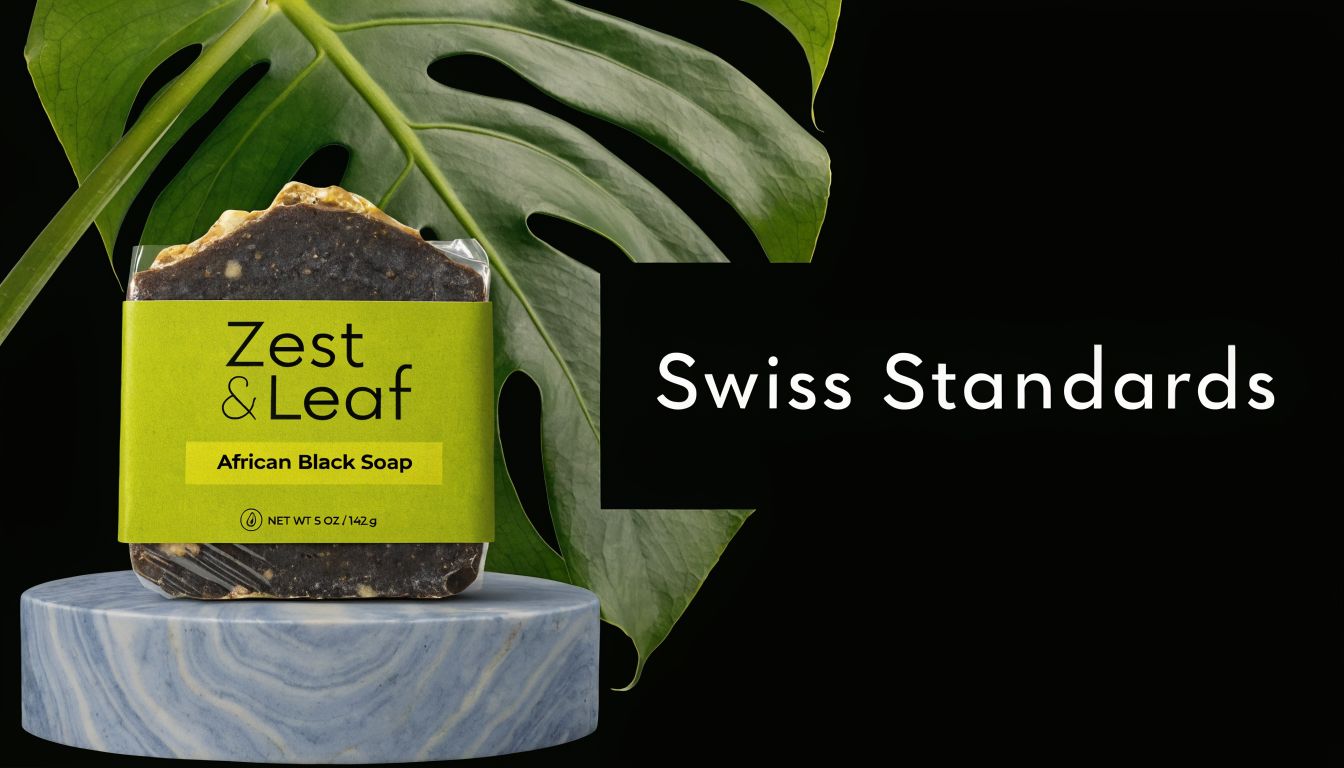
A key challenge is that handmade african black soap formulations must still meet strict EU and Swiss cosmetics requirements, including Ordinance SR 817.023.31, for ingredient labelling and safety. Validated safety dossiers for traditional products are often rare, which creates real non-compliance risk if a supplier can’t provide proper documentation, as outlined in this market analysis discussing compliance gaps for african black soap.
What Swiss buyers should demand before listing
If a supplier says the product is “authentic” but can’t support it with paperwork, authenticity becomes a liability. Swiss buyers should expect a documentation pack that matches the seriousness of the channel.
At minimum, review:
- Full ingredient listing: Not a folklore summary, but a proper INCI-compatible disclosure where applicable.
- Batch traceability: Handmade doesn’t excuse weak record-keeping.
- Safety documentation: If the supplier can’t provide a dossier or equivalent technical file, stop there.
- Microbiological and contaminant controls: Especially important for ash-based, variable formulations.
- Claims review: Packaging and online copy should avoid medicinal drift.
This is particularly important for pharmacies and dermatology-adjacent retail. Those channels attract more informed questions and less tolerance for vague answers.
ECOCERT, fair trade, and what certification can and can’t do
Certifications such as ECOCERT can improve buyer confidence, especially where ingredient origin, processing discipline, and ethical sourcing matter. But certification is a support tool, not a substitute for your own due diligence.
In practice, certification helps answer three useful questions:
| Question | Why it matters | What to verify |
|---|---|---|
| Was the product made within a recognised framework | Supports sourcing credibility | Current certificate scope and entity name |
| Are raw materials handled transparently | Reduces greenwashing risk | Supplier declarations and chain of custody |
| Does the brand understand export expectations | Signals operational maturity | Labelling, documentation, and audit readiness |
Swiss buyers should also think beyond cosmetics alone. Broader consumer trust increasingly depends on how brands talk about materials, packaging, and safety. The wider conversation around ethical sourcing and material safety debates shows why shoppers now expect evidence, not just values-led language.
How to spot products that will create trouble
The most troublesome african black soap listings often share the same warning signs:
- No clear country-of-origin explanation
- Ingredient list that reads like a lifestyle caption
- Strong perfume added to mask an unstable base
- Claims that sound medicinal
- No answer when you ask about heavy metal limits or microbial safety
A product doesn’t need to be industrial to be compliant. It does need to be documented.
If the supplier’s story is detailed but the paperwork is thin, you’re buying risk with attractive branding.
Merchandising and education rules that protect the business
Once you’ve sourced well, the next risk is misuse at retail level. African black soap needs stronger guidance than many conventional cleansers.
Use practical shelf and staff rules:
- Position it as selective, not universal: This reduces disappointment.
- Add usage directions at point of sale: “Lather in hands first” is a small instruction with a big effect.
- Train staff on contraindications: Especially winter dryness and over-exfoliation.
- Keep the heritage intact: Explain the origin respectfully. Don’t turn it into an abstract “tribal” aesthetic.
For Swiss spas, I’d also recommend treatment-room testing before retail launch. Let therapists use the bar on hands, forearms, or selected body protocols first. If the product is hard to work with in a professional environment, clients will struggle even more at home.
Conclusion The Opportunity in Authentic, Ethical Skincare
A Swiss retailer can bring in an excellent African black soap bar and still create complaints within weeks if the launch is handled loosely. I have seen that happen when a product with strong heritage and genuine appeal is placed on shelf without the same discipline applied to any other cosmetic line sold under Swiss rules.
African black soap earns its place in a curated assortment when buyers treat it as a category that needs control, not novelty. For the right client, it can answer a clear demand for traditional cleansing, low-fragrance formulas, and culturally grounded products. For the wrong client, or under poor retail guidance, it can also lead to dryness, overuse, and avoidable returns, especially in the Swiss winter and at altitude.
That is why the commercial opportunity is tied to execution. Swiss distributors, pharmacies, spas, and boutiques need supplier files that stand up to review under Ordinance SR 817.023.31, claims that stay cosmetic rather than medicinal, and product presentation that respects origin instead of reducing Ose Dudu to packaging aesthetics. If a brand also carries third-party markers such as ECOCERT where relevant, that can support credibility, but it does not replace batch documentation, safety assessment, or staff training.
Good results come from selective ranging. Position the soap for informed use. Explain who should start slowly, who may be better with a milder cleanser, and how frequency should change in cold, dry months. That approach sits comfortably within wider ethical skincare practices, where sourcing, cultural accuracy, and formulation honesty matter as much as shelf appeal.
For buyers working through these decisions, partners like beautysecrets.agency offer a compliance-aware, sourcing-focused lens that fits the Swiss market. Used well, African black soap can strengthen a portfolio with something distinctive and credible. It rewards careful buying, careful wording, and careful client education.