You’re ready to launch in Switzerland. The formulas are strong, the packaging looks premium, and the brand story worked in other markets.
Then the friction starts. Retailers ask different questions in Zurich than they do in Geneva. A pharmacy buyer wants proof, not mood boards. A spa director loves the texture but worries the story won’t translate to her clientele. Your e-commerce partner asks for cleaner claims, sharper copy, and local relevance. Nothing is broken. But nothing can stay generic.
That’s where a real go to market plan for Switzerland matters. Not the usual template built for a large, homogeneous market. Switzerland rewards brands that localise early, respect regulation, and understand that channel strategy is as much about trust as it is about reach.
Decoding the Swiss Clean Beauty Consumer
A founder lands in Zurich expecting one clean beauty audience and leaves with three retailer briefs, two claim questions, and a list of regional objections that did not show up in France or Germany. That happens often in Switzerland. The market is small, but buyer behaviour is split by language, channel, and trust model.
The population itself is segmented by language. The Swiss Federal Statistical Office reports that Swiss residents use German or Swiss German most widely, followed by French and Italian, with Romansh present on a smaller scale, which has direct implications for packaging, sampling scripts, and sales arguments by region (Swiss Federal Statistical Office language data). In practice, I do not advise brands to treat translation as localisation. A French-speaking pharmacy client in Vaud does not respond to the same proof points as a German-speaking pharmacy team in St. Gallen, even when the INCI list is identical.
One country, three buying mindsets
In the German-speaking cantons, skincare usually sells best when the logic is easy to defend. Buyers want to know what the product does, why the formula works, and where the claim boundaries sit. This is especially true in pharmacies, where staff need language they can repeat with confidence. Soft wellness wording on its own rarely carries enough weight.
In the French-speaking cantons, the purchase decision is often more presentation-sensitive. Texture, fragrance, ritual, and brand world matter more at the shelf and in the treatment room. Efficacy still matters, but it needs a more refined expression. The same serum may need a more technical script in Zurich and a more sensorial one in Geneva.
Ticino is different again. Relationship quality matters more there than many foreign brands expect. Standard distributor decks tend to feel too generic. A curated assortment, local training, and founder presence can have an outsized effect because the market is smaller and word-of-mouth travels quickly.
Swiss consumers are open to international brands. They screen hard for local relevance.
Sustainability is not a generic claim here
In Switzerland, “natural” is a starting point, not a positioning strategy. Buyers in pharmacies and premium retail are used to seeing brands overstate purity, origin, or ecological virtue. They test for consistency fast. If a brand highlights botanical sourcing, refillability, or responsible production, the team reviewing it will look for the evidence across certification, packaging choices, staff education, and claims language.
That is why ECOCERT can support trust, while Bio Suisse often carries a different type of meaning in the Swiss buyer's mind. ECOCERT is familiar in beauty. Bio Suisse is rooted in the broader Swiss organic standard and often signals local seriousness more than cosmetic glamour. A natural skincare brand does not need every possible label, but it does need a clear explanation of what it meets, what it does not, and why. Ambiguity creates hesitation, especially in pharmacy chains and better independent doors.
I usually advise brands to segment Swiss consumers by trigger, not age bracket. Useful frameworks like these customer segmentation techniques help structure that work. In Switzerland, the segments that matter most are usually:
- Trust channel. Pharmacist recommendation, spa therapist endorsement, or self-directed digital research.
- Proof standard. Ingredient transparency, third-party certification, clinical support, or all three.
- Usage context. Daily maintenance, targeted treatment, gift purchase, or cabin-friendly travel care.
- Regional language behaviour. Not just the language used, but the tone and sales framing expected.
The strongest opportunities are often outside the obvious postcodes
Many new entrants focus first on Zurich, Geneva, and online premium retail. Those channels matter, but they are crowded and expensive to activate well. Some of the steadier early wins come from smaller pharmacy groups, owner-led apotheken, and spa partners in cantons where trust is still built face to face.
I have seen brands perform better in semi-rural pharmacies than in polished urban retail because the staff took time to explain the formula, the founder story felt credible, and the merchandising was adapted to local routines. In places like Appenzell Innerrhoden, Uri, or parts of Valais, human recommendation can still outperform paid traffic for a young clean beauty brand. Generic GTM playbooks miss that because they are built around scale before credibility.
What your research needs to answer before launch
Before approaching Swiss partners, get clear on these points:
| Research area | What you need to know |
|---|---|
| Regional fit | Which claims, visuals, and product stories work in German, French, and Italian-speaking cantons |
| Trust driver | Whether conversion is more likely through pharmacy authority, spa recommendation, or digital education |
| Certification relevance | How ECOCERT, organic standards, and Swiss sustainability expectations will be interpreted by buyers |
| Routine role | Whether the hero SKU is a daily staple, treatment add-on, seasonal product, or giftable item |
| Purchase path | Where discovery happens, who validates the choice, and where the transaction actually closes |
Strong formulas help you get ranged. Swiss consumer understanding is what gets repeat sales.
Building Your Swiss Market-Entry Foundation
A launch can fail before the first sales call if the product isn’t ready for Swiss scrutiny. This is the part many founders rush because it feels administrative. It isn’t. It shapes whether buyers trust you, whether your stock can be listed correctly, and whether your claims hold up once a product reaches shelf, screen, or treatment room.
Compliance is part of positioning
In Switzerland, compliance doesn’t sit in a back-office folder. Buyers read it as a signal of seriousness.
A pharmacy team wants to know whether your labelling is complete and intelligible. A premium retailer wants fewer headaches with pack changes, translations, and claims disputes. A spa partner wants confidence that treatment-facing communication won’t create unnecessary risk. If your back labels, instructions, or marketing descriptions feel improvised, the brand reads as immature.
Use a launch checklist early. Don’t wait until cartons are already produced.
What to prepare before you approach partners
Start with the product file. Every SKU should have a clean internal record that includes formulation details, ingredient list, intended use, warnings, certification documentation, and approved claims. Keep one master version. Version confusion is one of the fastest ways to create listing delays.
Then review packaging for Swiss retail reality:
- Language readiness. Switzerland often requires multi-language practicality. Even when legal specifics vary by product context and route to market, buyers expect the product to be understandable in the market where it’s sold.
- Claims discipline. “Natural”, “clean”, “repairing”, “soothing”, “anti-ageing”, and “dermatologically respectful” all need internal substantiation and consistent wording.
- Importer and distributor information. Trade partners need clarity on who is responsible for the product in-market.
- Usage clarity. If a consumer can misuse the product because instructions are vague, the problem becomes commercial as well as regulatory.
Practical rule: If your sales deck promises more than your packaging can safely support, fix the sales deck first.
Certifications need interpretation, not just logos
A brand often assumes a known international certification will explain itself. It won’t. In Switzerland, logos help, but context sells. Your team should be able to explain what ECOCERT covers, what it doesn’t cover, and how that connects to the product’s sourcing and formulation choices.
The same applies to cruelty-free positioning. If you reference alignment with PETA or Cruelty Free International standards, make sure the wording is consistent across trade sheets, product pages, and staff training notes. Buyers notice when one version says “vegan”, another says “not tested on animals”, and a third says “ethical”. Those are not interchangeable.
Swiss regulatory and compliance checklist for skincare brands
| Compliance Area | Requirement/Action | Status (To-Do/In Progress/Complete) |
|---|---|---|
| Product dossier | Prepare complete technical and commercial file for each SKU | To-Do |
| Ingredient review | Verify INCI accuracy across all packaging and digital listings | To-Do |
| Claims substantiation | Match every marketing claim to internal support documents | To-Do |
| Language adaptation | Review packaging, instructions, and trade materials for Swiss market usability | To-Do |
| Certification proof | Organise current ECOCERT or related documentation and usage rights | To-Do |
| Cruelty-free messaging | Standardise approved wording across channels | To-Do |
| Responsible entity details | Confirm importer or market-responsible information is correctly shown where needed | To-Do |
| Packaging readiness | Check batch coding, shelf-life references, and warning visibility | To-Do |
| Logistics setup | Align shipping, warehousing, and retail fulfilment process before first order intake | To-Do |
| VAT and customs workflow | Confirm import process, landed-cost logic, and invoice handling with finance partners | To-Do |
| Sales materials review | Remove unsupported claims from decks, leaflets, and digital ads | To-Do |
| Staff briefing | Train sales and account teams on what can and can’t be said in market | To-Do |
Product-market fit also shows up in the pack architecture
Swiss buyers tend to respond well to range clarity. Too many SKUs at launch create confusion. Too few, and the line feels incomplete. The better route is usually a disciplined opening assortment with clear routine logic.
A strong initial assortment often includes:
- A hero that explains the brand quickly.
- A repeat-purchase staple that supports everyday use.
- A trade-up item for premium positioning.
- A discovery format that lowers hesitation.
This isn’t about shrinking ambition. It’s about making the first order easier for the buyer and the first recommendation easier for staff.
What often goes wrong
The most common mistakes aren’t glamorous. They are operational.
- Overclaiming on efficacy without tightening the wording.
- Late translation work that leaves different text on pack, outer carton, and website.
- Packaging built for another market and only partially adapted.
- Too many certifications shown without explanation, which creates clutter rather than trust.
- No internal approval chain for trade copy, social copy, and retailer descriptions.
The Swiss market is forgiving of a new brand. It is not forgiving of sloppiness. If your foundation is organised, the go to market process moves faster because buyers spend less time solving your problems for you.
Crafting a Multi-Channel Strategy for Switzerland
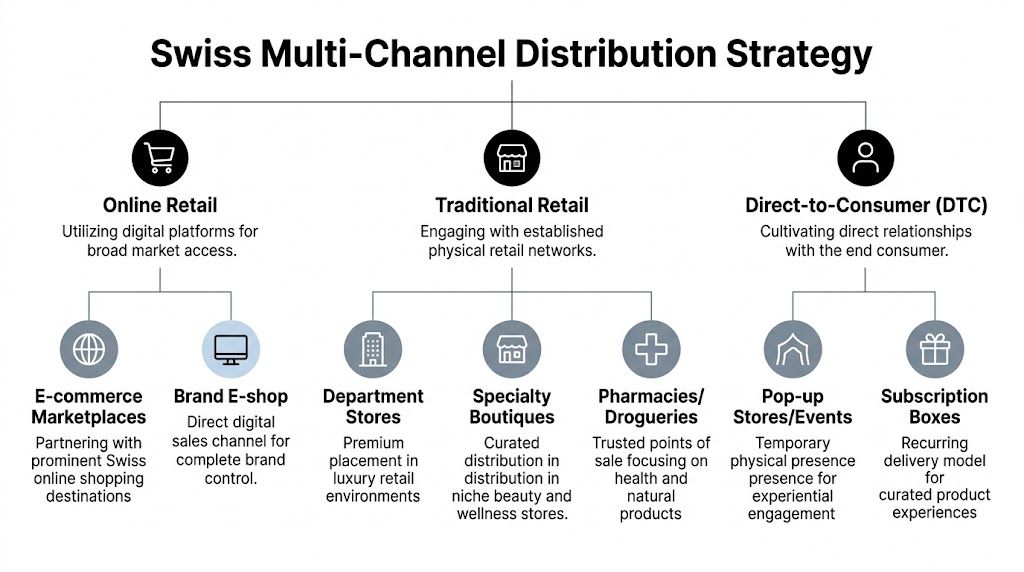
A new natural skincare brand can look perfectly positioned on paper, then stall in Switzerland within the first three months because it chose the wrong first door. I see this often. A founder wants pharmacy credibility, spa prestige, selective retail visibility, and direct-to-consumer sales from day one. Swiss buyers usually read that as lack of focus.
Channel strategy in Switzerland is about fit. It is also about regional behaviour. A pharmacy recommendation in Zurich does not work the same way as a spa-led introduction in Vaud, and a German-language product story that feels clear in Basel can feel too clinical for a boutique partner in Geneva. The market is small, but it is fragmented. Canton habits, language, and retailer expectations shape how a brand should enter.
Why pharmacy often anchors the launch
For natural beauty, pharmacy and droguerie remain some of the strongest trust environments in Switzerland. They matter because they reduce perceived risk. If a customer is trying a new facial oil, barrier cream, or sensitive-skin cleanser, the recommendation from a trained advisor often matters more than a polished brand story.
That matters even more for brands carrying natural or organic credentials. ECOCERT, COSMOS, NATRUE, or Bio Suisse signals can help, but they do not sell on their own. Staff still need to explain what the formula does, who it is for, and why it deserves space next to established lines.
Comparing the main channel options
| Channel | Best for | Strengths | Trade-offs |
|---|---|---|---|
| Pharmacies and drogueries | Efficacy-led natural skincare, sensitive skin, certified lines needing explanation | High trust, recommendation-based selling, good fit for education and repeat routines | Slower listing process, stricter buyer scrutiny, staff training must be ongoing |
| Spas and hotels | Ritual-led face and body care, sensorial products, treatment-linked aftercare | Strong premium perception, trial through treatment, better storytelling around texture and experience | Sell-through depends on therapist buy-in, cabin protocol, and retail follow-up |
| Premium retail and boutiques | Lifestyle brands, gifting ranges, visually distinctive lines | Visibility, curated placement, stronger impulse and seasonal opportunities | Shelf competition is high, and weak differentiation gets exposed fast |
| E-commerce partners | Search-led discovery, educated repeat buyers, niche assortment extensions | Faster testing, easier content updates, broad geographic reach | Price comparison is immediate, and trust is harder to build without offline support |
| Brand-owned DTC | Story control, bundles, sampling, retention programmes | Full control over message, customer data, and launch timing | Customer acquisition is expensive in Switzerland, especially without local retail proof |
Choose the first channel by proof, not ambition
The first Swiss channel should match the brand’s strongest selling logic.
If the line solves a clear skin concern, pharmacy usually gives the cleanest route. If the products are treatment-friendly and sensorial, spa can build stronger early advocacy. If the brand wins on design, gifting, and lifestyle identity, selective retail may be the better first test. DTC works best once the brand already has some local recognition or a founder community that can convert without touching the product first.
I rarely recommend launching every channel at once. The operational load is too high. Each door needs different education, margin logic, visuals, and assortment discipline.
What actually works in pharmacy
Pharmacy buyers in Switzerland are pragmatic. They want to know how quickly staff can understand the line, how cleanly the hero products fit into an existing recommendation flow, and whether the claims are tight enough for a regulated environment.
The brands that perform well usually have:
- A clear recommendation sentence for each hero SKU
- Pack copy that supports a quick counter conversation
- A small opening assortment that covers a routine without creating dead stock
- Training material in the right language for the region
- Certification language that is accurate and easy for staff to explain
This last point gets mishandled often. A buyer in German-speaking Switzerland may expect precise formulation language and direct efficacy framing. In Romandie, the same line may need a softer, more sensorial presentation without losing credibility. The formula stays the same. The sales argument should be adjusted.
What actually works in spas
Spa is a different commercial model. Treatment performance matters first. Retail comes second, but it only follows if the therapist believes the products improve the cabin experience and make sense as aftercare.
For Swiss spas, I look at five questions early:
- Does the texture perform well in treatment?
- Is the fragrance profile acceptable across an international guest base?
- Can the treatment protocol be taught quickly?
- Is there an obvious retail handover after the service?
- Will the brand sit naturally beside the spa’s existing positioning?
A line can succeed in high-end spas around St. Moritz or on Lake Geneva and still struggle in pharmacies because the product story is too ritual-led. The reverse happens too. A very functional, results-led line can reorder well in pharmacies and feel cold in a spa room.
A channel strategy breaks when every partner receives the same assortment, the same visuals, and the same selling script.
Multi-channel in Switzerland should be staged
The strongest launches expand in sequence. They do not chase visibility everywhere.
A practical rollout usually looks like this:
- Start with one anchor channel in one language region.
- Refine training, reorder rhythm, and hero SKU performance there first.
- Add a second channel with a different job, such as spa for treatment trial or e-commerce for replenishment.
- Expand by region once the message works locally, not before.
Switzerland is not one audience. Zurich, Zug, and Basel often reward clarity, routine, and ingredient confidence. Geneva and Lausanne usually need stronger attention to brand world, texture, and presentation. Ticino can respond well to Mediterranean sensorial cues, but the price-to-perceived-value balance still has to hold. A generic European GTM plan misses these nuances, and the wrong sequencing makes every later listing harder.
Early signs the first channel is wrong
The warning signs show up quickly if you know where to look:
- Staff hesitate when explaining who the line is for.
- Buyers like the concept but cannot place it clearly in their store or treatment menu.
- One hero SKU gets sampled, but the routine does not convert.
- Reorders come from only one product type, which usually means the assortment-channel fit is off.
- Online traffic is interested, but offline partners are not confident enough to recommend.
A good Swiss multi-channel plan gives each route a job. Pharmacy builds trust and recommendation. Spa builds ritual and trial. Retail builds visibility. DTC and e-commerce support education, replenishment, and retention. Once those roles are defined properly, expansion becomes much easier to control.
Pricing Merchandising and Partner Enablement
A signed retail agreement doesn’t mean you’ve won. It means you’ve earned the chance to prove the brand can move.
Too many launches treat distribution as the finish line. In Switzerland, the test starts after the first delivery lands. If pricing is clumsy, if the shelf presence is weak, or if partner staff don’t know how to speak about the products, even a strong formula stalls.

Price is a positioning tool first
Swiss consumers are used to premium pricing, but they still assess fairness fast. They ask whether the formula, pack, origin story, certification signals, and retail context all match the shelf price. If one element feels thin, the price starts looking inflated.
That’s why price setting should begin with channel reality, not founder ambition. A pharmacy line can justify a premium when the recommendation logic is clear and the clinical or natural rationale is well supported. A spa line can stretch further when treatment experience and aftercare connection are strong. A boutique line often needs stronger visual desirability to sustain the same level.
Work backwards from the final retail environment:
- What margin structure will the channel expect?
- What price architecture fits neighbouring brands without copying them?
- Can the hero SKU carry first-trial conversion?
- Does the range allow step-up purchases, or is every item fighting at the same level?
If every SKU feels expensive, nothing feels special.
Merchandising decides whether the story gets noticed
In Swiss pharmacy and selective retail, shelf space is disciplined. Your line won’t get infinite room to explain itself. The display has to do quiet, efficient work.
The strongest merchandising usually has these traits:
- Immediate category clarity. The shopper knows whether this is facial care, body care, mother and baby, treatment support, or ritual-led wellness.
- One visual hierarchy. Hero products lead. Supporting products follow.
- Readable proof cues. Certifications, ingredient highlights, and key routine benefits appear fast, without overcrowding.
- Testing logic. Where the format allows it, the shopper can smell, feel, or compare with minimal friction.
A common mistake is overdesigning for brand mood and underdesigning for decision-making. Beautiful display units can still fail if the shopper can’t understand what to buy first.
Partner training is where sell-through is won
A pharmacy assistant, spa therapist, or boutique adviser won’t become your advocate because you dropped off a PDF. They become effective when the training is practical, repeatable, and easy to use in live conversations.
The partner doesn’t need your full brand history. They need enough confidence to recommend the right product to the right person without hesitation.
That means training should cover:
Who the line is for
Give staff the core customer profiles, common concerns, and the best entry product.How to recommend
Offer simple scripts. Not memorised speeches. Short diagnostic prompts and clear product pairings.What makes the line different
ECOCERT, sourcing quality, alchemical approach, marine actives, or fresh-pressed oils become commercial tools rather than abstract features.How to handle objections
Staff should know what to say when someone asks whether the price is justified, whether the fragrance is natural, or whether a balm is suitable for multiple uses.How to build the basket
A cleanser without a companion serum or balm recommendation leaves value on the table.
Better enablement creates better brand perception
This isn’t just about sales. It changes how the brand is perceived in store.
When staff speak with confidence, the product feels established. When they hesitate, the line feels risky. Consumers pick up that difference instantly. In premium natural beauty, confidence transfer matters. The customer often buys because a trusted human translated the brand into a personal recommendation.
A simple partner enablement pack
Build one. Keep it tight.
| Asset | Purpose |
|---|---|
| One-page brand brief | Gives the commercial team and store staff a shared summary |
| Hero SKU card | Explains top product, ideal user, and recommendation script |
| Ingredient proof sheet | Translates technical formulation into customer-facing language |
| Objection handling guide | Helps staff answer common concerns cleanly |
| Merchandising guide | Shows how products should be placed and grouped |
| Launch calendar | Keeps promotions, sampling, and training aligned |
If a partner has to invent the selling story, the brand becomes inconsistent door by door. Strong go to market execution depends on making the sale easier for the people already closest to the customer.
Activating Your Brand Launch and Driving Sell-Through
A Swiss launch rarely succeeds because of one dramatic campaign. It succeeds because several small, well-timed moves reinforce each other. The shelf looks credible. Staff are prepared. Sampling reaches the right hands. Press coverage sounds local, not imported. The customer sees the brand more than once, in more than one context, and the story stays consistent.
That’s what launch activation should do. It should turn distribution into demand.

What a good launch month actually looks like
Week one is usually quiet from the outside. Internally, it’s where discipline matters most. Product pages go live. Retail partners receive launch assets. Staff briefings happen close to shelf date, not weeks too early when the information will be forgotten. Sampling stock is assigned deliberately, not scattered.
By week two, the brand should be visible in the places that match its credibility. For a pharmacy-led launch, that means recommendation-led content, not influencer noise. For a spa-led line, the first traction often comes from treatment integration, therapist advocacy, and selective post-treatment follow-up rather than broad digital spend.
By week three, you start looking for friction. Which questions keep surfacing? Which hero SKUs get interest but not basket completion? Which store teams are engaged, and which need another visit? A launch that listens early performs better than one that insists the original calendar must be followed regardless of feedback.
Sampling needs intent
Many brands waste product in Switzerland by treating sampling as a volume exercise. Better sampling is selective.
Good sampling often sits in one of these formats:
- Pharmacy hand-sell samples tied to a clear recommendation scenario
- Spa treatment samples linked to aftercare conversion
- Editorial and PR seeding with a focused product story
- DTC trial bundles for shoppers who need lower-risk entry
The sample should answer a specific barrier. If the main hesitation is texture, use a trial sachet or mini. If the hesitation is trust, pair the sample with pharmacist or therapist guidance. If the product needs ritual understanding, sampling without instructions won’t do enough.
PR and local relevance still matter
Swiss beauty editors, buyers, and selective creators tend to respond better when a brand sounds grounded and market-aware. Generic “global luxury clean beauty” copy usually disappears into the background.
The press material should feel built for Switzerland. That means tighter claims, cleaner proof points, and language that respects local retail logic. If your team needs a reference format for structure and tone, this press release example for a product launch is a useful starting point for shaping a release that reads clearly and doesn’t overcomplicate the announcement.
Launch publicity should never promise an experience the first retail visit can’t deliver.
In-store events should create conversion, not theatre
Events work well in Switzerland when they are compact, useful, and tied to recommendation. A demonstration day in a pharmacy, a treatment-focused retail afternoon in a spa, or a targeted boutique consultation event can all perform strongly if the staff know what they are driving toward.
The event should answer four operational questions:
- Who is invited?
- What product or routine is being featured?
- What should the attendee do next?
- How will follow-up happen?
Without those answers, events become brand decoration.
A practical launch rhythm
A dependable launch rhythm often includes:
| Launch activity | Purpose |
|---|---|
| Staff refresher training | Keeps recommendation quality high at shelf date |
| Localised digital posts | Reinforces store availability and brand relevance |
| Small-scale sampling | Reduces hesitation and supports first purchase |
| Trade partner event day | Creates footfall and gives staff a reason to engage |
| PR outreach | Builds credibility beyond the point of sale |
| Early feedback review | Improves message, assortment focus, and support |
The first month isn’t about proving the brand is famous. It’s about proving the brand is understandable, recommendable, and worth reordering. In Swiss natural beauty, that’s what drives sell-through.
The First Year Roadmap KPIs and Checklists
A go to market plan is only useful if it survives contact with the market. The first year in Switzerland should be managed as a sequence of decisions, not a single launch event with a long echo.
Most brands either overreact to the first weak month or relax too early after a strong opening. Both are mistakes. The better approach is to review progress on a fixed rhythm, using a small set of commercial and operational indicators that matter.
The KPIs worth watching
For a new skincare brand in Switzerland, the most useful KPIs are usually practical rather than flashy.
Track these closely:
Sell-through by door
Which partners are converting stock into consumer sales, and which are only holding inventory?Reorder frequency
Reorders tell you more than opening orders ever will. They show whether the line has found its place.Assortment productivity
Which SKUs are carrying the range, and which are taking space without earning it?Channel profitability
Not every active channel is a healthy channel. Some doors create noise without margin.Sampling-to-sale feedback
Are trial mechanics leading to purchase, or just draining stock?Training coverage and partner engagement
Which teams completed training, asked follow-up questions, and actively recommended the line?Claim-related friction
Any repeated confusion around usage, efficacy, positioning, or certification language must be fixed fast.
Day 1 to 90
The first three months are about proof of fit. Don’t expand too quickly.
Priority checklist
- Audit all live listings so the product descriptions, images, certifications, and claims match the approved brand language.
- Visit or review first doors manually to see how the brand appears in real conditions.
- Collect frontline questions from pharmacy teams, spa therapists, and retail staff.
- Identify hero SKU reality. The item you expected to lead may not be the one customers choose first.
- Review sample usage and stop any format that creates attention without conversion.
- Correct weak merchandising before assuming the product itself is the issue.
A useful internal meeting at this stage is not “How do we scale?” It’s “What friction keeps repeating, and who owns fixing it?”
Day 91 to 180
This period is where many brands become clearer. By now you can see whether the issue is product, message, price architecture, or channel mismatch.
| Focus area | Questions to answer by 180 days |
|---|---|
| Channel quality | Which channel is creating the healthiest reorder pattern? |
| Team readiness | Which partner teams need retraining or simplified tools? |
| Assortment logic | Should any SKU be paused, bundled, or promoted differently? |
| Localisation | Does language or messaging need regional refinement? |
| Commercial support | Which partner deserves deeper activation investment? |
If the line only sells when your own team is physically present, the system isn’t working yet.
Second-phase actions
- Tighten the assortment where performance is uneven.
- Rebuild underperforming product pages with clearer recommendation logic.
- Concentrate support on responsive partners instead of spreading effort thinly.
- Refresh staff materials using real objections gathered in the market.
- Decide whether expansion is earned or whether the current footprint needs more depth first.
Day 181 to 360
By the second half of the year, the launch phase should become a managed business. You’re no longer testing whether the brand belongs in Switzerland. You’re deciding how to deepen it.
This is the point to assess:
- Which canton or language region is responding most clearly
- Whether the first channel should remain the lead channel
- Which partners are ready for larger assortment commitment
- Whether the brand has enough proof for broader retail conversations
- Which activation formats deserve repeating next year
The most productive annual review usually combines commercial, retail, and brand questions in one document.
Year-one review list
- Top-performing doors identified with reasons, not just rankings
- Top-performing SKUs explained by use case and channel
- Weak points in onboarding that slowed partner adoption
- Messaging gaps that caused confusion
- Merchandising lessons from the strongest displays
- Training formats that created the best recommendation quality
- Year-two expansion options based on evidence, not optimism
The hidden KPI is operational consistency
A brand can look promising while still underperforming because the system around it is inconsistent. Swiss partners notice late deliveries, mixed claims, missing samples, outdated PDFs, or uneven account follow-up. Those details shape confidence.
That’s why the first year should be judged on two levels. Consumer response matters. But partner confidence matters too. If buyers trust your execution, they are more willing to test more doors, broader assortments, and stronger visibility support.
A Swiss launch becomes sustainable when the commercial story, the regulatory discipline, the training, and the sell-through data all start pointing in the same direction. That’s when go to market stops being a launch project and starts becoming a repeatable operating model.
If you’re preparing a natural skincare brand for Swiss pharmacies, spas, retail, or premium e-commerce, beautysecrets.agency can help you turn that plan into a market-ready launch. The team brings Swiss distribution knowledge, clean beauty category expertise, and hands-on support across assortment selection, partner outreach, compliance positioning, and trade activation.