A customer steps up to the pharmacy counter before work, points to the under-eye area, and asks for “something that works”. In a spa boutique, the same request sounds slightly different: “I need to look less tired by tomorrow.” In premium retail, it often becomes: “Which eye cream is worth the price?”
That question puts pressure on your team because the eye area is emotional territory. Customers want a visible result, quickly, but they also want safety, gentleness, and credibility. In Switzerland, they expect all three at once.
Caffeine eye cream deserves attention because it sits at the intersection of science, sensorial appeal, and strong merchandising potential. It answers a common complaint, fits neatly into anti-fatigue and anti-ageing routines, and gives staff an easy, evidence-based story to tell. But the category only performs well when retailers understand what caffeine can do, what it can’t do, and how formulation quality changes the customer experience.
Introduction Why Caffeine Eye Cream Demands Your Attention
Swiss retail partners are dealing with a skincare customer who is more informed than ever. She reads ingredient lists, asks about certifications, and wants results without irritation. That makes caffeine eye cream more than a trend item. It becomes a test of whether your assortment is curated or merely stocked.
For pharmacies, the category works because it addresses a visible concern that shoppers raise frequently. For spas and wellness locations, it fits the anti-fatigue ritual beautifully. For premium e-commerce, it offers a clear problem-solution product page with strong educational value.
The main opportunity isn’t just selling one jar or one tube. It’s using caffeine eye cream to demonstrate expertise. A staff member who can explain puffiness, dark circles, texture, and formulation differences in plain language will earn trust faster than one who only points to a “best seller”.
Retail reality: Customers rarely ask for caffeine because they understand the mechanism. They ask because they want to look fresher. Your job is to translate ingredient science into a believable recommendation.
That means knowing the science, but also knowing where Swiss expectations are highest. Clean beauty claims need substance. Premium pricing needs justification. And any under-eye product needs careful positioning because the skin in that area is delicate, visible, and unforgiving of poor formulas.
The Core Science How Caffeine Works on a Cellular Level
A customer in a Swiss pharmacy often points to the eye area and says one of two things: “I look tired,” or “Nothing seems to help these bags.” Your staff needs a sharper explanation than “caffeine wakes up the skin,” because that phrase sells the product poorly and creates compliance risk.
Caffeine acts through a few practical cosmetic pathways, and the first is the easiest to explain at shelf level. It has a vasoconstrictive effect, meaning it can narrow small visible blood vessels for a time. Under the eyes, where skin is especially thin, that matters. Less visible vascular congestion can mean a fresher-looking contour and reduced visible puffiness, particularly in the morning.
The garden-hose comparison is useful here. Small vessels under delicate skin behave a bit like hoses under a thin sheet. If flow is more apparent, the area can look darker or more swollen. If that appearance is reduced for a period, the eye area often looks calmer and brighter.

What happens in the skin
For retail training, the key distinction is cosmetic improvement versus structural change. Caffeine can improve the look of fatigue-related puffiness and some forms of under-eye darkness linked to visible circulation. It does not remodel bone structure, fill tear troughs, or erase inherited pigmentation patterns.
That distinction protects margin and credibility. A premium eye cream can perform well and still be the wrong recommendation for a customer whose concern is anatomical rather than fluid-related.
Published research on topical caffeine in the periorbital area has also described improved appearance in concerns such as hyperpigmentation, circulation-related dullness, and skin radiance after regular use. The same body of research notes that eyelid skin is much thinner than cheek skin, which helps explain why even modest changes in circulation or fluid balance show up quickly around the eyes. For Swiss B2B partners, this is the point worth teaching. The eye area reveals small formulation effects faster than many other facial zones.
Why staff should explain it clearly
A sales advisor does not need to discuss receptor pathways at the till. A precise, customer-safe explanation works better:
- For morning puffiness: caffeine may help the area look less swollen when fluid retention is part of the problem.
- For dark-looking under-eyes: it may improve appearance when visible vessels or sluggish-looking circulation play a role.
- For firm bags, hollows, or long-standing inherited darkness: results are usually modest, and another product type or treatment path may be more appropriate.
That wording is commercially useful because it sets realistic expectations without weakening the sale. In Swiss pharmacies and spas, trust often depends less on dramatic claims and more on whether the recommendation feels measured, informed, and honest.
A good staff phrase is “temporary visual improvement with regular use.” It is clear, defensible, and easier to support in a regulated market than exaggerated promises about reversing age or eliminating dark circles.
Unpacking the Full Range of Benefits
A customer walks into a Swiss pharmacy at 8:15 on a Monday and points to the mirror by the skincare shelf. “I slept badly. What will make me look less tired by the office?” If the advisor answers with only “this de-puffs,” the sale may still happen, but the consultation stays shallow. A better answer turns caffeine eye cream from a single-claim item into a more useful, better-positioned category for pharmacies, spas, and selective retailers.
The commercial value comes from understanding what caffeine can help, what it may help only modestly, and where another eye product is the better recommendation. For Swiss partners, that distinction matters. It improves conversion, limits overclaiming, and supports the measured advisory style customers expect in pharmacy and spa settings.
Benefit one, visible relief for morning puffiness
Puffiness remains the easiest benefit to explain because many customers notice it immediately. The under-eye area can hold excess fluid overnight, much like a thin sponge that swells slightly and then settles during the day. A well-positioned caffeine eye cream fits this morning-use need well.
This is also one of the easiest benefits to merchandise. Products aimed at travel fatigue, poor sleep, screen-heavy routines, or early commutes can sit naturally beside eye creams with caffeine because the customer problem is already clear.
Staff should still separate two very different situations. Soft, fluctuating puffiness often responds better than pronounced under-eye bags caused by fat pad protrusion or skin laxity. That distinction protects trust and reduces returns driven by unrealistic expectations.
Benefit two, a brighter look for certain types of dark circles
Dark circles are where many consultations go wrong. Customers use one phrase for several different visual problems. Some darkness comes from vessel visibility under thin skin. Some comes from pigment. Some is only shadow from facial structure. Caffeine is most commercially convincing when staff explain this clearly.
As noted earlier, research on the eye area supports a role for caffeine in improving the look of circulation-related dullness and some forms of uneven tone with regular use. In practical retail terms, that means the product may suit customers whose under-eyes look bluish, tired, or slightly congested, rather than customers with deep hollows or long-standing hereditary darkness.
A simple comparison helps here. Advising on dark circles is like matching the right lens to the right vision problem. If the cause is visible vessels and fluid stagnation, caffeine can be a sensible option. If the cause is shadow or anatomy, the better answer may be illumination, colour correction, or referral to a treatment-led solution.
Benefit three, support for smoother-looking skin
Caffeine eye cream also has value beyond the “wake-up” story. In the right formula, it can support a smoother, fresher-looking eye area over time, especially when paired with barrier-supportive and hydrating ingredients. For buyers, this broadens the category from a fatigue item to a maintenance item with repeat-purchase potential.
That point matters in assortment planning. A customer who wants a lighter eye product for daily use may prefer caffeine over richer anti-ageing formats if the formula still gives a cared-for, more refined finish. In spas, this makes caffeine eye cream a good retail companion to express treatments. In pharmacies, it gives staff a credible option for younger prevention-focused shoppers who are not yet looking for heavier corrective products.
The commercial lesson is straightforward. Caffeine works best as a targeted benefit ingredient, not as a promise to solve every under-eye complaint.
| Customer concern | Best caffeine angle | Staff language |
|---|---|---|
| Morning puffiness | Temporary cosmetic improvement in fluid-related swelling | “This can help the eye area look less puffy in the morning.” |
| Dark-looking under-eyes | Best suited to circulation-linked dullness or visible vessel appearance | “This may help if the darkness looks tired or vascular rather than hollow.” |
| Early fine lines or tired skin texture | Useful as part of a daily maintenance routine | “This is a lighter eye cream option for customers who want smoothing support as well as a fresher look.” |
The strongest position in Swiss retail is specific and measured. Match the benefit to the concern, and the product becomes easier to recommend, easier to justify, and easier to keep compliant.
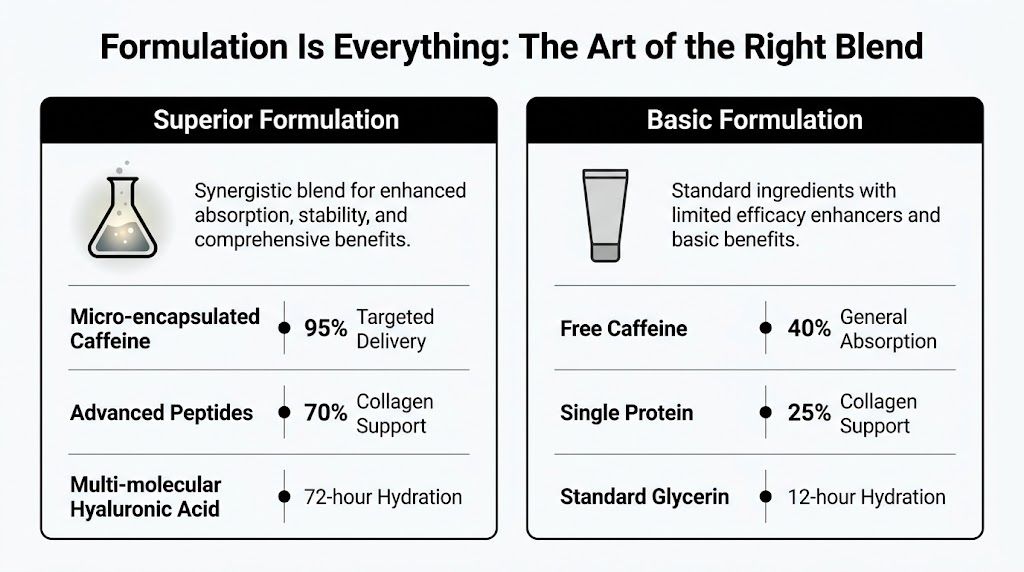
Formulation Is Everything The Art of the Right Blend
A Swiss buyer often sees the same pattern. Two eye creams sit side by side at a sourcing meeting. One leads with a bold caffeine percentage. The other gives a clearer formula story, better texture notes, and cleaner support for staff training. The second product usually performs better at retail because eye care is sold twice, first by the pack, then by the user experience.
More caffeine is not the whole answer
The eye area behaves like fine fabric. A strong active can be useful, but only if the weave holding it together is right. Vehicle, stability, skin feel, and tolerance all shape whether the customer keeps using the product long enough to notice a result.
Earlier evidence in this article already showed that a relatively modest caffeine level can still support visible improvement when the wider formula is well constructed. For B2B selection, that matters more than headline concentration. In practice, pharmacies and spas should treat very high percentage claims carefully unless the dossier also explains tolerance testing, texture choice, and intended frequency of use.
That approach also protects margin. Products that create early irritation, pilling, or stinging often generate weak repeat sales even if the launch sell-in looked promising.
Texture changes how efficacy is perceived
Under-eye care is one of the clearest examples of sensorial performance affecting commercial performance. A cooling gel can make the area feel fresher within minutes. A cream-gel can give better comfort under makeup. A richer balm-cream may suit evening use but feel too heavy for a customer focused on morning depuffing.
A placebo-controlled trial published in the Journal of Applied Pharmaceutical Science PDF is useful here because it showed that the gel base itself contributed strongly to perceived puffiness reduction. For retail partners, the lesson is practical. Customers do not separate active performance from texture performance. They judge the total experience.
This is why testers, sampling, and texture language on shelf matter. If a formula leaves residue, rolls under sunscreen, or migrates into the eye, staff will spend more time managing complaints than building basket size.
Ingredient pairings that make commercial sense
The best caffeine eye creams are usually built like a good Swiss watch. Each part has a clear job, and the mechanism works because the parts are coordinated.
Use this lens when reviewing a formula sheet:
- Hyaluronic acid supports hydration and helps explain the product to customers whose main complaint is tight, crepey-looking skin.
- Niacinamide strengthens a smoother, barrier-support angle, which is useful in pharmacy settings where customers often ask for gentle daily care.
- Peptides fit a firmer, more mature-eye positioning and can justify a more premium price architecture.
- Antioxidant support helps premium merchandising when the brand story includes environmental exposure, screen fatigue, or urban skincare.
For a retail benchmark, it can help to examine a product such as Lightboost Collagen Caffeine Eye Cream, not as a claim source, but as an example of how modern eye products combine caffeine with other supportive actives to create a fuller under-eye proposition.
What Swiss buyers should check before listing
Formula quality also has an operational side. Ask suppliers how the product behaves in real routines, not only in marketing copy. Does it sit well under concealer. Is the fragrance level suitable for the eye area. Is the pack designed to limit oxidation and contamination. Can the claims be translated into compliant German, French, and Italian shelf language without drifting into medicinal territory.
Those details decide whether a product is easy for staff to recommend and easy for customers to repurchase.
Buying rule: Ask what carries the caffeine, what supports it, how it feels on first use, and whether the claim set remains defensible in Swiss retail conditions. That question improves ranging decisions more reliably than chasing hero-ingredient marketing alone.
Guiding Customers on Application and Expectations
A customer buys a well-formulated caffeine eye cream in a Swiss pharmacy, applies far too much on the first morning, feels product drift toward the lash line, then decides the formula is ineffective by the third day. The product itself was not the problem. The handover was.
For Swiss retail partners, this section is less about beauty ritual and more about expectation management. Good advice at the counter protects trust, reduces unnecessary returns, and gives staff a clear, repeatable script across German, French, and Italian speaking environments.
The simplest method to teach at the counter
Customers retain physical instructions better than ingredient theory. A short demo usually works best.
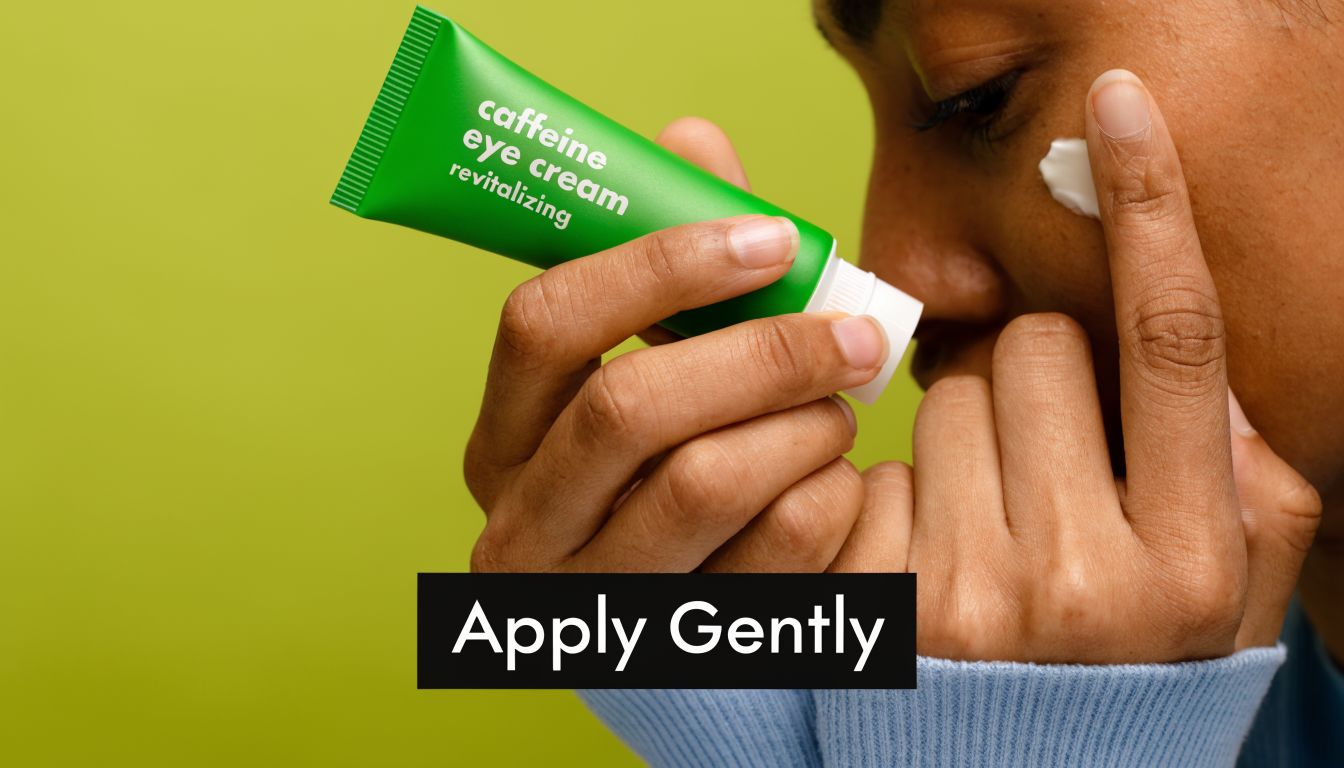
- Use a very small amount. A rice-grain-sized amount per eye is usually enough.
- Apply with the ring finger. It tends to place less pressure on the skin.
- Pat along the orbital bone. Keep the motion light and controlled.
- Use after cleansing and before a richer moisturiser if needed.
- Apply regularly. Morning use often fits de-puffing needs, while evening use helps maintain routine discipline.
The easiest analogy is dosage. Eye cream behaves more like a concentrated serum than a face cream. More product rarely improves the result. It usually increases pilling, migration, or irritation around the eye contour.
Set the timeline realistically
Staff should explain two different timelines. Puffiness may look better relatively quickly, especially when fluid retention is part of the problem. Darker under-eye appearance, tired-looking texture, and a generally smoother finish usually require steady application over time, as noted earlier in the article.
That distinction matters commercially. If a customer expects a cosmetic cream to perform like a treatment procedure, disappointment arrives before repurchase does.
A practical sentence for staff training is: “You may notice a fresher look early on, but the fuller cosmetic benefit depends on regular use.”
For teams that benefit from a visual demo, this application video can support in-store education or staff training:
Common misunderstandings to correct
Three misunderstandings appear repeatedly in pharmacy, spa, and premium retail settings.
- “If it tingles, it’s working.” The eye area usually responds better to comfort than to stimulation.
- “More product gives faster results.” Excess product often travels into the eyes or disrupts makeup wear.
- “It should remove every dark circle.” Some under-eye darkness relates to anatomy, pigmentation pattern, shadowing, or lifestyle factors that a cosmetic product can soften but not fully erase.
Trained staff create commercial value. A clear explanation helps the customer choose the right product, use it correctly, and judge the result by cosmetic standards rather than medical ones.
In Swiss B2B settings, that kind of guidance is part of the product offer. It turns a jar or tube on the shelf into a credible recommendation.
Navigating Swiss Compliance and Certifications
A Swiss pharmacy buyer reviews two caffeine eye creams with similar packaging, similar price points, and similar promises. One has disciplined claims, clear certification language, and a product file that answers questions quickly. The other relies on vague phrases such as “detoxifying” and “clinically inspired.” On the shelf, they may look comparable. In a compliance review, they are not.
That difference matters in Switzerland because product selection is tied to trust. Pharmacies, spas, and premium retailers are not only choosing a formula. They are choosing which claims their staff can repeat with confidence, which labels will withstand scrutiny, and which supplier creates the least friction during listing.
Why certifications matter commercially
Certifications help buyers separate a well-built product from a well-written sales sheet. They do not replace formula assessment, but they do provide a framework. For a retailer, that framework works like a customs document for quality cues. It shows what standards the brand says it follows and gives the buyer something concrete to verify.
For premium pharmacy and clean-beauty retail, ECOCERT can support a positioning around ingredient origin and production standards. Cruelty-free certifications from bodies such as PETA or Cruelty Free International can reinforce an ethical brand position that many Swiss customers expect, especially in selective skincare.
The commercial benefit is straightforward. Clear certification language lowers the risk of vague environmental or ethical messaging, gives staff safer talking points, and helps justify assortment decisions in a crowded category.
Clinical support is useful, but claim wording decides the risk
Swiss buyers often prefer products built around recognisable actives with a plausible mechanism and sensible supporting evidence. Caffeine fits that profile well. As noted earlier, its cosmetic role in reducing the appearance of puffiness and tired-looking eyes is easy to explain. The compliance question is different. The label and sales material must keep that story inside cosmetic boundaries.
In practice, that means avoiding medical language, disease references, or promises that imply structural correction. A caffeine eye cream can help the eye area look fresher, less puffy, or more awake. It should not read like a treatment for a diagnosed condition.
This point is easy for teams to miss. Ingredient credibility and claim compliance are related, but they are not the same thing.
A practical compliance checklist for buyers
Before listing a caffeine eye cream, check the product as if you were preparing a staff training card and a regulator's file review at the same time.
- Claims discipline: Are benefits described as changes in appearance, such as reduced-looking puffiness or a more refreshed eye contour, rather than medical outcomes?
- Certification clarity: Are ECOCERT or cruelty-free statements current, specific, and easy to verify through the certifying body or supplier documentation?
- Eye-area suitability: Does the pack and technical information present the formula as suitable for the delicate eye contour, with appropriate caution for sensitive use?
- INCI and formula logic: Do caffeine and the supporting ingredients match the product story, or is the concept driven mainly by fashionable claims?
- Supplier readiness: Can the brand provide product information, claim support, and artwork clarification quickly if a pharmacy chain, distributor, or cantonal reviewer raises questions?
In Swiss retail, premium does not mean “sounds better.” It means “holds up better” under questioning.
Buyers who apply that filter protect margin and reputation at the same time. They also make life easier for store teams, because a compliant product is easier to recommend, easier to explain, and easier to keep on shelf with confidence.
Merchandising and Marketing for the Swiss Retailer
A good caffeine eye cream can sit unnoticed for months if it’s merchandised like a generic eye product. The Swiss market rewards relevance. That means placement, staff language, and product education all need to connect with local buying behaviour.
Where to place it in store
Don’t isolate caffeine eye cream in a crowded “eye care” block with no context. It sells better when placed near adjacent needs:
- Anti-fatigue facial care: useful for customers shopping after short nights, travel, or screen-heavy routines.
- Anti-ageing ranges: especially where the formula also speaks to fine lines and firmness.
- Hydration and radiance displays: when the product has a lighter, brightening position rather than a heavy treatment feel.
Window and shelf communication should stay concrete. “Helps reduce the appearance of puffiness” is stronger than abstract language about awakening or energising.
Retailers refining store layouts may find practical ideas in this guide to visual merchandising in retail, especially for turning a small category into a problem-solution destination.
What to highlight online
For Swiss e-commerce partners, product pages should answer the questions a cautious buyer already has:
| Product page element | What to communicate |
|---|---|
| Main claim | Focus on visible puffiness, tired-looking eyes, or under-eye freshness |
| Formula story | Explain why texture and supporting actives matter |
| Usage guidance | Give clear application steps and realistic expectations |
| Trust markers | Show certifications and ethical positioning clearly |
Avoid exaggerated transformation language. The customer shopping this category is often sceptical already.
A Swiss-specific marketing angle
One underused talking point is stability. A 2025 ETH Zurich trial reported that caffeine’s antioxidant capacity can degrade 30% faster at elevations over 2000m, reducing efficacy, according to the cited market-gap discussion. For Swiss spas, mountain hotels, and high-altitude wellness retail, this raises a practical question: how well is the formula stabilised?
That gives you a sharper sales angle than generic “premium quality”. You can position well-formulated caffeine eye creams around packaging integrity, freshness, and thoughtful formulation for Alpine conditions.
Staff training language that converts better
Instead of memorising claims, train teams to diagnose the concern first.
A simple three-part approach works well:
- Ask what the customer sees. Puffiness, darkness, lines, or all three.
- Clarify when it appears. Morning-only issues often point to fluid retention.
- Match the formula to the concern. Gel textures for a cooling feel, richer creams for customers who also need comfort.
Here are a few useful staff lines:
- For puffiness: “This is best for tired-looking, fluid-related puffiness rather than permanent bags.”
- For dark circles: “It may help when the darkness is linked to circulation, but not every dark circle has the same cause.”
- For premium buyers: “The formula matters as much as the caffeine itself.”
Strong merchandising starts before the shelf. It starts with a staff member who can explain the category without sounding scripted.
Build the basket, not just the unit sale
Caffeine eye cream also cross-sells well with adjacent categories. In pharmacies, pair it with gentle cleansers and daily SPF as part of an eye-area care routine. In spas, pair it with anti-fatigue masks or cooling treatments. In e-commerce, bundle it with hydration-focused skincare for customers concerned about both puffiness and crepiness.
The commercial upside comes from treating caffeine eye cream as a gateway category. It opens conversations about sleep, stress, hydration, ageing, and routine consistency. That makes it more than a small add-on. It becomes a smart entry point into higher-value skincare advice.
Conclusion Your Strategic Advantage in Eye Care
Caffeine eye cream earns its place in a Swiss assortment when it’s treated as a serious category, not a trendy extra. The science gives it credibility. Good formulation gives it performance. Clear merchandising and careful compliance give it staying power.
For pharmacies, spas, retailers, and premium online partners, the advantage is straightforward. When your team can explain what caffeine does, identify who it suits, and recommend certified, well-built formulas, you stop competing on hype alone. You start competing on trust.
That matters in a market where customers expect evidence, comfort, and transparency in the same purchase. Stocked thoughtfully and sold transparently, caffeine eye cream can strengthen both customer satisfaction and category value.
If you’re building a cleaner, more differentiated skincare assortment for Swiss retail, beautysecrets.agency can help you source certified, ethically positioned cosmetics and cosmeceuticals that match today’s premium pharmacy, spa, and e-commerce expectations.