
A customer is standing at the pharmacy counter, holding a facial retinol serum in one hand and a rich body cream in the other. The question is familiar. “I know retinol works on my face. What should I use for my neck, chest, arms, or legs?” In many Swiss retail settings, that’s where the conversation starts to thin out.
It shouldn’t. Retinol body lotion has moved from niche add-on to serious category opportunity, especially for pharmacies, spas, premium boutiques, dermatology-led retail, and clean beauty e-commerce. The demand isn’t only about anti-ageing. It also comes from customers who want smoother texture, a more even-looking tone, and a body routine that feels as considered as their facial regimen.
For Swiss trade partners, this is a category that rewards precision. Product choice matters. Formula architecture matters. Compliance matters. Staff training matters even more. A well-chosen retinol body lotion can become a repeat-purchase item. A poorly chosen one, or poorly explained one, creates irritation, returns, and mistrust.
The Growing Demand for Body-Specific Anti-Ageing
The commercial shift is easy to recognise in-store. Customers no longer separate face care and body care as sharply as they did a few years ago. They’re asking for body products that do more than moisturise. They want treatment results.
That demand often shows up around visible concerns such as rough texture on the upper arms, loss of firmness on the thighs, or the thin, crinkled appearance people associate with crepey skin. When staff can explain where a retinol body lotion fits, the conversation becomes more credible and more useful.
Swiss retail partners are in a strong position here because the market already values premium care, ingredient transparency, and clinical logic. Retinol body lotion sits at the intersection of all three. It can be positioned as a treatment-led body product, but only if the assortment is disciplined and the guidance is responsible.
Commercial reality: Customers don’t buy this category because “retinol is trendy”. They buy it because they want visible improvement on body skin that ordinary lotion hasn’t delivered.
The strongest retail opportunity usually sits in three areas:
- Pharmacies and drugstores can present retinol body lotion as a structured at-home body treatment for texture and visible signs of ageing.
- Spas and hotels can frame it as maintenance between professional body rituals.
- Premium retailers can build it into a results-driven body care wardrobe, especially where natural, certified, or ethical positioning matters.
Body care is no longer the passive shelf behind facial skincare. In the right assortment, it’s a treatment category with margin, repeat potential, and room for expert recommendation.
The Science of Retinol for Body Skin
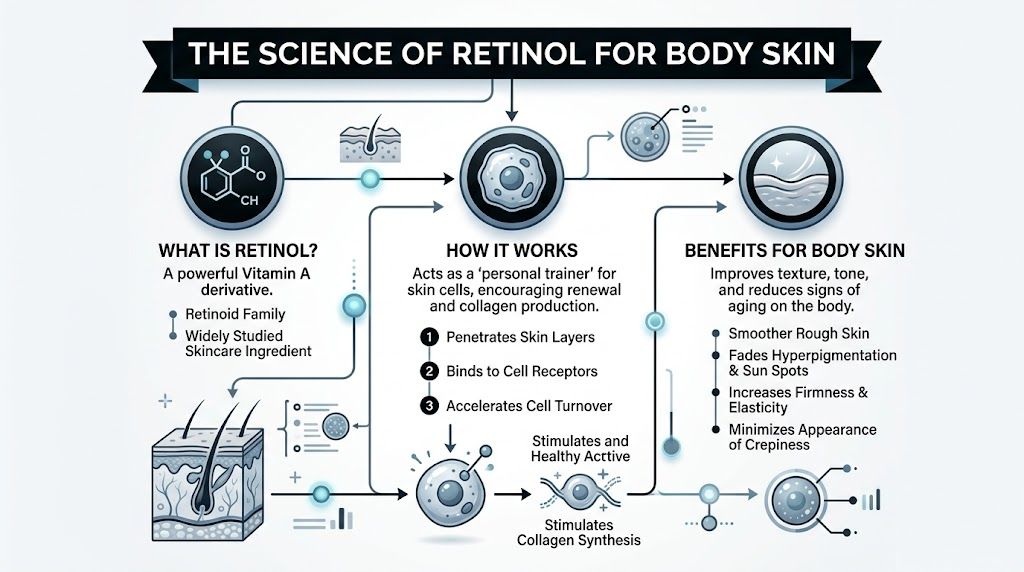
Retinol is a Vitamin A derivative. In cosmetic use, it’s valued because it helps skin behave more like younger, better-organised skin. That matters on the body just as much as it does on the face, but the way you explain it to customers has to stay practical.
A useful analogy is to think of skin as a building. The outer surface is the visible façade. Underneath, the structure depends on support materials and maintenance. When that maintenance slows, the surface looks rougher, less even, and less resilient. Retinol helps restart some of that maintenance work.
What retinol is doing in the skin
Retinol doesn’t work like a simple occlusive moisturiser. It works by influencing skin renewal processes and supporting the conditions for firmer, smoother-looking skin over time. A Healthline summary of retinol’s mechanism and clinical use notes that a landmark 2015 study demonstrated a significant reduction in wrinkles after 12 weeks of daily retinol use, while a 2019 study confirmed improvements in periorbital and neck wrinkles after 8 weeks. The same source explains that retinol helps neutralise free radicals and stimulate collagen synthesis in the dermis, and that 0.25% to 1% concentrations are considered optimal for body lotions.
For a retail team, the language can stay simple. Retinol acts a bit like a personal trainer for skin cells. It encourages better turnover and supports the deeper structure that gives skin a firmer look.
That’s why customers often notice body-focused benefits in a specific pattern:
- Texture first. Rough-feeling areas often become more refined before firmness changes are obvious.
- Tone next. Uneven-looking areas may start to look more uniform with consistent use.
- Then visible ageing concerns such as fine lines, crepiness, and slack-looking skin become less pronounced.
Why body formulas aren’t just face serums in a bigger bottle
Body skin and facial skin don’t behave identically in daily use. The body includes larger application zones, more friction from clothing, different exposure patterns, and wider variation in thickness depending on the area. A customer might tolerate one formula well on arms and legs, but not on the neck or chest.
That’s why retinol body lotion needs a different formulation strategy from a facial serum. The best body products usually rely on a lotion or cream base that supports spreadability, moisturising comfort, and slower adaptation. They should also be realistic for repeated use over a larger surface area.
In practice, retailers should expect these formulation differences:
| Area | What the formula needs | Why it matters |
|---|---|---|
| Arms and legs | Good spread, comfortable finish | Customers need enough slip to apply evenly |
| Neck and chest | Gentler sensory profile | These areas can react more quickly |
| Dry or mature body skin | Barrier-supportive base | Retinol works better when the skin stays comfortable |
| Premium natural positioning | Thoughtful oil phase and certification logic | Swiss customers often read the full label, not only the hero claim |
A common mistake is to overvalue the headline ingredient and undervalue the vehicle. On body skin, the base matters a lot. If the lotion feels sticky, pills under clothing, or leaves skin tight after application, compliance drops.
The formula that gets used consistently beats the “stronger” formula that ends up abandoned after two weeks.
What works and what doesn’t
What works is steady, tolerable use. What doesn’t work is treating retinol body lotion like an overnight rescue product. This category rewards patience.
Retailers should also be careful with language around body-specific timelines. There’s a genuine evidence gap. Consumer education often borrows from facial retinol guidance, but body skin may not respond on the same schedule in every area. That means responsible staff avoid promising exact body results by a fixed date.
A more accurate way to explain value is:
- Retinol has established activity in improving visible signs of ageing and texture.
- Body formulas must balance efficacy with comfort because the use pattern is broader.
- Customers should expect gradual improvement, not an instant cosmetic effect.
The role of supportive ingredients
Retinol rarely succeeds alone in a body lotion. A strong commercial formula usually combines it with ingredients that keep skin calm and useable. For trade buyers, this is where formulation literacy separates good assortment decisions from trend chasing.
Look for support systems such as:
- Ceramides when the formula is positioned for drier or more mature skin
- Hyaluronic acid when hydration messaging needs to be immediate and consumer-friendly
- Niacinamide when the brand wants to support barrier comfort and a more even-looking tone
- Nourishing botanical oils when the range is built around natural or certified positioning
The point isn’t to turn every formula into an ingredient buffet. The point is to make retinol more wearable.
Guiding Customers on Safe Retinol Application
Most dissatisfaction with retinol body lotion doesn’t come from the concept. It comes from rushed use, poor pairing, or weak staff guidance. If your team can teach a clear application protocol, sell-through improves and complaints drop.
Start with the practical reality. Body skin may be more resilient in some areas, but customers still need a cautious introduction. This is especially important for the neck, chest, and anyone already using active exfoliants.

The starter protocol staff can give at the shelf
A good recommendation sounds calm and specific. Not dramatic. Not vague.
Use this sequence:
Patch test first
Apply the product to a small area and monitor for several days before broad use. This doesn’t eliminate the risk of irritation, but it helps catch obvious intolerance.Apply on dry skin
Damp skin can increase penetration and sometimes increase discomfort. For beginners, dry skin is the safer entry point.Use at night
Customers usually find evening use easier to remember, and it reduces confusion around sun exposure during application hours.Start with limited frequency
Don’t tell beginners to use it nightly from day one. Slow escalation is the better route.Moisturise strategically
If the customer is dry or reactive, they can apply a simple moisturiser first, then use the retinol body lotion over it, or use moisturiser on alternate nights.Protect exposed areas with sunscreen
Chest, shoulders, arms, and hands need special attention if they’re treated and exposed.
For teams that want an extra educational asset, this guide on how to safely introduce retinol without irritation is useful for explaining why a gradual approach matters.
A simple introduction schedule
Use this as a staff script and as a printed or digital aftercare note.
| Week | Frequency of Use | Notes / What to Monitor |
|---|---|---|
| Week 1 | 1 to 2 evenings | Patch-tested areas only or limited body zones. Watch for tightness, stinging, redness, or scaling. |
| Week 2 | 2 evenings | Expand slowly if skin remains comfortable. Keep other strong actives minimal. |
| Week 3 | 2 to 3 evenings | Add more area only if there’s no persistent irritation. Moisturise generously on off nights. |
| Week 4 and beyond | Adjust based on tolerance | Maintain the highest frequency the skin can comfortably handle. More isn’t automatically better. |
Practical rule: The right frequency is the one the customer can sustain without ongoing irritation.
What to avoid in the first phase
Many routines often go awry here. A customer buys a retinol body lotion, then layers it with acids, scrubs, fragranced body products, and sun exposure. The result gets blamed on retinol when the underlying problem is the stack.
Advise customers to be careful with:
- AHA or BHA body exfoliants in the same routine at the start
- Aggressive scrubs or polishing mitts on treated areas
- Highly fragranced body care if the skin is already showing sensitivity
- Waxing or strong hair removal methods on recently treated zones, especially if the skin feels reactive
The best early pairing is boring in the best possible way. A bland, barrier-friendly moisturiser helps.
Sunscreen isn’t optional on exposed treated skin
A lot of body care customers use active products on the neck, décolleté, shoulders, forearms, and hands. Those are precisely the areas where daytime exposure can undo progress or increase sensitivity concerns.
Lead into the visual guidance with a direct explanation like this: sunscreen is part of the retinol protocol, not a separate category upsell.
How staff should handle early irritation
If a customer reports dryness or flaking, don’t default to “push through”. That advice creates preventable drop-off.
Instead, tell them to:
- Pause for several days if irritation is more than mild
- Resume at a lower frequency once the skin feels normal
- Reduce treatment area rather than stopping forever if they still want to continue
- Increase moisturiser support before and after use if needed
If the skin shows strong or persistent irritation, the recommendation shouldn’t become improvisation at the shelf. That’s the point to stop use and refer the customer appropriately.
Decoding the Label for Retail Success
A retinol body lotion can look premium on the shelf and still be weak where it counts. Label reading is where buyers protect both reputation and margin.
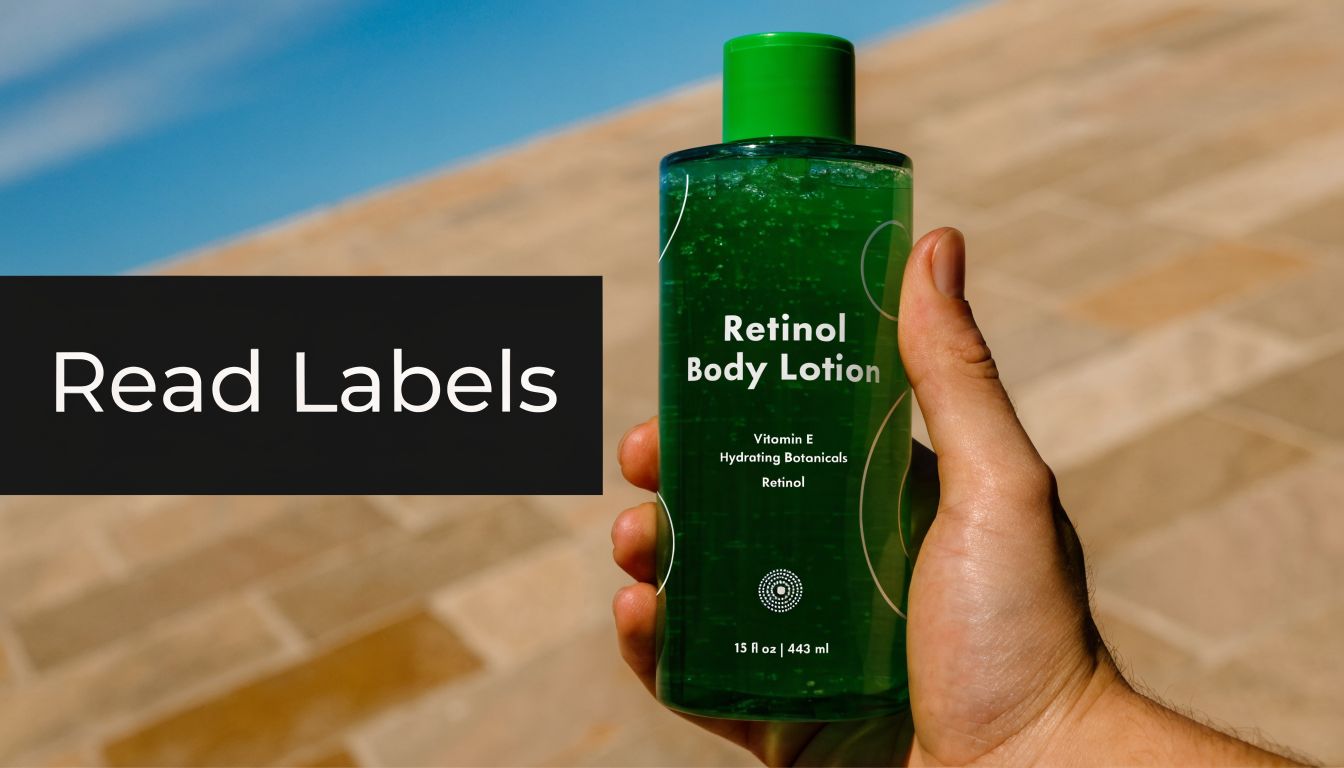
The first thing to verify is the type of retinoid. Not every Vitamin A derivative performs the same way in cosmetic use, and not every brand presents that distinction clearly. If the packaging leans heavily on “retinoid-inspired” language without making the active form obvious, that’s a warning sign.
What to look for first
When reviewing candidate products, start with a short technical screen.
Active clarity
The formula should identify the retinoid clearly. “Retinol” should mean retinol, not a halo effect built around another ingredient.Formula support
Look for a vehicle that includes barrier-conscious companions such as ceramides, niacinamide, humectants, or nourishing lipids.Packaging suitability
Retinol is not an ingredient that benefits from casual packaging. Light and air exposure matter. Pumps, sealed tubes, and controlled dispensers usually make more sense than open jars.Claim discipline
Premium products should sound confident, not theatrical. Excessive promises usually signal weak technical communication.
Why stability matters commercially
Retailers often focus on concentration because it’s easy to discuss. Stability is less visible, but commercially it matters more than many teams realise. If the formula degrades too easily, the customer experience becomes inconsistent. That leads to uncertainty. Uncertainty kills repeat purchase.
This is why concepts such as encapsulated retinol or time-release delivery deserve attention when they’re supported by the brand’s technical story. The benefit isn’t only “advanced science” language. The benefit is practical:
| Label concept | Retail relevance |
|---|---|
| Encapsulated retinol | Can support a gentler delivery profile |
| Time-release system | Can help make the product easier to tolerate |
| Air-restrictive packaging | Helps protect formula quality during consumer use |
| Barrier-supportive base | Improves the chances that customers stay with the routine |
You don’t need every brand in your assortment to use the same technology. You do need each brand to justify its design choices.
If the supplier can’t explain why the formula is built the way it is, the retailer is left selling slogans.
Reading concentration claims with a cooler head
Concentration claims attract attention, but they shouldn’t dominate buying decisions. A body formula that sits within an appropriate cosmetic range still has to be wearable, stable, and compatible with broad-area use.
For many Swiss retail environments, especially those serving cautious or premium customers, the better question is not “What is the strongest option?” It’s “Which option gives the customer the best chance of successful long-term use?”
That means looking beyond the front-of-pack hero number and asking:
- Is the texture credible for body application?
- Does the formula support the skin barrier?
- Is the sensory experience good enough for repeat use?
- Does the packaging protect the active?
- Can staff explain it cleanly in one minute?
Natural and certified positioning
For a Swiss assortment, natural and certified positioning can’t be a decorative layer added after the fact. It has to make sense from ingredient sourcing through packaging communication. Buyers should check whether the formula’s plant oils, fragrance approach, ethical commitments, and certification claims work together coherently.
A common mismatch is a product marketed as “clean” that still feels over-perfumed, overclaimed, and under-explained. Discerning customers spot that quickly. Better products tend to be quieter. They let formulation quality, certification integrity, and performance logic carry the range.
Strategic Merchandising in the Swiss Market
Swiss retail doesn’t reward generic retinol launches. It rewards credible curation. If you want retinol body lotion to perform, treat it as a specialist category with a clear retail role.
The business case is already compelling. The global body retinol lotion market was valued at $1.2 billion in 2024 and is projected to reach $2.85 billion by 2033, with a 10.1% CAGR, according to Market Intelo’s body retinol lotion market report. The same source notes that retinol creams and lotions captured 43.10% of the retinol beauty market in 2023, and that European growth aligns with EU Cosmetics Regulation (EC 1223/2009), which helps build consumer trust in compliant brands.
That data matters because it confirms this category isn’t a passing merchandising experiment. It has scale, momentum, and regulatory relevance.
Positioning for three retail environments
The same product shouldn’t be sold the same way in every channel.
Pharmacy and drugstore placement
In a pharmacy, retinol body lotion performs best when it’s framed as a cosmeceutical body treatment, not just a moisturiser with an active ingredient. Placement near treatment-led body care, neck and chest care, or mature-skin solutions usually creates a more logical buying context than placing it with general body lotion.
Staff language should focus on:
- visible texture refinement
- anti-ageing body care
- cautious introduction
- compatible barrier support
This customer expects competence. Shelf talkers should be informative, not decorative.
Spa and wellness positioning
In spas, the strongest route is to connect retail with service logic. A retinol body lotion can be positioned as home maintenance after a body treatment ritual focused on renewal, smoothing, or firming.
What works in practice:
- recommend it after exfoliation-based body rituals, but not for same-night use if the treatment was intensive
- pair it with a neutral body moisturiser for alternating nights
- train therapists to mention adaptation, not instant transformation
The tone should stay sensorial, but the advice should remain disciplined.
Premium boutique and department retail
In luxury retail, customers often buy body care emotionally first and rationally second. The product has to feel luxurious, but that isn’t enough. Swiss premium shoppers also read ingredient stories, packaging details, and ethical claims closely.
Indeed, ECOCERT, cruelty-free positioning, and transparent sourcing become powerful merchandising tools when they’re real and verifiable. They don’t replace efficacy. They strengthen premium trust around efficacy.
Compliance is part of the sales strategy
Too many buyers treat compliance as paperwork that happens before launch. In this category, compliance also supports sales.
Under EC 1223/2009, safety assessment and transparent cosmetic compliance help reassure buyers and end customers alike. In Switzerland, especially in premium and pharmacy-adjacent environments, that reassurance has commercial value. It supports better conversations around trust, tolerability, and quality.
For retail partners, the practical checklist should include:
- INCI transparency so staff can identify the active system clearly
- Use instructions that don’t encourage reckless frequency
- Warnings or guidance appropriate to retinoid-containing body products
- Packaging quality that aligns with active stability
- Certification consistency when natural or ethical claims are part of the positioning
Merchandising choices that improve sell-through
The best-performing launch plans are usually more disciplined than flashy. Three tactics tend to matter most.
Create a body treatment story, not a single SKU display
Pair retinol body lotion with a barrier-friendly body moisturiser and a body sunscreen option for exposed zones.Use consultant language at the shelf
Cards or shelf strips should answer real questions: who it’s for, where to apply it, how often to start, what not to combine immediately.Train for objection handling
Staff should be comfortable answering concerns about dryness, summer use, and whether the product is suitable for neck, chest, or hands.
Swiss customers often accept premium pricing when the product logic is clear, the certification story is credible, and the staff advice feels medically tidy rather than purely promotional.
A weak launch puts retinol body lotion beside generic body creams and waits for spontaneous discovery. A strong launch merchandises it as a guided treatment category with a premium but responsible identity.
Answering Advanced Questions and Troubleshooting
Retail staff usually handle the first wave of questions well. The harder part is what comes next, after the customer has started using the product and wants practical answers. At that stage, confidence at the counter matters.
Can I use retinol body lotion on the neck and chest
Yes, often, but with more caution than on arms or legs. These areas can be more reactive, especially in customers who already use active facial products or fragrance-heavy body care. The sensible advice is to start less frequently and monitor comfort closely.
If a formula feels too active for the neck or chest, that doesn’t mean it has failed as a body product. It may be better suited to less reactive areas.
Can it be used on the hands
Often yes, and many customers like this application because hands show visible ageing concerns quickly. The caveat is sun exposure. Hands are among the easiest places to forget when sunscreen is discussed.
A good staff response is simple: yes, but only if the customer also protects the area during the day.
How long until I see results on body skin
Avoid offering an exact body-specific promise. Facial retinol education gives useful context, but there’s still limited body-specific guidance on whether the timeline is identical across larger and thicker body areas.
A precise and responsible answer is that customers should expect gradual improvement with consistent use, and that texture changes are often easier to notice before firmness or crepiness shifts. Promise process, not a deadline.
Some customers stop too early because they’re waiting for a dramatic change. Body retinol usually rewards consistency more than impatience.
Is dryness and flaking normal
Mild dryness, tightness, or light flaking can happen during early use. The key word is mild. If the skin is uncomfortable enough to interfere with normal wear, the routine needs adjustment.
The first corrections are practical:
- reduce frequency
- apply over or alongside a simple moisturiser
- avoid other exfoliating body products
- pause if irritation builds instead of settling
What if the customer says they are purging
The idea of a “retinol purge” is often discussed in facial skincare, but staff shouldn’t use it as a catch-all explanation for every negative response on the body. If the customer is developing irritation, widespread redness, or an uncomfortable rash-like reaction, that isn’t something to reframe casually as a normal phase.
Better wording is: some adjustment effects can happen, but persistent or significant irritation means stop, simplify, and reassess.
Is it safe to use in summer
It can be used in summer, but only with sensible behaviour. This is especially relevant for exposed body zones such as shoulders, chest, forearms, and hands. Customers who are spending long periods outdoors, travelling, or already sun-stressed may do better reducing frequency or focusing on less exposed areas.
This is one of those questions where a retailer earns trust by sounding measured rather than absolute.
What should staff recommend if irritation keeps returning
If irritation keeps returning even after reducing frequency and simplifying the routine, the product may not be the right match for that customer, that area, or that season. Not every return to shelf should be pushed into a harder retinol sale.
A useful troubleshooting ladder is:
| Problem reported | First response | Next step if it continues |
|---|---|---|
| Mild tightness | Reduce use frequency | Add a plain moisturiser on off nights |
| Light flaking | Pause briefly and restart slowly | Limit to sturdier body areas |
| Burning or marked redness | Stop use | Recommend reassessment and appropriate professional advice |
| “It’s doing nothing” | Check frequency and consistency | Re-evaluate expectations, area treated, and formula fit |
Can customers combine it with other actives later
Sometimes yes, but only after the skin has adapted. The first phase should stay simple. Once the customer is stable, some may use complementary products in a more structured routine, but that’s not where beginners should begin.
For staff, the safest expert posture is to sequence the routine over time rather than stacking everything at once.
Partnering for Success with Premium Body Care
Retinol body lotion is one of those categories that looks simple until you have to sell it properly. The product itself matters, but retail performance depends on three other factors. Careful selection, careful explanation, and careful positioning.
For Swiss pharmacies, spas, boutiques, and clean beauty retailers, the opportunity is strong when the assortment is built around formulas that are credible, stable, comfortable to use, and aligned with the customer’s expectations around certification and ethical sourcing. Natural positioning only adds value when it is backed by formulation discipline and transparent compliance.
The retail partners who do this well usually make the same choices. They train staff to guide slow introduction. They merchandise retinol body lotion as a treatment category, not an impulse body cream. They choose brands whose packaging, claims, and technical logic support long-term customer trust.
That’s the difference between stocking a trend and building a profitable body care segment.
Swiss retailers looking to strengthen their premium body care assortment can explore curated, natural, and ethically positioned cosmetic brands through beautysecrets.agency, a specialist distributor supporting pharmacies, spas, clinics, and premium retail partners with compliant product selection and market-ready guidance.