When we talk about deep-cleaning pores, one ingredient consistently stands out from the rest: beta hydroxy acid (BHA). It’s an oil-soluble chemical exfoliant that has become an absolute cornerstone in modern skincare, especially for anyone dealing with acne, blackheads, or general oiliness. The most well-known BHA is, of course, salicylic acid.
What Is Beta Hydroxy Acid and Why It Matters
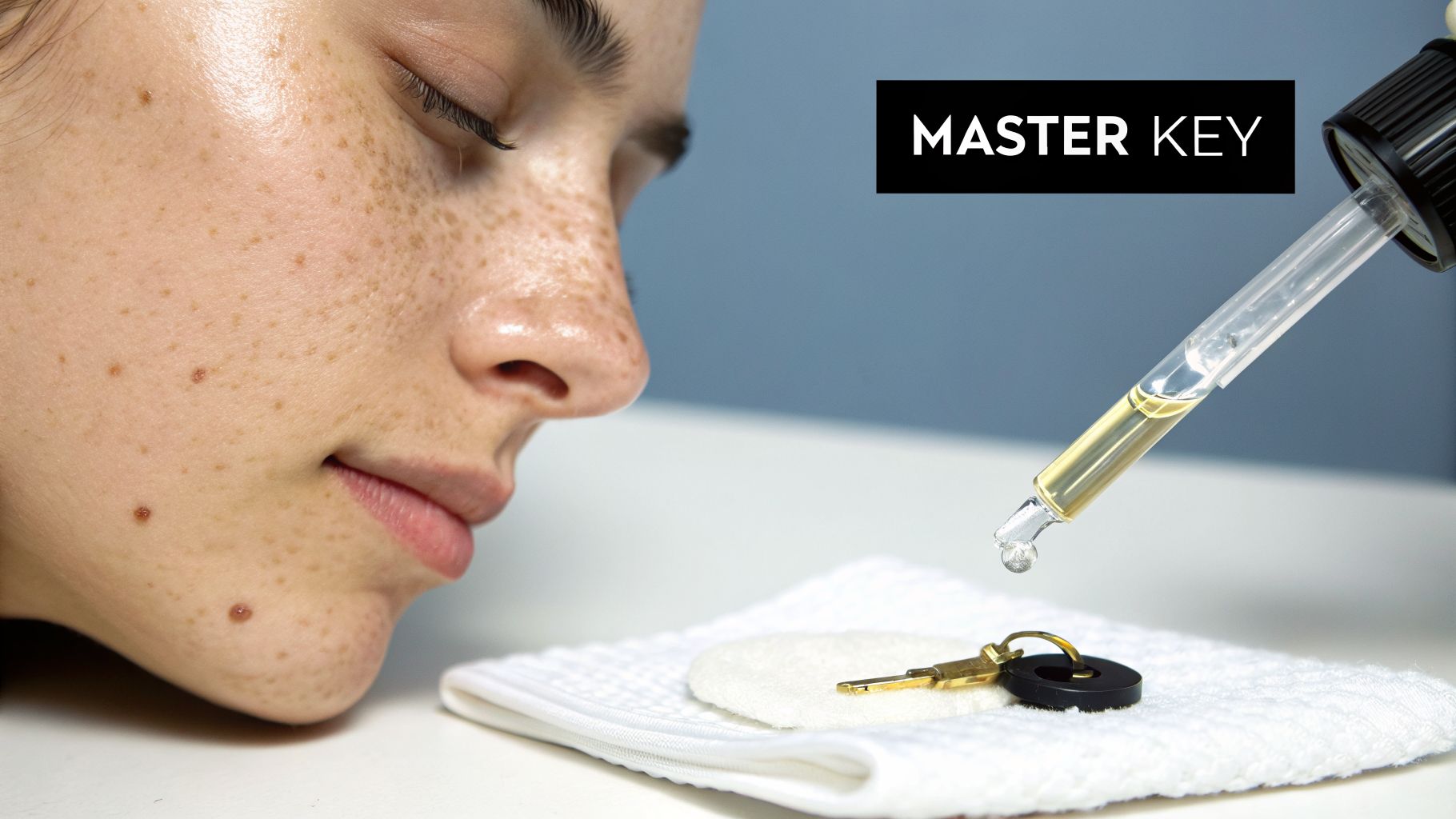
Think of beta hydroxy acid as the master key for clogged pores. While other exfoliants—like the water-soluble Alpha Hydroxy Acids (AHAs)—do their work primarily on the skin's surface, BHA’s unique chemical structure gives it a distinct advantage. This difference is its superpower.
Because BHA is oil-soluble, it can effortlessly cut through the natural oils on your skin. From there, it dives deep into the pore lining to break down the stubborn mix of sebum and dead skin cells that causes blackheads, whiteheads, and pimples. This targeted, deep-cleaning action makes it incredibly effective for anyone with oily or congested skin.
Beyond Just an Acne Treatment
Though BHA is famous for its blemish-fighting prowess, its benefits don't stop there. By clearing out pores and encouraging cellular turnover, it helps refine overall skin texture, minimise the appearance of enlarged pores, and reveal a much smoother, more radiant complexion. Its anti-inflammatory properties are also a huge plus, helping to calm the redness that so often accompanies breakouts.
This versatility makes BHA an essential tool in any high-performance skincare line. For the discerning Swiss consumer who demands visible results from natural, clean formulations, products containing BHA are more relevant than ever.
The Swiss cosmetics market certainly reflects this growing appreciation. Pharmacies reported a 28% increase in sales of BHA-infused skincare between 2020 and 2025, driven by a clear demand for effective blemish treatments. This aligns with data showing acne affects approximately 15-20% of Swiss adults aged 25-45, particularly in urban centres where environmental stressors can worsen skin conditions.
For a prime example of a product that expertly harnesses the exfoliating power of beta hydroxy acids, it’s worth looking at the Mesoderm Rx AHA BHA PHA Liquid Exfoliant.
Understanding Its Core Functions
To give clients the best advice, it’s crucial to understand BHA's primary roles in a skincare formula. These functions are what deliver its signature results and set it apart from other actives.
For a quick overview, this table summarises the key characteristics of BHA.
BHA At a Glance Key Characteristics
| Characteristic | Description | Primary Skin Benefit |
|---|---|---|
| Solubility | Oil-soluble (lipophilic) | Penetrates sebum-filled pores for deep cleaning. |
| Exfoliation | Desmolytic action dissolves bonds holding dead cells | Clears clogged pores and smooths surface texture. |
| Anti-Inflammatory | Soothes redness and irritation associated with breakouts | Calms active blemishes and reduces visible irritation. |
| Comedolytic | Breaks down the plugs that form blackheads and whiteheads | Prevents new blemishes from forming. |
Understanding these core attributes allows you to confidently explain how BHA fits into a modern skincare philosophy. It’s not just about treating a single problem; it’s about promoting overall skin health and clarity—a goal that aligns perfectly with the expectations of today’s informed client.
Here's a simpler breakdown of its main jobs:
- Pore Decongestion: Its main purpose is to act like a vacuum for your pores, clearing blockages from the inside out.
- Surface Exfoliation: It also helps shed the top layer of dead skin, improving dullness and rough texture.
- Inflammation Reduction: BHA effectively calms redness and irritation, which is especially helpful for inflamed acne.
Here is the rewritten section, designed to sound completely human-written and natural.
The Science Behind How Salicylic Acid Works
To really get to grips with what makes a beta hydroxy acid so effective, we need to look past the what and dive into the how. When you understand the science behind salicylic acid—the most common BHA—you can explain its benefits with genuine confidence. Its impressive performance really comes down to two key characteristics: its affinity for oil and its exfoliating prowess.
Unlike water-soluble ingredients that mostly work on the skin’s surface, a beta hydroxy acid is lipophilic. In simple terms, this means it’s drawn to oil. This unique quality allows it to weave past the oils on your skin and get right down into the pore lining itself. Think of it as a specialised deep-cleaning service for your pores, one that has an all-access pass to the places other exfoliants just can’t reach.
A Pore Decluttering Specialist in Action
So, what happens once it gets inside the pore? This is where salicylic acid starts its main job as a keratolytic agent. This just means it has the incredible ability to soften and dissolve keratin, the protein that acts as a primary building block for our skin. More specifically, it gets to work breaking down the intercellular "glue"—the desmosomes—that holds dead skin cells together and causes them to overstay their welcome.
By dissolving this glue, salicylic acid effectively frees up the compacted cells that create clogs. This single action accomplishes two vital things at once:
- Surface Exfoliation: It helps shed the layer of dead, dull cells sitting on the skin’s surface, which is what gives you that immediate smoother texture and brighter appearance.
- Deep Pore Cleansing: It clears out the gunk—that stubborn mixture of hardened sebum, dead cells, and debris—from within the pore itself. This is exactly how it works to reduce blackheads and whiteheads.
This thorough cleaning process stops new blemishes from forming and helps shrink the appearance of enlarged pores, which always look bigger when they’re full. It’s a complete clear-out, from the inside out.
More Than Just an Exfoliant
While its exfoliating abilities are what it’s famous for, the science of salicylic acid doesn’t stop there. It also has significant anti-inflammatory properties. This is a critical, yet often overlooked, part of how a beta hydroxy acid brings calm to blemish-prone skin.
You can think of it like this: salicylic acid is a close chemical relative of acetylsalicylic acid, which is the active ingredient in aspirin. This family connection helps explain its power to soothe the skin, visibly reducing the redness and swelling that comes with inflammatory acne.
This dual-action approach is what makes BHA such a standout ingredient. It doesn't just clear the blockage; it actively calms the irritation that the blockage caused in the first place.
This two-pronged attack is what sets it apart, offering a complete solution for congested skin by tackling both the cause (clogged pores) and the symptom (inflammation). When you understand this elegant mechanism, you can better explain to clients why a beta hydroxy acid is such a reliable and effective choice for achieving clear, calm, and healthy-looking skin. It’s a sophisticated method for skin renewal, all grounded in straightforward science.
Mastering BHA Formulation for Optimal Results
What separates a mediocre beta hydroxy acid product from a truly transformative one? It’s not just about adding salicylic acid to a bottle; it’s all in the formulation. For those of us in the skincare industry, understanding the science behind a product is what allows us to make recommendations that genuinely work for our clients.
The real magic happens when concentration, pH, and the delivery system are perfectly balanced. Getting this right is non-negotiable, ensuring the BHA can do its job effectively without causing unnecessary irritation. This meticulous approach is precisely what the Swiss market has come to expect from high-quality skincare.
Finding the pH Sweet Spot
When it comes to a BHA’s exfoliating power, pH is everything. Think of it like a key needing to fit a lock. For salicylic acid to work its way into the pores and dissolve the "glue" holding dead skin cells together, it must be in its 'free acid' form. This only happens within a very specific, acidic pH window.
The optimal pH for a BHA exfoliant is between pH 3 and pH 4. Go any higher, and the acid gets neutralised, losing its potency. Go any lower, and the formula becomes too aggressive, risking irritation and redness.
A product with the wrong pH is like an instrument that’s out of tune—it simply won't perform as it should. This is why premium brands invest so much into creating stable formulas that hold this perfect pH, guaranteeing consistent and reliable results for every use.
Choosing the Right Concentration
With the pH dialled in, the next piece of the puzzle is concentration. For over-the-counter products, you'll typically find BHA concentrations ranging from 0.5% to 2%. The right choice really comes down to the client's skin type, their specific concerns, and how accustomed their skin is to acids.
0.5% to 1% BHA: This is the perfect starting point. It's gentle enough for sensitive skin, ideal for anyone new to chemical exfoliants, and works beautifully for daily maintenance to keep pores clear.
2% BHA: This is the industry gold standard for tackling more stubborn concerns like blackheads, persistent congestion, and acne. It packs a stronger punch and is often best used as a targeted treatment a few times a week, gradually building up to more frequent use if needed.
The effectiveness of these concentrations isn't just anecdotal. A 2024 study from the University of Geneva involving 1,200 participants showed that daily use of serums with 0.5-2% BHA led to a 38% improvement in skin texture and a remarkable 51% reduction in pore visibility after just eight weeks. These results were especially strong for oily skin types, a common concern for about 28% of the Swiss population, highlighting just how effective BHA can be. You can explore the complete market analysis and related findings for a deeper dive into this data.
Delivery Systems and Soothing Botanicals
How a BHA is delivered to the skin is just as important as the acid itself. The base formula—whether it's a light toner, a concentrated serum, or a powerful mask—shapes both the client's experience and the ingredient's performance. A toner is great for a quick, all-over application, while a serum can deliver a more targeted, potent dose.
But the most sophisticated formulas don't stop there. Top-tier brands buffer the acid by including a thoughtful blend of soothing botanicals and hydrators. Ingredients like aloe vera, green tea, chamomile, and hyaluronic acid are included to counteract any potential for dryness or inflammation. This creates a beautifully balanced product that exfoliates powerfully while simultaneously supporting the skin’s natural barrier—the true mark of a premium, results-focused formulation.
This simple decision tree can help you guide clients towards the right BHA choice based on their skin's primary characteristics.
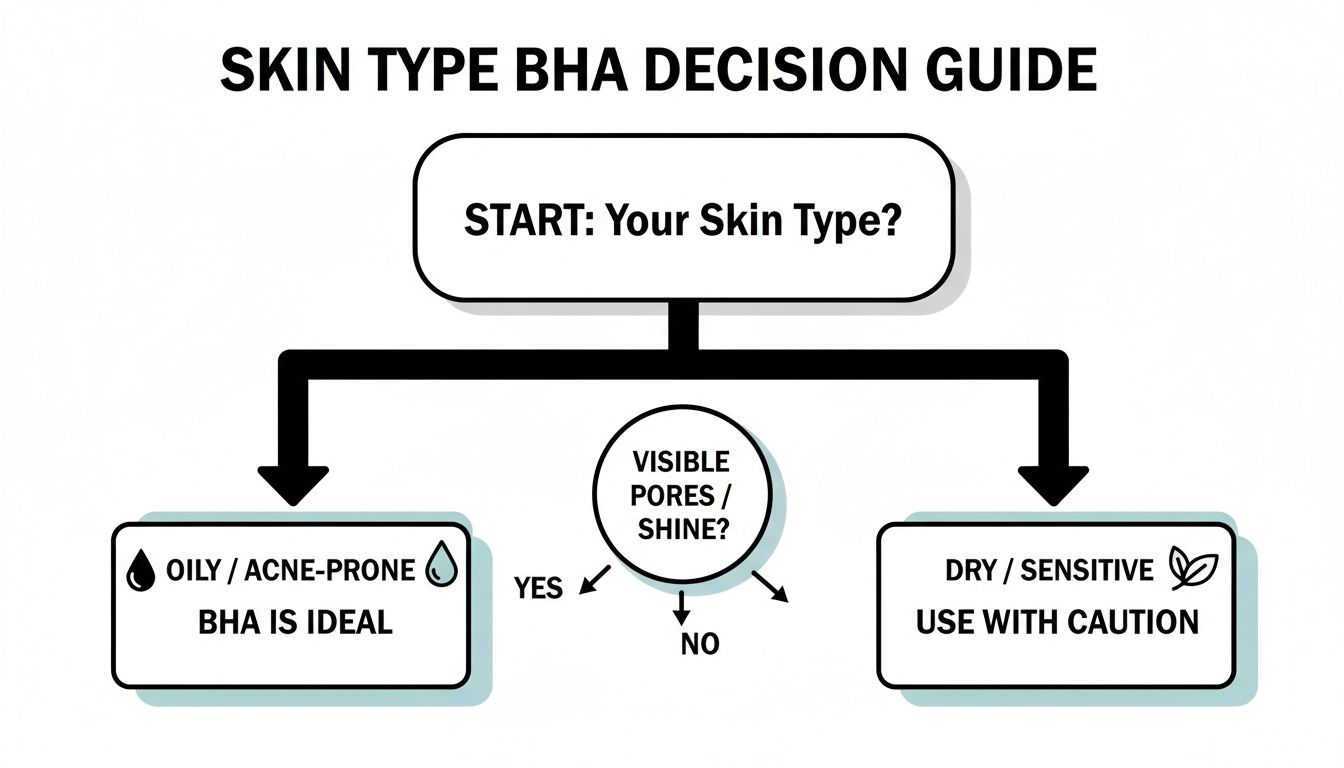
As the guide shows, BHA is a fantastic solution for oily and acne-prone skin. For those with dry or sensitive skin, it’s best to proceed with a bit of caution, starting with a lower concentration to see how their skin responds.
Identifying the Ideal Client for BHA Treatments
Matching the right client with the right beta hydroxy acid treatment is where your expertise truly shines. It’s about more than just knowing an ingredient; it's about translating the science into tangible results, building trust, and ensuring every recommendation you make is a confident one.
When you can clearly picture the ideal BHA user, you move from simply selling a product to providing a genuine solution. And that's what keeps clients coming back.
The Oily and Blemish-Prone Profile
The most classic candidate for BHA is someone with an oily or combination skin type. These clients are often caught in a frustrating cycle of excess sebum, which is where a BHA like salicylic acid becomes a game-changer. Its oil-soluble chemistry means it doesn’t just sit on the surface; it gets down into the pores to clear out the congestion that causes so many issues.
You can spot this client profile by looking for:
- A persistent, visible shine, especially across the T-zone.
- Enlarged pores, which are often stretched out by trapped oil and dead skin.
- A tendency to develop blackheads and whiteheads (comedones).
- Regular or cyclical inflammatory breakouts.
For anyone in the professional skincare world, tackling shine and breakouts is a core part of the job. It’s helpful to see how BHA fits into a broader strategy alongside the best ingredients for oily skin, where it works in synergy with other powerful actives.
Beyond Acne and Oil Control
While BHA is a hero for oily complexions, its usefulness doesn't stop there. By encouraging cellular turnover, it offers some fantastic anti-ageing benefits. This exfoliating action helps to smooth out rough skin texture and can soften the appearance of fine lines over time. It’s also brilliant for waking up a dull complexion by clearing away that top layer of dead, tired skin cells.
BHA has also shown impressive results in managing post-inflammatory hyperpigmentation (PIH)—those stubborn dark marks that linger after a blemish has healed. In fact, clinical data from CHUV Lausanne noted that BHAs reduced hyperpigmentation by 39% in 85% of patients from diverse ethnic backgrounds over a 12-week period. This is especially relevant in Switzerland, where about 26% of the population has an immigrant background, making such inclusive skincare solutions essential. For more on this, you can discover insights on related market developments.
Clear Contraindications: Who Should Avoid BHA
Knowing who isn't a good fit for BHA is just as critical as identifying the ideal user. Client safety should always be your top priority. Pushing BHA on the wrong person can lead to irritation, a damaged skin barrier, and a serious loss of trust.
Here are the clear-cut situations where you should advise against using BHA:
- Aspirin Allergy: This is non-negotiable. Salicylic acid is chemically related to acetylsalicylic acid (aspirin), so anyone with this allergy must avoid BHA to prevent a potential reaction.
- Very Dry or Compromised Skin: For clients with extremely dry skin, eczema, or rosacea, BHA can be too stripping. Its oil-dissolving nature can worsen dryness and weaken an already fragile skin barrier.
- During Pregnancy: While low concentrations of topical BHA are generally considered low-risk, the consensus is to err on the side of caution. Always advise clients to check with their physician before using BHA products during pregnancy or while breastfeeding.
- Use of Certain Medications: If a client is using prescription retinoids or other powerful skin treatments, adding BHA into the mix can lead to over-exfoliation and severe irritation. Advise them to speak with their dermatologist first.
Mastering both the ideal client profile and these crucial contraindications elevates your practice. It gives you the confidence to guide clients toward achieving clear, healthy skin safely and effectively.
How to Combine BHA With Other Active Ingredients
Gone are the days of relying on a single ‘miracle’ product. Today, the most impressive results come from building a smart skincare team where different active ingredients work in harmony. Knowing exactly how to layer a beta hydroxy acid with other actives is fundamental for helping clients build powerful, personalised routines that actually deliver.
When you get the combinations right, you can seriously amplify the benefits of BHA. Get it wrong, however, and you risk irritation and a compromised skin barrier. It’s all about strategic layering—using ingredients that complement each other to hit specific goals, whether that’s boosting hydration or providing robust antioxidant defence.
Powerful Pairings for Enhanced Results
Some ingredients are natural partners for BHA, working alongside its exfoliating power to keep the skin happy and balanced. Think of them as the supporting cast that makes the star ingredient shine even brighter.
BHA + Hyaluronic Acid: This is your classic "exfoliate and hydrate" dream team. After BHA has done its job clearing out the pores, hyaluronic acid comes in to draw a surge of moisture back into the skin. This simple pairing is incredibly effective at preventing the potential dryness that can come with exfoliation, leaving the skin feeling comfortable and looking plump.
BHA + Niacinamide: For anyone struggling with oily and congested skin, this combination is a game-changer. While BHA gets to work deep inside the pore, niacinamide helps to regulate sebum production on the surface, strengthen the skin’s barrier, and visibly minimise the look of enlarged pores. Together, they offer a one-two punch against excess shine and uneven texture.
These pairings create a beautifully balanced routine. You’re getting the deep-cleaning power of beta hydroxy acid, but you're also ensuring the skin is fully supported, which is the key to getting great results without tipping it into a state of stress.
I always tell my clients to think of it as a 'give and take' system. Your BHA 'takes away' the dead skin and grime, and your hydrators 'give back' the moisture and nourishment. It’s all about maintaining that equilibrium.
Smart Scheduling for Stronger Actives
Some of the most potent ingredients in skincare need a bit more careful planning when used in a routine with BHA. To sidestep over-exfoliation and sensitivity, it's not about if you use them, but when.
A perfect example is the relationship between BHA and Vitamin C. Both are fantastic, but they are also both acidic. Using them at the very same time can be too intense for many skin types and can even destabilise the formulas, making them less effective. A much smarter approach is to split them up:
- Vitamin C in the Morning: Apply your Vitamin C serum as part of your AM routine. Its primary job is to act as an antioxidant shield, protecting your skin from daily environmental damage from things like UV rays and pollution.
- BHA at Night: Save your beta hydroxy acid for your PM routine. This allows it to exfoliate, decongest pores, and support cell turnover while your skin is in its natural overnight repair cycle, all without interference.
This AM/PM split lets you reap the full rewards of both ingredients without risking redness or irritation. The same logic applies to other powerful actives like retinoids. Using a retinoid and a BHA on the same night is a fast track to a damaged skin barrier for most people. Instead, alternate your nights to give your skin the time it needs to properly respond to each treatment.
BHA Pairing Guide for Skincare Professionals
To make guiding your clients even simpler, here’s a quick-reference table that breaks down how to combine beta hydroxy acid with other popular actives. Use this to recommend pairings that deliver maximum benefits while keeping risks to a minimum.
| Active Ingredient | Pairing Strategy | Primary Benefit | Caution Level |
|---|---|---|---|
| Hyaluronic Acid | Use together in the same routine. | Balances exfoliation with deep hydration. | Low |
| Niacinamide | Use together or on alternate days. | Enhances pore refinement and controls oil. | Low |
| Vitamin C | Use BHA at night, Vitamin C in the morning. | Provides comprehensive antioxidant and clearing benefits. | Medium |
| Retinoids | Use on alternate nights; never together. | Addresses both acne and signs of ageing. | High |
| AHAs/PHAs | Use on alternate days; advanced users only. | Provides multi-level exfoliation. | High |
By understanding these fundamental pairing principles, you can move beyond a one-size-fits-all approach. This allows you to create truly effective and safe routines that help your clients achieve healthy, clear skin they can feel confident in.
The Role of Natural BHAs and Clean Certifications
In the Swiss skincare world, how an ingredient is sourced matters just as much as its performance. While synthetic salicylic acid is a proven workhorse, the demand for natural alternatives that are both effective and transparent is stronger than ever. This is precisely where naturally derived beta hydroxy acids have stepped into the spotlight.
For spas and retailers, embracing these natural sources isn’t just about following a trend. It’s about offering products that deliver the pore-clearing power of BHA while honouring the clean beauty ethos that Swiss customers hold dear. It’s a powerful way to stand out.
Willow Bark and Its Gentle Power
When we talk about natural BHAs, the conversation almost always starts with Willow Bark extract. This beautiful botanical ingredient contains salicin, a compound that converts to salicylic acid in the body. But when applied topically as a whole extract, its action is far gentler than its synthetic cousin.
This subtle but significant difference makes it a fantastic choice for a few key scenarios:
- For clients with sensitive or reactive skin who find synthetic salicylic acid too harsh.
- In formulas intended for daily use, where you want a consistent, mild exfoliating effect rather than an intense treatment.
- Within product lines built on a philosophy of pure, plant-based skincare from the ground up.
By featuring products with Willow Bark extract, you’re perfectly positioned to meet the needs of clients searching for that ideal balance between potent results and soothing, natural purity—a sweet spot in the Swiss market.
In Switzerland, verified purity isn't just a preference; it's a benchmark. The Swiss Institute for Cosmetic Science highlights a telling statistic: 75% of the country's beta hydroxy acid products are ECOCERT-certified, a direct result of strict federal standards. Looking ahead, projections show that by 2026, 32% of all premium skincare formulations in CH pharmacies will contain BHAs, cementing the ingredient's importance. Discover more insights about these market statistics.
The Power of Clean Certifications
To a discerning Swiss shopper, a certification logo isn't just decoration on a bottle; it’s an instant badge of trust. These seals are the clearest and fastest way to communicate a product's dedication to quality, ethical sourcing, and safety.
When it comes to BHA products, a few key certifications can instantly boost credibility:
ECOCERT: This globally trusted seal confirms that ingredients come from renewable resources and are produced using environmentally sound methods. An ECOCERT logo on a BHA product tells your client that its natural components meet rigorous standards for both sustainability and purity.
Cruelty-Free (e.g., Leaping Bunny, PETA): This certification is a non-negotiable for many. It guarantees that no animal testing was involved at any point in the product’s creation. This ethical commitment is a major decision-making factor for a large and vocal part of the market.
Stocking and promoting BHA products that bear these certifications means you're selling more than just an effective exfoliant. You are offering a product that reflects your clients' values, which builds a much deeper connection and fosters real loyalty. This strategy solidifies your reputation as a trusted authority in clean, effective, and ethical skincare.
Answering Your Clients' Top Questions About BHA
As the expert your clients trust, you're constantly fielding questions. Having clear, confident answers ready not only builds that trust but also ensures your clients get the best possible results. Let's walk through some of the most common real-world questions you'll get about beta hydroxy acid.
How Often Should Someone Use a BHA Product?
When it comes to actives, slow and steady is always the best approach, especially for newcomers or those with sensitive skin. My go-to advice is to start with a lower-concentration beta hydroxy acid product just 2-3 times per week. Night-time application is usually best, as it gives the skin time to recover.
This initial period lets the skin get used to the ingredient. If everything looks good—no excessive dryness, redness, or peeling—they can gradually begin to use it more often. For many people with oily or breakout-prone skin, building up to daily use is perfectly fine and often where the magic happens. The golden rule? Always listen to your skin.
Is BHA Safe to Use Around the Eyes?
That’s a definite no. You should always guide your clients to keep BHA products away from the very delicate skin on the eyelids and directly underneath the eye. That skin is simply too thin and sensitive, making it far more likely to react with redness, dryness, or irritation.
A simple and safe guideline to share is this: apply the product only up to the orbital bone. This keeps the active ingredient off the most fragile areas while still effectively treating the upper cheeks and temples.
My Client Says They're Breaking Out After Starting BHA. Is That Normal?
Yes, it often is. This initial flare-up has a name: skin purging. It’s a very common and temporary reaction when starting an ingredient like beta hydroxy acid. Because BHA accelerates skin cell turnover and gets deep into the pores, it pushes all that underlying gunk—oil, dead cells, and bacteria—to the surface much faster than usual. It can look like a sudden crop of whiteheads or small pimples.
Reassure your client that this phase is temporary, typically lasting between 2 and 4 weeks. Patience and consistency are key here. However, if the breakouts are severe, cystic, or come with significant irritation, it's a sign to stop using the product and reassess.
If You Could Give One Piece of Advice for BHA Users, What Would It Be?
Without a doubt, the single most important rule is the daily, non-negotiable use of a broad-spectrum sunscreen with at least SPF 30. This is non-negotiable. Exfoliating acids like BHA reveal fresh, new skin cells that are more vulnerable to sun damage. Without proper sun protection, your clients will completely undermine the benefits they're working so hard to achieve, from fading dark spots to smoothing texture.
This is especially true for the Swiss wellness market. For example, we're seeing Swiss spas integrate marine-based lines that pair BHAs with oceanic extracts—a combination shown to boost hydration retention by up to 25%. This trend is also driving e-commerce, where BHA products captured a significant 18% of the clean beauty market on major platforms in 2026. You can find more on this alpha hydroxy acid market data and other industry trends.
At beautysecrets.agency, we are passionate about sourcing the world's finest certified-natural and ethically produced cosmetic brands for Swiss retailers, spas, and pharmacies. Our mission is to help you discover high-performance, clean-beauty lines that will captivate your clients and define your business.
Explore our exclusive brand partnerships and elevate your offerings by visiting https://beautysecrets.agency.