At the heart of it, the difference between AHA and BHA comes down to one simple thing: solubility. AHAs are water-soluble, meaning they work their magic on the surface of the skin. In contrast, BHAs are oil-soluble, which gives them a special pass to get down deep into the pores.
This single characteristic is what makes Alpha-Hydroxy Acids (AHAs) perfect for tackling issues like dullness and fine lines, while Beta-Hydroxy Acids (BHAs) are the clear winner for anyone struggling with oily, congested skin.
Decoding Chemical Exfoliants for Skincare Professionals
For Swiss beauty professionals, truly understanding chemical exfoliants is the key to guiding customers toward genuinely healthy, radiant skin. The terms AHA and BHA might sound technical, but they simply represent two families of acids, often derived from nature, that provide a much gentler and more effective alternative to harsh physical scrubs.
Instead of physically scraping away dead cells, these liquid exfoliants dissolve the 'glue' holding those dull, old cells to the surface. This process, called desquamation, gently speeds up the skin's own renewal cycle. What your customers see is a smoother, brighter complexion with a more even tone.
The Gardener Analogy: A Simple Way to Understand
Think of your customer's skin as a garden. It's a simple analogy, but it works wonders.
AHAs, like glycolic and lactic acid, are the surface gardeners. They meticulously sweep away the fallen leaves (dead skin cells) and surface debris, letting the fresh, healthy lawn (new skin) underneath shine through. They're fantastic for improving overall texture and restoring a healthy glow.
BHAs, on the other hand, are the deep-soil specialists. Salicylic acid, the most common BHA, is like a gardener who aerates the soil. It gets right down into the pores to clear out all the compacted oil, dirt, and built-up gunk. This makes it incredibly effective for managing breakouts, blackheads, and general congestion.
By understanding this fundamental difference, you can confidently recommend the right 'gardener' for your client's specific skin 'garden', ensuring they achieve the best possible results with their AHA and BHA products.
To make this even clearer for you and your team, here’s a quick reference chart.
AHA vs BHA: A Quick Comparison
| Characteristic | Alpha-Hydroxy Acids (AHAs) | Beta-Hydroxy Acids (BHAs) |
|---|---|---|
| Solubility | Water-soluble | Oil-soluble |
| Action Area | Skin's surface | Deep inside the pores |
| Best For | Dry, sun-damaged, or mature skin | Oily, acne-prone, or congested skin |
| Primary Benefits | Improves texture, reduces fine lines, brightens | Unclogs pores, reduces blackheads, anti-inflammatory |
| Common Examples | Glycolic Acid, Lactic Acid, Mandelic Acid | Salicylic Acid |
This table helps put the core differences side-by-side, making it easy to recall which acid is right for which customer concern.
This distinction is more than just good advice; it's a critical part of meeting modern consumer expectations. The growing interest in effective, science-backed skincare isn't a fleeting trend—it's a major market shift. The global market for chemical peels is expanding rapidly, with clinical-grade formulas already capturing a majority 50.5% share.
This tells us that Swiss consumers are actively seeking proven, professional-quality products. You can read the full market projections for AHA and BHA peels to grasp the scale of this opportunity. It's the perfect moment for pharmacies and retailers to establish themselves as trusted experts in high-performance, natural skincare.
How AHAs and BHAs Get the Job Done
To really get why AHAs and BHAs are so effective, we need to look at how they each go about their work. It all boils down to one key difference: how they dissolve. This single property dictates where they work on the skin and what they’re best at fixing.
Alpha-Hydroxy Acids are water-soluble. Think of them as surface-level specialists. They can’t get past the skin’s natural oils to go deep, so they concentrate their efforts on the very top layer. Here, they expertly dissolve the “glue” holding dead, dull skin cells together, sloughing them away to reveal the fresher, brighter skin just beneath.
AHAs: The Surface-Renewal Experts
Because they stick to the epidermis, AHAs are fantastic for tackling problems you can see on the surface. They’re the go-to for anyone concerned with sun damage, a rough or bumpy texture, and a general lack of radiance.
Not all AHAs are created equal, though. The two most common ones have their own unique talents:
- Glycolic Acid: This one has the smallest molecule, meaning it can get to work a bit more intensely than its counterparts. It's a real powerhouse for smoothing out texture and evening skin tone.
- Lactic Acid: With its larger molecule, lactic acid is the gentler sibling. It exfoliates beautifully but also has the added benefit of being a humectant, meaning it helps the skin hold onto moisture. This makes it a perfect fit for drier or more sensitive skin types.
The numbers back this up. AHAs dominate the skincare acid space, holding a 50% market share. And within that, lactic acid is the star player, accounting for a massive 41.5% of the AHA segment. People are clearly looking for exfoliants that are both effective and kind to their skin. You can dig deeper into these figures and learn about the growth of the alpha-hydroxy acid market to see just how strong this consumer demand is.
BHAs: The Pore-Clearing Specialists
Now, let's switch gears to Beta-Hydroxy Acids. Unlike AHAs, BHAs are oil-soluble—and that is their superpower. This quality allows them to slip right past the oil on your skin’s surface and dive deep into your pores.
Once inside, they get to work dissolving the gunk—a stubborn mix of hardened sebum, dead skin cells, and other debris—that causes blackheads and breakouts. This makes BHA, which is almost always salicylic acid, the undisputed champion for anyone with oily or acne-prone skin. It cleans out pores from the inside, helps minimise their appearance, and can even calm the redness and inflammation that comes with a breakout.
Key Takeaway: The type of acid is only half the story. A product’s true exfoliating power hinges on its pH level. For these acids to do their job properly, they need an acidic formula, ideally sitting between pH 3 and 4.
If a product’s pH is too high, the acid becomes neutralised and won’t exfoliate effectively, no matter how high the concentration is. This is a critical detail that distinguishes a well-crafted, professional formula from a dud. When advising customers, telling them to look for products formulated within this specific pH range is a mark of real expertise.
Recommending the Right Acid for Every Skin Type
When a customer asks for help with their skin, matching them with the right exfoliating acid is where your expertise truly shines. It's about looking past the hype on the bottle and making a personalised recommendation that solves their specific problems. Getting this right is how you build trust and become their go-to skincare advisor.
Let's break down how to confidently choose the ideal AHA or BHA for any client.
For Dry, Sun-Damaged, or Mature Skin
When a customer is dealing with concerns that sit on the skin's surface—think fine lines, a rough or crepey texture, and a general lack of glow—it's a clear signal for an AHA.
Because AHAs are water-soluble, they are masters of surface renewal. They get to work on the uppermost layer of the skin, dissolving the "glue" that holds dead, dull cells together. The result? A visibly smoother, more radiant complexion peeking through. For these clients, suggest naturally derived options like lactic acid, which also has hydrating benefits, or the larger-moleculed mandelic acid for a gentler touch.
For Oily and Congested Skin
On the other hand, if a client comes to you frustrated with oily, blemish-prone skin, their problems start deeper down. The issue isn't just on the surface; it's inside the pores. Excess oil, dead skin, and everyday grime team up to cause blackheads and breakouts.
This is BHA's moment to shine. Salicylic acid, being oil-soluble, has a unique talent: it can cut through the oil and exfoliate inside the pore lining. It cleans out all that congestion right at the source. For anyone struggling with persistent oiliness and breakouts, a BHA is the most direct route to clearer skin.
This simple decision-making process is the key: is the problem on the surface or in the pores?
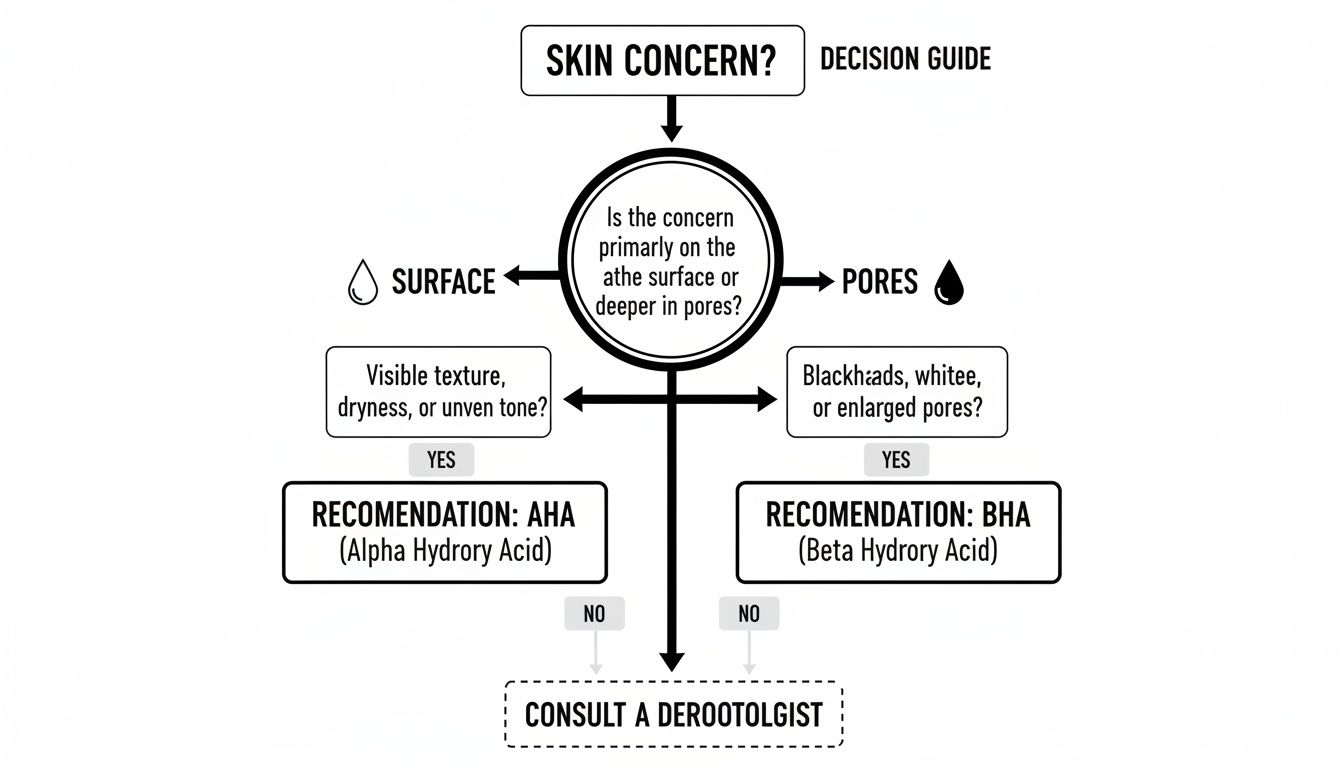
As the flowchart shows, surface-level issues like dullness and texture call for an AHA. Deeper, pore-related problems like blackheads and excess oil need the penetrating power of a BHA.
To make this even easier during a consultation, this quick-reference table connects common client complaints directly to the best acid solution.
Client Consultation Guide for Recommending Acids
| Client's Primary Concern | Recommended Acid Type | Key Benefits to Highlight |
|---|---|---|
| "My skin looks dull and lifeless." | AHA (Glycolic, Lactic) | Brightens, evens tone, restores radiance. |
| "I have fine lines and rough texture." | AHA (Glycolic, Mandelic) | Smooths skin surface, minimises fine lines. |
| "I have persistent blackheads and oily skin." | BHA (Salicylic Acid) | Clears pores, reduces oil, prevents breakouts. |
| "My T-zone is oily but my cheeks are dry." | AHA/BHA Combo or Spot-Treating | Balances skin, addresses multiple concerns at once. |
| "My skin is sensitive, but I want to exfoliate." | AHA (Lactic, Mandelic) / PHA | Gentle renewal, minimal irritation, hydrating. |
This table acts as a great starting point, but always remember to listen carefully to the client's full story before making a final recommendation.
Addressing Combination and Sensitive Skin
Of course, skin is rarely that simple. Many clients have combination skin, with an oily T-zone and dry cheeks. For them, you have two smart strategies:
- Spot-Treating: This is a fantastic, customised approach. Suggest they use a BHA product just on the congested areas and a hydrating AHA on the drier parts of their face.
- Blended Formulas: Point them towards a well-formulated product that contains a mix of both AHA and BHA. These multi-tasking formulas are designed to tackle a bit of everything in one easy step.
Sensitive skin demands the most caution. Exfoliation is still incredibly beneficial, but it has to be gentle. For these customers, recommend starting with a low-concentration, large-molecule AHA like mandelic or lactic acid. Even better, introduce them to Polyhydroxy Acids (PHAs), which are the gentlest of all.
The single most important piece of advice for anyone with sensitive skin—or trying a new active for the first time—is to patch test. Instruct them to apply a small amount behind their ear or on their inner wrist. They should wait a full 24 hours to see if any redness or irritation develops before using it on their face.
This kind of careful, considered advice does more than just sell a product. It shows you care about your customer's skin health, builds lasting trust, and positions your pharmacy as a true destination for expert skincare guidance.
Selecting High-Quality Natural Formulations
For Swiss pharmacies and retailers, bringing AHA and BHA products into your store isn't just about filling a shelf. It's about building a reputation for quality, efficacy, and genuine expertise, especially with the growing demand for clean beauty. Your customers are savvy; they're turning the bottle over, reading the fine print, and looking for brands they can trust.
To truly meet their needs, you need to focus on formulations that are transparent and rooted in nature. This means digging deeper than the marketing copy on the front label to find out where the active ingredients actually come from. The best brands aren't shy about this—they often feature the origin of their acids as part of their story, linking potent results back to nature.
Look for Natural Sources and Clean Ingredients
Top-tier natural formulations get their exfoliating power straight from botanical sources. When you're considering a new product line, keep an eye out for these hallmarks of quality:
- Fruit-Derived AHAs: Acids such as glycolic acid from sugarcane, or citric and tartaric acids from citrus fruits and grapes, tell a compelling story. These sources resonate with customers who are actively looking for natural, plant-based solutions.
- Willow Bark-Derived BHA: Salicylic acid, the most well-known BHA, is naturally present in willow bark. A formulation that uses this natural extract connects modern science with a long history of traditional use, which is a powerful message for customers.
Of course, a genuinely clean formula is also defined by what isn't in the bottle. Your customers are more aware than ever of potential irritants. Make it a priority to stock products free from common troublemakers like synthetic fragrances, harsh sulphates, parabens, and artificial colourants. This not only minimises the risk of skin reactions but also aligns perfectly with the clean beauty ethos your customers value.
Prioritise Transparency and Certification
In skincare, trust is built on transparency. When it comes to chemical exfoliants, this means being completely upfront about two crucial factors: the acid concentration and the product’s pH level. A brand that clearly prints these details on its packaging is showing confidence in its science and respect for its customers.
A product with 10% glycolic acid at a pH of 3.5 will be effective. The same concentration at a pH of 6 will not. This is the kind of detail that allows you to properly advise your customers, ensuring they walk away with a product that delivers real results.
Third-party certifications are another excellent way to instantly communicate quality. Look for reputable seals that confirm a brand's commitment to natural and ethical standards. For the European market, certifications from ECOCERT or COSMOS are powerful indicators of organic and natural integrity.
Likewise, cruelty-free certifications from organisations like PETA or Cruelty Free International (Leaping Bunny) are essential for many shoppers today. By selecting brands that hold these credentials, you're not just meeting a customer demand—you're cementing your pharmacy’s status as a trusted source for responsible, high-performance skincare.
Using Acids Safely in a Skincare Routine
When a customer decides to add powerful actives like AHA and BHA into their routine, they need clear, confident advice. Your guidance here is crucial—it helps them get those glowing results they're after without harming their skin, and it solidifies your position as a trusted expert.
The most important rule? Start low and go slow. This isn't just a catchy phrase; it's the best way to avoid irritation and let the skin adjust. Advise your customers to start using their new acid product just once or twice a week, always in the evening. If their skin handles it well after a few weeks, they can think about using it a little more often.
There is one piece of advice that is absolutely non-negotiable when using exfoliating acids: daily, consistent use of a broad-spectrum sunscreen. This is especially true for AHAs, which work by thinning the stratum corneum, leaving fresh, new skin cells more exposed to UV damage.
Without an SPF of 30 or higher, you’re not just risking a sunburn. You’re actively undoing the benefits of the acid, potentially making pigmentation and signs of ageing even worse. Sunscreen isn't an optional extra; it's the anchor of any routine that includes acids.
How to Layer Acids Correctly
How you layer products makes a huge difference. To get the best results from an acid, it needs a clear path to the skin.
The golden rule is to apply exfoliants right after cleansing and toning, but before you move on to thicker serums, moisturisers, or oils. This gives the low-pH formula a chance to get to work without anything blocking its way. After waiting a minute or so for it to sink in, your customer can then apply the rest of their routine to hydrate and protect the skin.
Navigating Ingredient Interactions
Not all skincare ingredients are friends. Mixing the wrong actives can easily lead to redness, irritation, and a damaged skin barrier. When you’re helping someone build a routine with AHA and BHA, make sure to flag these potential conflicts.
Acids + Retinoids: Both are champions of cell turnover, which is great, but using them together on the same night can be too much for most skin types. A much safer bet is to alternate. For example, use an acid one night and a retinoid the next.
Acids + Vitamin C (L-Ascorbic Acid): This combination isn't always a problem, but layering a low-pH Vitamin C with a low-pH acid can sometimes dial up the potential for irritation. The simplest solution? Use Vitamin C in the morning (always with SPF!) and the exfoliating acid at night.
Acids + Other Exfoliants: Doubling up on exfoliation is a recipe for trouble. Never use an AHA or BHA product on the same day as a physical scrub or another strong chemical exfoliant. Over-exfoliation is the fastest way to compromise the skin barrier.
This kind of expert advice is more important than ever. The market for at-home treatments, like multi-acid weekly peels, has ballooned into a USD 1.43 billion industry. People are reaching for potent, professional-style formulas, and they need to know how to use them safely. You can find out more about the rise of at-home chemical peels at growthmarketreports.com.
By offering these clear, practical safety tips, you empower your customers to use AHA and BHA products the right way, ensuring they see the beautiful, healthy results they want.
Your Customers’ Top Questions About AHAs and BHAs
When you’re talking about chemical exfoliants, a few questions always pop up. It’s natural for customers to be curious and a little cautious. Having clear, straightforward answers ready not only builds trust but also empowers people to use AHA and BHA products safely and effectively.
Think of it this way: mastering these points transforms a simple sale into a trusted consultation. It ensures every customer walks away with the right product for them and, just as importantly, the confidence to use it correctly. This is how you build loyalty and cement your pharmacy’s reputation for expert skincare advice.
Can I Use an AHA and a BHA at the Same Time?
This is probably the most common question, and the answer needs a bit of nuance. While it's technically possible to use both, it’s a path that requires real caution to avoid overwhelming the skin.
Here are the two safest ways to approach it:
- Choose a Blended Formula: The easiest and safest route is to pick a product that's already professionally formulated with both acids. These blends are carefully balanced for pH and concentration, taking the guesswork out of it.
- Alternate Your Nights: Another great strategy is to use them on different evenings. For instance, use an AHA product on Monday night and a BHA on Wednesday, leaving a rest day in between. This gives your skin time to process the exfoliation without being bombarded.
What you generally want to avoid is layering a separate AHA product and a separate BHA product in the same routine, one right after the other. That’s a fast track to over-exfoliation and irritation. For most people, the best bet is to figure out their main skin concern and stick with the single acid that targets it best.
How Long Will It Take to See Results?
Managing expectations is everything here. While skin often feels smoother and softer after just one application, the real, lasting changes come from consistent use over time.
The timeline really depends on what you're trying to achieve:
- Improved Texture and Brightness: When using AHAs for general dullness or rough texture, most people will notice a visible improvement within 2-4 weeks.
- Cleared Pores and Blemishes: For BHAs to work their magic on congested pores and breakouts, you need a bit more patience. It typically takes at least 4-6 weeks of consistent use to see significant clearing.
- Hyperpigmentation and Fine Lines: Tackling deeper concerns like sun spots or fine lines requires the longest commitment. Visible changes often start to appear after 2-3 months of dedicated use.
Is a Little Tingling or Redness Normal?
A slight, very brief tingle can be perfectly normal, especially when someone first introduces an acid into their routine. It should feel like a faint "hello" from the product and fade within a minute as it absorbs.
However, anything more than a fleeting tingle is a red flag. If the sensation turns into persistent stinging, burning, or visible, lasting redness, the skin is clearly irritated.
That irritation is your skin’s way of saying, "This is too much." It could mean the product's concentration is too high, it's being used too often, or the formula simply isn’t the right fit for that person's skin.
If a customer experiences this, advise them to stop using the product immediately. They should switch to a simple, gentle, and hydrating routine for a few days to let their skin barrier heal before even thinking about trying a gentler formula.
Why Is Sunscreen So Important When Using Acids?
This is the single most critical piece of advice you can give. Using exfoliating acids like AHA and BHA without daily sun protection isn't just a waste of time and money—it's actively damaging.
AHAs, in particular, work by sloughing off the top layer of dead, dull skin cells. This is great, but it also exposes the fresh, new skin underneath, which is far more vulnerable to sun damage. This increased photosensitivity means the skin is more likely to burn, develop premature signs of ageing, and even get new dark spots.
Basically, skipping sunscreen can make the very problems your customer is trying to fix even worse. You need to stress that a broad-spectrum sunscreen with SPF 30 or higher is a non-negotiable part of their morning routine. Every. Single. Day.
Discover a curated selection of high-quality, natural skincare formulations with beautysecrets.agency. We partner with Swiss pharmacies and retailers to provide certified, ethically sourced brands that meet the highest standards of efficacy and clean beauty. Explore our portfolio and elevate your skincare offerings by visiting us at https://beautysecrets.agency.